Showing posts with label processional santos. Show all posts

Wednesday, July 1, 2026

376. LA INMACULADA CONCEPCION OF MANDALUYONG

The Inmaculada at the "Flores" event, 7 June 1953

The principal patroness of Mandaluyong City is La Inmaculada Concepción de Mandaluyong, enshrined at the San Felipe Neri Parish Church. Because her venerated image is housed in the parish, the identity of the original carver or sculptor is considered a matter of undocumented ecclesiastical tradition. The city officially proclaimed her as the patroness and mother of Mandaluyong in January 2024. 

The Flores de Maria celebration have long been a tradition of the  San Felipe Neri Parish,  a month-long May devotion and offering of flowers to the Blessed Virgin Mary, as shown in this 7 June 1953 photo, highlighted by Her procession,

The Inmaculada Concepcion in the altar mayor of S. Felipe Neri Church

Any information as to the history of the image, its origin and maker , will be appreciated.

Friday, January 16, 2026

371. SAN MIGUEL ARCANGEL of Angeles City, Pampanga

SAN MIGUEL of the Evangelista Family, Photo: "Pisamban Maragul" book.

This 110 year-old image of St. Michael Archangel was commissioned in 1910 for the family of the prominent businessman Roman Bernardo Evangelista of old Culiat. The santo is depicted bearing a sword and helmet on his head, in the act of battle with Satan who is fallen and tampled underneath by the heavenly warrior. The San Miguel was intended for the La Naval celebration of Angeles.

Don Roman  Evangelista with wife Dona Francisca Dizon Dela
Resma , and their 2 older sons: David and Marcos  Ca. 1899 

The Evangelistas, known for their pioneering telecom business in the city, also owned the Sta.  Misericordia, a Holy Week tableau.The San Miguel image was bequeathed to Francisco and Domingo Evangelista upon the death of Don Roman, and successively passed on to their descendants.


The city of Angels also is home to other antique angel santos: El Santo Angel Custodio (Holy Guardian Angel, 1830, with Holy Angel University), San Gabriel Arcangel ( Jose Sanchez Family, 1916), and San Rafael Arcangel (Mariano V. Henson Family,1915).

As most of the Evangelista descendants have moved abroad, the carro and the image of San Miguel are both under the custodianship of the family of the late Jess Panlilio.

SOURCES:

Dr. Raymundo Feliciano Albums

Additional infor: Josel Evangelista Suarez

Pisamban Maragul: The Living Chrch of Angeles City, Nina Tomen in collabration with Bishop Virgilio David. Angeles City 2014


Friday, July 25, 2025

362. The Ivory Image of Parañaque's SANTA VERONICA

The processional ivory image of STA. VERONICA, is a representation  of the woman who offered a cloth (likely her veil)  to Jesus so He could wipe His face on the way to His Crucifixion, and on which His likeness was miraculously imprinted on the cloth.Though not mentioned in the Bible, the scene of the meeting endures in Catholic tradition in the Sixth Station of the Cross, "Veronica Wipes the Face of Jesus."

Parañaque’s Sta. Veronica has a head and hands crafted from high quality white ivory, This 2008 photo documentation of the santa shows her in a replacement  purple vestment embellished with gold-colored thread embroidery, for the Lenten procession of the Parish of St. Andrew.

She holds a “birang”, with the face of Christ imprinted three times that shows signs of fading due to age. The original “Veronica’s Veil” is believed to exist today in the Vatican and is considered one of the most treasured relics of the Church.

Photos from Dr. Raymundo Feliciano Albums in the care of the Center for Kapampangan Studies.


Sunday, July 13, 2025

361. PORAC’S LITTLE JOHN of the SANTOS FAMILY

The small, but handsome image of the young SAN JUAN APOSTOL is a family heirloom from the Familia Santos of Porac, led by Leon Santos, a planter and businessman. Family lore has it that the image was originally owned by a local Chinese who gifted it to the Santoses. The image was inherited by Leon's son Isidoro Ponce Santos, whose overseas-based children now contributes the funds for his upkeep, including procession expenses.

The San Juan image is just 3 feet tall, with articulated arms. In this version, San Juan has carved, brown-painted hair, that falls gracefully down his nape and shoulders. Over his stiff collared top, he wears a tunic of green with a red, shawl-like drape on his shoulders. He is topped with a brass halo and shown holding his attributes: a feather quill and a book.

For years, it was a regular participant in the annual Lenten processions of Poblacion, Porac, Pampanga, until 2000. His entry is preceded by his symbol as an evangelist, a carved figure of an eagle, which has the ability to gaze directly at the sun, representing the divinity of Jesus.

Last procession appearance of San Juan, 2000

As San Juan was the smallest religious image in the procession, the Santoses decided to pull it out and caused a new, taller image to be made, to  match the size and proportions of the other Lenten santos.

MANY THANKS TO MR. JERRY PUNZALAN SAGMIT for the photos and information.

Friday, April 7, 2023

355. A Penitent Redeemed: STA. MARIA MAGDALENA

STA, MARIA MAGDALENA, RESTORED 2005

The circumstance of how this beautiful Sta. Maria Magdalena image was delivered to me was one for the books. I had been working with a Bulacan dealer for sometime, when he called to say that there was an antique santa in the market available, but I had to decide fast whether to get it or not. To make my decision faster, he offered to bring it to me in Makati, where I lived and worked.

MAGDALENA, in its original state, when acquired

Intrigued, I told him to pass by for me by lunchtime, hitch with him in his van, go home together to my nearby studio where I can better check out the santa. Some 2 hours later, he was on his cellphone to tell me of his arrival at my office building. I hastily rushed down the elevator from my 23rd floor office, got out of the main door---and there, seated at the groundfloor Starbucks Café was my dealer, next to an old, naked, wigless santa, and which has started to attract the stares of the café patrons, building tenants, businessmen, visitors, and passersby! In a loud voice, he said: “Eto na ang Magdalena mo, boss…what do you think?”
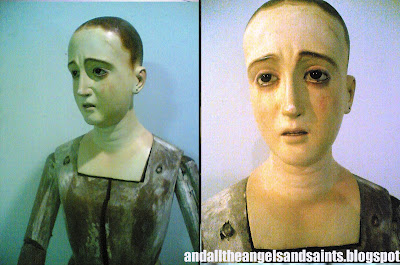
MAGDALENA, with a wan and white complexion.

“I think you need to put back the santa in your van NOW!”, I  muttered under my breath, while turning red with embarrassment. Just as a crowd had begun to gather around the santa, the dealer grabbed the wooden figure, stowed it in the van, and sped away with me to my place, just 5 minutes away.

MAGDALENA'S HEAD, before and after re-encarnacion

I’ve never been so stressed at the thought of the commotion we caused at that café. But all that dissipated when, in the privacy of the closed van, I took a closer look at the penitent saint.

STA. MARIA MAGDALENA, under restoration

Even in its state—paint gone pale and peeling, a vertical crack running down the body, shaky base, plus the usual dings, nicks and scratches—this Sta. Magdalena was a real beauty, with a long face face slightly frowning in restrained grief. Her mouth was slightly open, curled downward in sorrow, showing teeth. The slightly long neck featured 3 shallowly-carved neck folds that almost looked like a 3-strand necklace.

STA. MAGDALENA, under restoration

On the other hand, her ghostly white hands and slender fingers, and her bare feet were well-carved and defined. There was the slightest hint of plumpness in her body, characteristic of old female santas. This processional image was not exactly tall, only 52 inches, including the base.

REPAINTING THE PENITENT SAINT

The dealer and I struck a deal, wrote him a check, and Sta. Maria Magdalena was mine to keep. But it didn’t stay long with me either, for just a scant week after, I delivered the Magdalena to the atelier of Mr. Francisco “Kiko” Vecin, Makati’s eminent collector and santo restorer. His workshop was just across my street, near the Makati City Hall, and the schedule for its restoration was drawn up in no time at all.

THE SAINT AND HER BLONDE-BROWN LONG LOCKS

As the santa was complete, I thought restoring it would be a breeze. Other than the crack on the body,  no major repairs were really necessary. What took long was the repainting of the santa that took some 3 months to finish. A friend of mine suggested that I stick to the original paleface kind of encarna, commonly seen in old Semana Santa images. I opted for a more natural complexion that is more Filipino, rather than the fair, pinkish Caucasian type.

STA. MAGDALENA, CROWNED

Mang Kiko commissioned veteran encarnador Eddie Mabaquiao Sr. to handle the repainting, which took forever to do. But the wait was all worth it, as the santa’s expression came real and alive with his brush. The magnifical restoration of Sta. Maria Magdalena was completed in late 2005.

VESTMENT BY LOPEZ ATELIER

Even long before it was finished, a member of our local pastoral council had saved a place for me 2006 Holy Week procession. The reservation, however, was not for a Magdalena, as the town already had one—but for broom-wielding Sta. Maria Jacobe. The idea was to transform this Magdalena into a Jacobe, by having her hold a broom—which was very much possible with the grasping position of her fingers.

OLD EMBROIDERY RECOVERED AND
USED FOR MAGDALENA'S VETSMENT

This threw me into panic, as I had not really planned on having vestments and metal accessories made just yet. Dr. Raffy Lopez came to the rescue by quickly making a light blue half-cape and a matching light fuschia tunic decorated with old gold embroidery. I designed a pukpok broom handle executed in plated brass by Jeric Canlas, inserted with tambo reeds. A new brass crown that I had been keeping went to the head of the santa, which looked obviously bigger. With that the primera salida of this Sta. Maria Magdalena finally took place in 2006—in the guise of  Sta. Maria Jacobe! I soon had ambivalent feelings about that practice.

PRIMERA SALIDA, as Sta, Maria Jacobe, 2006

That was the first and last time this antique santa came out, eventually replaced by my in-law family’s antique Jacobe. But when a second Magdalena I owned suffered a similar fate, I have vowed not to allow these “conversions” to happen again.

In one corner of our covered porch today stands a glass case, in which the cloth-covered antique image of Sta. Maria Magdalena reposes. It has not been seen since 2006, and I intend to keep it that way. It is very much in keeping with a penitent saint who spent part of her life as a hermit in a cave on a desert—away from prying eyes. Her life continues to give us an example of how no person is beyond the saving grace of God, so—by the same token, no broken santo  should be left unsaved too.

STA. MARIA MAGDALENA, Castro Family


Sunday, March 19, 2023

354. CRISTONG MACAGAPUS: Passing on the Tradition from Generation to Generation, by Guest Writer, Allen Luis Galang Dizon Jr.

APUNG MACAGAPUS, 1855, Holy Wednesday 2023

The heirloom image of Apung Macagapus (Scourging at the Pillar) is among the very first Holy Week processional images of the town of Sta. Ana, Pampanga.

THE ANCESTRAL STA. ANA  HOUSE

This 19th century holy image was owned by Maria Dolores Pangan. She passed down Apung Macagapus to her niece Angela Pangan, who eventually married Domingo P. Dizon. His family owned the statue of Sta. Ana, making them the first camareros of the original processional image of the town’s patron saint.

Domingo and Angela had two children, Dr Antonio and Dr. Nilo. Due to old age, Angelina passed on Apung Macagapus to her son Dr. Nilo Pangan Dizon and daughter- in- law Amelia "Lily" Tiosejo Dizon. Although Dr. Antonio is the eldest, he and his wife Corazon and family lived mostly in the United States and Manila. Angela died at the age of 91.

DRESSING UP THE CRISTO

THEN, AS NOW, Dressing up the santo is a family affair.

When the Dizons decided to transfer to Manila, the holy image was entrusted to Grace Dizon Medina, niece of Domingo and first cousin of Dr. Antonio and Dr. Nilo. Grace is also the daughter of the ex-mayor of Santa. Ana, Pampanga - Hon. Roque Dizon Sr.

Domingo & Angela considered Grace as their real daughter since they only have two sons (Dr. Tony & Dr. Nilo) and were not able to have a daughter of their own. Apung Macagapus stayed with the Medina family for more than a decade.


ANTIQUE LOINCLOTH AND RIBBON

In 2002, Allen T. Dizon (son of Dr. Nilo & Lily Dizon) together with his wife Dra. Mayette G. Dizon and their kids decided to stay for good in Sta. Ana. So, on April, 2009 the holy image went back to the care of the Dizons.

 When Allen died in 2010 and Dr. Nilo in 2015, the family heirloom image and the pious tradition of the Dizons were passed down to the 5th generation of the family, the grandchildren of Dr. Nilo most specially Marvin, Jayr and Keith (Allen & Mayette’s children).

KEEPING A FAMILY TRADITION ALIVE

The tradition of the family still continues to this day, made possible through the love and profound dedication of the family and the many devotees of Apung Macagapus. From the time of Maria Dolores, the succeeding generations have vowed and continually kept the tradition alive and strong.

MANY THANKS TO MR. ALLEN LUIS DIZON GALANG JR., for the use of his article here.

 SOURCES/ REFERENCES: Dr. Antonio “Tony” P. Dizon (+), Edited By: Gertrudes "Ditas" Dizon

From the Photo Archives of Dr. Nilo P. Dizon (+), Photo Taken: March 26, 1986 at San Joaquin Santa. Santa Ana Pampanga


Thursday, January 7, 2021

341. Santo Stories: LA PURISIMA CONCEPCION of Guagua (under the care of the Tiongco-Villacorta Family)

LA PURISIMA CONCEPCION, Guagua

The story of the beautiful LA PURISIMA CONCEPCION of Guagua begins over a hundred thirty years ago, and has come to involved extended families beginning with Hipolito de Mesa Leoncio and wife Francisca Simon Chingcoangco, the first known owners of the image of the young Virgin.

The couple had acquired the image, and several others, in 1910, from Fr. Maximo Veron, the then-parish priest of La Natividad de la Virgen Church (now known as Immaculate Conception Paris of  Guagua). The other icons included the lifesize  Sto.Entierrro (“Apung Señor), Sto Niño Dormido (sleeping Child Jesus), and San Jose.

STO. ENTIERRO

NINO DORMIDO
 
More of these santos were acquired the same way by the couple’s cousins like the San Juan (Songco Family), Sta. Maria (Lozano Family) and Sta. Filomena (Lagman Family). 

LA PURISIMA CONCEPCION, was often described by the old members of the family as “beautiful beyond compare”, a most appropriate description as the face is exquisitely carved, showing the highest level of the carver’s skills. When descendant,  Johnny Tiongco Villacorta was cleaning the image, he found on its base the carved notation--AÑO 23 ~ 12 ~ 89, which dated the making of the santa to Dec. 23, 1889. 

When the family became Aglipayan converts, LA PURISIMA was transferred to the Aglipayan Church of Guagua and enthroned there. During World War II, LA PURISIMA, along with the family’s treasured images, were spirited away for safekeeping. The Virgin and the sleeping Niño were kept under the kamalig of the Gamboa Family, also kins of the family. The San Jose figure, however, did not survive the onslaught of war, when the Japanese burned the house.

LA PURISIMA used to wear a halo with 12 stars (“Dose Estrellas) which has now been lost, but she still has her star-designed, diamond-studded rostrillo (facial aureole), silver earrings in the shape of cherubs, and a gold pendant. Thankfully, she also has retained her century-old  “tiso de oro” vestments. 

In her old age, Lola Pacing Lozano, the eldest child who died at age 95 in 2004, once wistfully said to her twin siblings Minang and Sidang: “Ikwa tana mengatwa at mangamate obat, ing Virgen tamu sidsad ya parin keng lagu” (We have all grown to this ripe, old age, and some of us have passed away, but our Virgin still remains as beautiful as ever). Indeed,  through all these years, she has remained “beautiful beyond compare!”


The custody of the image of LA PURISIMA CONCEPCION (fondly called “Apung Puring” by the elders),as well as Apung Señor, the Niño Dormido and the replacement image of San Jose has  been entrusted to grandson Johnny “Buda” Tiongco-Villacorta, exacting a promise from him  to continue the family tradition and never to sell them. “Sadsad mula… pakyapusan at sundu mu ing gagawan mi karela agyang magdildil na kayu mung asin.  E yula pamisali, pangaku mu kekami yan” (Carry on..,care for them the way we did even if you go hungry, and have nothing to eat but salt. Promise us never to to sell them..).

CREDITS: All information and photos courtesy of Mr. Johnny Tiongco Villacorta