Showing posts with label religious prints. Show all posts

Tuesday, June 12, 2018

314. Reconstructing a Shadow Box Santo: SAN ANTONIO DE PADUA


One vanishing art that is taught in mostly Catholic schools is the construction of 3-dimensional religious images from flat pictures, encased in a shadow box. This art form has its origins in the monastic arts of yore that were created by nuns to while away their leisure time, that often includes embroidery, painting, shellcraft, paper tole and paper curling. When religious-run schools were established, nuns passed on this shadow box art to their students, as part of the art education classes.


This small vintage, 1950s 3-D picture of San Antonio de Padua with the Child Jesus, was found assembled in a cardboard box, its frame gone. To achieve the 3-D look, the colored figure of the baby-holding saint is first cut out,  then is “clothed” with brown fabric that is folded, creased and glue to the figure, to simulate the natural drapes of the robes when worn by a real person. 


The cincture was fashioned  from a piece of string, and the vestments decorated with sequins. The Child Jesus is dressed using the same process. The saint’s paper hands, and the Baby’s arm and feet, which have been cut separately, are then set appropriately to complete the 3-D illusion.


The whole ensemble was pasted on a cardboard backing, decorated with cotton,  fabric flowers and foil leaves. The backing, as it turned out, was from a bakery carton packaging (Plaza Bakery) that may once have kept a pie or a cake for Christmas.
 

The well-preserved San Antonio cut-out was carefully removed from this backing, and the most of the fabric flower decorations were saved.   The cutout, together with the rewired flowers and foil leaves, were then assembled on a new, thicker cardboard backing.


Meanwhile, a new cardboard box was constructed from foam board and the lined with brown, ruffled fabric to form the matting. The cardboard containing the 3-D San Antonio was then glued onto the inside of box. 


The whole assembly was then encased permanently under a vintage glass frame, the last step in the shadow box art reconstruction.

Thursday, November 24, 2016

274. THE SANTO SEPULCRO OF PACO IN ART


 STO. SEPULCRO DE PACO, ANTIQUE PRINT, 1814

 Paco was an old arrabal or district of Manila that used to be called “dilao” (yellow), from the color of turmeric, that used to grow in the area. It became San Fernando de Dilao after its Franciscan foudners, and was expanded to include Santiago, Peña de Francia and Dilao. It is also the site of a famous church built from 1809-1814 by Fray Bernardo de la Concepcion in honor of Nuestro Señor Padre de Sto. Sepulcro, also known as Señor de Paco.

PHOTO SOURCE:lasagradaexpedicion.weebly.com, Kendrick Dominic Yu.

 The ancient image represents the dead Christ in repose, and—like the revered Nazareno in Quipao Church-- has become the center of a long-standing tradition began centuries ago by its devotees who believe it to be endowed with miraculous powers.

PHOTO SOURCE: la sagradaexpedicion.weebly.com, Kendrick Dominic Yu.

 The Santo Sepulcro, housed in its magnificent calandra or an elaborately carved wood and glass casket, and is taken out during its feast day in the month of August for a procession. The calandra with the Señor is borne on the shoulders of chosen male devotees, but unlike the rowdy Quiapo procession, the Christ bearers march in cadence, in a more solemn, orderly manner.

 The age-old image has also become the inspiration of a few artworks featured on this spread:

ANTIQUE PRINT, STO. SEPULCRO DE DILAO, 1814

 This antique black and white print, found in a house in Sta. Rita, Pampanga many years back seem to be the oldest print of the Santo Sepulcro of Paco. The dead Christ is in his grand calandra, flanked by Nicodemus and San Jose de Arimatea, two personages who helped in the interment of Christ after the crucifixion in Calvary. The inscription promises special indulgences to those who pray before the image of the Señor, and bears the date 1814, under the term of Archbishop Juan Antonio Zulaibar.

STO. SEPULCRO DE DILAO, Antique painting on tin. 8 X 10".

 This rare and small painting of the Santo Sepulcro was obviously copied from the old print, minus Nicodemus and Jose Arimatea. It is a painting on tin, very similar to Mexican retablos. 

STO. SEPULCRO TIN PAINTING. Personal Collection.

Only 8” x 10”, the tin painting retains its original colors although its two corners have been trimmed. It was purchased from an antique dealer at the Philcite antique pavilions way back in the late 1980s.

STO. SEPUCLRO IVORY MASK FIGURE. Source: Images of Faith, by
Regalado Trota Jose. Cas Manila, Intramuros Collection

 A 19th century Santo Sepulcro with a 7 cm. ivory mask outfitted on a wooden body. The figure is encased in awood and glass calandra. Although it is not specifically identified as a representation of the Paco Christ, it was displayed at the piece Casa Manila in Intramuros along with a Santo Sepulcro embroidered art.

DETAIL OF THE STO, SEPULCRO, Embroidered art. 1817.

 Another unusual Santo Sepulcro depicting the dead Christ of Dilao was once on exhibit at Casa Manila in Intramuros. It is an exquisite example of monastic art, showing the dead Christ, with a face of ivory mounted on fabric, with all the other details painstakingly embroidered with gold thread.

STO. SEPULCRO OF PACO, Embroidered art, formerly exhibited at Casa
Manila, Intramuros.

Again, the old 1814 print seems to have been the basis of this very rare piece which is dated 1817. The artwork is double framed—first with a rectangular frame trimmed with silver panels with beaten rococo design, then encased in an octagonal frame.

MANY THANKS TO KENDRICK DOMINIC T. YU, 
whose 2 photos of the Sto. Sepulcro are used here, taken from his blog: 
http://lasagradaexpedicion.weebly.com/la-sagrada-expedicioacuten/santo-sepulcro-de-paco-414th-fiesta

Wednesday, November 9, 2016

272. THE AMAZING ANTIQUE ART RE-CREATIONS OF KING NIKOLAI VIRAY

CANOPY BED FOR A NINO DORMIDO. Made from a trinket box, silver
charms glued together, and other metal scraps. Trimmed with lace.

The works of young artist King Nicolai Viray are largely unknown except for his postings on his facebook page—and this was where I chanced upon him and his amazing vintage-style sacred art creations that beautifully captured the old-world feel of religious colonial art.

Viray, a fresh 2016 graduate and philosophy major of Mater Boni Consilii in San Fernando, Pampanga is a shy, unassuming 22 year-old, who was drawn to religious arts early.

His artistic leanings may have come from his genes—his maternal grandmother crafted shadow box arts that were taught in Catholic schools at the turn of the 20th century. His paternal grandmother was a Manansala-a relative of national artist Vicente Silva Manansala of Macabebe.
A school project, depicting a stained
glass, made from colored cellophanes

 As a kid, Viray drew figures of saints; even his art school projects had religious themes. It was no surprised that his early interest influenced his calling: he was accepted as a seminarian at Pampanga’s premiere seminary, Mother of Good Counsel seminary.

 Viray used to visit the Archdiocese Museum in San Fernando, which led to a chance meeting with Msgr. Gene Reyes, then parish priest of Sta. Rita (now with San Fernando), and the museum director.

Msgr. Reyes recalls that Viray was fascinated with the religious shadow box collection there, and so he asked him if could replicate one for his small Sto. Niño. Msgr. Reyes liked what he did and, pretty soon, he asked him to try his hand at some other old paper art forms like quilling (paper roll art).  Viray not only mastered that through self-study, but also quickly learned paper fretwork, tole and miniature art. Here is a survey of some of his outstanding vintage-style religious art:

 DRAWINGS. Viray’s intricate sketches evoke the style of old religious black and white engravings. Santos and santas are his favorite subjects—featured alone or shown enshrined in the altar niches or baldachins.

SAN FERNANDO, pen and ink.

SAN AGUSTIN DE HIPPO. Pen and ink drawing.

NTRA. SRA. DE LOS DESAMPARADOS.Pen and ink.

MATER DOLOROSA. Pen and ink.

PAPER CUT ART. The art of paper cutting dates back to the 4th century after the Chinese invented paper. Some of their earliest uses for papercutting were for religious decorations or stencils used in holy pictures or estampitas. Several Philippine crafts employ paper cutting-including cut paper fretwork decoration used in Christmas lanterns or parols. There is also the art of pabalát (wrapper), where paper is meticulously cut with small scissors to wrap pastillas (milk candy) and other traditional sweets. During the Victorian age, cutting out silhouettes of people and sceneries became a favorite pastime.

VERONICA'S VEIL. replicated antique estampita. Cut and pierced paper,
photocopied image of the Holy Face.

SAN ANTONIO DE PADUA. Fretwork background from cut  paper.

INMACULADA CONCEPCION. Replicated antique lace estampita.
Scanned copy, handcut paper.

 PAPER QUILLING. Quilling or paper filigree involves the use of strips of paper that are rolled, looped, shaped, and glued together to create decorative patterns and designs. These were used to decorate religious pictures that were then encased in boxes . During the Renaissance, European nuns and monks used quilling to decorate book covers and religious items. They used strips of paper trimmed from the gilded edges of books. These gilded paper strips were then rolled to create the quilled shapes. Quilling often imitated the original ironwork of the day.

AGNUS DEI PAPER QUILL ART. Cream colored paper strips were rolled and
manipulated into shapes, then glued to form the background for the Lamb of
God paper cutout
.

VIRGEN MARIA. Scanned copy of holy picture, with fretwork background,
trimmed with paper roll art and metallic foil flowers.

IVORY NINO. Adorend with quilled paper rolls arranged in floral patterns,
trimmed with lace paper and encased in oval frame.

RELIGIOUS SHADOW BOXES.A shadow box is a glass-fronted case containing thematic religious object presented in an artistic grouping with artistic grouping. They are the most common example of so-called “monastic” art found in Philippine homes, usually home-made or done as school projects. The simplest involves decorating prints of religious figures with paper, fabric or mother-of-pearl flowers, accentuated with beads, foil, cork birds and glass. Others entail “dressing up” individual figures by manipulating pieces of fabrics to simulate the folds on their vestments. Viray’s shadow boxes includes paper tole—in which he cuts and pastes parts of identical religious prints, building up these cutout portions using glue, to create a three-dimensional picture.

ALTAR TABLEAU FOR VIRGEN DE TURUMBA. 

SALVADOR DEL MUNDO. Paper cut out of Nino, dressed in folded and
pleated fabrics, surrounded by paper cherubims and paper flowers
.

SOLEDAD DE PORTA VAGA 3-DIMENSIONAL ART.
Decorated with assorted plastic gems from craft stores.

SAN VICENTE FERRER. Tole art, with paper quilling decoration.

STO. TOMAS DE AQUINAS. Paper cutout of
the saint, dressed in real fabrics.Cotton, lace, flowers.

STO NINO DELA PASION. Dressed paper cut-out figure,
old cross pendant. chains. 

RELIQUARY ART. A reliquary is a container for relics--actual physical remains of saints, such as bones, pieces of clothing, or some object associated with saints or other religious figures. Many relic casings are simple, but when they are presented before an audience, they are encased in magnificent monstrance-like holders. Others are framed in groups, and decorated for display purposes.

RELIQUARY MONSTRANCE. Made from the handles of
a silver spoon,  old halo, crystal gems, old ribbon brooch. 

PAPAL RELICS, with added pictures of Pope John Paul II
and Pope John Paul XXIII and metallic mini-decor.

SANTOS AND SANTO VESTMENTS. Another hobby of Viray is fashioning and dressing up santos—many received as gifts from friends. Some of these santos are commercially made, but this does not deter him from giving free rein to his creativity, while sticking to dressing traditions.

LORETTO KINDLEIN OF SALZBURG. A Nino replica of the Holy Child
of Salzburg, Germany.

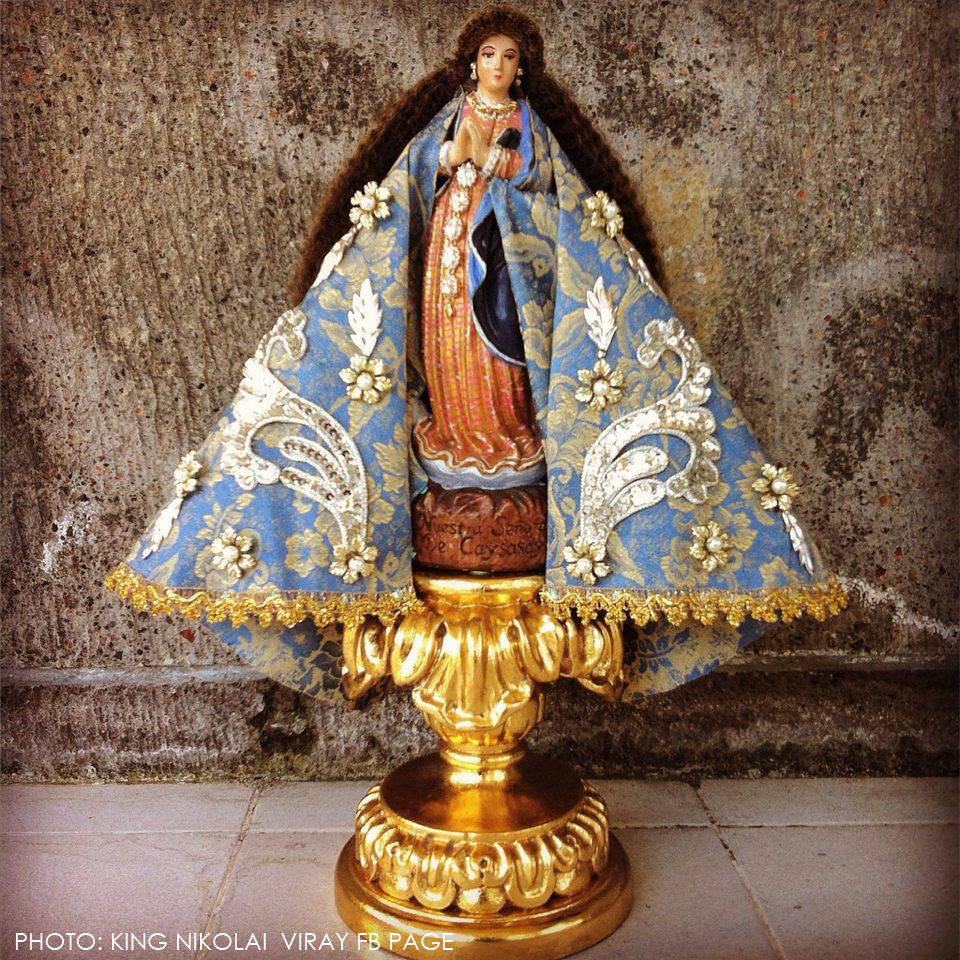
VIRGEN DE CAYSASAY. A resin image of Our Lady of Caysasay was placed
on a gilt base, wigged and dressed with acape trimmed with appliques.

STA. MARIA MAGDALENA DE NAGASAKI. Ingeniously
fashioned from an Japan surplus Japanese doll.

PADRE PIO. A wooden figure of the stigmatic saint dressed in a
chasuble and alb.

MINIATURES. Viray has managed to replicate retablos (church altars) in miniature, using available materials—resin statues of saints, wood, cardboard, foil and paper scraps.

RETABLO MAYOR. A main altar made from cardboard, wood,
and other paper trims. Small iamges are store-bought.

 Of late, the young artist has been accepting a limited number of commissions, despite his busy schedule. He is currently taking his regency (time off from the seminary ) and is working at the local DPWH as administrative aide. Meanwhile, Viray continues to amaze his facebook friends (and fans) with his regular postings of his creations. His body of work is very impressive, considering that he does these beautiful objects in his spare time, and only at his leisure.

CHURCH BANNER. Sta. Maria de Cabeza. 

 What’s more extraordinary is his use of everyday materials and found objects to create exquisite treasures. In his hands, cheap charms bought from Divisoria become decorations for a Niño Dormido’s canopy bed, while a silver-colored plastic container is transformed into an elegant santo base. Even plain paper, when painstakingly pierced and cut by Viray, becomes a delicate lace background for estampitas. His works are destined to be priceless treasures, worthy to be collected and enjoyed.

 Indeed, the future of devotional art looms bright, thanks to the amazing gift of King Nikolai Viray.

Tuesday, July 19, 2016

259. SANTO SHADOW BOX ART


 In the Philippines, monastic art is a collective term for the artistic outputs of nuns and novices who pass their cloistered hours doing arts and crafts projects. Later, the same skills were taught by religious teachers to girls in Catholics schools, who learned a bit of the Fine Arts along with the domestic arts.


 Popular at the turn of the 20th century, these artistic creations include tole art, paper quilling, religious embroidery, paper crafts, dried flower and leaf art, artistic patching and sewn figural creations. Since most of the creations were three-dimensional, they could not be contained in regular frames. Instead, they were kept in shadow boxes.


 A shadow box is an enclosed glass-front case that is made to contain objects presented in a thematic grouping with artistic or personal significance. The grouping of the objects and the depth effect created by their relative heights from the backing creates a dramatic visual result.


Most of the shadow boxes seen in local antique shops carry religious subjects as central figures. The most typical examples include using old prints of saints (commercially lithographed or ordinary estampitas). The pictures are then cut-out and decorated. For example, cut-out figures of Jesus or Mary, are “clothed” much like paper dolls,  with satin fabrics that have been crimped and folded to simulate drapes on a real dress.


These are then profusely decorated with paper, fabric or mother-of-pearl (‘lagang” or madreperla) flowers or buds. Sometimes, bird figures made of balsa wood are mounted on branches. Metal parts like halos were fashioned from foil. To create 3-D effects, elements of the picture were sometimes raised using thick cardboard and tole techniques. The frames used are standard period frames with art nouveau or art deco carvings, converted into a shallow box.


 Secular versions of shadow box art also existed, which was a favorite past-time during the Victorian age. Instead of religious themes, nimble fingers crafted art made of human hair—braided, soiled or used as embroidery thread to make memorials of dead loved ones. I have seen shadow boxes with patriotic figures, papier mache fruits and a heritage house in Sta. Rita has 4 rare shadow boxes containing dioramas of the allegorical figures of the Four Seasons.


 Most of the shadow boxes featured here can be seen at the Archdiocese Museum of San Fernando, Pampanga.