Showing posts with label Good Friday. Show all posts

Friday, July 25, 2025

362. The Ivory Image of Parañaque's SANTA VERONICA

The processional ivory image of STA. VERONICA, is a representation  of the woman who offered a cloth (likely her veil)  to Jesus so He could wipe His face on the way to His Crucifixion, and on which His likeness was miraculously imprinted on the cloth.Though not mentioned in the Bible, the scene of the meeting endures in Catholic tradition in the Sixth Station of the Cross, "Veronica Wipes the Face of Jesus."

Parañaque’s Sta. Veronica has a head and hands crafted from high quality white ivory, This 2008 photo documentation of the santa shows her in a replacement  purple vestment embellished with gold-colored thread embroidery, for the Lenten procession of the Parish of St. Andrew.

She holds a “birang”, with the face of Christ imprinted three times that shows signs of fading due to age. The original “Veronica’s Veil” is believed to exist today in the Vatican and is considered one of the most treasured relics of the Church.

Photos from Dr. Raymundo Feliciano Albums in the care of the Center for Kapampangan Studies.


Friday, July 1, 2016

257. Guagua's Dolorous Virgins III: THE LIMSON DOLOROSA (SOLEDAD)

LIMSON DOLOROSA (SOLEDAD)
Photo: Budhi, From Guagua to Quiapo by Jose Ma. Zaragoza.

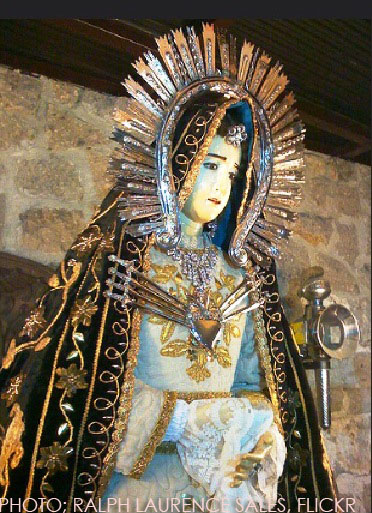
 Hailed as one of the most beautiful Dolorosas in the country, the antique ivory Dolorosa of the Limson Family of Guagua is an iconic Lenten image of the town, spoken with the same awe and reverence as the Sto. Sepulcro of the Infante-Velez Family.


 The Limsons are an old Chinese family who settled in Guagua and are presumed to have been known by their Chinese name Sonson Lin. The earliest known Limsons were a generation of siblings who lived in the early 1800s—Vicente, Pascuala and another brother whose name has been lost to memory.


 This nameless brother begot Diego Limson (ca. late 1850s-early 1860s) who married Severina Jingco. It was during Diego’s time that the existence of the ivory Dolorosa was recorded through oral history, so the age of 300 years attributed to the santo may not be a realistic estimate.


 In any case, what is correct was that the image was passed on through Diego’s line of descendants; in fact, the image was named Soledad after Diego’s first great-grandchild. The antique ivory figure was inherited by Diego’s only son, Don Guillermo Limson (ca.1880s) who had two sons, and three other children out-of-wedlock. (It is interesting to note that Guillermo’s youngest sister, Jacinta Limson, married Alejandro Lopez, who ordered a Dolorosa from Spain expressedly to replace the Bacani Dolorosa which was withdrawn by the owners from the Holy Wednesday procession).


 The Limsons’ Virgen de Soledad, a titular variant of the dolorous Virgin, has a head and hands of ivory. The head rests on a half-bust, with manikin arms and wooden framework for her lower body. When assembled, the Soledad stands 5 feet 7 inches tall, rostrillo included.


 During the last World War, the image was desecrated by the Japanese, broken in pieces, placed in a sack and stashed away forgotten in a vault. When rediscovered, the pieces were put back together again and the ivory Soledad was fully restored. The metal crown and the pierced heart of the Soledad are made of silver. Its original manto was taken by the late restorer and vestment maker Carlos Mercado of Sasmuan, who must have transferred the design on new velvet, as the design, as recalled by descendants remained unchanged.


 Today, the Limson Dolorosa or Soledad is still in service, with its own carroza triunfal that replicates the design of the magnificent carroza created for the Lopez’s Macarena. It is lovingly cared for and attended to by Limson descendants. Then, as now, she continues to grace the Good Friday processions of Guagua, as well as the Salubong rites, continuing a hallowed tradition that have become so much a part of the lives of devoted Guagueños for generations.

CREDITS: 
Photos: Ralph Laurence sales, flickr
Toto Gonzalez, Dr/ Dindo Limson Juco

Limson family tree, online

Online Interview with Dr. Dindo Limson Juco
Jerry Punzalan Sagmit

Sunday, June 19, 2016

255. Guagua’s Dolorous Virgins I: THE LOPEZ DOLOROSA

MATER DOLOROSA OF THE LOPEZES OF GUAGUA.
in its own silver-plated carroza triunfal, 1952
.

Through the years, Guagua, Pampanga has taken pride in having not just the most beautiful Dolorosa images in the region but also in having a pool of several statues of the sorrowful Virgin that are used in their Lenten celebrations.

One well-known Mater Dolorosa that exists to this day is the statue commissioned by town millionaire Don Alejandro Lopez. Married to Jacinta Limson, Lopez had humble beginnings. As a teaching graduate of the Philippine Normal School, he taught at Pampanga High School from 1912-1913, and rose to succeed Benito Pangilinan as a Division Superintendent of the Bureau of Education.

 In 1920, he engaged in commerce and agriculture, where he found his fortune and rose to prominence as director and vice president of the Pampanga Sugar Mills Planters Association. For his wife, he built the grand Villa Jacinta, the first all-concrete residence in Pampanga in 1929, at a cost of Php28,000.

 One of the sure signs of wealth in those days was the ownership of a religious image. When the Dolorosa of the Bacani family ceased to join the Holy Wedneday procession of Guagua after the war, Don Alejandro Lopez proceeded to order a beautiful wooden Mater Dolorosa image all the way from Spain.


 The wooden processional Dolorosa was created by an unknown sculptor from a taller in Madrid, Spain called Casa Garin. The shop, which also sold other religious articles for worship, operated until 2004. The classically carved Dolorosa, with its beautiful mournful features, had only a wooden conical frame for its lower body, without legs or feet. It was outfitted with a silver rostrillo and a silver heart pierced with 7 daggers.


 The Spanish-made Dolorosa was shipped to the Philippines and arrived in Guagua in 1952. Even as it was being made, Lopez also ordered from Victoriano Songco of the Catholic Trade Center, a magnificient carroza fit for the Dolorosa. (Siongco, in a few years, would also make the replica of the Virgen de los Remedios, patroness of Pampanga).

 The result was a grand carroza triunfal, shaped like a chariot, which was wrapped in silver-plated panels. The float was prefaced by two trumpet bearing angels up front, and light-carrying standing angels flanking its sides. The border of the carroza was lined with cherubs and puttis.


 On 9 April 1952, the Lopez’ Mater Dolorosa, arrayed in richly-embroidered vestments was enthroned on her fabulous carroza triunfal, and was blessed and inaugurated at the Villa Jacinta with the family and VIP guests in attendance.

 For years, the Mater Dolorosa participated in the Holy Wednesday processions of Guagua, but when the patriarch passed away, disputes of the heirs over family property caused the Dolorosa and the carroza to be assigned ownership to a male heir, who entrusted it for safekeeping to a neighbor. Recently, it was reported in local news that the silver accessories of the Dolorosa were stolen, but it was widely believed that they were sold by one descendant. Only the cape or manto survived.


The future of the Lopez Mater Dolorosa remains uncertain; its carroza triunfal has been duplicated as it has also broken down;  this new carroza is now in use to convey the antique Limson ivory Dolorosa for the annual Viernes Santo and Salubong rites.


NOTE: One of the last appearances of the Lopez Dolorosa (popularly called Macarena)  was in the Holy Wednesday procession of Guagua in 1992. Photo courtesy of Dr. Raymund Feliciano.

Monday, April 20, 2015

219. EL STO. ENTIERRO DE GUAGUA

EL STO. ENTIERRO DE GUAGUA. Considered as one ofthe most beautiful and most opulent in the country, the Sto. Entierro of the Velez-Ynfante Family is shown here during the Good Friday procession in 20__, Phot courtesy of Dr. Raymund Feliciano.

 The Santo Entierro of Guagua has been the soul of the Velez family over the last 250 years. It takes a week to prepare, polish, assemble, clean and light up this elaborate silver carroza for the Good Friday procession. 150 volunteers are chosen each year from the Barangay Santa Filomena, Guagua to serve the Senor Milagroso.

The Santo Entierro in its magnificent calandra, in 1949. Picture source: Budhi: A Journal of Ideas and Culture, Vol. X, No. 2, 2006. "Guagua to Quiapo", by Ramon Ma. Zaragoza. p. 22 

Sampaguita garlands are the only floral decorations allowed. When lighted candles proved to be unsafe for the crowds during the procession, electric lights were installed in the virinas of the carroza, requiring power from 11 heavy duty truck batteries. In addition, thirty violinists volunteer their services. The image of Jesus in repose is reputed to be the most beautiful of its kind in the country.