I took Friday off last week as I thought I needed a longer weekend to recover from the stress of writing, presenting, pre-producing and shooting a couple of commercials. I had not planned on going out on that day—until my Plaridel dealer texted me about some items in his shop “that
may be of some interest to me”. I usually dismiss nebulous messages like this—in the past, a dealer had sounded me off about “great vintage paintings” he had, but when I rushed to check, they were just awful paper prints.
But thank God for MMS.
In a few minutes, I received a text photo of the stuff he had in his shop and I knew right away that these were indeed, special, interesting items. So, after lunch, I hopped into my car and drove to his Bulacan shop, a good 40 kms. away. I was pleased with all the items shown to me--I got most of them. But my best and most exciting find yet was not even on display at his shop. It was actually taken out from a room when I was done checking the initial batch of santos on the shelf.
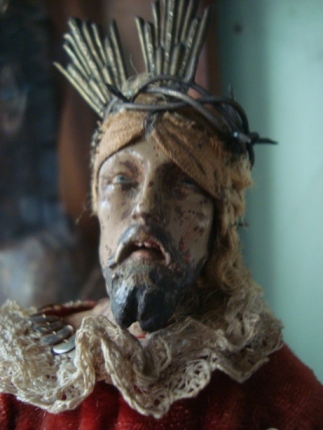
The last santo shown to me turned out to be a small 10 inch., but exquisitely detailed Nazareno in its original urna of narra wood. One look and I was smitten by the impeccable craftsmanship of this santo, which, relatively remained in good condition after all these years.
Surprisingly, the velvet dress is very simple—it has none of the heavy embroidery associated with the vestments of expensive santos, with only sequins, metal appliqués and lace to trim it.
It had an underskirt made of cheap abaca. Yet, from the looks of it, this santo is a notch level in quality than other old Nazarenos I’ve seen.
The face alone has a very human-like, sorrowful expression, complete with an open mouth that shows teeth, amazing details considering that the head is just about the size of a lanzones fruit. The unusual blue eyes—mere slits on Jesus’ face—are of glass.
The santo has lost its outermost dusky brown encarna complexion, although traces of brown paint can still be seen on its legs. The secondary encarna of lighter shade is what remains on His face. Clearly, the carver who made this was a gifted and a highly-skilled artisan.
Then there are the metal accessories made of real silver. It had all the accoutrements of a Nazareno—from the silver slippers, tres potencias, crown and bambalina neck chain, while the cross came complete with cantoneras.
The only missing piece was the silver belt. Undressed and unwigged, the wonderful detailing of the Nazareno were further revealed.
The anatomy was precise—from the torso all the way down to his delicately carved feet. The articulated arms were meticulously jointed at the shoulder and the elbows, allowing the limbs to move 360˚.
The posture of the small santo is accurate, as tradition depicts the Nazareno kneeling on his left knee, His body slightly angled by the weigh of the cross.
The figure is mounted on a realistically-painted “stoney” base framed by golden wood moldings. I can’t wait to have this Nazareno restored—all it needs is a new wig, a belt replacement, a new undergarment and a set of embroidered vestments.
And how much did I spend for my fabulous Friday find? I can’t say I got the cheap. But it's not every day that you find 4 quality santos in one shop, all in one day--and al available for the taking. The Nazareno piece itself is fantastic find, and just needs a bit of tender loving care to restore it to its original state. Now I know why they say with glee-- “Thank Good It’s Friday!”.