Showing posts with label Philippines. Show all posts

Thursday, September 10, 2020

339. FACES OF CHRIST


FACE OF CHRIST, Small painting on canvas. (PC)
As imagined by man, and created by hands both trained, unschooled and self-taught. Here are His Holy Images, captured in Western classical paintings, Mexican tin retablos, Philippine icons, and various portraits on wood, canvas, cloth and glass.
**********
SAGRADO CORAZON, by unknown Filipino painter. (PC)

HOLY FACE, vintage painting, after the Shroud of Turin. (PC)

ECCE HOMO, 19th C.pastel on board, U.S. (PC)

CHRIST BEARING HIS CROSS, Oil on canvas, 19thc, (PC)

BEHOLD THE MAN! 1940s U.S.painting, (PC)

ECCE HOMO, Undated and anonymous Phil. painting
sighted at a Tiendesitas antique shop.

SACRED HEART, American vintage painting on ebay.

ECCE HOMO, Reverse painting on glass, 19th c. (PC)

STO. ENTIERRO, painting on tin, Philippines (PC)

AGONY IN THE GARDEN, '50S painting (PC)

ORACION, by Domingo Celis, 1950s, (PC)

VERONICA WIPES THE FACE OF JESUS,
Station of the Cross, painting on tin, 1900s. (PC)

*PC = Personal Collection, all others, from private collections and shops.

Saturday, April 15, 2017

291. A SELECTION OF RESURRECCIONS

RESURRECCION. Photo courtesy of Mr. Leo Cloma

 Holy Week in the Philippines culminate in the pre-dawn Easter rite called “Salubong”—a pageant that dramatizes the reunion of the Risen Christ with His Blessed Mother. The religious figures are separately borne on andas or on carrozas, followed by a segregated crowd (men follow the Jesus icon, women, that of Mary) and the two processions converge together, resulting in the meeting of Mother and Son.

PHOTO: JEJOMAR ROBERTO

YAPTINCHAY-GANA Family.
PHOTO: MARK POTENCIANO

Photo courtesy of Dr. Raymund Feliciano

One of the highlight is the undraping of the Virgin’s black mourning veil by an “angel”—performed by a chosen young girl dressed with angel wings. The Virgin is then called the Nuestra Señora de Alegria ("Our Lady of Joy"), and the joyous rites are capped with a shower of flowers from other participating angels.

DYCHITAN FAMILY, from 1903.
Photo courtesy of Jerry Punzalan Sagmit

Photo courtesy of Jvlian P. Liongson

Photo courtesy of Dr. Raymund Feliciano

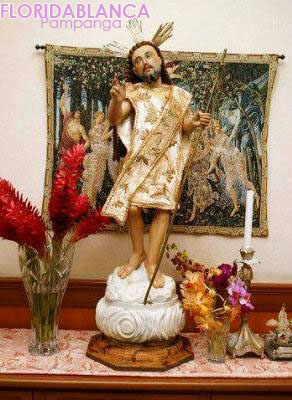
 The figure of the Risen Christ, on the other hand, is also called Cristo ng Muling Pagkabuhay or Resurrecion. He wears a loincloth, sometimes with a cape or a sash, and holds his standard in His left hand and His right hand, raised in benediction.

Photo courtesy of Jose Talapagobra FB page.

Photo by Alex R. Castro

Photo courtesy of Dr. Raymund Feliciano

On Christ's head are tres potencias, symbol of His faculties. He stands on a cloud base, fancifully called "ensaymada" base, especially the antique ones, for the resemblance to the swirly pastry.

Photo courtesy of Mr. Leo Cloma

Photo courtesy of Mr. Jejomar Roberto

Photo by Yuu Miyamoto FB page

Traditionally, the images of the Risen Christ are small—antique ones seem to have a standard size of 39 inches. That’s because Christ is meant to be shoulder-borne on a wooden platform, which can be maneuvered easily to move back and forth, or to lean—so that the Christ figure can be made to appear like it is animated, leaning or nodding when it meets the statue of Mary. 


Photo from Nuestra Senora de Loreto picssr page.

Photo courtesy of El Rey-Guapo FB page.

Photo courtesy of Mr. Leo Cloma

The Risen Christ is then enshrined in the altar for the Easter Mass to remind us all of the doctrine of Christ's resurrection and of the reward of life after death.

Photo courtesy of Romain Garry Evangelista

Photo courtesy of Dr. Raymund Feliciano

Resurreccion of Villa Escudero

 On this pages are images of the Resurreccion, from different towns and provinces, many still used for the festive Salubong easter rites.

Tuesday, March 21, 2017

288. SANTO SIGHTINGS IN TIENDESITAS ON A RANDOM DAY, 2011


VINTAGE STA., VERONICA Processional Santa.
When Tiendesitas, a shopping complex located within Frontera Verde in Pasig on 26 Sep. 20015, it was met with much hoopla. After all, it was envisioned to be a budget-friendly shopping destination (“tiendesitas” means a cluster of little shops), with specialty “villages” that sold fashion, native food, pets, plants and other novelties.

VINTAGE STO. SEPULCRO
Of course, for santo collectors, the opening of the “Antique Village” was a welcome section of Tiendesitas, another happy-hunting ground for antique santos, all in one location.

VINTAGE CRISTO DE LA PACIENCIA
Indeed, the early list of shops that could be found there included well-known names like Sarimanok (Henry Wee), Laong-Laan Antiques (Yanga), Unang Panahon (Esposos), 888 Noble Antiques and Henry Babiera—who was instrumental in getting the shops together at the new shopping hub.

VINTAGE RESURRECION
The shops did not disappoint, as the prices were relatively reasonable (the shops were not air-conditioned and the location—along C5—was then considered very far). But when access and generation of traffic became major issues, the shops started to close—and the “antique village” shrank in size to give way to more lucrative businesses.

NEW IVORY-FACED MANIKIN SANTOS
Tiendesitas deteriorated to the point that the antique shops were reduced to a handful. Eventually, as the area became more developed commercially, Tiendesitas was upgraded by the developers in 2014, adding buildings, second-level shopping places, escalators and airconditioning. The business climate improved with its relaunch and today, Tiendesitas has 450 traders from all over the Philippines.

ANTIQUE SAN VICENTE FERRER IN URNA
However, the same cannot be said of the antique shops. The dwindling supply of quality items forced more closures and for the remaining shops to carry lower-quality antiques and reproductions—a sad statement that the glory days of the Philippine antique trade is really gone.

ANTIQUE SAGRADA FAMILIA IN URNA
In March 2011, a few years before its renovation, a walk around the antique village of Tiendesitas yielded these santo offerings from select shops still operating in the complex.

ANTIQUE SAN YSIDRO & SAN ROQUE

VINTAGE STO. ROSARIO IVORY

ANTIQUE IVORY PURISIMA

ANTIQUE STO. ROSARIO, now in R. Lopez Collection

ANTIQUE BONE SAGRADA FAMILIA IN VIRINA

OLD INMACULADA CONCEPCION

Friday, September 2, 2016

265. SANTOS FROM THE VILLA ESCUDERO MUSEUM


The Villa Escudero Museum in Laguna houses some of the most beautiful and valuable collection of antique santos of inconceivable styles in the Philippines. Built like an old church, the museum is part of the 800 hectare sugar plantation estate founded in 1872 by Don Plácido Escudero and his wife Doña Claudia Marasigan. Son Arsenio shifted to coconut farming in the 1900s and began a burgeoning coconut industry in the area.


 Together with his wife, Dona Rosario Adap, the successful agro-industrialist built their hacienda residence in 1929 on their expansive estate that straddles three towns in in two provinces: San Pablo City (Laguna), Tiaong, and Dolores (Quezon).


 In 1981, their children opened the estate to the public and evolved it into a resort that has become a favorite tourist attraction for both local and domestic tourists. It has since become a showcase of Philippine culture and traditions in a charming rural setting, giving the visitor a unique hacienda life experience—from carabao rides, folksy entertainment to outdoor dining with the waters of Labasin Falls lapping at your feet.


 But Villa Escudero’s crown jewel is undoubtedly its museum that features the eclectic collection of Don Arsenio and Rosario amassed from their hobbies and from their travels here and around the world. The objects include a dizzying array of excavated and trade porcelain, tribal, domestic, wartime, and religious antiques and memorabilia.


 In 1987, the collections found a permanent home in the church of the hacienda that was constructed in the old Spanish colonial style. Antique colonial santos and the finest examples of ecclesiastical art are the centerpieces of the Villa Escudero Museum.


There are majestic carrozas of all shapes and sizes bearing processional saints of the Holy Week. These participate in Lenten processions held in San Pablo City annually. There are santos in wood and in ivory, some exhibited behind glass, and some, in reassembled antique church retablos salvaged from old churches.


 Don Conrado Escudero, an heir, has added more antique santos in wood and ivory and other sacred art pieces to the collection through the years. Santos can also be found in the Escudero private chapel where the departe members of Escudero families are interred, as well as inside the magnificent Escudero residence itself.


 A selection of the Villa Escudero santos are on this spread. Access to the Villa Escudero Museum is included with the entrance fee to this distinctive hacienda resort, the first of its kind in the Philippines.