Showing posts with label urna. Show all posts

Sunday, September 24, 2023

358. DIE PHILIPPINEN, Perle im östlichen Meer: SANTO PAGES

PROCESSIONAL MATER DOLOROSA IN IVORY

DIE PHILIPPINEN, Perle im östlichen Mee
r (THE PHILIPPINES, Pearl of the Orient Seas) is a German-language book, published by Lipp in 1985, with contributions from the Staattliches Museum fur Volkerkunde Munchen. A whole chapter was devoted to Spanish colonial religious art of the Philippines , and these photos are from the book.

SAN ISIDRO LABRADOR

SAN JOSE

SAN JOSE, INMACULADA CONCEPCION
from Bohol

SANTO NINO

SAN MIGUEL ARCANGEL, icon painting

AN ALTAR OF SANTOS

IVORY MADONNA

IVORY HEAD OF THE BLESSED VIRGIN

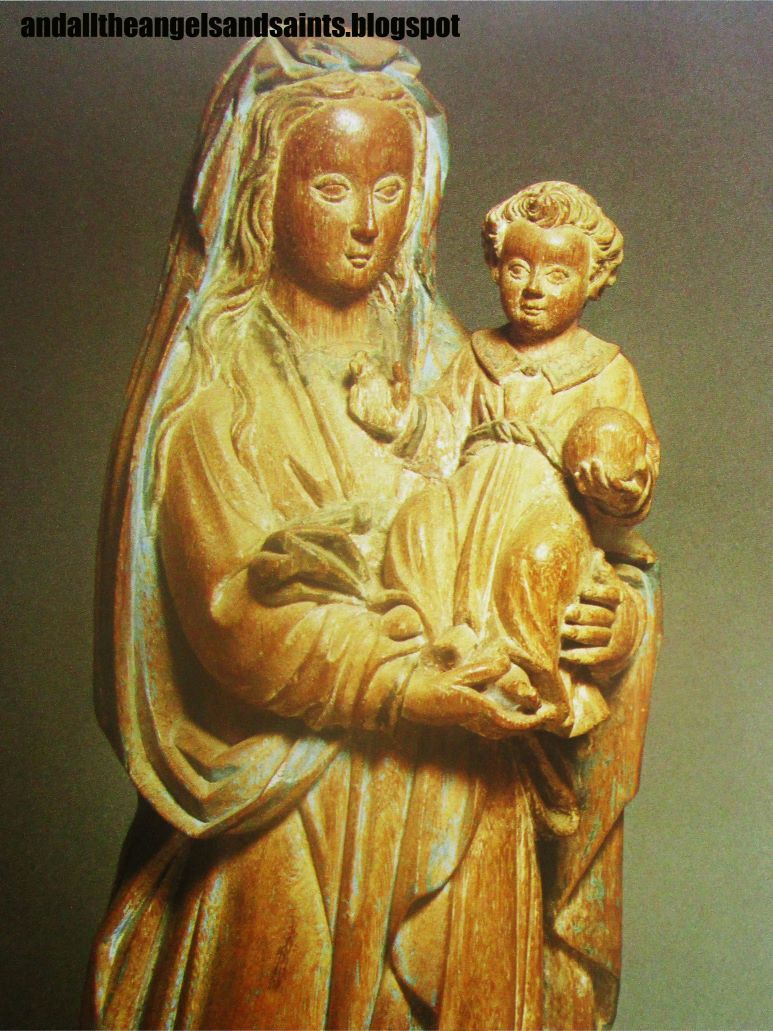
MADONNA AND CHILD,  with an intricately
carved gown and base.

NTRA. SRA. DE SALVACION

TRYPTICH ICON OF SAN VICENTE FERRER,
SAN ISIDRO LABRADOR AND STO. NINO

TWO SANTOS OF THE BLESSED VIRGIN

A PAIR OF FOLK MARYS

A PAIR OF FOLK MARYS

SAN ROQUE, WITH MISSING ANGEL

LA PIEDAD

CRUCIFIED CHRIST

BOHOL VIRGIN IN A POLYCHROMED URNA

THE BOOK: DIE PHILIPPINEN. PERLE IM OSTLICHEN MEER


Wednesday, December 15, 2021

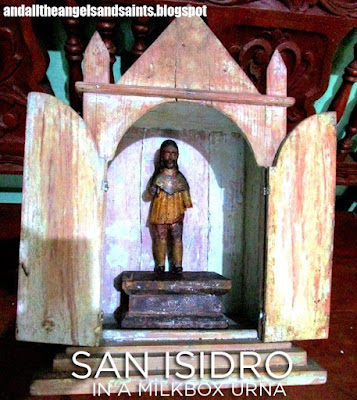
347. SAN ISIDRO AND HIS MILK BOX URNA

One of the most quaint folk art pieces I acquired just has to be this tiny San Isidro Labrador from Bohol, that was matched with a hand-made wooden urna, fashioned from an old wooden milk crate.

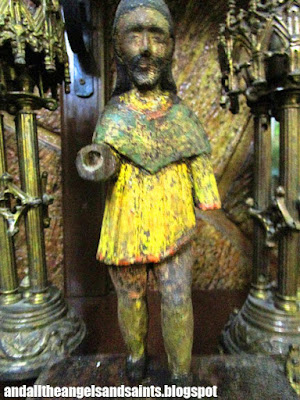
SAN ISIDRO LABRADOR BOHOL SANTO, 

The century-old San Isidro—a shade over 5 inches, excluding the base—is a typical Bohol piece with some of its brilliant polychromy still intact, all iconographically correct. He wears a green cape over a yellow tunic, with his boots on. He has missing hands, which once held a spade. 

The santo stands a mere 5+ inches tall

Despite the small rectangular base, there is a space once occupied by an angel plowing with a cow. The figure of the kneeling landlord is an optional element of the tableau, and he was left out in this representation, understandably because of the small dimension of the piece. 

Ordinarily, Bohol pieces were enshrined in folk urnas of the same qualities as the santo---small, brightly polychromed wooden altars embellished with relief carvings, raised by stair-shaped bases. This San Isidro, however, was found being displayed in an antique shop in a simple wooden urna, which stylistically does not match the Bohol style, but fits the santo’s size perfectly.

Wooden urna, handcrafted from milk crate

The small urna was ingeniously handcrafted from a milk crate—and the brand name can be found at the bottom of the urna to hide it—“Milkmaid Brand, Sweetened Condensed Milk". 

Milkmaid was an imported milk product, and it was first launched in the Philippines in the 1920s. By the 1930s, it was a successful brand, popularly known as “Marca Señorita”, because of the milkmaid brand character. 

Old Milkmaid ad, 1929

It was heavily advertised and promoted, and in 1929, Milkmaid even sponsored the search for the healthiest and cutest babies of the Philippines.

The urna itself, though simple in its creation, has many charming details. The “pediment’ is flanked by two “fence peg” spires. The double doors are hinged with wires, which were also used to make the latch. The boxy structure was attached to a 3-step stair base. 


 Its coating of white gesso or paint are still visible on the surface. Similar urnas made from commercial wooden crates were usually embellished with painted designs to make up for their plainness, but this example has no traces of color that I can see. In any case, San Isidro seems to be happy in his simple abode—after all, as a humble farmer-saint, he is used to a much harsher environment!

Tuesday, November 30, 2021

345. SAN ROQUE : Patron Against Pandemic and Pestilence

SAN ROQUE, Invoked Against Pandemic

 In these, the pandemic years, no other saint has been heard more often than SAN ROQUE as his name is included in the Oratio Imperata, specifically composed for  covid-19.

SAN ROQUE (“St. Roch” in France and “San Rocco” in Italy) was born in Montpellier, in southern France, near the end of the 13th century. It is said that Roch bore a vivid red birthmark on his chest, shaped like a cross. His father, a governor of Montpellier, as well as his mother,  died by the time Roch was 20, leaving him to fend for himself in Europe during the time of the Black Death, the plague which killed an estimated over half of the European population.


SAN ROQUE distributed his inheritance among the poor, gave the governorship of Montpellier to his uncle which he would have inherited.  With his few personal possessions, he headedfor Italy. In his journey, he encountered cities stricken by the plague. In Aquapendente, a village in Italy, he ministered to the plague-stricken citizens, healing them with the sign of the cross. He moved on to Cesena, Rome, Mantua, Modena and Parma,  curing people along the way.

DELICATELY PAINTED FACE OF SAN ROQUE

SAN ROQUE soon caught the plague himself; and like a “self-quarantined” patient in today's COVID-19 crisis, he sought a sanctuary, where he could be in prayerful solitude. A dog miraculously appeared to bring him food and sustenance every day. Surviving the plague, he chose to return to his France, but was imprisoned instead, as he was dressed like a pilgrim. He died after 5 years, but his identity was revealed when the cross on his chest was uncovered; he was given a holy burial. 

In 1414, when the city of Constaza, Italy was hit by a plague, people were called on to pray to SAN ROQUE for healing.  After their petitions and processions, the plague miraculously stopped.

This representation of the santo, in wood and ivory, depicts him as a pilgrim with his dog by his side. The head and hands are of fine ivory, classically carved, and outfitted with glass eyes. His boots are painted on.

SAN ROQUE, with original metal accessories

The saint is iconically posed with his right hand lifting his tunic, and his finger pointing at the festering wound on his knee. The other hand holds his original pilgrim stick in brass, with a metal flask tied on top.

The tunic and cape have been replaced using the original tattered garments as pattern for the new outfit, all re-created by Dr. Raffy Lopez. 

SAN ROQUE’s faithful canine companion is shown on his right, with bread in his mouth. The seated dog is made of painted wood. At first glance, the Angel –his other iconographic element—seems to be missing. 

Usually, the Angel is present bearing a scroll that proclaims the saint as the patron of pestilence victims, to be invoked for protection and relief  from their illness. However, a close inspection of the base shows no traces of nails or dowels that could have anchored the small figure on the base to complete the tableau. 

THE HEALING POWER OF SAN ROQUE

However, there are many representations SAN ROQUE that show him Angel-less, with just a dog for his companion. Besides, the reference to the Saint’s healing power is already written on the rectangular, stone-topped base. In Spanish, it reads: “Los que tocadas de la peste invocoven  mi siervo Roque se libraren por su intercesion de esta cruel de enfermedad.” (Those who are touched by the plague, invoke my servant Roque, and, through his intercession, you will be freed by his this cruel disease)

This SAN ROQUE was possibly made in the 1930s, as it came with a gothic-style wooden urna popular in the era. I have a special interest in the saint as I lived at the San Roque Rectory of the San Roque Church in Blumentritt, Sta. Cruz, Manila, the church that my late uncle, Msgr. Manuel V. del Rosario founded in 1958, and which he served until his retirement in the 1980s. 


Thursday, April 7, 2016

246. Rare Folk Santo Tableau: THE MOCKING OF JESUS

BURLANDOSE DE JESUS. A folk santo grouping in a primitive
urna, depicting the mocking of Jesus by Roman soldiers.
Pamintuan Mansion, Angeles City, Pampanga.

Bearing shame and scoffing rude,
In my place condemned He stood;
Sealed my pardon with His blood.
Hallelujah! What a Savior!

Religious tableaus depicting anything from Biblical scenes (the Nativity, the Crucifixion)  to various saintly groupings (e.g. Our Lady of Carmel, St. James Fighting the Moors, Salvacion) are familiar sights to antique dealers and santo collectors. Folk representations of the Sagrada Familia (Holy Family) commonly abound, often encased in a colorful folk altar. The same goes true for Calvario tableaus  that show Jesus on the cross, surrounded by Mary, Magdalene and St. John.


However, in the restored ancestral Pamintuan residence of Angeles City can be found a very rare and seldom seen folk tableau, representing the Mocking of Jesus Christ. This event, which Jesus had predicted, happened several times--after his trial and before his crucifixion according to the gospels of the New Testament.


The mocking of Christ took place thrice: immediately following his trial by the Sanhedrin, after his condemnation by Pilate, and when he was on the cross. The first instance was done by chief priests, temple guards and other elders.


The second instance occurred after his appearance before Pilate, where, upon his condemnation, was  was flogged and mocked by Roman soldiers. They clothed him with a purple or scarlet robe. crowned with thorns and made to hold a staff as his scepter. This wooden tableau seems to depict Jesus' second mocking by the Pilate's Roman centurions who knelt before him and said , "Hail, King of the Jews".


Curiously, the seated blank-faced Jesus figure is clean-shaven. Could this figure represent Pilate? Or was it just a way to differentiate Jesus from his bearded and moustachioed antagonists? A wire on top of his head that once held a halo--indicates with certainty that this is indeed, Jesus. One bemoustached official is either in the act of handing him his reed scepter or about to beat him up with a staff.


Still another is seen pointing his finger up. Two or three centurions stand at attention around Jesus, dressed in their pointed hats, breeches and boots. All the figures--no more than 7 inches high-- are carved from softwood in the naif style, with their separately-carved limbs wired to their bodies. Their faces are painted and they are dressed in fabric trimmed with lace and gold thread.


The ensemble is housed in a spectacularly carved, glass fronted  urna with 4 Solomonic columns, cutwork side flanges, and a roof with simulated rococo carvings. It stands on carved feet that are typical of Ilocos folk altars.

Christians see Jesus' suffering is redemptive, hence, they see the mockery that Jesus went through as being borne and endured on their behalf. Capturing this moment in a carved devotional piece must have been a challenge to the anonymous santero who wrought this exuberantly-crafted masterpiece. Which explains why it remains the first and only Mocking of Christ tableau I have seen thus far,

The rare Mocking of Jesus folk tableau can be viewed at the Pamintuan Mansion on Sto. Entierro St., located at the heritage district of Angeles City. The ancestral residence has been converted into a Museum of Social History. Opens daily 8:00 am-5 pm, except Mondays. Entrance is free.

Tuesday, October 14, 2014

209. FAMILY FIRST: A Folk Urna From Ilocos


FAMILY FIRST: A Folk Urna From Ilocos

 I remember the moment when I acquired my first antique urna, complete with the figures of Joseph, Mary and Jesus. It was in the early ‘80s when I started collecting santos, thanks to my Creative Director who turned me on to this fascinating hobby. But back then, my 50 peso budget could only buy ‘buraots’—an antique dealer’s parlance for old pieces on the verge of being called junk. So, my first pieces were crudely carved flatback santos, santo fragments ( a carabao from a San Isidro tableau, a Nazareno hand) and small crucifixes, often without bases.


 It was while on a shooting assignment in Baguio, sometime in 1982 that I bought my first complete santo ensemble in an urna—not a santo fragment, not an incomplete figure--but an almost perfect primitive altar from Ilocos. In a break from the shoot, I accompanied my boss to Maharlika Shopping Center—then Baguio’s center for arts, antiques and souvenirs, located in a multi-storey building right in the market district. Pinky Garcia, then, an up and coming antique dealer, had a shop there—already called PNKY—and that’s where I beheld the folk altar for sale.


The first thing I noticed was its rich, smooth patina, indicative of its antiquity. It was in the shape of a house, with a tin roof, topped with a turned finial and trimmed on the side with two graceful wooden swirls. Four columns marked the corner of the main structure, that sat on short carved legs. Wooden frontals were carved and decorated with floral swirls and curlicues. Inside the altar were the carved wooden figures of the Child Jesus, flanked by Mary and Joseph. The naïve figures were no more than 10 inches tall, crudely carved and feature-less, but painted with once-rich hues, with their dressed painted with flourishes.


 The whole ensemble was fashioned from soft wood and wood scraps—the latter, used as a backing for the urna. It had stood unscathed for years, saved for a few missing hands, tin halos and San Jose’s staff. I wondered too, if the urna once had glass panels, or if it had a door of some sort, but there are no nail marks to indicate that it had been equipped with these. The dealer had identified this antique piece as a Tagalog altar, but an expert corrected me to say that the style was very much from the Ilocos region.


Whatever, I fell in love with the urna, and so shyly, I asked the dealer for her best price. When she showed me the price tag—Php600—I nearly fell off my seat—it was way out of my league! I only had a Php 200 ‘baon’ for the duration of my production work (I still had a day to go). But—she added---she could lop off a few pesos more, arriving at a final, non-negotiable price of Php 495! Unfortunately, I still could not afford the discounted price—so sadly, and with a deep sigh, I turned away.


 The next day, we packed up our shooting and made a final dash to the Baguio market to buy last-minute pasalubongs for the folks back in Manila. This time, I was with my boss, and I egged her—being a more knowledgable collector--to check out the urna which I wanted, as the shop was just a floor above us.


 Of course, she was charmed by the piece! She then advised me to buy it, as the urna she said, was in such pristine condition and that I can’t get that piece for a Php495 once it is brought down to Manila. I told her though, that much as I liked it, I couldn’t afford it—and proceeded to show what’s left of my baon—all of Php150.

 “Goodness, Alex! Why didn’t you tell me? I can lend you that amount and you can pay me back anytime!”. It was so unexpected that I felt so embarrassed, and I started to object, protestations that fell on deaf ears. Right then and there, she whipped out her credit card from her wallet, and dealt with the shop owner herself. I insisted that I chipped in my last remaining Php100, so she was charged just Php395 on her card.


 We walked away from the antique shop with me lugging the packed urna proudly with one hand, along with my longganisa and peanut brittle. In the ensuing years, my dear boss would resign and make a splash as an accomplished advertising creative in Malaysia, while I would remain in the industry, until I too, joined the expat bandwagon in 1989. But through all those years, I have kept my beautiful Ilocos urna for 32 years—not just as an artifact of our religious history, but also as a wonderful reminder of the boundless kindness of friends.