Showing posts with label Paete. Show all posts

Tuesday, July 30, 2013

158. Santo Stories: LA MUERTE DE SAN JOSE of Paete and Pampanga


The dramatic tableau of La Muerte de San Jose (Death of San Jose) belongs to the famed woodcarving Cagandahan Family of Paete, the country's carving capital. Master carvers from this family include the 1952 Art Association of the Philippines awardee, Isaac V. Cagandahan, who created the "Orasyon", and Paete Arts Guild member, Glenn Cagandahan. 

This processional tableau shows the dying San Jose, comforted by Mary and Jesus and attended by a bevy of angels. It dates from the late 19th century.


In the 1900s, a member of the Cagandahan family, Basilisa Cagandahan, became the second wife of a Kapampangan man, Irineo Jose. As a gift to her husband, she had this smaller replica of their Paete's La Muerte de San Jose made. They are exact copies, only done in smaller scale.

This version now is in the care of the Tantingco Family, relatives of the Cagandahan-Jose Family. It is kept in its own storehouse in Mabalacat, Pampanga,  and is still regularly used for procession, especially on his feast days, March 19 and May1.

The twin images now serve as a link to two families, united in marriage, but divided by geographic locations--one in Pampanga, and the other in Paete, which incidentally, are two major carving centers of the Philippines.

(Pictures and info courtesy of Arwin Paul Lingat, Robby Tantingco, Rhea Jose Mateo)

Tuesday, July 26, 2011

73. Santo Stories: ANG MAHAL NA SEÑOR NG PAETE

(Excerpted from the article , Ang Mahal na Señor, English translation “Mire of Heaven” by Elmer Beltran Ingles. Original Filipino text by Manuel Baldemor. The Paete Phenomenon, p. 43-44, by San Santiago Apostol, Foundation of Paete, 1991)


According to town historians, the Catholic image of the dead Christ is the oldest, most miraculous and the most important of all images. It is said to have come from Mexico and the oldest-known saint in the stone church of Paete.


Before Lent, it is blessed with incense and daily and nightly prayers are offered. It is bathed with wine and the liquid is kept in small bottles to be distributed to devotees. The used wine becomes sacred and is believed to be a good cure for any ailment.

The Jesus Christ figure also receives the biggest amount of donation from devotees from all over the land. Donations are in the form of blankets, silk clothing and pillows. Excess donations are given to the church to be used as altar mantles or clothes for sacristans. The clothes and pillows are often borrowed for use of sick persons or those afflicted with grave ailments.


While the vigil for the dead Christ is in progress in te house of the recamadero (the keeper of the image), Catholics and even Aglipay take turns in kissing the hands and feet of the image. Men with devotion or personal pledges go on shifts in carrying the image in the procession. The feel the weight on their shoulders if their sins against God and their fellowmen are grave. It is said to be lighter when volunteers do it in gratitude for past blessings. Newly circumcised boys serve as support group with the wooden poles which they used to steady the float during the procession. After the Good Friday rites, everyone is invited to the house of the recamadero for a yummy bowl of sotanghon ( a variety of noodle) and hot biringhi dipped in refined sugar.

Tuesday, May 31, 2011

66. A PROCESSION OF MOVING SAINTS IN PAETE

By Carmen A. Navarro (originally published in The Chronicle Magazine, 29 June 1963, pp. 44)

Paete is a little town nestled at the foot of Sierra Madre ranges and locked by Laguna de Bay. It has no wide plains, not topographical greatness. Rather, it is a town by the road between highland and water. Its history is the unraveling of a way of life rendered starkly simple by a lack of physical grandeur. Crowded in by mountain and bay, Paeteños looked within themselves and found there, their greatness.

Thus, to know Paete, a town founded in 1580, fifty nine years after the historic date of the rediscovery of the Philippines in 1521, is to know a past that belongs to the present. For the accumulation of that deep human experience of a people steeped in self-awareness is tradition.

It is they who have kept the heritage of a unique custom of a “living saints” procession every Holy Thursday for the last two hundred fifty years by passing it to their younger kin with an unwritten will that the observance shall be without dichotomy between ceremony and belief.

In the past, Eugenio Quesada, a Paeteño who has written his memoirs in the form of a narrative of the town says:

“Holy Thursday was the biggest day of the week, for on this day, the procession was the largest because the ‘pasion’ or carrying of the cross in the different stages was shown and not only that, the meeting of Jesus and his mother Virgin Mary was re-enacted”.

During this re-enactment, the author notes that the town people who actually cried as though in pain, may have projected their own grief and the tediousness of their own lives in one packed moment of religious compassion.

American and German tourists who visited the town during the celebration remarked that it is perhaps the near realism of the drama that moves the spectators to such an experience. The tender scene of a sorrowful mother who breaks loose from the hold of tough soldiers to embrace her son, faithfully issued by vocal animation from living persons and movements through an intricate mechanism gives semblance of the real. The mechanism found within the statues is as old as the celebration, two hundred fifty years ago.

The second meeting place takes place in the upper portion of the town, in the Ilaya, almost in front of the small church called Ermita. It is the re-enactment of St. Veronica who meets Jesus with a piece of cloth on which our Lord imprints his face. St. Veronica in turn shows the printed face to the Virgin Mary, heightening her grief. The procession goes through all of Paete’s little streets, the menfolk bowed, the women in black, and the children sobered, singing in lamentable tones: “Populo meus quid feci Tibi” (O my people, what have I done to thee?).

A period of mourning marked by both interior and exterior silence trictly observed at the penalty of being called a Jew begins when the procession finally winds up in church for the tenebrae.

To the Paeteños, Holy Thursday celebration is not a ceremony but an element of their identity, just as woodcarving and lanzones tending are.

Woodcarving is the lifeblood of Paeteño culture which started in pre-Spanish times when the first group of Malay inhabitants happened to have a penchant for chiseling figures with a ‘apet’. In 1882, that penchant reached a golden age when Mariano Madriñan received a diploma and a medal of honor from King Alfonso XII of Spain for his Mater Dolorosa, a work of art exhibited at the International Exposition held in Amsterdam, Holland and Paete’s woodcraft found its wayin European palaces of kings and doors of Cathedrals. After a period besieged by idleness and oblivion, Paete woodcarvers in 1960 enjoyed a renaissance when the late Pope John XXIII commissioned them to make the statue of San Martin de Porres for the canonization rites. The Renaissance ay be completed when the Php75,000 worth of Paete woodcarving will be exhibited in the 1964 New York World Fair.

Paete’s economic framework remains inimical to contemporary economic schemes. Peculiar to her modest geography, her people who have remained oddly faithful to social justice. Land which was parceled among their grandfathers remains in the hands of their descendants, with the same size, the same fruits, never coveting, never wanting, year after year, generation after generation.

Like tradition, Paete merely stays.

Tuesday, May 4, 2010

8. Carving a Niche in History: EARLY SCULPTORS AND SAINTMAKERS

The first carved santos in the Philippines were created by anonymous hands. Many crude images for altars were carved by untrained town carvers who shall forever be nameless-- whittling available wood from their own backyards— santol, ipil or guava—turning them into folksy figures, painting them with natural dyes, then finally outfitting them with tin wings and halos.

In the 18th century, a few names have come down to us—one Esteban Samson was documented by art historian Enrique Dorta as an ‘escultor Filipino’ who carved a Santo Domingo and a San Juan Tadeo image in Argentina where he worked. French traveler Jean Mallat also noted a proliferation of carvers in his visit to the Philippines in the late 1830s-40s—“they sculpt saints in wood and ivory with a delicateness which make them sought after even in Europe..”.

Non-Christian Chinese carvers also figured in the creation of known images in the country. Foremost among these was the Virgin of La Naval, commissioned for the Dominican monastery in 1593, and carved by a Chinese from Ilocos. Chinese carving influences showed in the chinky eyes of Virgins, the Kwan-Yin pose, the neck folds and the inclusion of scroll-like designs on santo bases. Chinese artisans became very proficient in ivory sculpting, leading author Ramon Gonzales to point out in his 1875 guidebook to the Philippines that--”despite the Filipino’s admirable talent for imitation, they still do not approximate the fineness and delicacy of the works of the Chinese”.


It was only in the mid 1800s that formal training in sculpture was introduced in the country with the founding of the Society of Arts and Trades in Manila. The A (renamed Academia de Dibujo y Pintura Escuela de Dibujo, Pintura y Grabado in 1889) opened in 1850 under the auspices of the government. Sculpture, however, was included late in the school program. Soon, art scholars like sculptor Melecio Figueroa, were sent to Spain on scholarships, and art guilds like the Gremio de Escultores de Sta. Cruz, started holding competitions, livening up the art scene.

Art guilds flourished in Tondo, Binondo, Sta. Cruz and Quiapo, which were soon populated with craftsmen and artisans. Some of those who had their studios there became eminent carvers of santos:


Leon Asuncion (1813-1888), of Sta. Cruz had a shop along Sta. Rosa St., (now Evangelista) and was a master carver who wrought the Tercera Caida de Cristo for the Sta. Cruz Church. He also worked in ivory—a crucifix and a bust of the Sacred Heart of Mary is attributed to him. His son, Hilarion and grandson, Jose Ma., also dabbled in arts.

Also working in the area were Eduvigio de Jesus (1820s-1868) who comes from a family of carvers. His father, Anastasio, and his son, Romualdo, were also carvers of note, creating small ivory pieces to large processional images for churches all over the country.

From Quiapo comes Bonifacio Arevalo (1850-1920), who was actually a dentist by education. He worked mostly in wood.

Isabelo Tampinco (1850-1933) of Binondo had important commissions for several churches in Intramuros, carving the doors and retablos of Sto. Domingo and the decorations of San Ignacio. He is known for integrating native motifs into his design, which has come to be known as “estilo Tampinco”.

Graciano Nepomuceno (1881-1974), also of Trozo, Binondo did both religious and secular works.

In Paete, Mariano Madriñan, who trained under Bonifacio Arevalo, gained fame through his participation in the Amsterdam Exposition in 1882 where his Mater Dolorosa won raves. Also exhibiting abroad was Tomas Valdellon (active 1881-1887), who had a lifesize Dolorosa at the 1887 Madrid Exposition.


In the 20th century, a Tampinco descendant, Angel Tampinco, had a Gran Taller de Escultura, which specialized in carved wooden decors for altars, andas and carrozas.


But perhaps the most successful commercial santero was Maximo Vicente (b. 1885/d. 1964) , who had his one-stop shop Talleres de Pintura, Escultura y Plateria at 812 R. Hidalgo in Quiapo. Maximo was born in Malabon, the only son of Antonina Vicente, a fish vendor, and a Spaniard named Guardamonte, who died before Maximo's birth. Maximo went to the U.P. School of Fine Arts, graduating in 1909.


He set up his first religious statuary shop at Calle Hidalgo in 1908. His half-brothers--Rafael, Felix, Luciano, Roberto and Dionisio, children of Maximo's from her 2nd marriage to a Navotas fisherman named Pablo Santiago--both became expert artisans. They joined Maximo in his talleres, and they contributed much to the sucess of the shop. By the 1930s, the shop was not only known for creating images, but its services have expanded to making andas, altars, pulpits, church ornaments, gold embroidered vestments, even marble monuments and tomb markers. Most of his workers came from Malabon, Navotas and Pampanga like Juan Flores, Jorge Santiago, Rufino Rivera and Alfredo Contreras.

Maximo married Crispina Laxamana from Pampanga. Upon his death, his shop was managed by a daughter-in-law, Soledad Hernandez-Vicente, wife of his son, Maximo Jr., an architect. An only daughter became a nun and founded a religious order in Quiapo that propagated devotion to the Holy Face.


Irineo M. Cristobal had his own Taller de Escultura along Evangelista, which also did religious statuaries and decorations.


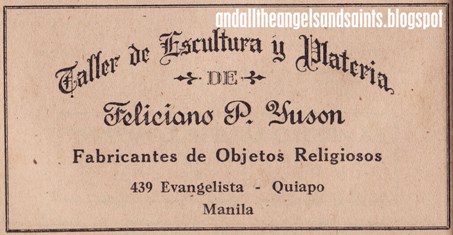
In the 1940s, other popular santo makers included: Esteban Sculpture Works along Rizal Ave., El Arte Cristiano of Gerardo Alonzo (Evangelista, Quiapo), Ang Batong Busilak (Hidalgo St.) managed by Cornelio Vicente and Taller de Escultura y Plateria de Feliciano P. Yuson (Evangelista St.).


Today, Quiapo and nearby Tayuman are still top-of-mind when it comes to religious shops selling santos, but as in mass-produced items, the quality of carving remains suspect. Devotees with discriminating taste prefer having images commissioned by well-known santeros in Paete (Laguna), Betis and Bacolor (Pampanga) and Bulacan whose art remains uncompromised.