Showing posts with label University of Santo Tomas. Show all posts

Wednesday, August 1, 2018

320. STO. TOMAS DE AQUINO: Patron of Catholic Education


I bought this beautiful antique santo for its beautiful symmetry, and not for any other reason. In fact, I didn’t even know its identity—I was simply struck by its perfect proportion, balance, and reflectional symmetry—that is, if there is a line dividing the santo into two, the pieces will be mirror images of each other. Remarkable for a folk santo carved by an anonymous, and perhaps, untrained artisan.


After some time sitting on a shelf, I took a more serious look at this 20 inch. santo. I knew it was a Dominican santo, but the biretta he was wearing stumped me. It was only after a thorough cleaning that details appeared, which led me to suspect that this was a rare Santo Tomas de Aquino.


This Dominican priest (1225-1274) is regarded as one of the greatest thinkers and writers of the Middle Ages. But save for his association with the Pontifical University of Sto. Tomas, and the town of Sto. Tomas in Batangas, the saint is largely unknow; there are few examples of hims as a carved santo figure.


The tell-tale sign that this was indeed Sto. Tomas de Aquino was a faded painting of a sunburst drawn on the saint’s breast—the sun of truth, a symbol of his teachings illuminated by divine truth. Another painted detail as this string of rosary beads that one can faintly discern hanging from his neck---the Dominicans often wore the rosary around their cowls or hoods.


As to the crown-like biretta with four points, this represents his being a angelic Doctor of the Universal Church (which is why, he is sometimes also represented as having wings). If he still had his hands, he would have held a pen to an open book. Or he would have held a small church on his left hand (as doctor of the church). Some portraits show a dove at his ear to symbolize the inspiration of the Holy Spirit, which is hard to capture in 3-dimensional images.

Sto. Tomas de Aquino is considered as Patron of Students, Universities, Catholic schools, Doctor of the Church . His feast day was moved to January 28 in 1970, but Filipinos continue to celebrate the original feast day of  March 7, which actually is the date of his death.

Tuesday, July 18, 2017

296. SANTOS FROM THE U.S.T. MUSEUM OF ARTS & SCIENCES

The oldest school-based museum in the Philippines--the University of Santo Tomas Museum of Arts and Sciences—is home to some of the finest collection of santos and other religious arts in the country. Founded in 1871 by Ramon Martinez, O.P., a professor of natural history, the museum showcases both scientific and artistic collections, including sacred objets d’art like religious imags, icons and paintings—a selection of which are featured below.

NTRA. SRA. DE LA ANUNCIACION

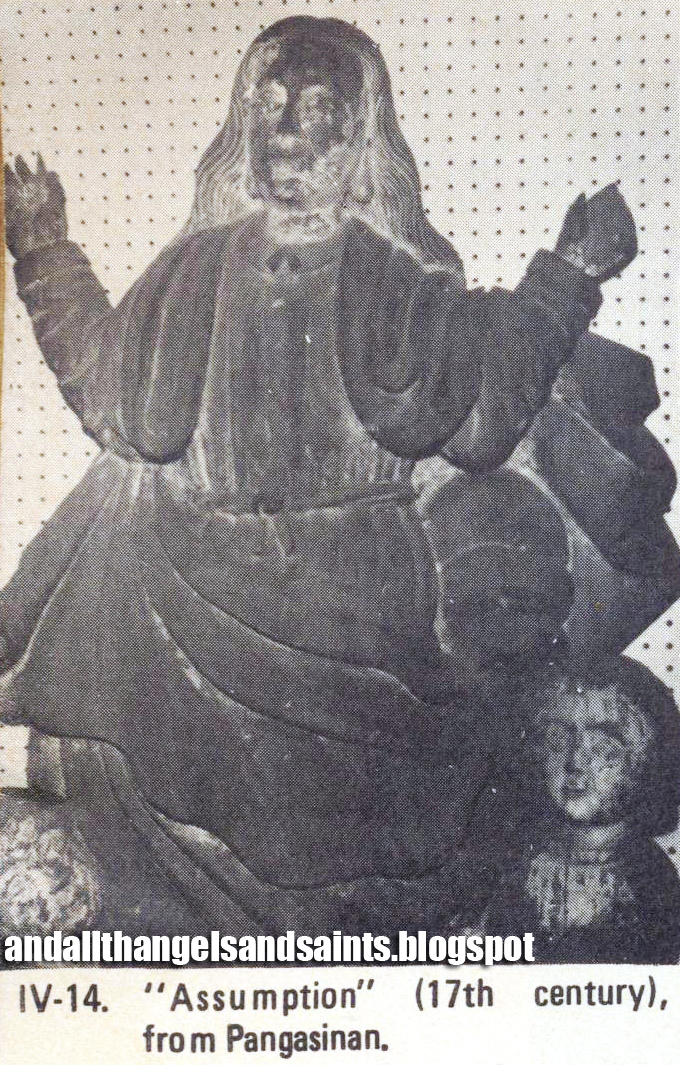
ASCENSION, FOLK SANTO

STO. DOMINGO GUZMAN & STO. TOMAS DE AQUINO

POLYCHROMED RELIEVE

BUEN PASTOR/ PASTORA

RELIEVES

PAINTED ICON ON WOOD

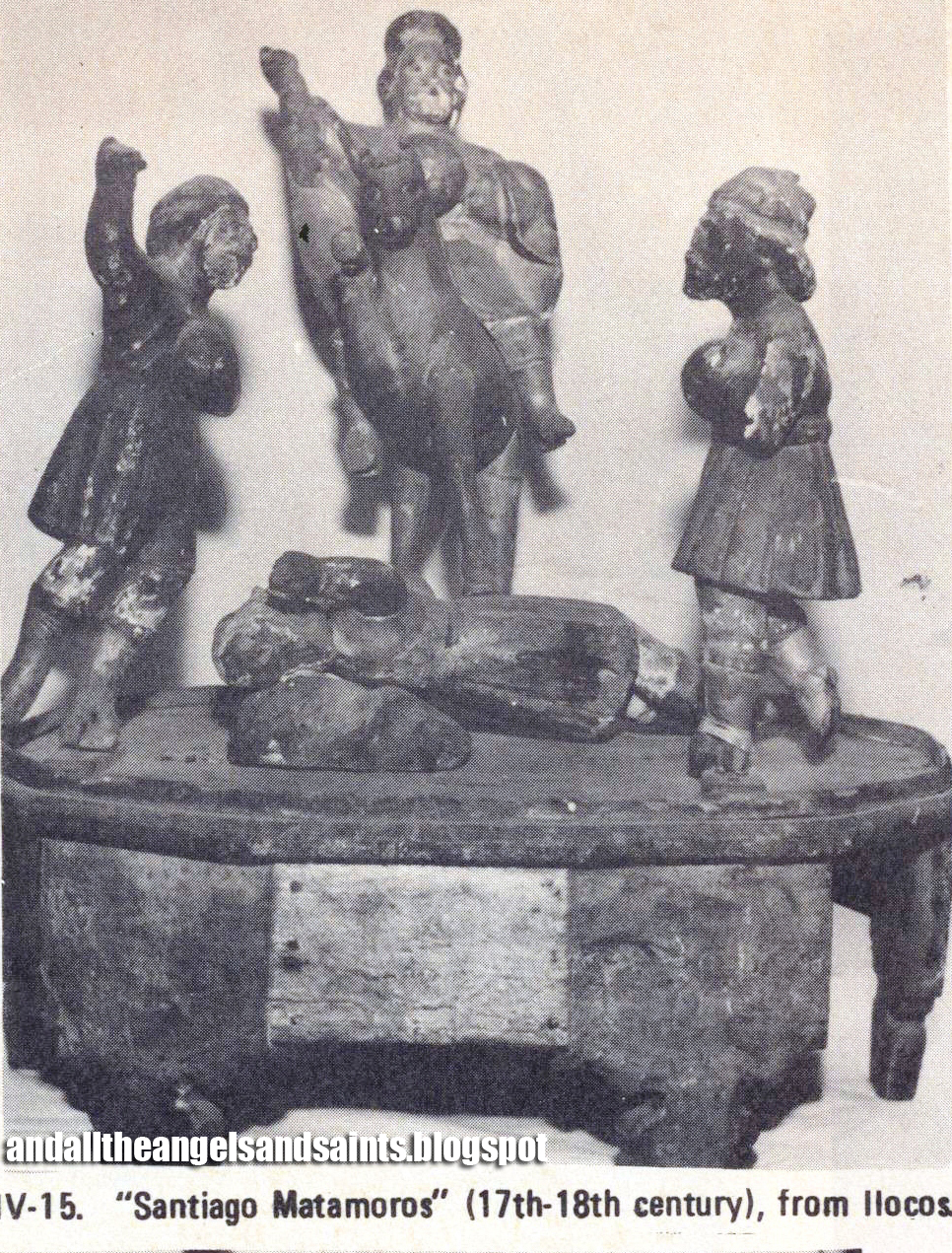
ST, JAMES, THE MOORSLAYER FOLK SANTO

OIL PAINTING ON CANVASS
SOURCES:
UST MUSEUM OF ARTS & SCIENCES COLLECTION, Printed Catalog, 1970s

Sunday, October 12, 2014

208. OUR LADY OF THE ROSARY, Santissimo Rosario Parish, U.S.T.


OUR LADY OF THE ROSARY, Santissimo Rosario Parish, U.S.T. ca. 1960. 

 The 1960 celebration of the Feast our Lady of the Most Holy Rosary, from September 24 to October 2, was pacled with activities and marked with great pageantry, culminating in the grand procession of the images of Our Lady and St. Joseph in the late afternoon of Oct.2, Sunday. The Santissimo Rosario parish itself was erected on 2 May 1942, with its seat at the Students’ Chapel and Fathers’ Residence of the UST.

The first parish priest was the very rev. Fr. Emiliano Serrano O.P. U.S.T.’s close association with Our Lady of the Most Holy Rosary began just before Santo Domingo Church was firebombed in December 1941, at the heaight of war. The miraculous image of our Lady was transferred under military escort to San Juan de Letran. But with Letran also under threat, the image was transferred to the U.S.T.’s Students’ Chapel where Our Lady stayed as a refugee, until her enshrinement at her magnificent church in Quezon City, built in 1954.

 A replacement image was installed in the chapel, made of wood and carved in the round. It depicts a standing Mary, with the Christ Child on her left arm, while holding a rosary with the fingers of her right hand. The smaller-than-lifesize crowned image stands on a cloudy base adorned with flowers. 

The devotion to Our Lady never waned even with her transfer, but in fact, became even stronger, as people flocked to U.S.T. to implore her maternal assistance particularly in October. The 1960 solemn festivities were marked with daily masses, novenas, flower offerings and vigils.

Block rosary units, established early in the parish area, practiced the “recitation of the rosary in the “Rosario de la Aurora”(dawn rosary) procession. This devotion took place at 4 a.m. on the first Saturdays of the month—from May to October. The faithful, carrying images our Lady and their candles, assembled at the U.S.T. gate and marched in procession around the campus, singing Ave Marias and praying the Rosary.

 Today, the grandeur that was the pre-war Santo Rosario fiesta lives on, as more devotees from all corners of the Philippines gather every October to personally reaffirm their faith in the unfailing protection of their patroness, Our Lady of the Most Holy Rosary.