Showing posts with label The Sunday Times Magazine. Show all posts

Monday, May 14, 2018

313. HONORING SAN ISIDRO, by Bibsy M. Carballo, Sunday Times Magazine

By Bibsy M. Carballo    /    Photos: Romeo Vitug 
Photos of  San Isidro, courtesy of Jayson Maceo
The Sunday Times Magazine, 21 May 1972, pp. 26-27


Sincerity Flamboyance, Festivity.
Nowhere else in the world, perhaps, is as much tribte and homage given to the food god than in the coconut-producing towns of Quezon province,

Perhaps it had to do with the utter dependence of the crop on the whims of nature; perhaps it can be explained through the people’s love for ritual and spectacle. Whatever the reasons, the fifteenth of May each year is a special day dedicated to San Isidro, patron saint of the farmers.

In Sariaya, boys clamber up abamboo
pole to try to topple it.

For weeks before this day, all regular work stops and the entire towns busy themselves in preparing the buntings and delicacies that will hamg from wondows and bamboo poles around the town.


Although each town celebrates the feast in its own way with even urbanized Lucena paying lip service with a few street decorations, the towns of Lukban and Sariaya, are the perennial competitors in the art of celebrating San Isidro.

The street is a mad sceneof happy grabbing and elbowing.

Lukban, with its candy-colored kipings in fancy shapes, its fruits and baskets, its entire window facades in a riot of colors. Sariaya, with its bamboo poles festooned with goodies which are torn down as the venerable San isidro passes by in the procession in the early evening; less colorful, less party-pretty, bit more exuberant and spontaneous.

A satisfied grin on his face, Sariaya well-wisher
walks away with his prized possessions.

And, as always, in keeping with the tradition of prayers for food and a good harvest, no visitor is allowed to go home empty. Food is literally pushed down one’s throat; it is an insult to decline. Houses are opened up to entire strangers; and as the Alcalas of Sariaya have found out, no one has really been proven to be the loser by such a reckless gesture.

Friday, August 18, 2017

298. ANTIPOLO, by Ileana Maramag

People make yearly pilgrimage to this Rizal town to pay homage to centuries-old Brown Madonna.

By Ileana Maramagpublished in The Sunday Times Magazine, 20 May 1962.

Still drawing a steady stream of pilgrims at this time of year is Antipolo, the small hilly town in Rizal province made famous as the shrine of the centuries-old brown Madonna as Our Lady of Peace and Good Voyage.


Antipolo, however, is not what it used to be. In the olden days, old folks like to recall, the place was no more than an isolated hamlet that could only be reached by carretela or cascos, via one of the Pasig River’s tributaries that wends its way to several Rizal towns. Thus, pilgrimages to the Virgin of Antipolo in those days were more hazardous and involved no small amount of sacrifice.Often enough, the pilgrims had ti hike the slippery trails of the region or cross the difficult terrain in man-borne hammocks. Aisde from this, the pilgrimages were made more festive by the bright parasols, colorful balintawaks and camisas de chino worn by the pilgrims, Today, the practice has all but disappeared; Antipolo is easy to reach via paved highways and modern-day pilgrims make the Maytime trek in buses or drive down the 28 km. road to Antipolo in snazzy cars,

Source: Sunday Times Magazine, May 1962

From Manila, it takes no more than 45 minutes to reach the town proper, and once ed there, pilgrims converge at the modern church which is easily Antipolo’s biggest landmark. Once inside, one discovers that the age-old image of Our Lady of peace and Good Voyage is enshrined in a special niche atop the main altar.

Source: Sunday Times Magazine, May 1962

Annually, on May 1st, by tradition, the Virgin is borne in solemn procession to an improvised altar atop Pinagmisahan Hill, where a mass is said to commemorate the first Mass celebrate by the early Spanish missionaries on the same hill. Devotees also mark the feast of Antipolo Virgin every first Tuesday of May.

Early historians report that the image was first brought to Manila from Mexico on June 29, 1626 by the then newly-appointed Governor General Juan Niño de Tabora to isnure the safe voyage of the galleons against pirates and typhoons.


No one can tell exactly how the Virgin became enshrined in the town of Antipolo. There are two versions. One reports the image was taken to the Rizal town by the Governor general and Archbishop and crowned as Nuestra Señora de la Paz y Buen Viaje. Another account says the statue disappeared and was found perched atop an antipolo tree, on the same spot where the Antipolo church now stands.

Another legend tells of how the Virgin of Antipolo acquired its dark color. The story goes that during the 1639 Chinese Rebellion (which include Rizal and  Laguna towns), the Chinese burned the statue but somehow the image miraculously remained unscathed. Instead, the carving turned black and has retained its dark hue through the centuries.

When the Japanese commandeered the old Antipolo church and used it as their garrison during the last war, devotees smuggled the image, buried it in a drum, and later transported it to the Quiapo Church where it was enshrined until after the Liberation.

Thursday, June 8, 2017

295. ALL ‘S FAIR IN LAL-LO, by Nancy T. Lu


By Nancy T.Lu
Sunday Times Magazine, 28 Sept. 1968, p. 38-41

Experienced collectors with a discriminating eye for genuine museum pieces are wont to spot them all over the archipelago whether be in some isolated, weather-beaten ruins, or in some unexplored nooks of private homes. Because many a Cagayan artifact was not meant to be kept unseen, a number of these cultural treasures which can easily swell he Cagayan pride recently left their forbidding enclaves to undergo maximum public exposure in Lal-lo, the site of the Cagayan Provincial Fair.

The preliminaries involved in the ostentatious display of Cagayan’s cultural heritage demanded concerted efforts including no less the governor’s personalized attempts in convincing the reluctant citizenry to loan the valuable family heirlooms they have been hoarding all this while in the privacy of their homes for the provincial exhibit. Which true-blooded Cagayano dared refuse Governor Dupaya’s request when she made it a point to call on the selected families personally? Repetitious assurances of security precautions had to be made in many cases to assuage the concerned individuals’ anxiety over the loss or damage that may befall their cherished properties.

Thus, the the cultural relics were brought in from all over Cagayan. And thus began also the pressing problem of identifying, sorting out, and classifying the numerable items comprising Cagayan’s cultural wealth. While the mian responsibility was delegated to the committee on relics, artifacts and antiques, a supervising authority was wanting. Invitation was extended a museology expert and soon enough, Fr. Jesus Meriño, O.P., of the U.S.T. Museum of Arts and Sciences flew in as the givernor’s special guest from Manila.

The enthusiastic Dominican friar took one look at all the collected objects laden with dust of the centuries and proceeded to single out slowly the “real wonders of art”. Taking care to jot down the outstanding features of the unique antiques as he went about rummaging for more of Cagayan’s historical possessions, he decided to direct the obliging engineer and helpful architect to classify and arrange the artifacts according to three general divisions: 1). People. Life and History, 2). Home, 3). Church.

Grouped along with the first category were tablewares imported from all over Eirope. There were eighteenth century chocolate cups of Spanish make. Some porcelain plates were German-made as a sopera all the way from Vienna. Certain chinawares had designs that connoisseurs would easily detect as rough British imitations of the fine, delicate artistic Chinese strokes. Gracing the opening of the Cagayan Fair with her very presence, the First Lady was reported to have taken fancy to a platter with a dent for gravy.


An alert guard constantly kept close watch over one of those contemporary glass showcases showing private collections of international coins and currencies. For security reasons, these precious personal belongings had to be locked away elsewhere every night. And for the same reason the owners chose to remain unidentified by name throughout the duration of the cultural exhibit.


Spanish Attires
Sweeping feminine attires of the Spanish era came in different colors tha had faded unevenly with the times. Nineteenth century camisas, panuelos and sayas that lay almost completely forgotten there in dust-colored trunks  and spider-webbed chests that had seen better days were put out once more ahere a fairly strong whiff of air caused that distinct smell of age to permeate the atmosphere. But a real item for Ripley’s Believe it or Not was this sable-hued tapis with romantic Castilian verses woven in white silk thread all over it. Father Meriño obligingly translated the love poem as a love-stricken lovers’ reproach to his loved one never to forget that he is unhappy if should forget him. The Spanish priest volunteered  a surmise that he must have been jilted by the girl. Apparently, the boy must have asked his sister to weave the chiding message into the tapis he later gave his girlfriend as a sentimental gift immortalizing his affections for her. Father Meriño further concluded from the numerous misspelled words that the poetic lover must have been a native and not a Spaniard.

The first recorded museums of old found in Egypt and Greece were reported to have been temples which held community treasures mainly religious in nature. Even today, votive objects for propitiatory purposes constitute a greater bulk of solicited artifacts in the traditional repositories all over the world. By sheer coincidence or otherwise, the recently tagged Artifacts Building found in the Tabacalera Compound in Lal-lo was once a convent-chapel servicing the Lal-lo community. Surviving the earth tremors of the seventeenth century, it had since been converted into some other more mundane use. Nevertheless, the indisputable cracks effected by the earthquake remain visible as the original concrete structure never really gave way to complete renovation. The only incongruous touches contradicting its otherwise incontrovertible claim to antiquity rest in the rust-free galvanized iron roofings and the wooden additions  still fresh with paint. Furthermore, the dimly-lit interior was not stripped of its sacrosanct air.


“I simply directed the architect and the engineer to give a particular portion of the building a semblance of a chapel,” Father Meriño said. “How they would go about it I left it to their discretion for what really mattered was that they should project a suggestion of an improvised altar with all the essential elements that should go with it. It was a pity, however, that the 3-tiered altar could not be reconstructed as such because the ceiling did not extend upward high enough.”

From Tuao, lying ion the boundary of Cagayan and Mountain Province,  had come the curious elements of a once magnificent altar.  For one reason or another, the severely-damaged church of Tuao was neglected for a time by the people and eventually, its gilded altar was exposed to the elements. It took a prudent parish priest to go out of his way to salvage whatever was left of a once beautiful place of worship. Dismantling the whole construction, he proceeded to keep the columns  and the wings of the altar under his house where they would be safe.


Mishandled
Instances of mishandling of the high-priced artifacts were not exactly unheard of. Father Meriño bewailed, for instance, how too much cleaning of the wings of the altarby eager individuals caused the parts of the altra to be deprived of the gold-plated designs of flowers and leaves. The traces of gold sheen came off when the clay beneath got wet and gave way.

Of the twenty one columns chiseled along the pseudo-classic artistic plan, three were not in pairs. Then, too, a number of these elaborated designed columns were as there should be thirty six columns all in all. Also nowhere to be found were the indispensable connecting beams of the altar.

Each pillar was carved from the trunk of the sturdy narra tree. Father Meriño concluded that the columns must have been carved by native artists well-trained in the Spanish tradition. But who supervised these artists? He asked. Could it have been the parish priest who was known to have been an artist himself?


Just as attractive was the seventeenth century century retablo from the Camalanlugan church where it served as a screen shielding the interior of the church from the outsiders. Formed from nine enduring narra trunks, the unique relief depicted Our Lady of the Rosary as an intercessor for souls in purgatory. The curious thing about it, however, was in its representation of souls as differentiated from angels flying about freely with wings. The penitent souls ascending into heaven all by themselves were without wings. In had to look closely to see the striking difference.

As borne by the subdued tones of colorings and enamel, artistry was prominent in this work of art. While the planning and drawing , the panorama and the general idea were unquestionably Spanish, the carving itself was adjudged as Chinese,

However, on the whole, the wide array of displayed objects could not boast of outstanding or fine artistry. In several instances, the anonymous creators of these solid figures manifested an obvious lack of artistic academic training. The feet either went out of line thus producing an abnormal effect or the head suggested strongly a mournful absence of a sense of proportion, In one case, the crucified Christ could have passed with fairly good remarks from sharp critics except for the flaw that took the shape of an oversized crown of thorns.

But that was not what really counted. In spite of it all, these classified works of art
Do have a place in national repositories known as museums. They make even more interesting subjects of study.


Trooping in
And so they trooped in—the people from the remote towns all ver Cagayan valley and even the residents of the neighboring provinces. Artifacts galore turned out to be part of Lal-lo’s treat for the day. Garbed in motley attires, they took a close look at Cagayan’s treasured belongings vying for attention: medium sized saints molded along the traditional poses whether it was st. Peter portrayed as a penitent in a sixteenth century carving or St. Thomas Aquinas crushing the malignant church heresies aptly represented by a vicious serpent with seven venomous heads; from Tuao, a sixteenth century pedestal highly suggestive of Kalinga art; round brass candlesticks belying Kalinga influence also; the primitive-looking sitting figure of Our Lord of Patience—an object of special devotion during the sixteenth and the seventeenth centuries; the priceless ivory images of the Blessed Virgn Mary and the crucified Redeemer of mankind; priestly vestments from Valencia, Spain, such as the chasuble and the dalmatic all sporting embroidered designs in silk and gold threads.

For objects closer to home , there were chairs from Vienna, a dining table reportedly 265 years old; an antiquated creaking trunk, an austere rattan and wooden bed; a harp and even a strange-looking escribania or writing desk with several minute drawers.

The enterprising organizers who set about introducing a pleasantly stimulating aura of culture consciousness not just to an exclusive sophisticated clique but to the public at large had fanned the clamor for a permanent repository of valuable artifacts. The idea then was for the government to subsidize an aesthetic refuge—call it  a museum—where privately-held relics could be brought for safekeeping. Here, too, experienced personnel, trained to engage in research, curatorial and library work will know how to handle best the delicate works of art so that the artistic heritage of a people may be preserved.

Meanwhile, Lal-lo’s Artifacts Building if converted permanently into a veritable showcase of Cagayan treasures portends well for what may , in the long run, emerge as a flourishing cultural institution for the Cagayan inhabitants. It certainly has the prototype shapings of a provincial museum in the making. And who could have thought of a more fitting place than Lal-lo, with its historical background and interesting topography?

The millennium for complete recognition of the the importance of a museum may not have arrived in the Philippines, but many a Cagayano will certainly not object to Lal-lo, nce the provincial capital, as the site where a sanctuary of Cagayan pride will find a lasting place.

Wednesday, February 22, 2017

285. ALL THAT GLITTERS IS REALLY GOLD, by Nancy T. Lu

OUR LADY OF THE HOLY ROSARY. De Jesus family. by Maximo Vicente
By Nancy T. Lu  /  Photos by Ben Santos
Originally appeared on The Sunday Time Magazine, 16 February 1969 issue. pp. 26-27

The art of decoration by means of needle and thread is an ancient one. But what remained most fascinating is the needlework done in genuine gold.

Elaborate embroideries of fine floral pattern generally adorn the vestments of religious sttaues gracing the altars and the affluent homes of today. The glitter of gold somehow never fails to catch the attemtion of the human eye because of its richness. The leaves and the flowers  as a continuous sheet of burnished metal.

Such an observation calls for a closer scrutiny leading to the discovery that gold threads and lintejuelas are used artistically for decorative purposes.

Fine needlework in the making is shown here as four trained sewers from
the shop of Maximo Vicente embroider gold designs on the silk foundation
material stretched on the embroidery frame.

Gold threads passed and sewn at intervals vary considerably in structure and quality. A closer look that they are made by winding a high-carat gold around some silk thread. Mrs. Soledad Vicente from the shop of Maximo Vicente announced that she uses only threads imported from France. This, in some ways, accounts for the forbidding cost of ordering a santo for private use or for the church.

Furthermore, the gold leafing process used, for instance, on the Our Lady of Guadalupe in Pagsanjan makes it all the more expensive but pious individuals who are devotees of the of the Blessed Mother do not exactly mind the cost.

Some four sewers expertly-trained in the artwork on the embroidery of one assignment for months. Different kinds of stitches are tried after the silk or velvet foundation material has been stretched and temporarily sewn to an embroidery frame.

Designs are patterned after  that of antiques. Enterprising sewers try out original floral patterns. In some cases, the gold embroidery is lifted from centuries-old santos and transferred elsewhere because the original foundation materials fails to survive the onslaught of time.

Embroidering in gold used to be an uncontested preoccupation of nuns in convents. Gradually, lay families took to the trade. To date the tallere de Maximo Vicente which was established in 1908, has tuned out a good number of religious images found in parishes all over the archipelago.

Its most recently-completed commissioned jobs include the Our lady of the Rosary which has a height of one meter and sixty centimeters, including the base. It was finished in time for the fiesta of San Fernando, Pampanga. An even bigger finished work is the Our Lady of Guadalupe statue, roughly 2 meters in size with a diamond studded diadem for its crowning glory.The residents of Pagsanjan are proud of it.

French-imported gold threads varying in structure and quality
are used to bring the fine floral patterns on the vestments
of our Lady of the Rosary.

Thursday, December 1, 2016

275. WANTED: RELIGIOUS ANTIQUES, by Patty F. Mapa

By Patty F. Mapa
Originally published on 2 January 1959, Weekly Women’s Magazine

A local newsman on being shown the ruins of the Pantheon in Acropolis during the course of a conducted tour of the once mighty isle of Greece remarked to his guide in mock disbelief,”You mean these ruins have been here for hundreds of years and you haven’t done anything about them? Why, look at Manila. It was razed to the ground during the last war but look at it now.”

 Although said in fun, this remark is indicative of the attitude of a majority of our people. One of the latest to deplore this lack of artistic values is Prof. Galo Ocampo of the University of Santo Tomas’ College of Fine Arts, who is one of the country’s foremost painters.

Designated by Archbishop Rufino J. Santos of Manila to collect religious antiques for an archdiocese museum which has been given ample space in the new Cathedral building.

Prof.Ocampo laid slow siege on old parish churches throughout the country. The results were not very encouraging. Not because there is a dearth of religious antiques in the Philippines, for sacristies throughout the islands hold a wealth of liturgical items and religious objects of arts, but because custom and habit have contributed to the mutilation of these remaining heirlooms.


Take a typical Filipino town getting ready for its annual town fiesta. Since the reason for a town fiesta is very often, if not always a religious one, a procession is usually the order of the day. Now.processions must have images or statues of saints to grace the occasion; so the townspeople either acquire anew statue or look over their stock of blessed facsimiles.

They find an anay-infested wood-carved image, aged but whose delicate workmanship is still in evidence. To the horror of people like Prof. Ocampo, they cover it with a garish coat of silver paint, which to these simple people is like restoring it to new life.

Or take the once dignified façade of a local parish church. The cracks in the stone carved wall do not please the devout, church-going parishioners; so they patched it up with more paint and galvanized iron, all, of course, with the best of intentions.

In all fairness to the town fiesta devotee, it must be mentioned here that this naivete is not confined to this country alone but to other countries as well.

 This disheartening (both to the collector and the artist) state of affairs prompted the archbishopric of Manila to send out a circular to all parish priests and heads of Catholic schools and colleges entreating them to turn over to of to appraise the archbishopric’s office of “any existence in their respective jurisdiction of any museum items which may be properly displayed and authenticated”.

The inspiration for the establishment of the archdiocesan museum itself came to Archbishop Santos during a visit to the Catedral San Francisco el Grande in Madrid, in the company of Prof. Ocampo. After seeing the church’s sacristy resplendent with religious antiques from all over Spain, he conceived of an idea for a Cathedral Museum.

One drawback in the complete collection of these antqiues is the competiton the museum committee has to contend against rich private collectors. Poor parishes have only been only too willing to sell an antique for much needed cash for the maintenance of parish schools and charitable projects. 

However, the request for the collection and preservation of these religious artifacts is slowly yielding results. Already in the possession of the archbishop’soffice are items from the estate of the late Archbishop O’Dougherty. Belongings of the late Archbishop Gabriel Reyes were also donated by his relatives in Cebu.

The ornately carved Nozaleda chair owned by one of Manila’s most unpopular archbishops, Mons. Bernardino Nozaleda (1889-1899), and long in the possession of the Earnshaw family who sold it to Mrs. Bachrach who in turn sold it to Club Filipino, was also donated to the new museum. Most recent acquisitions of the archbishop’s office is an old chasuble with a unique and distinctive design donated by the parish church of Bocaue, Bulacan.

 During the course of his scouting trips as chairman-in-charge of the collectionof the museum items, Prof. Ocampo came upon some finds.One is a gattered old painting of the Immaculate Conception, found in the parish church of Baras, Rizal. Clearly a collector’s item, it ahd been shelved, almost forgotten,in the sacristy only to be salvaged by Prof. Ocampo. Still another painting, a beautiful Madonna and Child signed “ Angeletti” and dated in the 17th or 18th century, was recovered from the pro-Cathedral school in Tayuman street.

Along the bay towns of Laguna, Prof. Ocampo discovered exquisitely carved reliquaries whose workmanship has been unfortunately refurbished with an ungainly coat of paint.

Wood-carved statues of St. Augustine and St. Anthony de Padua turned up, also bathed in cheap paint, in Binangonan, Rizal. In the possession of the artist is a capital from the one of the limestone-carved columns of the original Manila Cathedral. Also up for exhibition are portraits of the former archbishops of Manila and their coat-of-arms.

 With the cooperation of the parish priest and the possible donations from private collectors, the new Archdiocesan Museum should soon become a “fitting repository to the historical and liturgical relics and heirlooms of Catholic Philippines”.


Saturday, November 19, 2016

273. A COLORFUL ARRAY OF CATHOLIC SAINTS, by Rodolfo Y. Ragodon

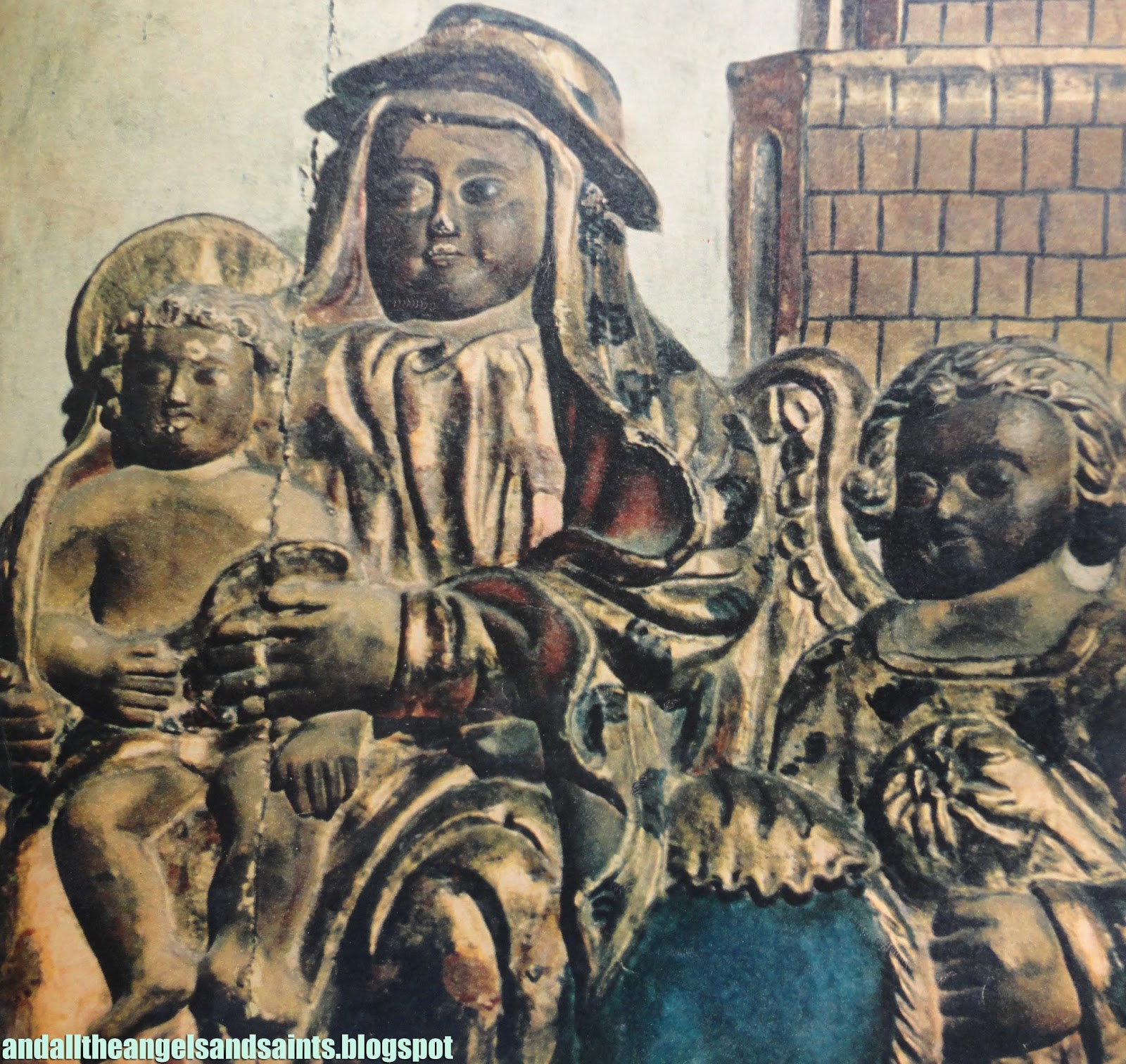
FOLK RELIEVE of the Virgin and Child Jesus, with angels in attendance.
Excerpted from a 1965 Sunday Times Magazine article 
by Rodolfo Y. Ragodon 

Exhibit of Religious Art in Cebu IV Centennial Festivities Traces Evolution of Filipino Christian Way of Life 
ANTONIO BANTUG, one of the early santo collectors in the Philippines.
The biggest collection of Philippine artifacts from primitive religious images to icon-like paintings and some of the best representatives of contemporary arts have been gathered this year in Cebu for exhibition in commemoration of the 4th centennial celebration of the Christianization of the islands.

A CONGREGATION OF FOLK NINOS

This collection of religious arts revolves around the Filipino way of life, its customs and mores; in other words, it traces the development of our Hispanic culture today from the time that our forefathers embraced the Christian way of life. These artifacts—many borrowed from private collectors and from the collections of the National Museum—are mostly wooden images that date back to as far back as the 17th century.

ECCE HOMO BUST, Bust of Christ, centuries-old.
The early images carved by Filipino artisans, though crude and primitive, are just as significant. The number of sculptured images which adorn the early churches in the country came from Mexico through the galleon trade.

A GROUPING OF PRIMITIVE SANTOS
The intricately carved images mostly come from Central Luzon, especially from the province of Pampanga. Some of these images were carved from hardwood like molave or kamagong. The zeal for collecting these age-old artifacts of religious images spread only after the war.

PROF. GALO OCAMPON Painter
National Museum Director, UST Professor
However, collectors like the Bantugs, the Pardo de Taveras and the Hidalgos were among the few Filipinos who took notice of Philippine arts during the Spanish period.

The flowering of the Filipino sculpture during the Spanish regime came in the 19th century.The factors that brought about the development include the natural skills of the native carvers, the presence of competent critics and the arrival of well-made images from Spain and Mexico.

Wednesday, May 11, 2016

250. 50 Years After: VIRGEN DE LOURDES of BARRIO TALANG, CANDABA

VIRGEN DE LOURDES, patroness of Brgy. Talang, Candaba,
as she appear today, and in 1966.

In 1966, the barrio of Talang, in Candaba, Pampanga was featured on the December 25 issue of Sunday Times Magazine, then the country’s most popular weekend magazine, in an article entitled “Christmas in Huklandia”.

THE OLD VISITA OR CHAPEL, in 1966.

 Back then, Talang was a remote and impoverished barrio of Candaba, where Huk dissidence marred the quest for peace and progress of this rural place. But though mired in poverty, the faith of the barrio people remained unshaken. All because of their devotion to their patroness that they kept in a ramshackle “visita” or chapel that stood in the middle of the small clearing: Virgen de Lourdes or Our Lady of Lourdes.

VIRGEN DE LOURDES and Lourdesenian Youth Group.

 The Virgen de Lourdes in 1966 was described thus, by the writer of the article: “It is not a well-sculptured, richly-garbed, bejeweled icon that lords it over the rough-hewn archaic facsimile of an altar here. Instead, the four-foot image of our Lady of Lourdes, seemingly embarassed by the provincial touches of imitation,gaudy adornment, hides within the principal niche above the altar. There are no tall candles on gleaming candlesticks, to light up her sad-eyed, benign features with, and the flowers,still to be picked from some garden plot by her devotees, are conspicuous by their absence on the two-tiered facade flanking her post.” 

The people of Talang have their own pressing needs, but during the Christmas season, they put priority to the needs of their patroness first. In the days leading to Christmas day, the barrio folks unite to go on fund-raising initiatives; for 1966, the objective was to raise money for the Virgen’s carroza. 

DANCING FOR ALMS, Talang barrio folks go from town
to town, to raise funds by dancing.

 The Lourdesenian youth groups would organize themselves into carolers and venture out of their barrio, carrying the image of the Virgen with them as they sing for alms. Adults, on the other hand, become itinerant dancers, going from town to town to dance for alms for their church’s patron. For them all, the days are rich in love and goodness and goodwill, even as violence rage menacingly along the periphery of their private lives.

THE CHAPEL, then and now.

There is a happy postscript to the story of the Lourdes Virgin and the barangay Talang, after fifty long years.

VIRGEN DE LOURDES CHAPEL INTERIOR.

The once-decrepit wooden visita is now a modern concrete structure—now known as Virgen de Lourdes Parish Chapel-- with a floor area, many times bigger than the old chapel, carved pews and stained glass windows. It was established in 1983 through the efforts of Fr. Nolasco Fernandez.

VIRGEN DE LOURDES, in the chapel that was built
in 1983. Photo: Dr. Raymund Feliciano.

Bright and well-lit, it features main retablo and lateral altars, the right side of which houses the original Lourdes image, the same revered icon that was featured in a magazine over five decades ago.

VIRGEN DE LOURDES, Photo: Dr. Raymund
Feliciano

Virgen de Lourdes even sports a new globe base, and a kneeling figure of the visionary St. Bernadette has also been added.

 As for Barrio Talang, it has indeed, moved forward. Thankfully, the Huk unrest that plagued Candaba and the barrio in the 60s has abated. Today, the barangay has its own own barangay hall, elementary and high schools and is dotted with many leisure farms that attract visitors from Pampanga and beyond, especially during their February fiesta days (Feb. 10-11).

OUR LADY OF LOURDES, pray for us.

 Resident devotees will always attribute their changing fortunes to the workings of Virgen de Lourdes; but undeniably, it is also the people’s resilience and unwavering faith in a time of hate and discord that has served them well, as the once-lowly barrio continues its strive for lasting peace and enduring progress.

 SOURCE: “Christmas in Huklandia”, Sunday Times Magazine, by Gloria Garchitorena Goloy, Photographed by Dominador Suba, 25 December 1966

PHOTO CREDITS: 

Virgen de Lourdes: Taken by Dr. Raymund Feliciano
Virgen de Lourdes Parish / https://commons.wikimedia.org/wiki/Category:Virgen_de_Lourdes_Parish_Church_(Talang,_Candaba,_Pampanga)

Monday, June 2, 2014

197. A RELIGIOUS RESTORATION IN PAINTING

The Sunday Times Magazine 
19 January 1964, pp. 24-25 


 A doctor wields his scalpel to restore life to an art that has been dead for many years from age and neglect. For the past two years, Dr. Gregorio G. Lim—a physician by profession and painter by avocation—has been collecting old Philippine santos (religious wood statuettes) of the 17th, 18th, and 19th-century vintage. Not very long ago, he started adding to his collection some religious paintings on wood panels which he salvaged from the heaps of statuettes in the shop of an art dealer.

At that time, very few collectors would have bothered about the paintings because the pictures were hardly recognizable and would have taken so much time and expense to clean and restore them. The avid an curious arrtist that he was (and still is), Dr. Lim did not allow himself to be fool or daunted by the deteriorated appearance of the paintings. With a good amount of patience and ingenuity, he believed that he could retouch the pictures back to their original looks.


 Dr. Lim’s interest, resourcefulness and imagination have paid off. Today, he has about a hundred of the wood-panel paintings in his collection—“veritable art treasures”, in the words of the doctor who considers them more colourful than the sculptured ones and certainly more fascinating because of the challenging task of restoration.

The problem of restoration is manifold. First, the old paints have become powdery so that they often peel off at the slightest touch. Second, the many years’accumulation of dirt and mud has almost become an integral part of the original paint. There, too, is the discovery of two or more pictures over the original painting; thus, the removal of these ‘’over paintings’’ taxesone’s knowledge of how paints behave after application. 

 Dr. Lim cautions those who would attempt to do the job of restoration to exercise utmost care. ‘’Many good paintings have been lost,’’ laments the doctor, ‘’because of careless or impatient hands’’.

 For an idea of how painstaking and time-consuming the work of restoration is, Dr. Lim describes in detail his first experience with a centuries-old painting. ‘’I came upon a badly painted-but clear picture on an old panel which nobody paid attention to, because it had no artistic quality. What attracted my attention were several small cracks in the paints. Peeling off a very small area, I discovered old paints underneath. I bought the panel and and did the scarping of the overlaid paints with a surgical knife. After carefully exposing the middle areas of the panel, I was surprised to see the outline of a face and neck partly hidden by a smaller second painting of the Madonna. The third and topmost painting was superficial so that it was easily scraped off. The second overlay, however, proved tough because it was very adherent to the original. The removal of this second picture taxed my patience. I did it meticulously, pinpoint by pinpoint, especially on the facial area. Then, with little retouchings, the masterpiece in its original form was uncovered.’’


Despite a busy daily schedule of preserving or restoring health to ailing bodies at the Blessed Heart Hospital where he is the director, Dr. Lim manages to find time for his restorative art in painting. His usual hours for his hobby are from four to six in the early morning and late at night when “I can no longer sleep after a medical call.’’

 Dr. Lim’s hobby is in itself a distinct contribution to the historical and cultural wealth of the country. His restored paintings have brought to light the fact that during the Spanish regime, many unknown—and most probably untutored—Filipino artisans displayed remarkable skill in their production of religious works which, in some cases, bore amazing resemblance to the style of classical masters.

 As for his own paintings, Dr. Lim’s works rank among the best in the country. He has won various awards in art competitions both here and abroad. These include first prize, APAA exhibit in Atlantic City; award of merit, 1955 in New York; second prize, 1958 exhibit, AAP, in Manila; and honourable mention, 1960 exhibit, AAP , Manila. Specializing in still-life, Dr. Lim, has had several one-exhibits sponsored by the AAP of which he was once president; from 1956 to 1958.


The 56-year old physician-painter is a 1935 graduate of the UP college of medicine with anatomy and surgery as his field of concentration. In 1955, he took advanced courses in general medicine at the University of Vienna, after which he practiced at the famous John Hopkins for two months. At present, he is president-elect for 1964 of the Philippine Academy of General Practice, secretary of the Philippine Medical center and member of the Juan Luna Centennial Commission.

 The skill and dedication that Dr. Lim has shown in his profession he has brought to bear on his avocation render in symbolic form the saying that life and art are one and indivisible.

Saturday, February 26, 2011

53, Cebuano Sculptor gains STATURE FROM HIS STATUES

The Sunday Times Magazine, January 9, 1966

By D. M. Estabaya

Fidel Araneta and Flash Elorde have many things in common. Both are from the town of Bogo, Cebu. As youngsters, they were so poor they ran away from home and staked out a living in Cebu City. And both packed talent in their hands: Flash with his boxing gloves and Fidel with his carving knife.

Sculptor Araneta hacks away at the wooden image of the “Sleepy Santo Niño”. The piece evoked praise during the centennial exhibit in Cebu last April. Many ordered copies.

Today, at 51, Fidel Araneta is easily the top-ranking commercial sculptor of Cebu City. His sculptural works are found everywhere in the Visayas and Mindanao. His patrons are mostly priests, secular and missionary, from as far away as Jolo. He has lost count of the munipalities in the South which have placed orders for statues from him.

Sculptor Araneta is a product of the U.P. School of Fine Arts. In school, he was a medalist every year. However, his family was so poor he had to quit school for good in his senior year.

As a child, Fidel never tired of shaping miniature objects from adobe clay, called ‘manggol’ in Cebu. He made fishes, elephants, lions—and whatever else his young, imaginative mind took a fancy to.

In grade school, he had a never-ending fascination of the portrait of Rizal. He used to take along a lump of ‘manggol’ to class and shape it into a bust of Rizal. He became so proficient with the face of the hero, that upon graduation from elementary school, he was able to give the principal a miniature bust of Rizal. For years, it adorned the cabinet of the principal’s office.

In the Cebu High School, Fidel turned up the undisputed artist (he’s also good at pen-and-ink sketches). The American principal suggested that his father send him to Manila for an art education. Upon Araneta’s return to Cebu City shortly before the War, he opened a sculptural shop of his own. Shortly after, he became known as Cebu’s most outstanding sculptor.

In Cebu today, it is likely that the religious or civic statue you point to with admiration is Fidel Araneta job. Even in Mindana provinces, his sculptural works are everywhere. During the Rizal Centennial in 1961, he could hardly cope with orders for Rizal statues for public plazas. The Dapitan City Knights of Rizal commissioned him t do a life-size concrete statue of the hero for the public plaza. Araneta’s work is the best to rise in the historic Rizal place of Mindanao.


However, it is in the field of religious sculptural renditions that the Cebu artist makes his living. It is the rule, rather than the exception, that the altars and altar objects in Cebu’s 49 towns and four cities are Araneta creations. Araneta’s statues of saints come out in wood, plaster of paris and concrete. Recently, an Italian priest ordered from him a cubistic Madonna and Child. His Christ on the Cross in the posh Redemptorist Church of Cebu Cityis regarde by many as his masterpiece.

A religious man (he has a son studying for the priesthood in Canlubang and is himself a 4th degree K of C),he puts up a large elen, or crèche, ever Christmas season with the help of his wife. The objects are his works.

In the 50s, Araneta used to submit entries for the national sculptural tilt held yearly in Manila. His wooden bust of then U.S. President Eisenhower in 1953 won first prize. The Cebu artist likewise won a major prize for his bust of former President Osmeña. He donated several busts of great Filipinos to the national museum.

In 1961, he did a wooden bust of President Kennedy for a client n Manila. Early in 1963, the owner complained to the artist that a fissure or crack appeared on the temple of the bust. A few days later, JFK was shot dead on the same spot. A newspaper played up a big photo of the bust’s phenomenal damage.

Young hopefuls consider it a privilege to work under Araneta. A former Araneta apprentice, Napoleon Abueva, is a famous sculptor now. (Recently, Abueva visited his art mentor).

During the 4th centennial fete of Christianity in Cebu this year, the sculptor and his eight assistants had to work day and night to meet orders. Moreover, Araneta was tapped to put up an art work for the national art exhibits at the Cebu Normal School in connection with the centennial celebration.


His rough-hewn piece evoked the lavish admiration of art lovers. It was a wooden Santo Niño in an unorthodox stance: reclining wearily on an oversized orb. (The sculptor titled it, “The Sleepy Santo Niño after 400 Years”). Many centennial visitors ordered copies.

Also during the Centennial Week, the Papal Legate, Ildebrando Cardinal Antoniutti, unveiled an oversized statue of Lapulapu at Camp Lapulapu, Lahug, for the Third Military Area Command. It was a work Fidel Araneta did upon the specifications of the Commanding Brig. General Silvino R. de Goma who made researches on the Mactan hero.

People in Cebu City today are saying the likeness is “closest” to the real-life Lapulapu. The Cebu City government supported the project and the unveiling was done last April 27, the 444th anniversary of the Battle of Mactan.