By Nick Joaquin
Philippine Quarterly, Vol. II No. 1—October-December 1961. p. 1-2.
(Nick Joaquin was a Rockefeller Foundation fellow in 1954. He won the Eugene Saxon Memorial Fellowship in 1955, the Palanca Prize in 1957, the Stonehill Award in 1958 and recently, the Republic Heritage Award. Many of his stories evoke the Manila of olden days. The feast of La Naval described here celebrates the victory over the Dutch armada which invaded the Philippines in 1646.)

The festivities began on the Saturday before the first Sunday of October. One went to Sto. Domingo to find the great image of the Virgin transferred from the Lady’s Chapel to the main altar and arrayed in gold robes and jewels.

In the afternoon, the novena began. The music of Santo Domingo was famous; the monastery had a fine boys’ choir and eminent friar musicians; and the novena of the Rosary was, in effect, a series of 9 superb sacred concerts. One heard polyphonic renditions of the Litany of the Virgin, old Castilian motets and, every evening, a different Salve, a different Tantum Ergo, sung to organ and orchestra. But the ceremonies always ended with the Despedida, the lovely hymn of farewell so associated with this feast. As the tiples went into the haunting closing phrases of the Despedida, a descending curtain slowly hid the radiant image of the Virgin, the bells rang.
Outside, in the patio, a band played, people clustered around the feria stalls to buy lanzones and roasted chestnuts, the internos from Letran and internas from Santa Rosa romped through the crowd, squealing with delight at the prospect of 9 nights with no study periods after supper.

On the morning of the 1st Sunday of October, before the high mass, the image of the Virgin was borne in procession from the Plaza de Santo Tomas to the patio of Santo Domingo. The morning procession commemorated the Battle of Lepanto in 1571, when Christian forces crushed the last attempt of Islam to conquer Europe. From this victory arose the Feast of the Rosary.

From a side portal of Santo Domingo emerged the carrozas of St. Pius V, the Pope of Lepanto and of St. Dominic. Then, though a cloud of incense, appeared the Santo Rosario, the most splendid image of the Virgin in the Philippines. (The image was carved in 1612 by a pagan Chinese sculptor who later embraced Christianity.) Down the street, past the Colegio de Santa Rosa, rode the Virgin, the crowds on the sidewalks falling to their knees as this image that had been the palladium of the city for three centuries passed by, in a rainbow of precious stones. (The gem of the Virgin’s brow, was, according to legend, wrested from a serpent.)

Into the patio flowed the procession, the bells pealing as the Santo Rosario entered the gothic portals of Santo Domingo, the lit chandeliers now illuminating the crown of the Virgin wrought of gold and jewels that had come as offerings from all over the country for the Virgin’s coronation in the early 1900s. (The Santo Rosario was the first image of the Virgin in the Philippines to be crowned canonically.) At the altar waited the Archbishop of Manila, or the Apostolic Delegate, to celebrate the mass of the victory of Lepanto, the victory in which Cervantes lost an arm.

During the first week of October, all Manila gathered, morning and evening, at the Dominicans, and Manila houses filled with visitors from the provinces who had come to attend the novena of the Santo Rosario but would stay the whole month, for after the Naval came the fiestas of Sta. Cruz and Binondo, once the city’s gayest celebrations. What Manileño can forget the old-time merriment of October in Manila?

The novena of the Santo Rosario ended on the second Sunday of October with the Feast of the Naval. This is one church feast special to the Philippines; it began in 1646, when a might Dutch armada sought to invade Manila but was routed in a series of 5 naval battles (from March 15 to October 3) by 2 decrepit galleons, the city’s only defenders. The victories were attributed to the Santo Rosario, to whose shrine at Santo Domingo the crews of the galleons had vowed to go on pilgrimage if they would triumph over the Dutch. Manila was saved; and the returning victors fulfilled their vow, marching barefooted from the gates of the city to the shrine of the Virgin. That was the 1st Naval procession, on an October day in 1646.

Six years later, the cathedral chapter of Manila decreed that the 5 victories of 1646 were “miracles vouchsafed by the Divine Majesty of God through the intercession of the Blessed Virgin, Our Lady, and the devotion to her Holy Rosary”. For four centuries now, Manileños have annually been reenacting the fulfillment of a vow made in 1646, when their city was saved through a small naval triumph that has become, for them, as magnificent and memorable as the victory of Lepanto.

On the afternoon of the Dia de La Naval, all roads led to Intramuros for the “procession of processions”, and a multitude lined the traditional route: from the Plaza de Santo Tomas to Plaza McKinley to Arzobispo to the faded grandeur of Calle Real. Above would be the wild dark skies of October, but the streets of Intramuros would be ablaze with light as, once again, across the ancient cobbles, moved the city’s ancient Queen, symbol of the traditions that once welded Manileñans into one.

Manila lost unity when Intramuros perished, and old palladium was borne away to another shrine, far from the city’s gates. The Feast of the Naval has not died, but much of its old glamour has vanished, now that one must go to Quezon City instead of Intramuros. The feast and the setting were one; they should never have been separated And October in Manila has ceased to be magical now that Intramuros and Sta. Cruz and Binondo have decayed into mongrel communities, without a common memory, a common tradition.

But one can still get an idea of what the Naval used to be. Two years ago, the Dominicans finally released all the old beloved images that used to accompany the Santo Rosario in the Naval processions in Intramuros. One can see them again now, in procession, in Quezon City, on the Day of the Naval---St. Vincent Ferrer with his wings, St. Thomas with his sun, St. Catherine of Sienna with her lilies, St. Dominic with his dog. Only one, the most dramatic of the images perished in the war: that of St. Peter Martyr, the image that provoked the most curiosity among the children, because St. Peter Martyr had a bolo through his head.

Now “exiles”, like Santo Rosario, in Quezon City, these lares and penates of the old Manila again emerge in October, after a long absence, to provoke wonder and nostalgia, on the feast called La Naval de Manila.


 The festivities began on the Saturday before the first Sunday of October. One went to Sto. Domingo to find the great image of the Virgin transferred from the Lady’s Chapel to the main altar and arrayed in gold robes and jewels.
 In the afternoon, the novena began. The music of Santo Domingo was famous; the monastery had a fine boys’ choir and eminent friar musicians; and the novena of the Rosary was, in effect, a series of 9 superb sacred concerts. One heard polyphonic renditions of the Litany of the Virgin, old Castilian motets and, every evening, a different Salve, a different Tantum Ergo, sung to organ and orchestra. But the ceremonies always ended with the Despedida, the lovely hymn of farewell so associated with this feast. As the tiples went into the haunting closing phrases of the Despedida, a descending curtain slowly hid the radiant image of the Virgin, the bells rang.
 On the morning of the 1st Sunday of October, before the high mass, the image of the Virgin was borne in procession from the Plaza de Santo Tomas to the patio of Santo Domingo. The morning procession commemorated the Battle of Lepanto in 1571, when Christian forces crushed the last attempt of Islam to conquer Europe. From this victory arose the Feast of the Rosary.
 From a side portal of Santo Domingo emerged the carrozas of St. Pius V, the Pope of Lepanto and of St. Dominic. Then, though a cloud of incense, appeared the Santo Rosario, the most splendid image of the Virgin in the Philippines. (The image was carved in 1612 by a pagan Chinese sculptor who later embraced Christianity.) Down the street, past the Colegio de Santa Rosa, rode the Virgin, the crowds on the sidewalks falling to their knees as this image that had been the palladium of the city for three centuries passed by, in a rainbow of precious stones. (The gem of the Virgin’s brow, was, according to legend, wrested from a serpent.)
 Into the patio flowed the procession, the bells pealing as the Santo Rosario entered the gothic portals of Santo Domingo, the lit chandeliers now illuminating the crown of the Virgin wrought of gold and jewels that had come as offerings from all over the country for the Virgin’s coronation in the early 1900s. (The Santo Rosario was the first image of the Virgin in the Philippines to be crowned canonically.) At the altar waited the Archbishop of Manila, or the Apostolic Delegate, to celebrate the mass of the victory of Lepanto, the victory in which Cervantes lost an arm.
 During the first week of October, all Manila gathered, morning and evening, at the Dominicans, and Manila houses filled with visitors from the provinces who had come to attend the novena of the Santo Rosario but would stay the whole month, for after the Naval came the fiestas of Sta. Cruz and Binondo, once the city’s gayest celebrations. What Manileño can forget the old-time merriment of October in Manila?
 The novena of the Santo Rosario ended on the second Sunday of October with the Feast of the Naval. This is one church feast special to the Philippines; it began in 1646, when a might Dutch armada sought to invade Manila but was routed in a series of 5 naval battles (from March 15 to October 3) by 2 decrepit galleons, the city’s only defenders. The victories were attributed to the Santo Rosario, to whose shrine at Santo Domingo the crews of the galleons had vowed to go on pilgrimage if they would triumph over the Dutch. Manila was saved; and the returning victors fulfilled their vow, marching barefooted from the gates of the city to the shrine of the Virgin. That was the 1st Naval procession, on an October day in 1646.
 Six years later, the cathedral chapter of Manila decreed that the 5 victories of 1646 were “miracles vouchsafed by the Divine Majesty of God through the intercession of the Blessed Virgin, Our Lady, and the devotion to her Holy Rosary”. For four centuries now, Manileños have annually been reenacting the fulfillment of a vow made in 1646, when their city was saved through a small naval triumph that has become, for them, as magnificent and memorable as the victory of Lepanto.
 On the afternoon of the Dia de La Naval, all roads led to Intramuros for the “procession of processions”, and a multitude lined the traditional route: from the Plaza de Santo Tomas to Plaza McKinley to Arzobispo to the faded grandeur of Calle Real. Above would be the wild dark skies of October, but the streets of Intramuros would be ablaze with light as, once again, across the ancient cobbles, moved the city’s ancient Queen, symbol of the traditions that once welded Manileñans into one.
 Manila lost unity when Intramuros perished, and old palladium was borne away to another shrine, far from the city’s gates. The Feast of the Naval has not died, but much of its old glamour has vanished, now that one must go to Quezon City instead of Intramuros. The feast and the setting were one; they should never have been separated And October in Manila has ceased to be magical now that Intramuros and Sta. Cruz and Binondo have decayed into mongrel communities, without a common memory, a common tradition.
 But one can still get an idea of what the Naval used to be. Two years ago, the Dominicans finally released all the old beloved images that used to accompany the Santo Rosario in the Naval processions in Intramuros. One can see them again now, in procession, in Quezon City, on the Day of the Naval---St. Vincent Ferrer with his wings, St. Thomas with his sun, St. Catherine of Sienna with her lilies, St. Dominic with his dog. Only one, the most dramatic of the images perished in the war: that of St. Peter Martyr, the image that provoked the most curiosity among the children, because St. Peter Martyr had a bolo through his head.
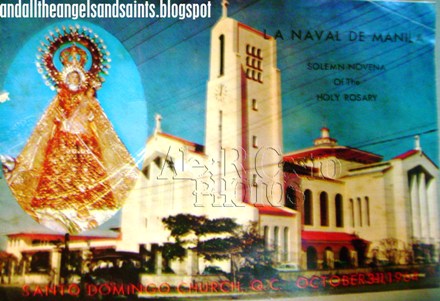 Now “exiles”, like Santo Rosario, in Quezon City, these lares and penates of the old Manila again emerge in October, after a long absence, to provoke wonder and nostalgia, on the feast called La Naval de Manila.