Showing posts with label Bohol. Show all posts

Tuesday, November 23, 2021

344. A NIÑO DORMIDO FROM BOHOL FINDS A NEW HOME

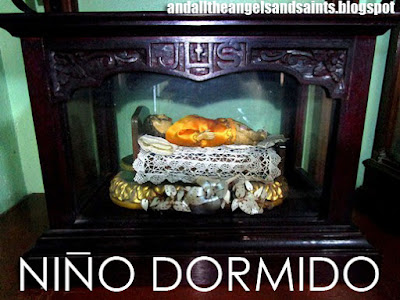
THE SLEEPING CHRIST CHILD, personal collection

The image of the sleeping Jesus in sacred art is drawn from His birth in Bethlehem, where He was born in a manger and wrapped in swaddling clothes. It was St. Francis of Assisi, of course, who perpetualized that depiction when he put up a manger in a church.

NINO DORMIDO, from the Francisco Vecin Collection

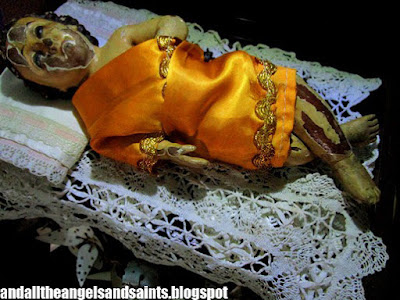
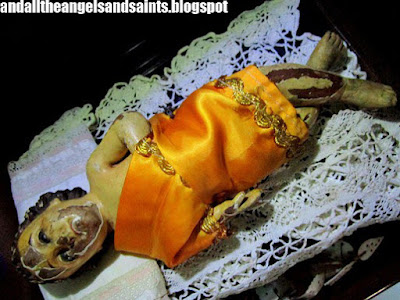
NINO DORMIDO, on a repurposed doll's toy bed.

The sleeping Christ Child has been the subject of many artists through the centuries, often represented naked, consistently shown with eyes closed or half-closed, with charming poses—tiny finger in His mouth or pointing to His head,  a Hand raised in blessing,  cheek resting on a palm, with straight, bent and crossed legs. In painting and sculpture art, the sleeping baby is shown in different settings---lying on a manger, on a pastoral landscape, on a flaming heart, or adored by the Blessed Mother,

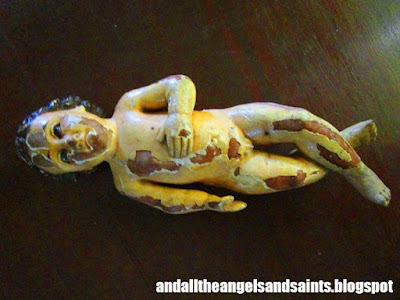
NINO DORMIDO, note the unusual crossed legs.

The hole on the back was where a stick was placed to
support the Nino Dormido while painting.

The most prized sleeping baby Jesus are made of ivory, known as “Niño Dormido”,  which today, are so precious, that they command astronomical prices in auctions, that is, if you can find one. Generally, Niño Dormidos of ivory, come in small sizes for home devotion—with average sizes ranging from 6 to 8 inches. The images are commonly displayed nude to show off the ivory, but many are dressed in gold-embroidered raiments, complete with gold or silver caps, belts and sandals studded with gems.

NINO DORMIDO, Provenance: Bohol

As equally appealing are the locally-carved wooden Niño Dormidos. Though not as expensive as ivories, these antique wooden figures of the Christ Child are much rarer to find, as the traditional Sto. Niño had a more popular following.

The Nino Dormido has its original (but flaking) encarna

This wooden Niño Dormido is one such fine example of religious folk art. It comes from the Francisco Vecin Collection, who owns many of these miniature wooden examples. It is carved from heavy wood, just a little over 7 inches, and is Bohol-made, with its original (now flaking) encarna. I acquired this from him sometime in 2006, when I was still working in Makati, and I was pleasantly surprised that Mr. Vecin let it go.

A CLOSE UP VIEW, reveals open glass eyes.

This Niño Dormido is outstanding in every respect, classically carved with baby features, curly locks, and a plumpish body. Though small, his thick droopy eyelids are outfitted with glass eyes, making him look more awake than sleepy.  This Dormido is one of those rarer versions that show the Baby with crossed legs, as if to foreshadow his Crucifixion.

I decided to keep this Niño Dormido in its “as found” condition, and tried to look for an appropriate bed for it. For years, it laid on a vintage 4-poster toy wooden bed that was too short for him, and encased in an urna that I had asked a furniture shop to make, patterned after an old one.

The Nino sleeps on a piece of antique European lace,

It was only lately that I found another vintage toy bed of the right size ( but with more modern features, alas!). I covered the bed up up with antique laces, and made a flat pillow, and propped it on a new peaña that I no longer use—so that will do for the moment. The final touch is the addition of a spray of wired “lagang” flowers, hoping that it will add to the antique look that I wanted to recreate.

The Sleeping Christ Child is represented in many art forms.

It may not be authentic, but at least this Niño Dormido from Bohol has a new and better home. In the future, I will probably have a new “resting place” made, although I have not figured out if it’s going to be a daybed, a manger, a 4-poster (definitely, not a sofa!).

The Nino's bed rests on a vintage gilded peana,

And what do you think of the idea of having a silver cap and a belt? Well, let me see.. I will sleep over it!.

Thursday, June 28, 2018

316. THE BOHOL CHURCH MURALS


By Mary Marshall
Originally published  in Archipelago, The International Magazine of the Philippines, 1978-VI A-48. Pp. 24-26.

The church of Loboc in Bohol was built in 1602, paintings and ceilings were restored in 1927.

 Bohol island is probably  most well-known in the Philippines for its strange, humpy Chocolate Hills and its startled, saucer-eyed tarsiers. Its mefolk too have something of a reputation. Bohol’s heroes include fierce datus such as Warai Tupueng and Sikatuna (famous for his blood compact with the conquistador Legaspi), Tamblot the apostate pries, and Dagoho the outlaw and priest-killer. Not a breed to be trifled with. Nor a region where one would expect to find the flowering of Christian folk art. Nevertheless, some of the most remarkable churches in the Philippines are found in Bohol, and some of the oldest.

Baclayon. The most ancient, was built by its parishioners in 1595 to the design of Spanish priests, Juan de Torres and  Gabriel Sanchez, members of the first Jesuit mission sent to the Philippines, in 1581. Typically, it is a massive construction made from limestone blocks hewn from the quarries of Baclayon and neighboring Albuquerque. It stands confronting the sea, its massive  three-storey tower with splayed base resembling a fortress is not fortuitous. The belfry served as a citadel in which parishioners could huddle for protection when Moro pirates made one of their lightning salving raids during the seventeenth and eighteenth centuries.

The seven sacraments which correspond to the seven ages of man are also depicted in the ceiling murals.

Harassed by Moro pirates from the seas and unbelievers from the hills, Chrstian missionaries had limited success in Bohol. The initial impact of the Jesuit missions was confined to the coastal areas around Baclayon, Loboc and Dauis. Even then, it seems to have been superficial as far as most impressionable Boholanos were concerned.

In 1621,a native priest, Tamblot, incited the lowland converts to abandon the new religion. Only Lobic and Baclayon held firm in the new faith.Elsewhere, the renegades burnt villages and churches and built temples to the old gods. In 1774, another, more serious rebellion broke out. When a Spanish priest refused to give Catholic burial to a Boholano killed in a duel, the dead man’s brother Francisco Dagohoy killed he priest and formed an outlaw band in the hills. Many malcontents and rebels against Spanish rule joined him and the revolt lasted nearly 100 years.


Despite the constant challenges to Christianity to Bohol and throughout typhoons and earthquakes, the great churches of Baclayon and Loboc survived. Other damaged churches were laboriously rebuilt or repaired (Loboc in 1855 for instance, and Dauis in 1883). Today, the churches of Albuquerque, Loboc, Loon and Dauis house some remarkable ceiling morals which seem to have been first painted around the middle or later half of the last century.

Many of the murals portray scenes from the life of Christ, his mother and various saints, with San Roque and the Santo Niño especially popular subjects. Sometimes, special themes are followed, such as the Resurrection and the Ascension, or the Childhood of Christ. Sometimes, “musical” paintings are carefully selected for the rear of the church near the choir gallery. We see King David playing the harp, or an angelic trio of violinist, harpist, and flautist, with a ladylike accompanist at the piano.


In Albuquerque and Loon, , the murals include a delightful and unusual series of tableaux on the theme of the Seven Ages of Man. The various scenes illustrate events of religious significance in man’s life, from birth through baptism, first communion and confession, marriage, last rites and funeral mass.

The Ages of Man murals have great appeal. The turn of the century middle-class costumes have an evocative period flavor. In the Loon paintings, the artist allows himself some wry humor: in the scene of the first confession, a horned devil lies in wait outside the confessional for a girl who clearly has been no better than she should be.

In November 1876, the river of Loboc overflowed and flooded the town to the level of the feet of the Virgin painted on the altar reredos. The townspeople implored the help of Our Lady and her intervention in stopping the flood is commemorated with ceiling paintings.

The paintings in Loboc have very local reference. In November 1876, the waters of the river Loboc, across the street from the church, rose during a severe typhoon to the level of the feet of the Virgin of the church, in the reredos above the altar. At this pint, the flood waters were stayed and gradually receded. The miracle, attributed to the Virgin, is recalled in two of the  ceiling paintings, one a Filipino version of the biblical flood with dramatically tumbling nipa huts.

The Bohol mural painters make no claim to be Michelangelo, but their rk has vigor and sincerity hich endows their church interiors with a warmth and life missinh from many more austerely or conventionally modernized Spanish churches elsewehere. For one travel-strained visitor least, their discovery was truly a serendipity.

Sunday, October 21, 2012

127. Visualizing Sanctity: SAN PEDRO CALUNGSOD by Thom Joven

The country is thrilled to see the courageous teen "beato" raised to the rank of a saint--San Pedro Calungsod--only the second Filipino saint after San Lorenzo Ruiz. San Pedro Calungsod (b.1654 – d. 2 April 1672) was  a young sacristan who worked alongside San Diego Luis de San Vitores and who was martyred  in Guam for preaching Christianity to the Chamorros through catechism.

Beatified on 5 March 2000 by Blessed Pope John Paul II, Calungsod was  canonized by Pope Benedict XVI at Saint Peter's Basilica in Vatican City on 21 October 2012 together with 6 others: Jacques Berthieu, a Jesuit martyr-priest ,Giovanni Battista Piamarta, founder of the Congregation of the Holy Family of Nazareth, Maria Carmen Sallés, founder of the Conceptionists Missionary Sisters of Education; Marianne Cope, a religious who worked among lepers, Kateri Tekakwitha, the first Native American Saint and Anna Shaffer from Germany.
San Pedro Calungsod's most well-known representation is based on a portrait modelled by then 17 year old Ronald Tubid, a basketball player from Iloilo. This same portrait became the basis for artist Rafael del Casal's artwork done in 1999 that was used as the official picture for the canonization rites in Rome. Del Casal's portrait is the first to feature a Christogram, the seal of the Society of Jesus with which San Pedro was associated. Sculptors Francisco dela Victoria and Vicente Gulane (Cebu), Felix Baldemor and Justino Cagayat Jr. ( Paete, Laguna), also created statues of Calungsod in 1997,1999 and 2012, respectively. Most images show the saint wearing a white camisa and trousers, with his characteristic palm, a rosary,a crucifix or a Doctrina Christiana book pressed to his breast.
Pampanga's most accomplished ecclesiatical artist, Thom Joven of Bacolor has also been commissioned by Bishop Angel Lagdameo of Iloilo to execute his santo version of the teen martyr, following his approved iconography. Made by a local carver under his stringent supervision and personally painted using traditional encarnacion technique, San Pedro Calungsod stands all of four feet and bears a strikingly young, lifelike and saintly mien. He pensively looks at an open book of Christian doctrine, with another hand holding a palm branch in brass--his official attributes.

It is impeccable in its simplicity, and appropriately so, for the saint lived a life of austerity and hardship while catechizing in the Marianas. Just like San Lorenzo Ruiz, he is similarly attired in a camisa chino-daily wear for most Filipinos-and a pair of loose, hanging pants. Carved in the round, he is shown unshod, unlike other representations where the saint wears sandals.
Thom Joven is well-known in the santo circle as a leading figure in saving and restoring the altars, niches and wooden saints of San Guillermo Church in Bacolor, heavily damaged by the Pinatubo aftermath. He has likewise worked on the San Vicente de Zaragoza Church, also in his hometown. His prized works and restorations are in private collections and have even reached the Vatican--an image of of Nuestra Sra. de Guia, was chosen by then Pres. GMA and given to  Pope Benedict XVI as a "Gift from the Filipino People". His interpretation of the likeness of San Pedro Calungsod is indeed, a most apt artistic tribute to one who now belongs to the pantheon of saints of the Catholic Church.
FEAST DAY: Celebrated every 2nd day of April, the anniversary of his martyrdom. If the date falls within Holy Week or Easter Week, the feast is observed on the Saturday that immediately precedes Passion/Palm Sunday. If April 2 falls on a Sunday of Lent or on a Sunday of Easter, the feast is celebrated on April 1.

PRAYER:
Blessed Pedro Calungsod, young migrant, student, catechist, missionary, faithful, friend, and martyr, you inspire us by your fidelity in time of trial and adversity, by your courage in teaching the Faith in the midst of hostility and by your love in shedding your life’s blood for the sake of the Gospel of Jesus. 

We beg you, make our cares and troubles your own [here mention the special intention you are asking him to bring to the Lord] and intercede for us before the throne of Mercy and Grace, so that as we experience the help of Heaven, we may be encouraged and strengthened to proclaim and live the Gospel here on earth. AMEN. 

 (Imprimatur: Ricardo Cardinal J. Vidal) 

(ALL PHOTOS USED WITH PERMISSION, COURTESY OF MR. THOM JOVEN).

Wednesday, June 13, 2012

112. BEFORE STRANGE ALTARS


When devotional santos found their way into Philippine homes, they had their own special places atop mesa altars--altar tables--which became a standard piece of furniture in the homes of Filipino Catholic families. Further reverence was accorded these santos by putting them inside home altars--locally called urnas--not only to protect them, but also to mimic the church altars with beautifully designed retablos and nichos to house these religious figures.


Folk artisans crafted wooden altars such as these examples from different periods and imbued with distinctive styles. The first two examples above are from the Visayan region, similarly made with a sunburst topper, columns, legs and signature flanges (palikpik) with cut-out decorations. The urnas are crudely carved but brightly painted in contrasting colors. Such primitive altars were made from remnant wood pieces, including wood crate packaging that are sometimes imprinted with the brand name of the product.


Other common altar designs are these urnas with leafy, sinuous floral frontals, carved in low relief.  The characteristic rounded opening, and the simple rectangular base are consistent features of these urna types.


The niches are outfitted with glass-panelled doors, but a lot of these urna types are available in the market sans their doors.


The province of Bohol is known for its very distinctive 19th c. urnas that are easily recognizable by their vivid polychromed colors and their simple structure, with parts put together by pegs and joints. Each piece is carved in low relief, with floral and vegetal motifs concentrated on the two side panels anchored with columns, the topperboard and the base.


The removable base is multi-tiered, usually showing 3 gradas (levels). Detached bases with missing altars are often sold separately and are used by collectors for other decorative purposes.


I have seen a lot of these boxy urnas in northern Luzon, and they are a common sight in Manila antique shops. The above example is almost complete, except for a missing glass-panelled door. Note the serpentine-like decorative panels on both sides of the altar and the four columns that support the structure. The figures of Jose, Maria and Jesus are directly pegged onto the floor of the urna. The altar legs end in stylized 'clawfoot' forms.


An incomplete example of the same style is shown above, featuring a Madonna and Child. The decorative side panels and the door are missing, as these pieces were often just joined to the altar body using pegs and short nails and are thus, easily damaged or lost.


The urna of San Vicente Ferrer is also of the same type as the previous two. Note the serrated edges of the door, which has lost its glass panel, a common treatment artisans used in fashioning these folk altars. The roof is also missing--which may have been made of wood or tin.


From Bohol comes this more sophisticated urna, elaborated with oversized finials, the 'eye of God" topper, carved side trims and turned Greek-inspired columns. There are floral appliques on the top and base of the altar structure. The floor of the urna is trapezoidal in shape, giving it a more expansive look.


This next example is a finely crafted urna done in the neoclassic style and executed in heavy dark wood. The roof is glass-panelled, like the body. Lean Corinthian columns hold up the roof, supported by carved, gold-leafed brackets on the base. This must have housed an exquisite ivory santo.


From the 30s down to the 60s, commercial religious statuary shops offered these box-type wooden altars that were simply varnished and carved with decorative details such as Christ's or the Virgin's monograms, gothic design motifs, crosses. These streamlined, glass-panelled urnas were mass-produced, so one sometimes find the same design executed in different-sized versions.


Carved along gothic lines, such urnas feature pointed arches topped by crosses and trefoil forms. Many of these sturdy examples have survived today and  chances are, you'll find one or two in the current stocks of downtown Manila antique shops. Whether primitively-carved or commercially-crafted, these home altars represent not only the reverence of the people who bought them for their treasured santos, but also the skill, artistry and creativity of the Filipino artisans who lovingly made them.

Wednesday, September 28, 2011

83. BELL-SHAPED VIRGIN SANTOS

A selection of century-old Virgins carved with massive, bell-shaped bodies typical of those made in the province of Bohol, Philippines. Mostly primitive in style, the santos came in many varieties--all-wood or with small ivory heads and hands, polychromed--but all with the trademark bell-shaped bodies often carved from dense, heavy wood.

INMACULADA CONCEPCION. Ivory head and hands (now missing), polychromed, with carved base featuring cherubs. The santo used to wear a wig.

INMACULADA CONCEPCION. Ivory head Virgin with beautifully carved vestments trimmed with relief carvings to simulate drapes, decorated hems and sleeves. Intricate floraln patterns are painted on the body. Low relief angel carvings decorate the base.
VIRGEN Y NINO JESUS. A stocky Madonna and Child, craved in the round and borne aloft by a bevy of angels.
INMACULADA CONCEPCION. A primitive representation of the Immaculate Conception with chubby cheeks and heavy, sloping shoulders on a horned base.
A TRIO OF BELL-SHAPED VIRGINS. Primitively carved from heavy wood, set with bone and ivory heads. The three are similarly carved with praying hands, gently spreading bell bodies with bases decorated with low-relief winged angel heads. The polychromed bodies and bases are carved from one piece of wood.

(Photos from The Catholic Digest, c. 1964)