Showing posts with label Salubong. Show all posts

Saturday, April 15, 2017

291. A SELECTION OF RESURRECCIONS

RESURRECCION. Photo courtesy of Mr. Leo Cloma

 Holy Week in the Philippines culminate in the pre-dawn Easter rite called “Salubong”—a pageant that dramatizes the reunion of the Risen Christ with His Blessed Mother. The religious figures are separately borne on andas or on carrozas, followed by a segregated crowd (men follow the Jesus icon, women, that of Mary) and the two processions converge together, resulting in the meeting of Mother and Son.

PHOTO: JEJOMAR ROBERTO

YAPTINCHAY-GANA Family.
PHOTO: MARK POTENCIANO

Photo courtesy of Dr. Raymund Feliciano

One of the highlight is the undraping of the Virgin’s black mourning veil by an “angel”—performed by a chosen young girl dressed with angel wings. The Virgin is then called the Nuestra Señora de Alegria ("Our Lady of Joy"), and the joyous rites are capped with a shower of flowers from other participating angels.

DYCHITAN FAMILY, from 1903.
Photo courtesy of Jerry Punzalan Sagmit

Photo courtesy of Jvlian P. Liongson

Photo courtesy of Dr. Raymund Feliciano

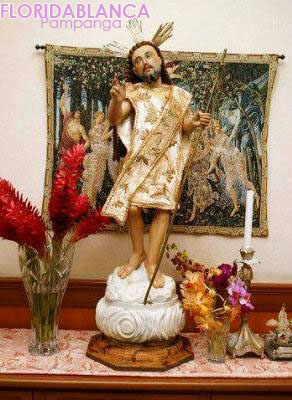
 The figure of the Risen Christ, on the other hand, is also called Cristo ng Muling Pagkabuhay or Resurrecion. He wears a loincloth, sometimes with a cape or a sash, and holds his standard in His left hand and His right hand, raised in benediction.

Photo courtesy of Jose Talapagobra FB page.

Photo by Alex R. Castro

Photo courtesy of Dr. Raymund Feliciano

On Christ's head are tres potencias, symbol of His faculties. He stands on a cloud base, fancifully called "ensaymada" base, especially the antique ones, for the resemblance to the swirly pastry.

Photo courtesy of Mr. Leo Cloma

Photo courtesy of Mr. Jejomar Roberto

Photo by Yuu Miyamoto FB page

Traditionally, the images of the Risen Christ are small—antique ones seem to have a standard size of 39 inches. That’s because Christ is meant to be shoulder-borne on a wooden platform, which can be maneuvered easily to move back and forth, or to lean—so that the Christ figure can be made to appear like it is animated, leaning or nodding when it meets the statue of Mary. 


Photo from Nuestra Senora de Loreto picssr page.

Photo courtesy of El Rey-Guapo FB page.

Photo courtesy of Mr. Leo Cloma

The Risen Christ is then enshrined in the altar for the Easter Mass to remind us all of the doctrine of Christ's resurrection and of the reward of life after death.

Photo courtesy of Romain Garry Evangelista

Photo courtesy of Dr. Raymund Feliciano

Resurreccion of Villa Escudero

 On this pages are images of the Resurreccion, from different towns and provinces, many still used for the festive Salubong easter rites.

Friday, July 1, 2016

257. Guagua's Dolorous Virgins III: THE LIMSON DOLOROSA (SOLEDAD)

LIMSON DOLOROSA (SOLEDAD)
Photo: Budhi, From Guagua to Quiapo by Jose Ma. Zaragoza.

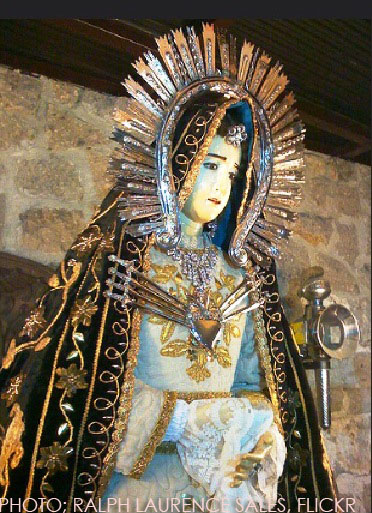
 Hailed as one of the most beautiful Dolorosas in the country, the antique ivory Dolorosa of the Limson Family of Guagua is an iconic Lenten image of the town, spoken with the same awe and reverence as the Sto. Sepulcro of the Infante-Velez Family.


 The Limsons are an old Chinese family who settled in Guagua and are presumed to have been known by their Chinese name Sonson Lin. The earliest known Limsons were a generation of siblings who lived in the early 1800s—Vicente, Pascuala and another brother whose name has been lost to memory.


 This nameless brother begot Diego Limson (ca. late 1850s-early 1860s) who married Severina Jingco. It was during Diego’s time that the existence of the ivory Dolorosa was recorded through oral history, so the age of 300 years attributed to the santo may not be a realistic estimate.


 In any case, what is correct was that the image was passed on through Diego’s line of descendants; in fact, the image was named Soledad after Diego’s first great-grandchild. The antique ivory figure was inherited by Diego’s only son, Don Guillermo Limson (ca.1880s) who had two sons, and three other children out-of-wedlock. (It is interesting to note that Guillermo’s youngest sister, Jacinta Limson, married Alejandro Lopez, who ordered a Dolorosa from Spain expressedly to replace the Bacani Dolorosa which was withdrawn by the owners from the Holy Wednesday procession).


 The Limsons’ Virgen de Soledad, a titular variant of the dolorous Virgin, has a head and hands of ivory. The head rests on a half-bust, with manikin arms and wooden framework for her lower body. When assembled, the Soledad stands 5 feet 7 inches tall, rostrillo included.


 During the last World War, the image was desecrated by the Japanese, broken in pieces, placed in a sack and stashed away forgotten in a vault. When rediscovered, the pieces were put back together again and the ivory Soledad was fully restored. The metal crown and the pierced heart of the Soledad are made of silver. Its original manto was taken by the late restorer and vestment maker Carlos Mercado of Sasmuan, who must have transferred the design on new velvet, as the design, as recalled by descendants remained unchanged.


 Today, the Limson Dolorosa or Soledad is still in service, with its own carroza triunfal that replicates the design of the magnificent carroza created for the Lopez’s Macarena. It is lovingly cared for and attended to by Limson descendants. Then, as now, she continues to grace the Good Friday processions of Guagua, as well as the Salubong rites, continuing a hallowed tradition that have become so much a part of the lives of devoted Guagueños for generations.

CREDITS: 
Photos: Ralph Laurence sales, flickr
Toto Gonzalez, Dr/ Dindo Limson Juco

Limson family tree, online

Online Interview with Dr. Dindo Limson Juco
Jerry Punzalan Sagmit

Sunday, March 18, 2012

101. Filipino Holy Week Practices: SALUBONG

By Armando P. Rubin
(Taken from 'The Philippines Herald Magazine', 17 April 1965 issue, p. 7)

PROSESION NG PASKO NG PAGKABUHAY, Pandaka, Maynila, 4 April 1926

One of the most enchanting of local traditions is the “Salubong” (meeting) which is actually a reenactment of the sequence or hymn for Easter Sunday: “Speak Mary, declaring what thou sawest wayfaring”. The entire procession at the first flush of dawn is an elaborate portrayal of “what Mary sawest”.

What takes place on Easter Easter morn is one of the most unique and beautiful dramatizations of the ‘meeting’ ever conceived. In many towns of Rizal, Cavite and Bulacan, just outside Manila, the colorful custom survives. Long before dawn, the village is astir with preparations for the spectacular event. Wit incredible ingenuity, the drama and pageantry of the miracle of Easter starts to unfold.

PROSESION NG PASKO NG PAGKABUHAY, Pandaka, Maynila, 4 April 1926

At early dawn, the “salubong” or meeting of the risen Christ and His Sorrowing Mother is reenacted. Two processions issue from separate church doors, one composed of males and headed by the figure of Christ, the other composed of females led by the image of the Virgin Mary. The processions converge on the town plaza, where the main rites take place.

Brass trumpets blare forth. As soon as the notes die down, a ceremonial dance called “bate” begins. This is performed by young girls on top of a platform facing the images. The dance is followed by the “tula” or declamation of verses in praise of the Virgin.

Immediately after the “birds” come sliding down along the wires, piercing a papier-mache heart which opens up to reveal a little girl or “angel” dressed in white, two of the birds glide along the wires onto a bag of confetti which they tear open with their beaks, spilling the contents on the dancers below.

In a series of rapid movements, the angel is lowered, lifts the veil from the Virgin Mary, is pulled up again while a censer is swung, perfuming the air. The Virgin Mary stands revealed in splendid glory, her rich robe sparkling in the sun.

The band plays on, and the little angel sings the “Alleluia”, all the while scattering rose petals on the images below, bringing this elaborate spectacle to a close. In the evening, the people flock to the last performance of the ‘senaculo’, which officially ends the Lenten Season.

THE SANTOS OF SALUBONG

The two principal images of the “Salubong” are that of the Risen Christ (Resurrecion) and the Virgin Mary (Virgen de Alegria).

FIGURES OF RESURRECTED CHRIST AND MARY, Pasko ng Pagkabuhay, Pandakan, Maynila.
Most antique “Resurreccion” images are small in stature, a little over 3 feet in height. It depicts the figure of Christ resurrected, right arm raised in blessing, the other arm holding his standard. He is usually shown bare from the waist up, displaying his wounds, and wearing an embroidered “tapiz”. He can also be shown caped and sashed, for modesty’s sake. The Christ figure stands on a cloud base to symbolize His rise and passage from his earthly death.

The shrouded image of Mary represents her at her moment of sorrow. When the mourning veil is lifted, we see her joyful expression, hence the “Virgen de Alegria” (regarded as the opposite of Virgen Dolorosa). She is shown standing, with clasped hands or crossed hands over Her chest. Most of the time, the standard image of the Immaculate Conception is used for this purpose.