Showing posts with label PDI. Show all posts

Wednesday, July 18, 2012

117. ICONS OF ST. JOSEPH ON EXHIBIT

Originally published on Philippine Daily Inquirer Lifestyle 5 March 2007, Monday 

A back-to-back exhibit will open at the Museo de Santo Domingo in Quezon City as part of the celebration commemorating the centennial of the canonical coronation of Our Lady of the Rosary, La Naval de Manila, as Patroness of the Philippines. The fourth and fifth in a series of exhibits will begin on March 10 and 24, respectively.

 SAN JOSE CON NINO JESUS. An early 20th century piece courtesy of Gino Marasigan. 

The fourth exhibit, "San Jose, Esposo de la Virgen", will feature various images and depictions of St. Joseph, the patron of the universal church. Gino Marasigan, with his early 20th century image, is the hermano of the exhibit, together with the Cofradia de San Jose headed by Rolly Tayo. Other images and icons will be provided by designers Manny Castro; Steve de Leon; Fr. Roland dela Rosa, OP; Fr. Robie Reyes, OP;Nena Bernales; Ting Escobar; Deus Antique Shop; Toots Munar; and museum curator Rei Nicolas.

 SAN JOSE, from the collection of Rei Nicolas. 

The special veneration of St. Joseph began in the east where the apocryphal "History of Joseph" enjoyed great popularity in the fourth to the seventh centuries. In the ninth century, Irish Felire of Oengus, a commemoration is mentioned, but it was not until the 15th century that the veneration of St. Joseph in the west became widespread when his feast day was introduced in the Roman Calendar in 1479. The devotion was particularly popularized by St. Teresa of Avila and St. Francis of Sales.

The chaplain of the shrine, Rev. Fr. Roberto Pinto, OP will open the exhibit on March 10, at 4: 30 p.m., with a blessing of the information lobby of Santo Domingo Convent. The exhibit runs until March 19.

 VIRGEN DOLOROSA, owned by Tom Joven. 

The fifth exhibit, "Misterios Dolorosos" will open at the Museo on March 24 and will run until April 6. It highlights the rosarian character of the Sto. Domingo Church, with rare images, icons, photos and prints of the suffering of Christ and the Mater Dolorosa on exhibit.

Sunday, October 16, 2011

87. MY ANNUAL HOLY WEEK SOJOURN

By Oscar A. Macanan Jr. 2bU! Correspondent
(This article was originally published on PDI)

It’s true that most of us look forward to Holy Week spent under the sun in a beach resort somewhere. But if I were given the option on how and where to spend my vacation, it would be always to recharge my spirituality by attending a traditional Filipino prusisyon, and, of course, to spend it with my family.

Unlike your regular urbanite who’s out for a good time on a religious weekend, this party person heads out to his mom’s hometown of Calumpit, located just a few kilometers from Bulacan’s capital of Malolos. Each visit to this quiet, rural town by the river brings out memories of pure nostalgia. In short, nothing but good memories that have left me with a happy and contented childhood to remember: delicious foods like garlic-laden pork longganisa; loud and spirited family get-togethers at my lola’s house; and of course, the traditional Good Friday procession that has been part of the town’s proud history.


The prusisyon is an annual event that brings together several karosa that display scenes from the Passion and Death of Christ. While majority of the townsfolk are reduced to mere observers during the event itself, our family has played the active role of preparing a karosa that will take part in the procession.

The tie that binds.
The whole can usually spends a good part of the weekend preparing for Prusisyon. The “Poon”, an antique statue showing Christ after He had been taken down from the Cross and prepared for burial, is removed from its wooden shrine. This priceless heirloom has been with my mom’s family for generations. An equally antique, glass-paned wooden shrine has served as the statue’s keeping place and the carriage’s main body.

It’s one of the few occasions that my lola’s home would come alive with so much activity. Every year, my cousins take out and sort the artificial flowers to be used for decorations. After a year of spending time stored in boxes, the flowers are cleaned and inspected for defects, then hanged in wires placed in the middle of the house’s great living area.

I would always help my dad placing the lamps that would light the carriage carrying the Poon. I would check out the electrical wiring that runs along the shrine’s crevices. After making sure everything is in order, my cousins and my tito would usually help place the other lights.

The family affair doesn’t end in the busy living room, though. The kitchen plays witness to the family’s chef extraordinaire (mom and all my titas), whipping up huge batches of homecooked cuisine that would put my self-respecting restaurant to shame.

I would always indulge myself in hefty servings of rellenong bangus, lapu-lapu and pancit that are on the table. If I’m lucky enough though, maybe my cousins have left me some puto, kutsinta or sapin-sapin. I would wash them down with fresh fruit juice for dessert. Sometimes, I would find out that there’s still room for a cup or two of refreshing halo-halo.

The Friday rush.
Spending overnight out of the city seems to nudge everyone to be up and awake for anther busy Good Friday. A hearty breakfast courtesy of the family’s culinary masters perks everyone up for the big day ahead. It’s about 6 a.m. right now, and everyone has until noon to finish the carriage in time for the afternoon procession.

Good Friday morning here starts like this every year. Every able-bodied male in the family and the surrounding neighborhood would come and help lift the carriage’s body in the living room, carefully moving it through the second-floor window, and then carry the thing on top of the carriage’s under belly which houses the wheels. Everyone, including some friends and neighbors, get into this proud moment of the classic bayanihan spirit we Filipinos are well known for.

From that moment on , the seemingly frantic activity of fixing up the karosa spills out from the living room and into the streets.

Most of the work involves cutting up bamboo into thin sticks. This would later be nailed and formed into the undercarriage to form a frame holding the multi-layered mantle that serves as its cover.

Most of my titos would use nails and industrial staples to arrange the flowers along the carriage’s narra body. The theme behind the decoration was formed the night before, after much brainstorming among the elders of the family. Plastic strings secure the bamboo.

After the elaborate flora has been placed around the carriage, metal wires would be used to hold the electrical tubing gripping the outer lamps. The lighting itself has been designed to be both decorative and practical: the bulbs are covered by black velvet shades that symbolize the tragedy that was Christ’s death. The golden lining that serves as the lampshade’s lone design, on the other hand, tells of Christ’s victory over death on Easter Sunday. Snack would be bought down at regular intervals for the hungry laborers. After all, it takes hundreds of flowers, more than a dozen technical lightings, and hearts of gold to make this year’s karo special.

A full moon night.
Later in the afternoon, the local townsfolk would head to Calumpit’s lone parish church. They would attend the 3 p.m. Mass. About that time, too, everyone will dress up for the procession.

At this time, every carriage that’s going to join the procession would be ready. Like our family ‘s karosa, they would be adorned with fresh flowers and lamps lighted by gasoline-fed electric generators.

The church bells are rung to signal the end of the Mass. That’s when 12 of the town’s men, symbolizing the Apostles, are given the task of pulling the carriage that contains Christ’s body. The procession itself would start from the parish grounds, with carriages from other household leaving at regular intervals.

Every carriage has its own act to follow, a piece of the story depicting Christ’s suffering and death. Familiar scenes like Jesus carrying the Cross on His way to Calvary, one of the wailing women of Jerusalem holding up the cloth bearing the image of the suffering Christ, and the Crucifixion animate the darkness of night.

The procession itself goes on without a hitch. Everybody in this town has come out wearing his or her Sunday best to join the procession. Those who have chosen to stay in their homes the whole town isn’t left out either. Houses that line the procession’s path are dotted with people holding up lighted candles. Laity unite with the religious in reciting the rosary. Men, women and children cling to each carriage’s side to help it move along.

Imposing sight
In streets where electrical lighting is impossible, the faithful on both sides of the path provide observers a wave of flowing, living fire with their candles—an imposing sight with the numerous balete trees in the background. And did I mention a full moon that’s made even brighter by the absence of glaring city lights?

Sad to say, the serenity of the whole thing breaks up just as when the procession nears the church again. Toward the end, a mob has started to form around the carriages containing the fresh flowers. People would push to gain position to reach and grab the flowers that adorn the carriages.

We would try to protect the carriage from the wave of humanity that tries to push the karo. Under a temporary blanket of protection given by local police acting as security, I would help my cousins remove lamps and light bulbs that may be damaged during the foray.

People hold on to the flowers as a souvenir of the procession. Local folks say the flowers hold healing powers and protect the owners from harm, like some kind of an amulet.

With the crowd thinning, everyone in the family helps carry the Poon to the church’s altar. It’s inside the church that Christ would spend the night. In here, devotees from near and far would come and pay their respects, if not relive sacred history.

E-mail to boynextdoor@gwapo.com

Sunday, May 1, 2011

60. WINGED SAINTS--Protector of Filipino Homes in the Past

Text and photos by Linda B. Bolido

(Originally published on Philippine Daily Inquirer, 4 April 2004 issue)

An antique collection shows early Pinoy Catholics put their trust in saints who would now seem obscure.

It seems even religion is not impervious to the penchant for following what is uso. Almost 4 decades of collecting religious antiquities and this prominent lawyer, a resident of Quezon City who wants to remain anonymous for obvious reasons, has yet to add an image of the child Jesus to his treasure trove.

But then, his pieces are no younger than 50 years, and the Nino phenomenon—although sweeping—seems to be more recent vintage. Of course, given the current popularity of the Nino (not only is He seen everywhere, on dashboards, offices, wet markets and even beside Buddha, but the Ati-atihan, the traditional celebration of the Child Jesus’ feast day in Kalibo, Aklan, is likewise staged all over). His images will doubtless be among the collectibles soon.

The antique collection, which the lawyer says he started with the first money he earned while still a college (he bought a pair of angels in his native Bulacan for P50), seems to suggest 2 things: One, Pinoys have always been maka-ina, hence renderings of the Virgin Mother (or Mama Mary as many Filipinos prefer to call her) in her various appearances; and two, even in religion, the Pinoy’s “favorites” tend to change.

While the Nino may be many people’s current object of devotion, if not favorite doll—with costumes ranging from the sublime to the ridiculous—farmer, soldier/policeman, rock star, little prince, Constantino in a santakrusan, etc.—that if put together, will put to shame the wardrobe of Barbie’s ex, Ken—early Filipinos still put their trust on saints hardly heard of today.

Take San Vicente Ferrer. The collector has found out that the Dominican priest was a constant presence in Filipino homes in the early days, and was considered a bringer of good fortune and protector from illness.

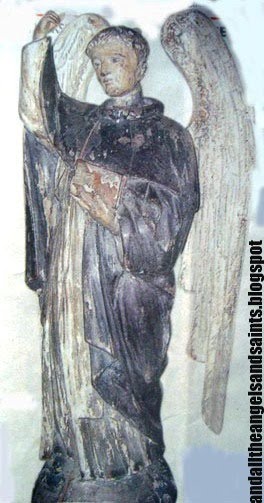
So popular was San Vicente in earlier times that the lawyer has at least 5 statuettes of the saint. The saint, also known as the Angel of the Apocalypse, is usually shown with wings. He was reportedly the patron of builders not so much for erecting physical structures but for helping rebuild and strengthen faith.

The Holy Family—Joseph, Mary and Jesus—seemed to be another favorite object of veneration. By the time the collector got the images, however, the Nino fever appeared to have been in full force that the child was often missing.

Another favored trio by earlier artists and religious was the Holy trinity of Father, Son and Holy Spirit. The collector was especially proud of a large painting of the coronation of the Virgin Mary after Her ascension to heaven, which used to grace the hall of some monastery.

Also occupying pride of place are images of Mary as the Lady of Penafrancia, patroness of the Bicol region, and Nuestra Senora de los Remedios, patroness of the Malate Church.

One of the oldest (over a hundred years old) and most expensive pieces he got was the Virgen de Porteria, which, as the name suggests, was often placed in the receiving area.

Tuesday, October 5, 2010

33. A FAMILY'S GOLDEN TRADITION

Phil. Daily Inquirer Sunday, April 13, 2003.

For the past 50 years, the image of Jesus Christ falling for the third time as He Carried His cross to Mount Calvary, has allowed the family to return to God the blessings it has received and to atone for sins.

The image of Christ suffering from intense pain, fatigue and hunger has become a source of strength and inspiration. He showed, that despite being the Son of God, He allowed Himself to be humiliated and mocked.


It all started in 1952 when the family patriarch, the late Jesus, decided that an offer of penance through prayers and “work” every Holy Week should be imposed. He wanted to return to God the blessings the family received that allowed it to have a good and comfortable life.

The Rebustillos acquired a float depicting Christ’s third fall on His way to be nailed to the cross. For the past 50 years, the float had given the Rebustillos family the strength to overcome the difficulties they encountered. The family prepared the float each Holy Week, not allowing even a death in the family to divert them from their commitment.


Over the years’ the float’s 3 images had become almost members of the family and treated with utmost care.

Dehlia, the family matriarch who did not raise any objections to her husband’s decision five decades ago, carries on the tradition.

The Rebustillos couple contracted the late Castro Vibar, known for his life-size images—Christ in a prone position carrying a cross with His head inclined upwards, a person helping Him support the heavy burden, and a Roman centurion.


Preparation of the caro immediately started, with even the little boys Jim and Johnnie, then 4 and 2 years old, helping. Dehlia said it was during the procession that the family and friends felt the offer of penance truthfully. The float stayed in Balintawak with her parents for two years after. It returned to Albay for good in mid-1954.

With the children all grown up (two more came after the float was acquired, Jesse and Dehna), the work of caring for the images during Holy Week was divided among them.

After 50 years, even grandchildren have started to help. The family has also received help from many people the past five decades.

Monday, August 16, 2010

25. ‘MARY MAGDALENE’ WENT TO BINANGONAN IN 1920

By Gerry Lirio , Philippine Daily Inquirer , 2000

Mary Magdalene set foot in Binangonan, a sleepy town in Rizal province sometime in 1920. She was fo sale.

A young woman named Brigida Antazo-Ojeda and her trader husband Segundo Ojeda first saw Mary Magdalene on Evangelista St. near Quiapo one fine day. She was a towering 5’8” image of the woman from whom Jesus Christ cast out seven devils in Galilee.

Brigida and Segundo bought and brought Mary Magdalene home in Binangonan. They adopted her like the child they never had.

She was actually the second Mary Magdalene who came to the town. The first one was a smaller, owned by another couple in a nearby barangay. But for still unknown reason, the couple joined Iglesia Ni Cristo and abandoned her in a bodega, like any other old fashioned mannequin.

Another couple wanted to buy her but the Iglesia couple turned it down, saying what the Iglesia had rejected should not be given to somebody else. Nobody ever saw her again. She disappeared without a trace.

In contrast, Brigida’s Mary Magdalene was warmly welcomed at the Ojedas’ ancestral home. She was an instant attraction. The house had huge windows made of capiz and a wide balkonahe that allowed people to see her from the outside.

Earthquakes, typhoons and floods struck Binangonan one after another in the years that followed but Mary Magdalene never left the Ojedas. She stayed even when Japanese soldiers occupied Binangonan during the war.

Mary Magdalene stayed in the corner of the ancestral house even when a Japanese Army captain seized and used it as his command center, forcing the Ojeda couple and their relatives to evacuate.

But the Japanese captain didn’t touch Mary Magdalene, probably either out of fear or out of respect. Brigida would later tell this story to her nieces, among them Leticia P. Manuzon, now a 76 year old retired public school teacher.

Mary Magdalene stayed with the Ojedas, even after Segundo died before the liberation. In no time, she gained the respect of the residents who attributed to her certain miracles in their lives.

She would later join the annual Holy Wednesday, Good Friday processions and Easter Sunday “salubungan” in the town’s poblacion, representing the Galilean woman who washed Jesus Christ’s feet with her tears, dried them with her long hair, and covered them with perfume.

Dressing up Mary Magdalene for the processions that dramatize the life and passion of Jesus Christ is not easy, especially with her 5’8” frame. It is one elaborate production, Manuzon said.

Because she was once a woman of the world, Church leaders in Binangonan allow Manuzon’s family to dress Mary Magdalene to the nines.

“Ay naku”, said Manuzon’s cousin, 53-year old Ursula Libramonte-Ojascastro, another retired public school teacher. “Si Magdalena kasi pustoryosang babae. So we have to capture that”. A petticoat and a robe are a must, for instance.

She wears one bright dress with rhinestones and semi-precious stones for the Holy Wednesday procession and an elegant black dress for the funeral or the Good Friday procession.

Still she has to wear one set during ordinary days and another set when she is brought to remote barangays for the “Pabasa”. Unlike other women saints on parade, Mary Magdalene must hold a bottle of perfume on her right hand. Even if she was once a woman with a checkered past, she wears a sparkling crown.

When Brigida died of old age in 1960, she asked her nieces to cherish Mary Magdalene the way she did. In 1986, Brigida’s ancestral house gave way to a new one. By then, Brigida’s own nieces have their own families. Still, Mary Magdalene continued to occupy an esteemed place.

Mary Magdalene would later undergo some changes: her body and arms were repaired. Her face had to be waxed. Her hair color turned from burgundy to white. Roughly, she’s now 80 years old.

A few years back, a wealthy Chinese trader approached Manuzon and offered to buy Mary Magdalene for a huge sum. The offer was so tempting but it was flatly rejected. In fact, townsfolk would be the first to reject it. To them, Mary Magdalene is priceless.

She belongs now not only to the Ojedas but to all of the town’s devout Catholics, serving as an inspiration to repentant sinners.

A mother sending her little boy to school once made the sign of the cross when she got past Brigida’s ancestral house a few years back. She said a few prayers and urged her little boy to do the same: ”There is a saint in the house”.

Like the Galilean woman who changed her ways, Mary Magdalene is not for sale. Not at all.