Showing posts with label relieve. Show all posts

Friday, May 29, 2020

336. RELIEVES FROM THE MIGUEL GALVEZ COLLECTION

ANGEL RELIEVE, Miguel Galvez Collection

It is no wonder that one of the most avid collectors of antique colonial santos was the artist MIGUEL GALVEZ y Geronimo (b. 27 Sep. 1912/d.Nov. 1989) of  Paombong, Bulacan. He grew up in a farming family, who later ventured into "sukang Paombong" business when they lost their landholdings. Determined to help his family, the young Miguel went to Manila to work odd jobs in the home of his artist-uncle Teodoro Buenaventura. His uncle saw his drawing talent, trained him, and then took him to U.P. to sit-in through the art classes there, where he eventually was accepted after art teachers aw his work. 

An artist who painted in the conservative style, Galvez impressed professors, art critics and painters alike, and he 1940s was his heyday, and his works won prizes and were patronized by private corporations. Galvez also represented the country in international exhibits in Kuala Lumpur, Hawaii and Tokyo. 

By 1949, he had a flourihing gallery along Mabini St., where he made his art while accumulating antiques. Galvez cashed in not only on his paintings but also in selling old ceramics, colonial paintings,  furniture and religious folk art in the form of primitive santos, and relieves (woodcarving in relief)--examples of which are on this spread. 


SOURCE:
All photos from the Miguel G. Galvez Collection, asfeatured in Philippine Catholic Digest, 1965

Saturday, March 10, 2018

306. TWO RELIEVES OF CANDABA CHURCH


Adoration of the Shepherds and Adoration of the Magi form part of the series on the Nativity in the collection of Don Luis Araneta. Both are bas reliefs of polychromed molave taken from the old catholic parish church of Candaba, Pampanga, and dated approximately from the 17th century. They represent some of the earliest samples of religious wood work done in the Philippines.

Pampanga is well-known to be one of the centers of image-making during the period. Most pieces coming from here are made of hardwood and the treatment best approaches the classical among all other regions of the Philippines. The artisans of this area are relatively well-versed in the handling of drapes. Although there are deficiencies in anatomical proportions, the quality of craftsmanship is already advanced.

For instance, the Adoration of the Magi was evidently done by the same craftsman as the one who did the front cover but with a more polished effort. The color is even more exciting and vivid due perhaps due to the psychological effect of the subject dealing with kings on the sensibilities of the craftsman. The similarity in the expression of the faces is so characteristic of the images of Pampanga.

Tuesday, February 27, 2018

305. THE 14 STATIONS OF THE CROSS OF TANAY CHURCH

RETABLO MAYOR OF TANAY CHURCH
The church of Tanay, dedicated to San Ildefonso de Toledo, has a long history, but its seeds were planted by Franciscan friars as early as the late 16the century. Tanay itslef—known a Monte Monte Tan-ay in ancient times, was a visita of Pililla, until it became an independent parish in 1606. The town was eventually relocated to a place called San Antonio in 1620.
 
1.      Pilate condemns Jesus to die
2.      Jesus accepts his cross
The church of Tanay, was we know it today, evolved from a series of structures—at first, from a bamboo and cogon structure,  to a stone church erected in 1678, under the initiative of Fray Pedro de Espallargas. The stone church was completed in 1680. But subsequent damages wrought by nature necessitated the construction of a new, sturdier church—and this is the present-day church that was built from 1773-1783.
 
3.      Jesus falls for the first time
4.      Jesus meets his mother, Mary
The impressive church is a fine showcase of baroque architecture, evident in its profusely-decorated retablo mayor or main altar (finished in 1785), naïve relleves folksy (relief carvings) and retablos. Spaniards took note of the excellent woodcarving skills of natives and employed them in creating decorations and religious articles for the church.
 
5.      Simon helps carry the cross
6.      Veronica wipes the face of Jesus
The most well-known examples are the 14 Stations of the Cross rendered in wood reliefs. The Stations of the Cross are a 14-step Catholic devotion that commemorates Jesus Christ's last day on Earth as a man. The 14 devotions, or stations, focus on specific events of His last day, beginning with His condemnation.
 
7.      Jesus falls for the second time 
Note Caiaphas, holding a pince-nez with dark lenses.

The works are not dated nor do they appear in church record, but it is believed that the first twelve stations were carved by a local artist from Tanay. This can be gleaned from the folksy features of the characters, flaws in proportions and perspectives.  They also look Malayan, with dark features, and some characters carry native objects like the carabao horn “tambuli” and the native bolo, instead of the metal trumpets, lances and swords of the original Biblical figures.


8.      Jesus meets the women of Jerusalem
9.      Jesus falls for the third time
Another often-noticed anachronism can be found on the 7th Station (“Jesus falls for the 2nd time). If one looks closely, behind the crossbar is the High Priest Caiaphas, who seem to be holding a pair of dark glasses, that look like a pince-nez.  
 
10.  Jesus is stripped of his clothes
11.  Jesus is nailed to the cross
The last two stations (Jesus is taken down from the cross, Jesus is placed in the tomb) have marked Caucasian features. The carvings are more proportioned,  refined and detailed—from the facial features to the musculature of Jesus. These are clearly the works of a trained artisan.
 
12.  Jesus dies on the cross
 13.  Jesus is taken down from the cross (no photo)
14.  Jesus is placed in the tomb
Note the Caucasian features of the characters. This
indicates that a different carver made the last 2 stations.
The 14 Stations of the Cross, reputed to be the most beautiful in Asia,  are prized treasures of the Tanay Church, which in itself is a historic masterpiece, declared a National Cultural Treasure by the National Commission for Culture and the Arts on July 31, 2001.

ALL PHOTOS TAKEN BY DR. RAYMUND FELICIANO, 1993.
From the Feliciano Album Collection at the Center for Kapampangan Studies.

Saturday, February 10, 2018

303. THE CARVINGS OF SAN AGUSTIN

Santo Tomas de Villanueva, bas-relief 18” x 24”.

Miguel Lopez de Legazpi officially established the colonial city of manila on June 24, 1571. He organized the local government and laid down the plans of what later would be known as Intramuros, the Walled City.

He was following the orders of the Real Audiencia in Spain during the reign of Philip II. “Highest among the design of His Majesty is the spreading of the Catholic faith”. Going into details, the royal ordinance instructed: “Alongsie the fortress, you should have a church built where Mss shall be held and nearby should be a house for the religious..”

Cherubs serving as column support for the lectern, carving 8” x 19”
Fires burned down the church and the two others that took its place. In 1599, the cornerstone of the actual church hich stands today was laid by the Mexican bishop, Pedro Gurto. The original plan was laid by Juan Macias, but he died before the church and the monastery were finally finished in 1607. Antonio Herera, an Augustinian lay brother who was supposedly a relative of the architect lf Escorial, took over and finished the work.

The present church is fully 371 years old an d has withstood earthquakes and invasions during the colonial era, profanation and bombings during World War II. In the final dys of the battle for the liberationof Manila in 1946, the church and the monastery became a refugee camp for nearly seven thousand people. When the entire Intramuros was razed by nearly 300 bombs that were dropped each day by American fighter planes, only San Agustin remained intact—a true miracle. A visible prayer, it stood alone amid a devastated city that once held as many as twenty equally old and beautiful churches.

Cherubs and dragons serving as column support for the base of the lectern, carving 12” x 9”
The façade of San Agustin Church is classic. Four twin columns support the gable with its rose window. A cross tops the central pediment. The beautifully carved main door depicts St. Augustine, patron of the church and of the order. Four granite lions, carved in the Chinese manner, guard the bases of the columns. They match the two granite lions at the entrance to the patio.

An odd note about the facade: one tower is notbly missing. It was taken down after it cracked during the earthquake of 1880. Which is a pity. From the tower hanged a most historic bell which rang only to announce good news—and very bad news, such as big fires which often engulfed the Walled City.

Purgatory, bas relief, 2 x 5”
The central nave is long and high, punctuated with circular windows through which the light streams in. Two side aisles led to ten chapels which were donated by the leading clans and families of Manila. One of these chapels is dedicated to Miguel Lopez de Legazpi,who died in 1572, only a year after he founded the city. He was buried in the church he provided first for and his remains have been kept in San Agustin ever since.

Beside the church is the monastery whose lower cloisters are now a museum housing a collection of colonial Philippine art. Among the pintings are huge oils that commemorate the life of St. Augustine, his mother St. Monico and other scholars and holy men who belonged to the Augustinian order.

Close up view of the pulpit’s panel.
The large refectory, with seventeenth-century frescoes on the ceiling, contains religious statuary and paintings as well as mission furniture from three centuries of the Spanish colonial era. The library contains books and documents of the once extensive San Agustin archives. Among those on display is a handpainted 17th century Missal, opened to the page of the Christmas Mass. From the windows of the library may be seen the botanical garden of father Manuel Blanco whose book (published in the 19th century) on tropical plants and flowers is a much cherished volume.

The finest examples of woodcarvings may be found in San Agustin; within the church and throughout the cloisters. Stunning is the choir—fro the carvings on its woodwork and on its furniture. The choir seats, done in the Renaissance style, are often enthusiastically called “jewels of art”. They are in hardwood with bone inlay. Consisting of 68 seats supported by colossal arches, it dates back to the 17th century, the work of artisans from Canton.

 Full-length view of the pulpit with canopy, bas relief
San Agustin is a witness to Philippine colonial history. The very first school in the country ws opened in its premises; it housed the first printing press; later it opened the first sanitarium. During the calamities, it was always a  refuge. But it was not spared from damage, sacking and looting. During the British Occupation of Manila in 1762, sacred vessels, religious art treasures and the library of more than 3,000 volumes with manuscripts and incunabula were stolen.

In San Agustin was held the first national synod in 1581 which is of utmost significance for it compelled the colonial government to abolish slavery. In San Agustin, too, was signed the capitulation of Manila from the Spaniards to the Americans in 1898. There is a particular irony here—from it was in San Agustin in 1581 that the legal bsis for the colony was calrified. It may truly be said that the most outstanding carving on San Agustin is the inscription of history itself on its very walls.

Tuesday, July 18, 2017

296. SANTOS FROM THE U.S.T. MUSEUM OF ARTS & SCIENCES

The oldest school-based museum in the Philippines--the University of Santo Tomas Museum of Arts and Sciences—is home to some of the finest collection of santos and other religious arts in the country. Founded in 1871 by Ramon Martinez, O.P., a professor of natural history, the museum showcases both scientific and artistic collections, including sacred objets d’art like religious imags, icons and paintings—a selection of which are featured below.

NTRA. SRA. DE LA ANUNCIACION

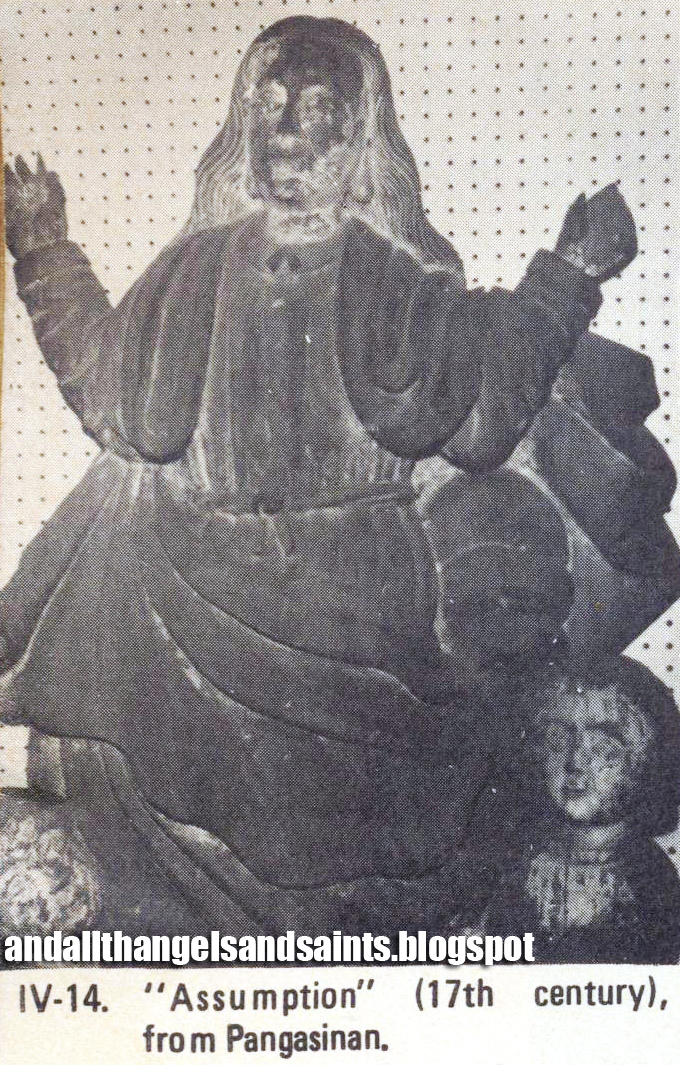
ASCENSION, FOLK SANTO

STO. DOMINGO GUZMAN & STO. TOMAS DE AQUINO

POLYCHROMED RELIEVE

BUEN PASTOR/ PASTORA

RELIEVES

PAINTED ICON ON WOOD

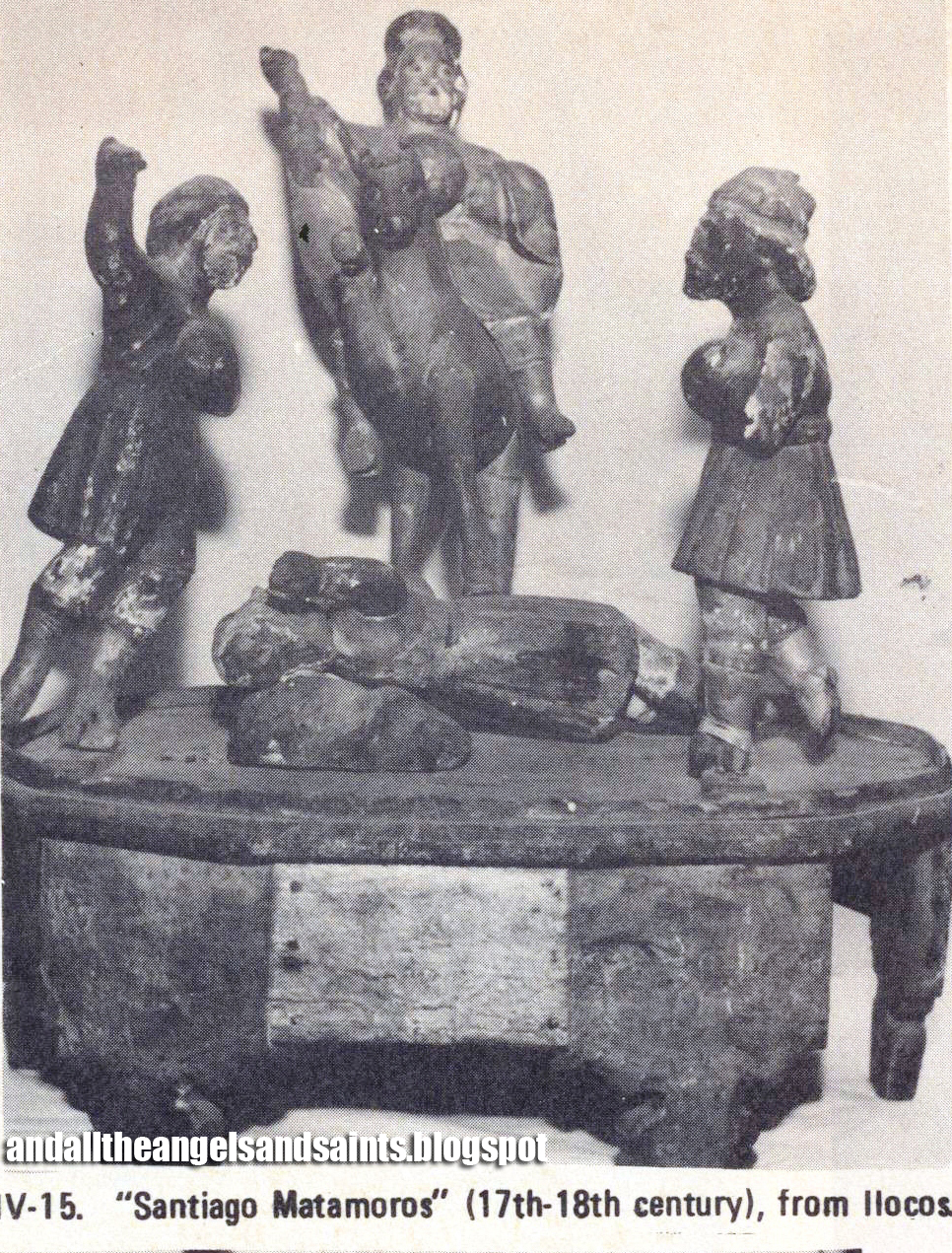
ST, JAMES, THE MOORSLAYER FOLK SANTO

OIL PAINTING ON CANVASS
SOURCES:
UST MUSEUM OF ARTS & SCIENCES COLLECTION, Printed Catalog, 1970s