Showing posts with label religious festival. Show all posts

Thursday, April 30, 2026

373. APO IRO! APO IRO! Discovering the Year-Long Cult of St. Peter in Apalit, Pampanga, by Ross M. De Leon

(Transcribed from the magazine article published on Weekend Malaya 20 Sept. 1987)

By Ross M. de Leon, Photos by Zek Barroso & Jolly David

Apalit town becomes exceedingly alive from June 28 to 30 every year. It is when the whole town becomes one and celebrate the feast of Sta. Peter whom folks lovingly call Apo  Iro. Actually, the people get busy as early as May when the fiesta committee members start mounting the bamboo poles for the buntings.

That the Apaliteños put their minds and hearts in the fiesta event is eveident in the buntings alone. The colors are well-chosen, the hangings have identical shapes and sizes.Arranged very close to each other, the buntings would look like one bg canopy. If one views it from the window of a century-old two-storey house, it turns into a magnificent rainbw that dips somewhere in the Pampanga River.

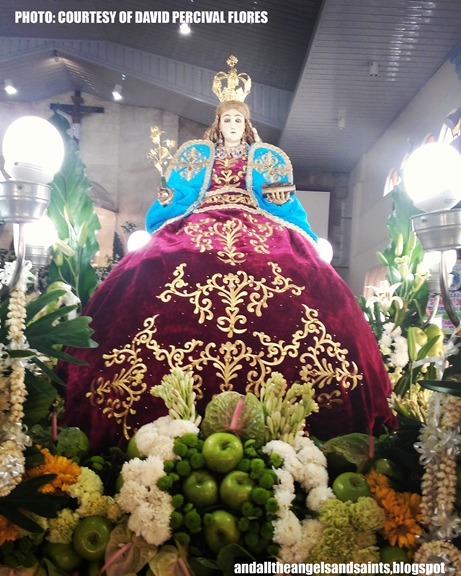
With a band playing fiesta tunes and people coming in with their glorious smiles, the scene takes a different appeal. It is as if time hangs suspended for three days and everyone is reborn. Nothing occupies the people’s attention except to give their best to Apo Iro. The life-size image in pure ivory is 287 years old. It is the only on in the country which sits on a throne.

Most of us are familiar with St. Peter in an upright position holding a rooster and keys. But Apo Iro of Apalit is a magnificent Prince of the Church in papal robes. Fr his feats, he wear a three-tiered crown symbolic of his being a first Pope. He has a scepter, a huge cross around his neck, a ruby ring and keys. On other days, Apo Iro wears a simple, priestly robe, not the old pajamas and baseball cap he used to. “A pope would never appear in public wearing pajamas, would he?”, asks Rick Badenhop who is married to the camarera, Erlinda Sazon-Badenhop.

Through the Years. It is Linda’s ancestors, specifically Don Pedro Armayan Espiritu, who bought Apo Iro t the country. Don Pedro got the image done in Spain including its original crown, scepter, ring , keys, necklace , cross, the fisherman’s shoes in pure slver. All those have remained intact since Apo Iro’s arrival in 844 at the old home of Don Pedro in Alauli, Apalit. Don Pedro transferred it to a bigger house in Capalangan and has stayed there ever since.

St. Peter’s shrine in sitio Capalangan, Apalit, Pampanga

From 1974 till now, Apo Iro has been under the care of Dña. Elisa Sazon, a direct descendant of Don Pedro. The old lady died in May this year which made her daughter Erlinda, the new camarera.

The family has undertaken the awesome task of being host to Apo Iro’s numerous visitors throughout the year. But it is on his feast day when the preparations are even bigger. Linda, a well-known dentist, is not daunted by the responsibilities for she has fund the perfect partner  in Rick. The latter is a busy executive of Equitable Bank and has accepted Apo Iro graciously as part of his life.

The very old Spanish home of Rick and Linda opens its doors to everybody ob Apo Iro feast day. Rick reveal as , “we have to hire no less than 40 cooks to feed the devotees for free.” About 10 to 20 cavans of rice are needed each year, four large pigs, 300 peces of chicken, 40 kilos of beef, and a jeepload of bihon and not less that 30 cases of softdrink are consumed. “Of course, there are other ingredients and other items butthose are the staples. The cash donation may reach up to Php 15,000 but we always add Php20,000 to that”, declares Linda.

Devotees expecting miraculous cures for rheumatism, asthma, and other ailments.

Aside from which, the family spends over Php3,000 for the coconut oil which the devotees request. Then there’s the maintenance of the chapel and the garden built in 1981 which come from the Badenhop’s purse. “We will keep the tradition the way Linda’s parents and ancestors did it. You cannot just close the shrine for lack of fnds. We believe that Apo Iro will help in every way,” says Rick without hesitation.

The Badenhop’s faith in the miraculous power and generosity of Apo Iro is echoed by the devotees who flock by the thousands. Maria Santos, a 68 year old resident of Caloocan, and her whole clan come yearly in 4 jeepneys. There are 80 of them and they have been faithful to Apo Iro for the last six years. “Lahat kami pati dalawang apo ko, pinagalig ni Apo Iro,” remarks Aling Maria, a furniture shop owner.

Aboard the barge are Apo Iro and the Virgin Mary on their 6-hour  fiesta time journey to the Apalit Cathedral.

She herself goes down the river when the fluvial procession begins. The woman explains, “Dati hindi ako makalakad dahil sa rayuma sa pareho kong paa. Pero simula nang magdebosyon ako kay Apo Iro, gumaling na ako.” In between fiestas, Alig Maria usues coconut oil to massage her feet. “Mabilis ang ginhawa. Ganon din kapag nagbabad ka sa ilog na dinadaanan ni Apo,” came the simple declaration of faith. Her two grandchildren were rid of their asthma again through the water and oil from Apo Iro.

There’s Felisa Cabildo Albina who is now 73 years old and widowed. She began her panata at 17. Aling Feling’s eyesight was failing because of cataract, “pero iniligtas ako ni Apo Iro.” She used to suffer from hypertension and severe headaches. But she does not look her age nor does her illness seem to bother her when she dances on the street with other devotees. This, they do, when Apo Iro leaves the shrine for the población and on the day that he returns.

Felisa Albina, 73, has been dancing for Apo since 1921.

The dancers bring with them all kinds of leaves but especially guavaleaves. “Kahit anong halaman basta isinama kayApo Iro nakagagaling,” relates Aling Feling. “Pakulo ka lang ng tubig at yoong dahoon pag may sakit ka ng tiyan, ulo o lagnat at tiyak na wala.”

For this year’s festa, however, there were signboards requesting devotees not to destroy the plants. Rick points out, “They can get the leaves but nothing should be uprooted. We spend a lot in the upkeep of the plants.”

Miracles? Another devotee of Apo Iro is 14-year old Nicomedes Estrella of Iba. He was only 4 years old when he got leukemia and his parents were told that he would die soon. Once, when he was delirious, he told his father, “Itay, dalhin mo ako kay Apo Iro.” He and his parents stayed in the chapel for two weeks after which Nick recovered for good. He is now a healthy teener who for the last 10 years has been spending the last 3 days of June with Apo Iro.

Aling Maria, Aling Feling and Nick are only three of the tousads of devotees who greet Apo Iro on his feast. They wait rain or shine till Apo is brought out from the chapel and down into the river. The chanting of “Apo Iro, Apo Iro!” is awesome, the kind that makes your hair stand on its end and sends shivers down your spine. There is a marvelous rain of petals, confetti and leaves followed by a thunderous applause. Dancing on the street continues as Apo Iro is carried to the river by the Knights of St. Peter.

Devotees Mary Indiongco, Knights of St. Peter Macario Vargas 
and Amado Arceo with Dr. Erlinda Sazon-Badenhop in front of the
287-year old Apo Iro.

Despite the gaiety, the festivities do nt turn into a circus that would lessen the solemnity of the event. More people await Ao Iro at the river where he takes a barge. From Capalangan, he is transferred to a bigger, more splendid float at the point where the Calumpit and Pampanga Rivers meetfor his 6-hour journey to the Apalit población.

The fluvial procession is a sight to behold, a powerful feast of colors for photographers. The large float carrying Apo Iro and and the Blessed Mother is followed by smaller bancas, barges, etc. all filled with people. The banks are lined with more devotees who immerse themselves in the water for everyone believes that this is the only time of the year when the water becomes curative through Apo Iro.

A vigil and procession are held at the Apalit cathedral for a day when Apo Iro returns to the shrine in Capalangan. The return journey is awaited with greater joy and enthusiasm as if the Apo left the sitio not for a day, but for years. Dancing, dousing of water, and feasting are the order of the day. The folks stay till late at night in thanksgiving, for their belove Apo Iro is back and safe.

Monday, May 14, 2018

313. HONORING SAN ISIDRO, by Bibsy M. Carballo, Sunday Times Magazine

By Bibsy M. Carballo    /    Photos: Romeo Vitug 
Photos of  San Isidro, courtesy of Jayson Maceo
The Sunday Times Magazine, 21 May 1972, pp. 26-27


Sincerity Flamboyance, Festivity.
Nowhere else in the world, perhaps, is as much tribte and homage given to the food god than in the coconut-producing towns of Quezon province,

Perhaps it had to do with the utter dependence of the crop on the whims of nature; perhaps it can be explained through the people’s love for ritual and spectacle. Whatever the reasons, the fifteenth of May each year is a special day dedicated to San Isidro, patron saint of the farmers.

In Sariaya, boys clamber up abamboo
pole to try to topple it.

For weeks before this day, all regular work stops and the entire towns busy themselves in preparing the buntings and delicacies that will hamg from wondows and bamboo poles around the town.


Although each town celebrates the feast in its own way with even urbanized Lucena paying lip service with a few street decorations, the towns of Lukban and Sariaya, are the perennial competitors in the art of celebrating San Isidro.

The street is a mad sceneof happy grabbing and elbowing.

Lukban, with its candy-colored kipings in fancy shapes, its fruits and baskets, its entire window facades in a riot of colors. Sariaya, with its bamboo poles festooned with goodies which are torn down as the venerable San isidro passes by in the procession in the early evening; less colorful, less party-pretty, bit more exuberant and spontaneous.

A satisfied grin on his face, Sariaya well-wisher
walks away with his prized possessions.

And, as always, in keeping with the tradition of prayers for food and a good harvest, no visitor is allowed to go home empty. Food is literally pushed down one’s throat; it is an insult to decline. Houses are opened up to entire strangers; and as the Alcalas of Sariaya have found out, no one has really been proven to be the loser by such a reckless gesture.

Tuesday, January 24, 2017

282. HOMETOWN BLUES AND 'APO TIAGO', by Blanche David-Gallardo

by Blanche David-Gallardo
Originally published on  @inquirer.net/ Inquirer Lifestyle/ 31 July 2016

SANTIAGO OF BETIS.

Last night I dreamt I went—not to Manderley—but to Betis again, the fiesta and holiday haunts of my youth and childhood and my father’s hometown where, like Manderley,  my grandfather’s house is “no more… ours no longer.”

At times looming larger than life, at other times dissipating like morning mist in the harsh light of everyday reality, memories of my grandfather’s Betis home float wraithlike, as ghosts from the past.

In the dim light of faulty recall, and through the idealized prism of advancing years acutely aware of time slipping away, I can still see the 19th-century bahay-na-bato, its stone front steps leading up to the wooden upper story living areas.


Branches of a giant chico tree loomed menacingly over the rail-enclosed balcony, occasionally dropping a fruit or two with a thud in the dead of night, confirming our childhood fears that indeed, kapres inhabited the tree and the nearby towering sugar mill. 

It was there we sat, my cousins and I, whiling away lazy afternoons when we outgrew childish pranks and games.

There I learned to love that magic time between day and night, the melancholy of twilight, and discovered the first stirrings of puppy love.
The balcony opens out, through double doors and carved lintel of Agnus Dei (Lamb of God) to a vast living room. To one side stood my grandfather’s bedroom, perpetually dimly lit with flickering oil lamps and votive candles.

 Velvet finery

There the family santo—Apo Tiago, St. James the Apostle— was kept in its glass case, dressed in simple cotton garment for everyday wear, until metamorphosed for delivery to the Betis church, elegant in his gold-embroidered velvet finery, wig in place, cheeks rouged to soften the pallor of its ivory face, and picked up by several groups of marching bands for town fiestas, Holy Week observances, and/or other special occasions.


Like the year waning into shorter days and longer nights, we of the twilight generation of Betis Davids rarely “rage, rage against the dying of the light,” but rather “go gentle into that good night,” notwithstanding Dylan Thomas’s poetic counsel to his father.

Once in a great while, however, we come face to face with a facet of the past—a moment of truth, as it were—that brings together present reality with fragments of ourselves that we have long lost, like pieces of a puzzle recombining to form a whole picture.

One such occasion came for me more than a decade ago. On the eve of the of Betis district fiesta, when a handful of us cousins, remnants of the David clan from the line of my paternal grandfather Pedro Lampa David, came together for a brief, and largely impromptu, family reunion.


The group included my London-based sister Marita, who was in town for the holidays with her Canadian-born husband and their daughter Teresa, and numerous US-based cousins, home for the holidays and the town fiesta, and to attend the wedding of a nephew. 

As well, there were those of us who, like me, were living in Manila or in Pampanga, many of us no longer carrying the David family name by virtue of marriage.

The reunion was held at the home of a cousin who, through the years, has maintained her residence in Betis, at precisely the spot where our grandfather’s house once stood.  The ancestral home is long gone, as are the once extensive family land holdings.

Erratic memories
Only erratic memories remain, along with larger-than-life perceptions of the elegant four-foot-tall ivory and wood image of the town patron saint—Apo Tiago—around which the remaining generations of our branch of Betis Davids found an inspiring rallying point.

We are all, they say, a product of nature and nurture. Nature is what we are born with—the genes we inherit from our parents and ancestors. Nurture is the superimposed layer upon layer of post-natal forces that help shape us as individuals— the milieu and culture into which we are born and raised, and the attitudes, views and influences that color our world view and continue to evolve and transform us through the years.

In our instinctive search for individual identity, we forget— and sometimes deliberately reject—the roots of our “nurture” which, paradoxically, has the power to draw us back precisely to the point of our true identity as an individual.


Spared from the devastation of Mount Pinatubo in 1991, the municipality of Betis adjoins Bacolor, a town so totally devastated by lahar, only the church steeple and a reconstructed portion remains today as a reminder of where the town once stood.

The fact that the lahar flows stopped just short of Betis is a miracle attributed by townsfolk to the intervention and protection of the town’s patron saint, Apo Tiago. To this day, people from neighboring towns and districts borrow the image from my cousin Violeta—for years the family custodian—whenever any of the nearby towns or villages find themselves threatened by floods, or any other natural calamities.

Whether the statue, imported from Spain, was acquired by my grandfather, or by his father before him, is a matter of conjecture among us. But my generation of Davids and those immediately after us, grew up with the familiar sight of the image housed in its glass case in my grandfather’s darkened bedroom.


 Ritual
Whether we were there for the three-day town fiesta, or the weeklong Semana Santa  (Holy Week), it was the first place we headed upon arrival, to touch the hand of the image upon our foreheads, even before we greeted our grandfather and touched his hand to our forehead.

Preparing Apo Tiago for his church sojourn and the religious procession that followed, and setting him upon the gilded carrosa, decked with flowers and lights, were part of the ritual of my growing up years, an intimate portion of our life, upbringing and family traditions.

Thus it was with a rediscovered sense of belonging and oneness that, a decade ago, our assembled kith and kin awaited the marching bands that were to fetch the image from my cousin’s house and escort it to church.

Listed as a national heritage, the St. James Church of Betis is one of the oldest in the country and the only one with wooden floors.  Built by the Agustinians between 1610 and1670 in typical mission architecture, with frescoes on the ceiling, murals on the walls, and carved, gilded wooden altars and pillars, the Baroque church is also one of the country’s most beautiful.

I have often watched with a tinge of nostalgia those Italian, and/or Spanish movies depicting religious processions wending their way through narrow, winding streets, “oompah-pah” brass bands setting the funereal pace, and masses of candle-carrying devotees following hard at the heels of saintly images borne aloft on carriages, or upon the shoulders of devotees.

These are scenes straight out of my childhood, and on that eve of the San Miguel district fiesta, reality and memory came alive in what I can only describe as a “moment of grace” when we, as remnants of a now scattered branch of a Betis David clan, candles lit in the fading light, joined the marching band and the “Coraldal” dancers in escorting our Apo Tiago to the Betis church. Faith in action, glorifying the Creator through an earthly ritual.

Every few meters, the procession stopped to allow the dancers to express their exhuberance and joy before the image of St. James in a mock routine of clashing swords and shields—a reference to the mythical James who fought and triumphed over the Moors.

All along the route, people lined the streets, greeting the approach of Apo Tiago with awed reverence, or a burst of firecracker salute!  It was as I remember the event from childhood, and yet different from what I remember! I was told that my memory regarding the “Coraldal” dancers was flawed, because when we were kids, the dancers were elderly, and not the young men who perform the “Coraldal” today.

Perhaps it is only in the twilight of our years that we can appreciate—or be reinvigorated—by our half-forgotten beginnings. But I do hope that one day soon, my own children (and grandchildren) will find the time—and the inclination—to join me on a visit to Betis on the eve of a town fiesta to discover for themselves an undying family legacy that will outlive us and our generation, as it did my father and grandfather before him.

Read more: 

Follow us: @inquirerdotnet on Twitter | inquirerdotnet on Facebook

Sunday, January 8, 2017

280. A NATIONHOOD OF NAZARENOS

JESUS NAZARENO OLD ESTAMPITA,

Every year, in January, Quiapo becomes the center of fervent religious attention during its fiesta. The devotion revolves around a dark, life-size, cross-bearing image of Nuestro Padre Jesús Nazareno (Poóng Itím na Nazareno) that is enshrined in the district’s minor basilica.

Photo courtesy of Dr. Raymund Feliciano

Photo courtesy of Dr. Raymund Feliciano

The image comes out thrice in a year—on New Year’s Day, on January 9, and on Good Friday. The Januaray 9 “prusisyon” is the largest of the three, when the re-enactment of the image’s solemn transfer (Traslacion) to the basilica from its original location in what is now Rizal Park.

Photo courtesy of Dr. Raymund Feliciano

Photo courtesy of Dr. Raymund Feliciano

Religious veneration of the Nazareno—so-called because Jesus is identified as having come from Nazareth, in Galilee is profoundly  rooted among Filipinos who identify with Christ’s sufferings as represented by the statue.

Photo courtesy of Dr. Raymund Feliciano

Alex R. Castro Photo

The black Nazareno image was brought here in a Mexican galleon which sailed from Acapulco. It was carved by an unknown Mexican sculptor  in the mid-1600s. Its dark color is not due to the black fumes of votive candles, or to being scorched by fire that occurred in the galleon  as widely believed,--but because of the dark mesquite wood used.

Photo courtesy of Dr. Raymund Feliciano

Photo courtesy of Dr. Raymund Feliciano

Because the Nazareno had attained national popularity as early as the 18th century, it has inspired replicas all over the country. The older and more popular copy belonged to the Recoletos, but this was destroyed during the last War.

Photo courtesy of Froilan Guanzon

Photo courtesy of Dr. Raymund Feliciano

Today, practically every church in every Philippine town has a Nazareno image, many of which are also antiques. Outside of Quiapo, there are similar “Traslacion” processions  being carried out, using official replica images—like the one in Cagayan de Oro.

Photo courtesy of Dr. Raymund Feliciano

Photo courtesy of Dr. Raymund Feliciano
Overseas, copies of the Nazareno could be found in Australia and in parishes in the United States, where Filipinos gather to process their images around the church grounds.


Photo courtesy of Dr. Raymund Feliciano

While Quiapo has become the focal point of homage to Christ, the Nazarene, its fiesta has also become a season for all men, for all Filipinos, a nation of worshippers still coming to grips with the conflict of God-inspired rituals and human chaos. 

Friday, January 29, 2016

239. The Untouchable: STA. INES of BULACAN, BULACAN

TOUCH HER NOT: The revered antique ivory Sta. Ines of Bulacan, Bulacan.

In a chapel in Bulacan, Bulacan can be found a small, ivory image of the young virgin-martyr, Sta. Ines (St. Agnes of Rome)—venerated by pious Bulakenyos and pilgrims from all over. But with the ardent devotion comes a warning—that the image must never be touched by menfolk in deference to her purity which she kept intact after being subjected to all sorts of torments and abuse. Even priests are no exceptions.


 The ancient ivory image was found by a fisherman from Pariahan who was out looking for a good catch in the sea. The sea was soon enveloped by a thick mist followed by claps of thunder, lightning and a heavy downpour. In the midst of this tempest, the fisherman saw a mysterious glow at the far end of his boat.


When he came nearer to inspect the light, the fisherman was surprised to see the image on a floating basin. He tied the basin to his boat and towed it for home. Upon sighting land, the fisherman attempted to lift the basin with the image and bring it ashore, but he could not even lift it. Other fishermen came to help him, but the basin would not budge. But when the women came to their succor, they handily and easily lifted the image safely to the shore.


 Considering the event as miraculous, the barrio people constructed a “visita” and put it under the patronage of Sta. Ines—a name that was on the book held by her left hand. Eventually, the saint’s name replaced “Pariahan” as the name of the barrio.


 Then and now, the feast of Sta. Ines every 21st of January is marked with days of prayer capped by a procession. In the course of the 9-day novena, the petite Sta. Ines image is dressed indifferent vestments every day.


Twice the image is processioned—in the morning and in the evening—borne on a decorated anda by women, who also heap tributes of songs and poems to their beloved patron in a tradition called “Luante”. 


 To remind uninformed men, signs bearing the warning “Paunawa: Bawal Humawak Ang Mga Lalaki” are placed strategically on the anda, lest misfortune comes—in the form of floods, storms, lightning strikes and other natural calamities.


 The antiquity of the Sta. Ines image can be seen in the fine lines on the ivory face. On her right hand, she holds an olive palm, a symbol of her martyrdom.


The other hand holds a book topped by a primitive lamb, which stands for purity. The story of the saint could be read at the “visita” where she is enshrined.

WATCH "STA. INES SA BULACAN RATED K" 
PART 1 VIDEO HERE:


"STA. INES SA BULACAN RATED K" PART 2

 Sources: 
“Gunita”, by Naning Santos. 
Alfonso, Ian Christopher B. at Rodrigo, Jose Antonio M. 2013, Bulakan: Pag-alaala sa biyaya ng nakaraan -- ikalawang tomo: sining, kalinangan, at mga natatanging anak ng Bulakan, Bulacan. Malolos, Bulacan, Center for Bulacan Studies, Bulacan State University.

Friday, October 23, 2015

233. LA NAVAL DE MANILA SOUVENIR PROGRAMS

LA NAVAL SOUVENIR PROGRAM, 1957


LA NAVAL SOUVENIR PROGRAM, 1964

LA NAVAL SOUVENIR PROGRAM, 1970

LA NAVAL SOUVENIR PROGRAM, 1974

LA NAVAL SOUVENIR PROGRAM, 

Friday, February 20, 2015

215, Santo Stories: STO. CRISTO OF PAKIL

 SANTO CRISTO DE PAKIL. The ancient image of the Crucified Christ in the church of Pakil, as it appeared in the 1950s.

 In the Franciscan-founded town of Pakil, Laguna, one can find an ancient, life-size crucifix venerated at the altar near the church’s entrance. The present church itself, dedicated to San Pedro de Alcantara, dates to 1732, a masterpiece in stone marked with florid ornamentation.


 The Santo Cristo de Pakil is an object of deep veneration among residents, but is also popular among the devotees of the Virgen de Turumba. The legs and feet of the Santo Cristo have all but darkened with age, and the habit of kissing the feet and the anointing of the santo’s extremities with perfume has persisted.


 The origins of the crucified Christ in Pakil is shrouded in mystery. It was said that an old man sought refuge in the town, begging the cura to find sanctuary in the church. The kind priest allowed him in, and the old man requested that he be given some carpentry tools so he could do some work for the church, in return for the hospitality.


 When the old man did not emerge from the room after some time, the door was forced open—and the priest found him gone. But inside the room was a splendidly carved image of Christ crucified, wonderfully wrought in wood and capturing the agony of the Lord in his passion.


 The image – known as Santo Cristo de Pakil—was enshrined in a retablo menor and is used every Holy Week for the Good Friday rites. As the arms are articulated, the figure of the Christ can be brought down from His Cross to be transformed into a Santo Entierro.


 In this form, the image is processioned on the streets of Pakil, followed by a band of violinists, musicians, singers and hundreds of devotees.