Showing posts with label San Juan. Show all posts

Sunday, July 13, 2025

361. PORAC’S LITTLE JOHN of the SANTOS FAMILY

The small, but handsome image of the young SAN JUAN APOSTOL is a family heirloom from the Familia Santos of Porac, led by Leon Santos, a planter and businessman. Family lore has it that the image was originally owned by a local Chinese who gifted it to the Santoses. The image was inherited by Leon's son Isidoro Ponce Santos, whose overseas-based children now contributes the funds for his upkeep, including procession expenses.

The San Juan image is just 3 feet tall, with articulated arms. In this version, San Juan has carved, brown-painted hair, that falls gracefully down his nape and shoulders. Over his stiff collared top, he wears a tunic of green with a red, shawl-like drape on his shoulders. He is topped with a brass halo and shown holding his attributes: a feather quill and a book.

For years, it was a regular participant in the annual Lenten processions of Poblacion, Porac, Pampanga, until 2000. His entry is preceded by his symbol as an evangelist, a carved figure of an eagle, which has the ability to gaze directly at the sun, representing the divinity of Jesus.

Last procession appearance of San Juan, 2000

As San Juan was the smallest religious image in the procession, the Santoses decided to pull it out and caused a new, taller image to be made, to  match the size and proportions of the other Lenten santos.

MANY THANKS TO MR. JERRY PUNZALAN SAGMIT for the photos and information.

Wednesday, February 2, 2022

349. A MINIATURE SAN JUAN EVANGELISTA

Miniature wooden santos –those measuring 8 inches or less, including the base—are a rare sight, so much so that there are collectors who specialize in them—like artist Claude Tayag. The standard for the carved figures alone is 6 inches, most often dominated by figures of the sleeping or standing Sto. Niño.

Less common are miniature figures of adult saints and divinities, like San Vicente Ferrer, the Blessed Virgin. Rare still are diminutive tableaus of the Sagrada Familia, San Roque and San Isidro.

Which is why, when a beautifully carved San Juan Evangelista popped up last year I the FB Marketplace, I lost no time in contacting the dealer ( a fellow Kapampangan collector!) and acquiring the piece.

The standing figure of San Juan is a shade under 6 inches tall, with a double base ending in an ochovado block that added another 2 inches to its height.

For a miniscule santo, San Juan is exquisitely carved and finished. True to his iconography, he is vested in a yellow robe with a green collared cape, holds a book, with only his quill missing from his other hand.


He was painted like a regular-size santo, gessoed, with his facial features  rendered using a very fine brush. His longish hair is parted in the middle, and swept at the back. His robe is decorated with tiny fleur de lis. Remarkably, the vestments show traces of gilding. The usual surface scruffs are typical of old santos, just like this

We can only surmise the reason why santeros were compelled to carve miniature santos. Maybe these were commissioned for children, or for smaller home altars. Or maybe it was a way of leveling up their skills, as carving intricate details such as  tiny hands and strands of hair were difficult to do. 

This San Juan may have been the result of such an exercise,  and we can all agree that the santero did very well, a very fine job indeed!


Friday, December 3, 2021

346. FROM JOHN DOE TO ST. JOHN: An Antique Bone Santo Transformation Story

A BONE TO PICK. A nameless santo found in Ermita

I only remember hazy details of how I got this santo with head and hands made of bone. What I can only recall was that, I got this from one of the dealers in Ermita perhaps in the 1990s, when I started becoming drawn to ivories which I could not afford. 


Nobody knew who he was, as it was without clothes, metal accessories, wig and base that may have otherwise given us clues to his identity. Because it was affordably priced, I purchased this nameless santo and became a sort of a stand-in piece, as in my mind, it was the next best thing to owning a more valuable ivory. 


The antique male santo has quite a young, but expression-less face. It looks like it had been carved from cattle bone—square-jawed, with pronounced cheeks, but a finely detailed nose. There is a certain flatness to the carving, perhaps because bone tends to be brittle. 


Even with his painted features, he look so stoic, with lips pursed. He stares with bulging glass eyes and a blank gaze, The fingers are unremarkable, carved almost “tinidor-style”, with open palms. The bone head (a half-mask, actually) and hands are assembled on a wooden body with the usual jointed arms.

The closest santo that vaguely fills this male santo type is San Juan, the young apostle and apostle.  His most common iconography shows him holding a quill and a book—but this santo’s hands just jut straight out from his wooden arms. 

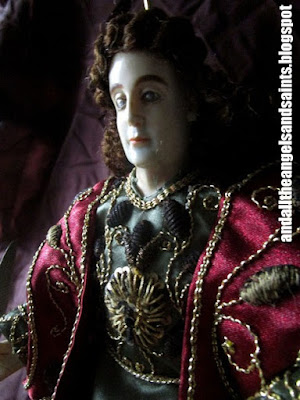
And so I decided  San Juan Evangelista he shall be.  Creating the look was my favorite ivory restorer, Dr. Raffy Lopez, who salvaged old embroidery from his “baul” of santo supplies, and incorporated them with new embroidery he designed on green and maroon satin. He also provided his “peaña” or gilded base, plus his wig. 

I contributed the paragua-style halo (which is a bit big!), and pukpok artisan gave me a new, silver-plated quill pen, which looked more like a sword than a feather quill. There was no way of having the right hand with an open palm hold it, so I just secured the pen with putty.  

FROM JOHN DOE TO ST. JOHN

After more than 25 years, still have this antique bone santo, even if, year after year, I keep telling myself to dispose it. The reason probably why I am hesitant to let it go is because of the interesting back story attached to the piece---of how a John Doe santo became a John the Evangelist santo!

Saturday, June 6, 2015

223. Santo Stories: MISERICORDIA of the EVANGELISTA FAMILY, ANGELES


The Santa Misericordia of Angeles is owned by the Evangelistas of this city, known for their pioneering telecom business. It was commissioned by Don Roman Bernardo Evangelista and his wife Dona Francisca Dizon Dela Resma, along with another statue intended for the La Naval celebration—the image of San Miguel Arcangel.


 The Misericordia was completed in 1907 to honor the birth of the couple’s youngest son, Santos Evangelista, while the San Miguel, given to the eldest son, Domingo Sr., was inaugurated in 1916.


The Santa Misericordia, also locally known as “Macapacu Qng Cruz”or the Crucifixion, is a tableaux that depicts figure of the crucified Christ flanked by San Juan and the Mater Dolorosa. Interestingly, there are two other characters atop the ladder another horse-riding soldier positioned at the back of the cross.


With all these santo figures, the Misericordia looks more like another scene known as The Descent from the Cross (El Sagrado Descendemiento), in which San Nicodemus and San Jose Arimathea are shown bringing down the body of Christ from the cross. Could it be that the two figures on the ladder were later additions to transform the Crucifixion into a Descendemiento tableau?


 In the past, Angeles’ Sta. Veronica, for example, is converted into a Sta. Salome on Holy Thursday. I have also seen two-faced Virgins so that using the same body, the image can either be a Dolorous Virgin and a Joyful Virgin, with just a twist of the head.


When the Misericordia was completed, it was given to the care of Don Ramon’s only daughter, Leonora Evangelista (Panlilio) and the aforementioned youngest son, Santos. When the Evangelista siblings passed away, Jesus and Zon Gopiao, became the caretakers of the carroza.


When not in use, the santos and their carrozas are stored in a spacious room designed expressly for their safekeeping.


 Today, the children of Leonor-- Gerry, Mary Ann Panlilio Reyes and William Panlilio, plus the 3rd generation members of the clan—continue the family tradition of caring for these beloved family heirlooms. They regularly participate in the annual Lenten rites of the city of Angeles.

I wish to thank Mr. Ira Jay Evangelista for the pictures and Mr. Josel Suarez for the bacground of the images, both of whom are descendants of Don Roman Evangelista.

Wednesday, January 2, 2013

133. THE ROAD TO CALVARY


I have always wanted an antique ivory Calvario tableau for my collection, but their availability—not to mention their prohibitive cost, have thwarted this dream. The closest I could get to owning one was when I purchased in Apalit, this part-ivory Crucifixion set. One look and you will know that it’s been put together—the wooden Christ with one outstretched arm, actually is part of a 2-character tableau that included the now-lost figure of St. Francis embracing Christ.


Two ivory santos have been redressed and added to the crucifix-- San Juan and a Dolorosa—which originally was a Magdalena. The two had ivory heads and hands (many missing fingers though). The santos were crammed in a primitive urna, and it is in this state that I bought them, with the intent of separating the two ivory figures and putting them on separate bases. This was what I actually did, with the help of expert santo restorer, Dr. Raffy Lopez. I gained two individual ivory santos but now lost a tableau!


 I forgot about owning a Calvario tableau until, this year, I chanced upon this antique wooden crucifix that was so badly disfigured and messed up with silver paint. But I really didn’t care much for the wooden Christ—it was the silver grabado cantoneras that appealed to me. The crucifix was set on what seemed to be its original base that simulated a stoney mound. Since I could afford it, I bought the crucifix and had it immediately restored.


A month and a half later, the Crucifix was returned to me—and the painted restoration stunned me.


 The new encarna showed the exceptional carving of the figure—from Christ’s pain-racked expression to his bloodied physique—one of the finest I’ve seen. Raffy had given me an old wig that fitted the Cristo perfectly.


Rummaging through my own stock of old santo stuff, I found a small silver thorny crown that also matched the head size of my crucified Christ.


Meanwhile, at the recent Greenhillas Antique Fair, I found an almost complete set of silver fittings for a standard crucifix, including these INRI and the symbolic sun with a face, with a spring mount.


From another old crucifix, I salvaged 3 silver potencias, which were of the right size for my Cristo. I was rather pleased with the result.


It was at this point that I toyed with the idea of assembling my own Calvario —using this completed and fully restored crucifix as the focal point of the tableau.


The ivory San Juan and Dolorosa were almost proportional in size to the crucified Christ and I figured they could be re-set on the original stoney mound where they could stand flanking the dying Christ figure. In the past, I have seen many Calvarios that featured wooden Christs matched with ivory Johns and Marys, so I thought I could do the same here.


Again, I took the ivories to Dr. Lopez who dismantled them from their bases and staged them on the restored base which had been raised to half an inch, then refinished and repainted.


 The final step was mounting the crucifix on the mound—and the pleasing results are on this page. The road to recreating my own Calvario is done. Consummatum est!!

Wednesday, September 14, 2011

80. YOU'RE THE JUAN THAT I WANT

I can’t believe this 13 in. ivory San Juan found in Tiendesitas was passed up several times by many antique collectors. It had sat for too long at the Bernales Antique Shop—and had been relegated to a shelf full of repro santos and second-rate antiques.

When I asked about the piece, the girl manning the store told me that this ivory santo (which she couldn’t even recognize) had elicited a lot of inquiries and interest from prospective buyers, both here and abroad. In fact, she said, a U.S. customer had been calling her about his particular item. If that were so, I thought about telling her, why is this ivory Juan still here?

Well, as collectors know by now, when Tiendesitas opened a few years back, the arts and antique section was much ballyhooed as the place with the most number of dealers carrying the finest selection of antiques. Indeed, some of the shops in Mabini and Philtrade relocated to Tiendesitas with the hope of winning new clientele and doing good business there. Apparently, this did not happen; but it’s not easy to see why. The exorbitant price tags of antiques at Tiendesitas are the biggest turn-offs--prices often pegged according to the dealer’s whim rather than based on true market values.

When I finally asked about the price, I was already expecting the worse. To my surprise, she quoted something that I thought was very reasonable. When the shop owner arrived, I tried to have the price trimmed, but he was firm, contending that it was a good price to pay for a piece that’s relatively complete.

The most striking part of this ivory piece is the carved and gilded floral base, with the upper peana deeply carved with roses and the lower part with acanthus leaves. At first I thought that the base was a replacement as floral bases were often seen on female santas, but a closer inspection showed it to be original to the piece, as the feet, pegged to the base, showed no sign of having been transferred.

The clothing of San Juan was in bad shape, but the major embroidery was intact. Its violet satin cape had turned yellow while the green robe was in tatters. The santo was wearing a hoop skirt to keep the shape of his robes, which I thought was a nice detail. The santo head had lost much of the painted detail as its wig. The hands were intact, although one was missing a finger. The halo and other metalwork were all gone.

When I got home to Makati, I could not keep my mind off the San Juan, so I called the dealer and asked if they make free deliveries. He said ‘yes’, and by the time the afternoon ended, I had my ivory San Juan—my third ivory San Juan, in fact.

The next weekend, my San Juan was off to Dr. Raffy Lopez for his usual diagnostics. It turned out he had seen this santo in Tiendesitas before, and had even been interested, but he found it too short (just 10 inches + 3 in. base) for his taste. He took note of the well-made ornate floral base and he asked my permission to have it copied (permission granted). As usual, I discussed what I wanted with the San Juan. I wanted the embroidery from his old robes saved and transferred to a new vestment of deep green satin. I also wanted the base to be repaired and re-gilded.

When we took a look at the ivory hands, I noted that one hand was in a gripping position, so he could not have held a quill but a sprig of flowers (St. John’s Wort). Fortunately, I saw a small San Juan holding a similar branch at Floy Quintos’s Deus shop, so I just drew it from memory for Raffy to copy.

After two and a half weeks, Raffy finished the work and as always, the results of the restoration were startling:

The face of San Juan was repainted with details, and a painted wooden book was added—at no extra cost.

Raffy also stuck to the original embroidery design for the robe even as he recreated and supplemented the missing parts with more gold threads and sequins.

Friends have often asked how on earth I could still find reasonably-priced ivory pieces, such as this San Juan. I wish I knew the answer.

Serendipity? Being at right place at the right time? Charisma? Seeing how cash-strapped the antique industry is now, the only thing that is guaranteed to work is to flash—what else?—your cash. In the end, all things considered, the definition of a 'fair price' depends on how much you are willing to pay for the piece.