Showing posts with label Pakil. Show all posts

Monday, March 13, 2017

287. VIRGEN DOLORES DE TURUMBA of Pakil, Laguna

THE MIRACULOUS VIRGIN OF PAKIL.
In the year 1640, several fishermen saw a statue floating on the waters of Laguna de Bay. Seeing that it resembled the statue of of the Blessed Virgin, they tries to bring it to Pakil, but they could not do so because it was too heavy.
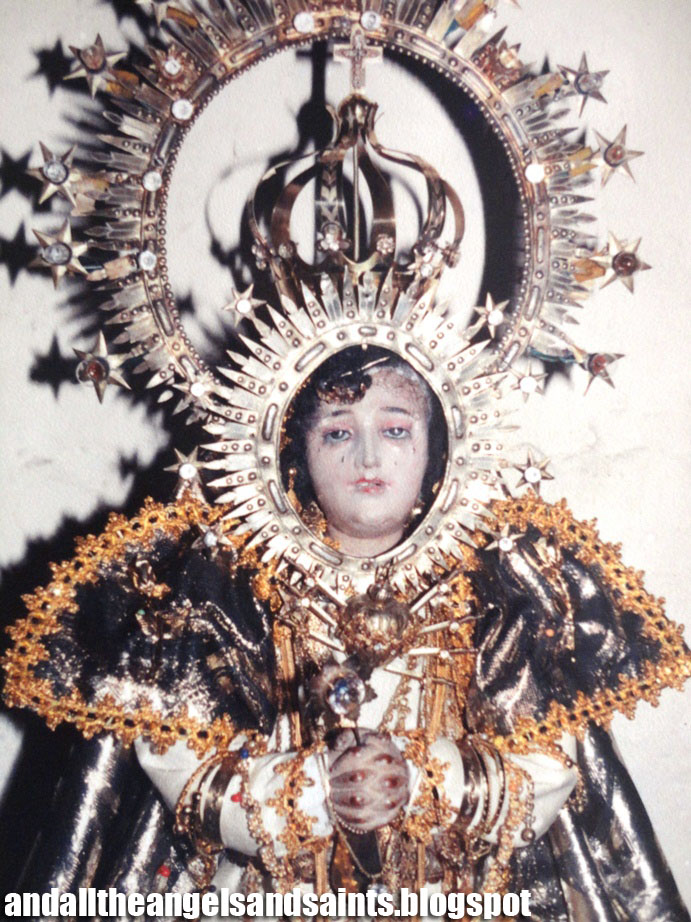

Some of the old folks of the town gathered on the shore were about to begin their traditional devotions to Our Lady. As they sang the words of the “Turumba” (a song and dance tribute that often results in people “trembling and falling down in great joy) , the image became light enough to be carried in procession. The people enshrined the image in the church and called it ‘Our Lady of Turumba’ .


Every year, on the third day after Easter, the faithful honor her with seven consecutive novenas. The image stands 85 cms high,with its face and hands made of ivory. It depicts Our Lady of Sorrows, showing her heart pierced with seven swords and a golden handkerchief in her hand. She is clothed in rich silk material with rhinestones, and she wears a blue mantle, a gold bracelet and a golden crown.

PHOTOS COURTESY of: Dr. Raymund Feliciano

Article reprinted from  “2nd Marian Congress Philippines Souvenir Program, 1954.
NOTE:  The image is actually made of wood, not ivory head and hands, as the original article reported.

Friday, February 20, 2015

215, Santo Stories: STO. CRISTO OF PAKIL

 SANTO CRISTO DE PAKIL. The ancient image of the Crucified Christ in the church of Pakil, as it appeared in the 1950s.

 In the Franciscan-founded town of Pakil, Laguna, one can find an ancient, life-size crucifix venerated at the altar near the church’s entrance. The present church itself, dedicated to San Pedro de Alcantara, dates to 1732, a masterpiece in stone marked with florid ornamentation.


 The Santo Cristo de Pakil is an object of deep veneration among residents, but is also popular among the devotees of the Virgen de Turumba. The legs and feet of the Santo Cristo have all but darkened with age, and the habit of kissing the feet and the anointing of the santo’s extremities with perfume has persisted.


 The origins of the crucified Christ in Pakil is shrouded in mystery. It was said that an old man sought refuge in the town, begging the cura to find sanctuary in the church. The kind priest allowed him in, and the old man requested that he be given some carpentry tools so he could do some work for the church, in return for the hospitality.


 When the old man did not emerge from the room after some time, the door was forced open—and the priest found him gone. But inside the room was a splendidly carved image of Christ crucified, wonderfully wrought in wood and capturing the agony of the Lord in his passion.


 The image – known as Santo Cristo de Pakil—was enshrined in a retablo menor and is used every Holy Week for the Good Friday rites. As the arms are articulated, the figure of the Christ can be brought down from His Cross to be transformed into a Santo Entierro.


 In this form, the image is processioned on the streets of Pakil, followed by a band of violinists, musicians, singers and hundreds of devotees.