Monday, January 28, 2013

136. Retro-Santo: LA PURISIMA CONCEPCION of Malabon

LARAWANG TUNAY NG MAHAL NA BIRHEN. "La Purisima Concepcion". Malabon, Rizal. ca. 1960s.

Malabon’s most important Marian image is the Immaculate Conception, a 3-foot image believed to be over 300 years old. Enshrined at the parish dedicated to Her, the image has very graceful lines, with delicately chiselled features, with hands in a prayerful pose.

 Our Lady is dressed in flowing white robes and two wind-blown mantles, one of gold and the other in red and blue. She stands on a globe with a serpent crushed under her feet. Her magnificent metalworks include a crown, a halo and a luminous silver sun and crescent moon before the globe.


For the past 63 years, the people of Malabon and Navotas honor the image with a fluvial procession held every December 9. Before being installed in an altar on a casco or a decorated barge, the image is paraded along the streets on an anda, carried by men and followed by people serenading her to the borrowed tune of “Santa Clarang, pinung-pino”.

The image is then brought to the church for a 4 p.m. Mass; after which, our Lady is conveyed on the barge by fisherfolks as the rosary is prayed and Marian hymns are sung. The barge sets sail for the Navotas River, following the river bank, until the revered image is returned to the church.

Tuesday, January 22, 2013

135. SAN ANTONIO: Patron of the Lost, Found.

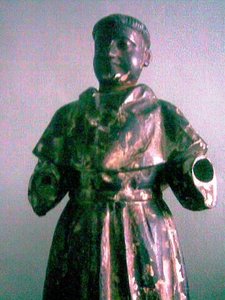
And you thought fine quality, century old-santos could not be found in second-hand shops and thrift stores. Well, I just found one in Bangkal over the holidays—a 22 inch softwood San Antonio, that plumpish Franciscan invoked by devotees when they lose something—car keys, books, money, perhaps, even sanity. Evangelista St. and its dizzying side streets offer bargain hunters and thirll seekers like me, the chance of unearthing treasures amidst its heaps of domestic refuse, broken furniture, used books, ukay-ukay clothes, bric-a-bracs and gewgaws.

On a Monday afternoon—a holiday—and under a searing sun, I took off for the famed thrift shop capital of Makati. I was not disappointed at the first store I went to—I found old oval frames which I bought for the school museum, 50 bucks each. The next store yielded a pair of pink ceramic ballet dancer figurines, typical 50s camp, my cup of tea! But with my limited budget, I was focused on finding antique religious items, as I had been on a santo spree lately. Kitsch had to wait.

So off to my old suki’s store, which often had a stray santo now and then, but Belinda was nowhere to be found. Instead—the next-door shop sitter popped in and asked me to look around her shop. Sure enough, I saw a pair of fine altar candlesticks, which excited me for about 30 seconds. ..until the price dampened my enthusiasm.

 But lo and behold—on a chair, partly hidden by dama juana bottles—I saw the peeking head of a santo, which I mistook for San Nicolas—until the owner pulled it out, revealing the unmistakable form of the friar saint.

Here he is, relatively intact, sans a pair of hands, complete with a separate wooden base, with primitive triangular patterns. He may have held a book, or a Nino at one time, but that's okay; what I don’t see, I won’t miss.

One look and I knew it was a certified antique—from the bulging eyes of the saint, the classical profile, to the delicate and detailed flow of the garments and the primitive-style orb-like peana. The santo had lost its paint totally and only traces of gesso remained. Traces of gilding could be seen on its robe.

 At the back, someone affixed a paper tape with the following information: “St. Anthony, patron saint of those who losses (sic) things. Came from Bicol region, southern part of Phil. Island. Age over 100 years old. Carved by early Christian Filipinos”. Bless the dealer for adding this information. True or not, it adds to the mystique of this ancient santo. The santo carried a hefty price tag, but I was not intimidated. I asked the shop attendant to call the owner, and I made a ridiculously low offer that she vehemently refused. Having set an asbolute limit, I prepared to go and say goodbye to San Antonio. But wait---she said if I added P200 more, I could have it.

My only problem was, I only had a thousand bucks in my wallet. Please San Antonio, find me an ATM machine! Poof! I found a working BPI ATM just across the street. Praise the saint! As they say, seek, and ye shall find.
 Wait till the next holiday week-end..

Wednesday, January 9, 2013

134. THE NINO THAT NOBODY WANTED

About five months ago, this Niño was circulated by a dealer via SMS to collectors and prospective buyers. It was passed on to me by a colleague who said that it was available for Php25,000.

One look and I was instantly turned off by the sorry state of this image carved in softwood. The Holy Child, which looked very old, seemed to have caught a bad case of vitiligo—it had peeling encarna all over his face and body.

To make matters worse, it had broken toes and fingers, and its glass eyes were blackened with age, giving it a look not unlike a creature with a ghostly stare.

It was pretty obvious that there was also something totally wrong with the way it stood on a pointed wooden perch that was affixed to another circular base.

Clearly, the base was not original to the piece—and upon closer examination, I saw that the foot of the Niño was just screwed onto the perch, which suspiciously looked like an old architectural detail salvaged from some antique house.

But I sensed something special in the Niño itself, barring its major imperfections. For one, it was classically carved, well-proportioned and, at 12 inches, was of very good size.

The standing Niño shows his two uplifted hands, with the left hand in a palm-up position. The right arm, which is traditionally raised in the act of benediction, curiously shows a set of hands turned inwards, in a grasping position, which indicates that the image may have held a staff or a rod at some time (or maybe an orb?)

It was also an authentic antique, perhaps a century-old, based on its patina. At the back, there was a paper label that was glued on the carved piece, indicating that, at one time, it was part of a Manila antique shop inventory. Cagayan was listed as the image's provenance, and that it was from the 18th century.

Apparently, after peddling the image for several months, the Seller found no Buyer. It was then that I received another phone notification from a friend who had originally seen the Nino's photo, informing me of another cut price--this time, to more than half! My friend acted as a middleman, and in no time at all--I had the piece delivered to his office. The Nino was mine!

 Soon as I brought the image home, I removed it from its perch and discarded the base, which was not old, after all. Left with just the damaged image, I came to a decision to have it re-painted and completely restored. Some collector-purists would disagree with me on this—preferring to keep the image in its original state to preserve the integrity of its antiquity, but I was not interested in creating a museum piece.

 As has been the case, off I went to see Dr. Raffy Lopez to consult him on this project. I had several ideas about the Niño’s restoration, inspired by some images in the Santo Niño book of Ben Farrales.

In the end, I decided on a “cushion base” for my Christ Child (made by Celso Mataya), adapted from my preferred peg featured in the book.

 Raffy and I agreed on an appropriate color for its encarna—something close to the complexion of Spanish/ Mexican colonial pieces that are characterized by a rosy blush. His painter, Edgar, new to the santo scene, did the paintwork and this was how it looked with the first paint layer:

 Its broken fingers and toes had earlier been repaired by Bong Lauderis, Raffy's resident carver. When the Nino was staged on its new base, it looked something like this:

I felt that the potencias (by Dodong Azares) were way too big for the Niño head, and Raffy agreed to change them. And there was still something spooky about the eyes, so those were eventually changed too.

 A few more days, and the Nino--standing 16.5 inches tall on its new base-- with its replaced potencias, new eyes and eyelashes—plus a free gold thread embroidered tapiz, courtesy of Raffy Lopez was ready to be picked up.

All it needs is a staff and an orb, which my metalsmith from Mexico will create. Maybe a new open crown and a longer wig will be made for my newest santo, but in the meanwhile, I am just happy with the thought that the Santo Nino that nobody wanted had finally found a home!

Wednesday, January 2, 2013

133. THE ROAD TO CALVARY


I have always wanted an antique ivory Calvario tableau for my collection, but their availability—not to mention their prohibitive cost, have thwarted this dream. The closest I could get to owning one was when I purchased in Apalit, this part-ivory Crucifixion set. One look and you will know that it’s been put together—the wooden Christ with one outstretched arm, actually is part of a 2-character tableau that included the now-lost figure of St. Francis embracing Christ.


Two ivory santos have been redressed and added to the crucifix-- San Juan and a Dolorosa—which originally was a Magdalena. The two had ivory heads and hands (many missing fingers though). The santos were crammed in a primitive urna, and it is in this state that I bought them, with the intent of separating the two ivory figures and putting them on separate bases. This was what I actually did, with the help of expert santo restorer, Dr. Raffy Lopez. I gained two individual ivory santos but now lost a tableau!


 I forgot about owning a Calvario tableau until, this year, I chanced upon this antique wooden crucifix that was so badly disfigured and messed up with silver paint. But I really didn’t care much for the wooden Christ—it was the silver grabado cantoneras that appealed to me. The crucifix was set on what seemed to be its original base that simulated a stoney mound. Since I could afford it, I bought the crucifix and had it immediately restored.


A month and a half later, the Crucifix was returned to me—and the painted restoration stunned me.


 The new encarna showed the exceptional carving of the figure—from Christ’s pain-racked expression to his bloodied physique—one of the finest I’ve seen. Raffy had given me an old wig that fitted the Cristo perfectly.


Rummaging through my own stock of old santo stuff, I found a small silver thorny crown that also matched the head size of my crucified Christ.


Meanwhile, at the recent Greenhillas Antique Fair, I found an almost complete set of silver fittings for a standard crucifix, including these INRI and the symbolic sun with a face, with a spring mount.


From another old crucifix, I salvaged 3 silver potencias, which were of the right size for my Cristo. I was rather pleased with the result.


It was at this point that I toyed with the idea of assembling my own Calvario —using this completed and fully restored crucifix as the focal point of the tableau.


The ivory San Juan and Dolorosa were almost proportional in size to the crucified Christ and I figured they could be re-set on the original stoney mound where they could stand flanking the dying Christ figure. In the past, I have seen many Calvarios that featured wooden Christs matched with ivory Johns and Marys, so I thought I could do the same here.


Again, I took the ivories to Dr. Lopez who dismantled them from their bases and staged them on the restored base which had been raised to half an inch, then refinished and repainted.


 The final step was mounting the crucifix on the mound—and the pleasing results are on this page. The road to recreating my own Calvario is done. Consummatum est!!

Tuesday, December 18, 2012

132. Private Devotions: CRISTO REDENTOR of Familia Llacer-Teotico

ENTHRONEMENT OF CHRIST THE REDEEMER OF THE LLACER-TEOTICO FAMILY, 20 October 1925.

A rarely-seen representation of Christ the Redeemer (Cristo Redentor) in a standing position, holding a cross, owned by the Llacer-Teotico family. It is possible that the Teotico side of the family is related to the acclaimed multi-awarded sculptor from Sta. Cruz, Manila, Domingo Teotico. He had a religious statuary shop along Palma St. in Quiapo.


Christ the Redeemer is carved in the round, and stands on a magnificent cloud base adorned with 4 cherubs. The plain cross he holds in His left hand stands out from the classically-carved image dressed in white robes wth decorative gilding on the edges. The other hand is raised in benediction. Normally, the exposed heart is not part of the iconography of Christ the Redeemer, but the sculptor probably took creative license and carved the sacred heart in relief.The most iconic image of Christ as the redeemer of the world is the giant marble statue in Brazil, which today is recognized as one of the world's seven wonders.


Christ is the world’s Redeemer, 
The lover of the pure, 
The font of heavenly wisdom, 
Our trust and hope secure, 
The armor of his soldiers 
The Lord of earth and sky, 
Our health while we are living, 
Our life when we shall die.

(--attributed to St. Columba)

Tuesday, December 4, 2012

131. WHAT CHILD IS THIS?


Before a Filipino santo online dealer fell from the good graces of ebay (he failed to honor legitimate winning bids of buyers, myself included, resulting in 18 negative feedbacks in one month), I was able to get this antique, 8-inch Niño of heavy wood—bald, with peeling paint and glass eyes blackened with age, making him appear pupil-less and eerily blind. The Child Jesus, in a semi-standing position with legs slightly bent at the knees, has his right hand raised in blessing. This arm was threatening to separate from the rest of his body, but other than that, all parts were intact, including his fingers.


 At first, I thought this must have been detached from either a Virgin Mary or a St. Anthony figure—except that the position of the legs, which are almost upright, does not indicate that he was seated. The back showed no hole from where a peg is often placed to secure it to the main image; instead, the Niño’s bottom has a small hole where a peg could be inserted to make Him stand. In fact, it came to me mounted this way.


I have seen standing Niños atop the book held by San Antonio, but this image is too heavy to be put in such a precarious position. It could not also be a Dormido--a sleeping Jesus-- for its eyes are wide open. I could only surmise that this is a small Salvador del Mundo in a lying down position. Besides, the soles of the feet were not carved flat, so he could not have possibly stood on a peaña; the hole in his bottom could have been used to hold him upright during the painting process.


 Done with my conjectures, I brought the Niño to Nick Lugue as a ‘finish-when-you-can-minor project’ alongside my more important commissions. It took awhile to have the small image repaired and repainted, but I was in no real rush, as I haven’t figured out what to do with it.


In the meanwhile, I found an embroidered strip of cloth from an old Dominican santo vestment, so I saved that for the Niño as I thought it would make a perfect tapiz. Putting my limited sewing skills to use, I managed to make the strip into a decent wrap-around for the Niño. Then it went into storage in a cardboard box for a months, as I was kept busy with my Mother’s lingering illness.


A week ago, I decided to skip lunch and check out Manila’s antique shops. Antique-hunting has a way of lifting me out of my depression, even if the effect is just temporary. It was at Padre Faura, at the shop of Floy Quintos, that I found this small, antique tiara encrusted with paste jewels, and engraved with the name of its previous owner, “Maria Purtran Hermana, Enero 6, 1924-1925”. I thought of my Niño, momentarily forgotten in a cardboard box stowed inside my book cabinet. I bought the tiara, vowing to complete my Niño project this weekend.

Saturday afternoon, I took out the Niño and started putting things together, outfitting it with a wig, a leftover from another project, and a necklace made from tiny old beads. The antique tiara was a bit big for his head, but a slight adjustment solved the problem. This was the result:


The last step was finding the right size urna for my restored Salvador del Mundo—or whatever Child was this-- and thank God, I had one in stock. You’ll never know when you need one.


So, there. Maybe I’ll put mother-of-pearl flowers when I find some, but in the meanwhile, you can consider this project successfully done and finished!