Sunday, October 21, 2012

127. Visualizing Sanctity: SAN PEDRO CALUNGSOD by Thom Joven

The country is thrilled to see the courageous teen "beato" raised to the rank of a saint--San Pedro Calungsod--only the second Filipino saint after San Lorenzo Ruiz. San Pedro Calungsod (b.1654 – d. 2 April 1672) was  a young sacristan who worked alongside San Diego Luis de San Vitores and who was martyred  in Guam for preaching Christianity to the Chamorros through catechism.

Beatified on 5 March 2000 by Blessed Pope John Paul II, Calungsod was  canonized by Pope Benedict XVI at Saint Peter's Basilica in Vatican City on 21 October 2012 together with 6 others: Jacques Berthieu, a Jesuit martyr-priest ,Giovanni Battista Piamarta, founder of the Congregation of the Holy Family of Nazareth, Maria Carmen Sallés, founder of the Conceptionists Missionary Sisters of Education; Marianne Cope, a religious who worked among lepers, Kateri Tekakwitha, the first Native American Saint and Anna Shaffer from Germany.
San Pedro Calungsod's most well-known representation is based on a portrait modelled by then 17 year old Ronald Tubid, a basketball player from Iloilo. This same portrait became the basis for artist Rafael del Casal's artwork done in 1999 that was used as the official picture for the canonization rites in Rome. Del Casal's portrait is the first to feature a Christogram, the seal of the Society of Jesus with which San Pedro was associated. Sculptors Francisco dela Victoria and Vicente Gulane (Cebu), Felix Baldemor and Justino Cagayat Jr. ( Paete, Laguna), also created statues of Calungsod in 1997,1999 and 2012, respectively. Most images show the saint wearing a white camisa and trousers, with his characteristic palm, a rosary,a crucifix or a Doctrina Christiana book pressed to his breast.
Pampanga's most accomplished ecclesiatical artist, Thom Joven of Bacolor has also been commissioned by Bishop Angel Lagdameo of Iloilo to execute his santo version of the teen martyr, following his approved iconography. Made by a local carver under his stringent supervision and personally painted using traditional encarnacion technique, San Pedro Calungsod stands all of four feet and bears a strikingly young, lifelike and saintly mien. He pensively looks at an open book of Christian doctrine, with another hand holding a palm branch in brass--his official attributes.

It is impeccable in its simplicity, and appropriately so, for the saint lived a life of austerity and hardship while catechizing in the Marianas. Just like San Lorenzo Ruiz, he is similarly attired in a camisa chino-daily wear for most Filipinos-and a pair of loose, hanging pants. Carved in the round, he is shown unshod, unlike other representations where the saint wears sandals.
Thom Joven is well-known in the santo circle as a leading figure in saving and restoring the altars, niches and wooden saints of San Guillermo Church in Bacolor, heavily damaged by the Pinatubo aftermath. He has likewise worked on the San Vicente de Zaragoza Church, also in his hometown. His prized works and restorations are in private collections and have even reached the Vatican--an image of of Nuestra Sra. de Guia, was chosen by then Pres. GMA and given to  Pope Benedict XVI as a "Gift from the Filipino People". His interpretation of the likeness of San Pedro Calungsod is indeed, a most apt artistic tribute to one who now belongs to the pantheon of saints of the Catholic Church.
FEAST DAY: Celebrated every 2nd day of April, the anniversary of his martyrdom. If the date falls within Holy Week or Easter Week, the feast is observed on the Saturday that immediately precedes Passion/Palm Sunday. If April 2 falls on a Sunday of Lent or on a Sunday of Easter, the feast is celebrated on April 1.

PRAYER:
Blessed Pedro Calungsod, young migrant, student, catechist, missionary, faithful, friend, and martyr, you inspire us by your fidelity in time of trial and adversity, by your courage in teaching the Faith in the midst of hostility and by your love in shedding your life’s blood for the sake of the Gospel of Jesus. 

We beg you, make our cares and troubles your own [here mention the special intention you are asking him to bring to the Lord] and intercede for us before the throne of Mercy and Grace, so that as we experience the help of Heaven, we may be encouraged and strengthened to proclaim and live the Gospel here on earth. AMEN. 

 (Imprimatur: Ricardo Cardinal J. Vidal) 

(ALL PHOTOS USED WITH PERMISSION, COURTESY OF MR. THOM JOVEN).

Thursday, October 11, 2012

126. SAN JOSE & STA. MARIA: Santo Shopping on Buy and Sell Free Ads


Before ebay, I had long ago been a fan of Buy and Sell Free Ads, that tabloid size magazine full of classified ads, with long listings of services and products for sale, of the wide and wild variety. My toy collection for instance, was expanded by my purchases of vintage Batman figures, Fischer-Price toys, Mattel dolls and tin lunchboxes, all obtained from advertisers on this paper. One man’s junk, is another man’s joy, so they say, and my joy of the moment happens to be antique santos, a quest that has led me to all sorts of places, from Kamuning shops to cyberspace and to the pages of Buy and Sell Free Ads.

While 95 percent of the items are of no consequence to me, I do pay attention to the listings under “Antiques”, “Collection” and “Arts” every now and then. Two and a half weeks ago, I picked up a copy of Buy and Sell from a sidewalk stall and checked out the entries under “Antiques”. Lo and behold, almost lost among the ads selling Rolex and old coins was an ad announcing “4 foot processional santos for sale, P120,000”.


 I learned never to be fazed by exorbitant price tags attached to items for sale; there is no such thing as fixed price especially if the item remains unseen and uninspected. A few years ago, a lifesize Agony in the Garden Cristo together with a Salome and a San Isidro Labrador were being sold as a lot for a six figure sum, but I successfully negotiated for the sale of the Cristo alone for a fraction of the desired price. I just wondered if my magic will work again for this pair.

I called the number and I managed to talk to the Seller, who was from Pasig. I asked him to describe the images and he said they were a Mary and Joseph, both family heirlooms that were once processed before. I asked if there was a Nino and he said, as far as he could recall, the pair never had a Niño, as the standing images had separate bases. I asked if it were possible to send me pictures by mms or by e-mail, but the Seller was not savvy with either both cellphone and computer. Nevertheless, he said he will ask a relative to send the photos via the internet. I gave my e-mail address and waited.


Three days after, I received an e-mail from him with the attached pictures badly taken from a cellphone camera. But even then, the quality of carving was very much evident in the faces, as well as the encarna, moreso on the San Jose image. The only thing that worried me was the size; they did not look at all like 4-footers to me; they looked shorter. I delayed giving him a call for fear that I might sound too enthusiastic, and it was only the next day that I gave him a ring.


 When he answered, the first thing I confirmed were sizes of the images—if they were indeed 4 feet tall. He said they were—but with the bases. It turned out that the images were 38 inches tall, with 10 inch bases. My minimum requirement for a processional image is that it should be at least 42 inches tall, without the base. But the Seller maintained that these are processional images, indeed and the holes on the bases prove that. My guess is that that these may have been oratorio or chapel images, meant to be placed on both sides of a major image. The holes may have been use to bolt the image to the niche. But whatever, I still found the images to be small for my taste.; However, I said that I would drop by to do an ocular check on a Sunday weekend, my only free time. I made sure my sigh was audible for him to hear when I hung up the phone.


So one recent Sunday, on my way back to Makati, I swung over to Pasig to meet the Seller. Thank God for my new driver who was familiar with the area; I don’t think I can locate the address on my own. We parked the car at McDonald’s in front of the Cathedral, and in a few minutes, the Seller came a-knocking at my car.


He looked pleasant enough, not the serial killer that I imagined him to be. He took me on a labyrinthine route that led to his place--a small, overcrowded apartment full of house parts, furniture and other indescribable stuff. In the garage was the half of a big arched carved door, an antique piano, a couple of rundown cabinets and stacks of newspapers and magazines. Inside the living room, I found the other half of the arched door leaning on one wall, a broken altar table before it. A platera with old bottles was next to the window partially covered with a stained glass divider. As it turned out, he related that the lot on which their ancestral house stood was brought by a fast-food chain, so now the contents of their home were crammed into this shoebox apartment.


When I turned to one corner, there were the santos, finally, atop another table overflowing with house décor and houseware. It was bedlam in here, but thank God, I did not have trouble focusing on inspecting the images before me. The images were dirty and in a state of disrepair, the bodies had peeling paints and the bases were missing some border trims. Sta. Maria’s hands had multiple broken fingers, but all the digits were intact. What was most important was that the heads were preserved, and what beautiful heads were they! They were genuine antiques, carved from light wood, with smooth pegs and flaking encarna indicating their age.


 I felt that San Jose was the better image, as the carver had to carve more details like facial hair and beard. It bears its original dark encarna. The Sta. Maria had plumper cheeks, and in fact, looked bigger and heftier than San Jose. It looked like it had been painted over once, which would explain its fuller look. It still had details like pierced ears, which had on a pair of old rhinestone earrings.


I had actually devised a visual test for ascertaining the beauty of santos, and this is to view the heads at a quarter-turn. You not only see the profile, but you also get a better look at their expression, rather than when the santo faces you up front with a blank, pointed stare.


When I did that to the Sta. Maria head, she looked so sweet and amiable while the San Jose had the most perfect nose and chin! I was sold on this pair, but the challenge was how not to show my gung-ho enthusiasm.  “I don’t know, “ I told the Seller, “they’re good pieces, but honestly, your price tag is too steep for such small pieces..”.


 “What you’re saying is, you like them”, he surprised me by saying, “ except the price? Maybe if you could give me an offer, one that would make me and you happy. I really need the money to rehabilitate our Baguio property...” . I put in my offer, and at that point the Seller became jumpy. When a Seller behaves this way, believe me, it means that you are close to the price that is already acceptable to him. He said, “Oh, but if you could add a little more..”. And so I did.


 We sealed the deal with a shake of hands. I paid him and I lugged the two dismantled santos to my car, together with their tattered wigs and replacement brass halos—my purchase of the year! The bodies went home to Pampanga, while I brought the heads with me to my Makati place for me to further ponder on. I can’t wait to have them restored; when repaired, repainted and dressed, they will look perfect in the altar of our Pampanga home. True, the best things in life may not be free, but some are on the FREE Ads of Buy and Sell.

Sunday, September 30, 2012

125. VIRGEN MILAGROSA: A 'Miraculous' Restoration


I rarely make visits to my oldtime Angeles dealer, whose residence-cum-shop is tucked in one of the narrow side streets of Friendship Ave., near Clark, but when I do, I never fail to bring home a good buy or two. I’ve known this dealer since my interest in santos began in the 1980s, and he used to have a popular shop right on Friendship Ave.

The shop was always filled with Americans back then, mostly dependents and families of U.S. servicemen who populated Clark and its nearby environs. I would see them browse though his store, enthralled by the richness of his merchandise—from Oriental plates, colonial furniture to local arts and crafts and, of course, santos. He enjoyed brisk business all through the 80s and 90s, until Mt. Pinatubo took all that away.


But I remained in touch with my dealer, now grown more hoary, eccentric and sickly. After all, I was a loyal customer, buying regularly what I could afford. What I could not, he would let me take home anyway, to be paid in several affordable installments.


 Four months ago, I met up with him and as always, he opened his doors to me. My visit was really a social call, as I learned that he had been hospitalized again. But he seemed fine enough to ply me with his “new arrivals”, a fresh stock of antiques from Ilocos—all laid out for me to peruse on a table. One look and I knew they were mostly clever reproductions mixed up with a few old santos that were not really up to my liking.

I turned my attention to an old cabinet that contained more stuff—and it was there that I found a santo image, broken in 3 different places. It had no hands, and the feet had been detached from the globe base, which clearly identified the carving as an Immaculate Conception image. The santo was of the manikin type, and it was fortunate that the head was still intact, but loose from the body.


 A close inspection showed that the head was outfitted with glass eyes and was carved in great detail—including neck rings. The face was not exceptionally pretty, a bit roundish, the nose a bit big and the lips, pursed and thin. The arms were threatening to disengage from the body, which was in good condition. A portion of a snake coiled itself around the globe base, partially eaten by termites and missing its stand.

When I expressed my interest to buy this damaged santo, I could sense my dealer’s surprise. He wanted PhP 1,000 for it, but I hemmed and hawed, until we agreed on PhP800. I am sure he was happy to get rid of that santo which seemed beyond repair. The santo in all her sorry state, languished in a shoebox for another two weeks or so until I finally brought it to the Apalit shop of santero Nick Lugue. I had an ivory project with Nick, and I thought I’d throw in the broken santo too, for him to work on, no rush. That time, I had made up my mind to transform it into a Virgen Milagrosa, by whose name our town patron, Our Lady of Grace, was also known.


 Nick carved hands for the santa, added a stand to the globe base, and repaired the snake. The feet were reglued to the base and in a month, I had a 21 inch, completely repaired and repainted Virgin, standing securely on a gilded orb.


Nick had the wonderful sense to keep the original white paint of the santa’s torso, the only part that was undamaged, to serve as proof that this was an antique piece. But Nick did even better—he restored the santa for free, for which I will always remain grateful.


In early November, I finally had the time to bring the restored santa to the shop of Dr. Raffy Lopez. I've always liked Raffy's candor, and as I was still unsure at that time, I asked if my restored santa was worth transforming at all into a Milagrosa--considering its aesthetic quality. he said that with the appropriate vestments and slight facial retouches, he could bring out the beauty of the santa, which to him had an interesting air.


 First, the metalworks—a pair of rays, an open crown and a simple 12 star halo—were commissioned from the workshop of master metalsmith, Dodong Azares. I was familiar with his work as some of the metal accessories used by my processional santos were done by him. It was clear that he is just as adept in creating small-scale metalworks as shown by these detailed pieces.


 It took a little over a month for Raffy to finish the project, and when I finally got to his shop to see the completed Milagrosa, I was completely bowled over by the amazing transformation, a total makeover that went beyond my expectation.


 Vested and robed, and with features defined (the eyebrows were thickened and arched, nostril dots were painted on, the eyes were lined), my Virgen Milagrosa now stands taller (additional 5 inches courtesy of the halo) and more beautiful than when I first found her.


In her blue and white vestments, she reminds me so much of Pampanga’s own Virgen de los Remedios. Home in time for Christmas, our La Virgen Milagrosa now occupies a special place in our altar, a new object of our veneration, and a beautiful reminder that miracles do happen!

Thursday, September 20, 2012

124. SANTOS FROM THE CHURCHES OF SAN PABLO

An altar-ful of santos from the Diocese of San Pablo and its Churches. From the book edited by Chit Lijauco and photographed by Mon Acasio. (c) 2000 by the Diocese of San Pablo.

 SAINT GREGORY THE GREAT. From the church of San Gregorio Magno. The patron saint of Majayjay, he was elected Pope in 590 A.D., the first Benedictine to occupy the highest position in the Catholic hierarchy.  He was resposible for the Gregorian chant. Feast Day: March 12.

 ST. BARTHOLOMEW. From the church of San Bartolome de Apostol. One of the 12 apostles of Jesus. Tradition holds that he preached in the East and died a martyr's death in Armenia, being flayed alive for having won converts to the Lord Jesus.. Feast Day: August 24.

 ST. PETER ALCANTARA. From the church of San Pedro de Alcantara in Pakil. The town's other patron is the Ntra. Sra. Dolores de Turumba. Feast Day: October 19.

 VIRGIN OF GUADALUPE. From the church of Our Lady of Guadalupe in Pagsanjan. Fray Agustin de la Magdalena donated the first image of the town patron, Virgen de Guadalupe in 1687. A new image was crowned in 1947 by Bishop Obviar. Another image was donated by the Basilica of the Ntra. Sra. de Guadalupe of Mexico in 1958. Feast Day: December 12.

 ST. JOHN NEPOMUCENE. The second patron saint of the town of Pakil is the martyr San Juan Nepomuceno. Feast Day: December 11.

OUR LADY OF O. From the Church of Our Lady's Nativity in Pangil. The image of the pregnant Virgin and the Christ Child were sent by King Carlos II to Pangil in 1764 as sign of his gratitude. Feast Day: December 18.

SAINT ANTHONY OF PADUA. From the church of San Antonio de Padua in Pila. The Franciscan patron is housed in the first Antonine parish in the Philippines (est. 1581). The town's other patrons include San Roque and Virgen de las Flores. Feast Day: June 13.

SAINT ROSE OF LIMA. From the church of Santa Rosa de Lima in Santa Rosa. The Peruvian santa, whose devotion was begun by Dominicans who first ministered in the area in 1792. Feast Day: August 23.
SAINT JOHN THE BAPTIST. From the church of San Juan Bautista in Calamba. The church where Dr. Jose P. Rizal was baptized was rebuilt after WWII. Feast Day: June 24.

SAINT PAUL. From the magnificent domed Cathedral of San Pablo in San Pablo. The first hermit is the patron of the town, although images of San Francsico de Asis and San Agustin are displayed prominently on the church facade. Feast Day: January 15.

Sunday, September 16, 2012

123. VIRGEN DEL ROSARIO: A Patron Recovered, A Devotion Restored


For many years now, I have been looking for an affordable antique Nstra. Sra. Del Rosario ivory; we have long considered the Virgin of the Holy Rosary as our family patron. After all, my mother’s surname was Del Rosario, and as a young woman growing up in Angeles, she would pay homage to Our Lady at the ancient Sto. Rosario Church.


When my mother passed away in 2009, it became even more imperative to look for a Del Rosario image. Sometime in December 2009, I texted a free-lance dealer on a whim, asking if he had old ivories for sale. Sure enough, he texted back—he had one, he said—a Virgen del Rosario. I didn’ expect him to respond too soon, as I realized that my antiquing budget had been stretched too far with my almost-weekly acquisitions of vintage paintings, processional images (a pair!) and other sacred art.


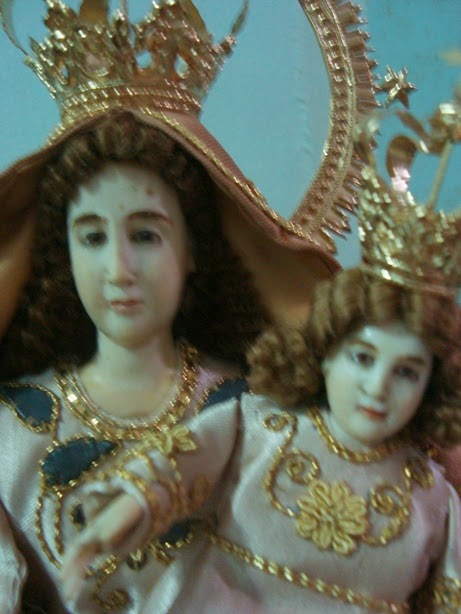
But when he sent me an MMS photo of the antique image, I was taken by the simple yet beautiful qualities of the image, despite its flaws. Obviously, this is not a top quality image—the carving shows that: the facial features are not well defined and the fingers are of the usual “tinidor” style, associated with folk images. But the ivory parts of this Virgen del Rosario are complete, from the heads and hands of the Virgin to those of the Child Jesus. It is becoming increasingly rare to find complete Del Rosarios these days. Often,  antique shops separate the Virgin from Jesus, which are then sold individually.


A closer look at the images reveal that the bodies are without any damage and the original gilded base, though ridden with holes, remains intact. While the images still have their original human hair cabelleras (wigs), they have lost their glass eyes.


The vestments, with simple and sparse gold embroidery,  have also survived,  but I doubt if the tattered clothes can still be salvaged. I would be crazy if I passed up this Del Rosario, and so, after a short wheeling-and-dealing, the seller agreed to my offer and came rushing to my office to personally deliver the antique Mother and Child santo.


After Christmas, I came a –calling once more on Dr. Raffy Lopez, my suki restorer. He still had to finish my 3 santo projects with him, and here I am again with yet another one. Already harassed with vestment orders for the approaching Sto. Niño Malolos Exhibit on January 24, Dr. Raffy nevertheless took on my usual “no-rush” Del Rosario project.


Two and a half weeks after, I got a text that the Virgen del Rosario  was ready for pick up. Now, that was fast! As always, the results were amazing. Now outfitted with glass eyes, daubed with color and wearing new wigs (I had wanted to save the original frizzy human hair wigs  on the images as they gave them a real antique look, but alas, they had become too brittle to be re-used), the ivory faces looked more expressive.


Although we initially agreed on a blue and pink ensemble--a quick examination of the faded vestments actually showed her cape to be blue—I eventually opted for a cream and gold ensemble. Besides, I already had an Immaculate Conception vested with the same color scheme.
 

The vestment design was based on some antique metallic embroidery I had long ago saved from an a lost Del Carmen image. The rosette and trefoil patterns were re-assembled on the front of the robe and the cape, supplemented with new embroidery.


As I was absolutely clueless about  crowns and halos, I left the choice of metalworks to Dr. Lopez, who commissioned his platero, Dodong Azares, to make identical gold plated brass crowns.


A few before and after photos are shown here, to give you an idea of the extent of restoration done on the Virgin:


Thus restored, our antique Virgin del Rosario is housed inside a 20 in. made-in-Spain virina purchased from ebay, with a customized base provided by Dr. Lopez. 


Maybe I’ll add a mini-rosary and a scepter later, but for now, I consider this project completed.