Tuesday, July 24, 2012

118. Holy Week Santos: SAN PEDRO


The first santo figure that heads the Holy Week processions in the Philippines is the image of San Pedro. His name in Greek means “rock”. Saint Peter or Simon Peter is one of the twelve apostles of Jesus, and acknowledged as the Prince of the Apostles and the first Pope.


The son of Jonah, San Pedro was born ca. 1 BC in the village of Bethsaida in the province of Galilee. His brother, San Andres (Andrew) was also an apostle.
 

Originally a fisherman, San Pedro was assigned a leadership role by Jesus and was with him during important events such as the Transfiguration. He was part of Jesus' inner circle, saw Jesus walked on water, denied Jesus, was restored by Jesus, and preached on the day of Pentecost.


He is said to have been put to death by crucifixion at the hand of Emperor Nero in Rome, possibly in 67 A.D.  Since he deemed himself unworthy to be crucified in the same way as Christ, the cross was positioned upside down.


San Pedro is portrayed in Philippine images as an oldish man having  a short, square beard with a tuft of white hair on his bald pate, curled at the center of his forehead. In antiquity, he was depicted with a full head of hair.


His primary attribute is a pair of keys, referring to Christ's words to Peter in Matthew 16:18-19, "I will give to thee the keys of the kingdom of heaven."  There is a gold key to open the heaven and a silver key to open the gates of hell. These are shown either being held by the saint in one hand or shown hanging from his waist.


San Pedro also often has a book, a reference to the two New Testament letters ascribed to him. When not holding his attributes, he is shown with clasped hands, in a prayerful pose.


San Pedro's triple denial of Jesus is one of the most common narrative images involving the saint and is symbolized by the presence of a rooster (“manok ni San Pedro”), which crowed thrice every time the fearful saint denied the Lord. The rooster is shown standing separately on a pillar, or placed by his feet.


In Bulacan—in the towns of Bocaue, Marilao, Sta. Maria and Meycauayan—a machete-holding San Pedro comes out during Holy Thursday processions, in reference to his protecting Christ from the guards who had come to arrest him in the garden of Gethsemane. The “tabak” he wields recalls the faithful apostle’s attempt to cut off the ear of Malcus. The next day, Friday, the hands are replaced with clasped hands.


His feet are bare or sandaled and his garb almost always consists of a long, sleeved tunic in green, matched with a deep yellow mantle draped over his shoulders.

Wednesday, July 18, 2012

117. ICONS OF ST. JOSEPH ON EXHIBIT

Originally published on Philippine Daily Inquirer Lifestyle 5 March 2007, Monday 

A back-to-back exhibit will open at the Museo de Santo Domingo in Quezon City as part of the celebration commemorating the centennial of the canonical coronation of Our Lady of the Rosary, La Naval de Manila, as Patroness of the Philippines. The fourth and fifth in a series of exhibits will begin on March 10 and 24, respectively.

 SAN JOSE CON NINO JESUS. An early 20th century piece courtesy of Gino Marasigan. 

The fourth exhibit, "San Jose, Esposo de la Virgen", will feature various images and depictions of St. Joseph, the patron of the universal church. Gino Marasigan, with his early 20th century image, is the hermano of the exhibit, together with the Cofradia de San Jose headed by Rolly Tayo. Other images and icons will be provided by designers Manny Castro; Steve de Leon; Fr. Roland dela Rosa, OP; Fr. Robie Reyes, OP;Nena Bernales; Ting Escobar; Deus Antique Shop; Toots Munar; and museum curator Rei Nicolas.

 SAN JOSE, from the collection of Rei Nicolas. 

The special veneration of St. Joseph began in the east where the apocryphal "History of Joseph" enjoyed great popularity in the fourth to the seventh centuries. In the ninth century, Irish Felire of Oengus, a commemoration is mentioned, but it was not until the 15th century that the veneration of St. Joseph in the west became widespread when his feast day was introduced in the Roman Calendar in 1479. The devotion was particularly popularized by St. Teresa of Avila and St. Francis of Sales.

The chaplain of the shrine, Rev. Fr. Roberto Pinto, OP will open the exhibit on March 10, at 4: 30 p.m., with a blessing of the information lobby of Santo Domingo Convent. The exhibit runs until March 19.

 VIRGEN DOLOROSA, owned by Tom Joven. 

The fifth exhibit, "Misterios Dolorosos" will open at the Museo on March 24 and will run until April 6. It highlights the rosarian character of the Sto. Domingo Church, with rare images, icons, photos and prints of the suffering of Christ and the Mater Dolorosa on exhibit.

Wednesday, July 11, 2012

116. RETRO-SANTO: Ntra. Snra. de Guia


Ermita in Manila is the site of a shrine dedicated to Our Lady of the Way, represented by what could be the oldest Marian image in the Philippines. The image of "Birhen ng Patnubay" (or Ntra. Sra. de Guia) is a small wooden image found on the shores of Manila on 19 May 1571 by a Spanish navyman who came with Miguel Lopes de Legaspi's expedition. 

Its strong resemblance to the Santo Nino of Cebu leads us to believe that it must have been brought to the Philippines by Ferdinand Magellan, who made an earlier voyage in 1521. The image was discovered atop a pandan bush, while being adored by natives in a pagan ritual. The image was taken by the Spaniard amidst great rejoicing, and from that day on, it was said that the Virgin "began to shed the rays of her charity i ever so many miracles which she wrought in behalf of the people at large and the Navigators". Thus, she was given the title of "Virgen de Guia" (Guide) and named as the protector of the galleons in Castille. 

Like the Santo Nino, the De Guia image is believed to be of 13th century make, with a style characteristic of Flemish carvings. She is shown with clasped hands, with palms facing each other, wearing a large bejewelled crown and halo. It rests on an elevated base trimmed with pandan leaves, in direct reference to how it was seen upon Her discovery.

On 9 August 1758, the Spanish king declared the Ntra. Sra. de Guia as the "sworn patroness" of the city of Manila. The image survived the pillage of Chinese, earthquakes and the catastrophic effects of the last World War. It was sealed in one of the niches of the crypt of the stone church and was dug up only during the Liberation, placed under the care of a Taft Avenue resident until it was safe to enthrone her at her shrine where she has reposed ever since.

The image was canonically crowned on 30 December 1955 by Archbishop Egidio Vagnozzi and was  blessed by Pope Paul VI at the Manila Cathedral on 27 November 1970.

Shrine: Ntra. Sra. de Guia Parish, M.H. del Pilar St.
Feast day:  Last Sunday of December

Tuesday, July 3, 2012

115. RETRO-SANTO: Nstra. Sñra. Del Pilar of Sta. Cruz

DEL PILAR VIRGIN, as she looks in 1954, enthroned at the Sta. Cruz Church, Manila.

The original Virgin of the Pillar resides in Zaragoza, Spain. The one enshrined in the Sta. Cruz Church in Manila is a replica of that statue, bought to the Philippines by Jesuits before 1768.

“La Pilar” has ivory head and hands, mounted on a carved wood beauty. She holds the Child Jesus, made entirely of ivory. The Mother and Child, which were once arrayed with radiant jewelry, sits on top of a pillar, based on a legend in which the Virgin appeared before St. James in that manner.

As early as 1743, a confraternity already existed in the district, thus the arrival of Virgen del Pilar made the devotion official. As a patroness of the Sta. Cruz district, she was the object of prayers, mid-day Saturday Masses and recitation of the Rosary. During novenas, the statue was mounted on a carriage and placed at the left side of the altar until after the procession.

During the second World War, it was taken from the baptistry where the image was kept and and stored inside a bank vault in the office of the PNB president, Juan B. Quintos.

 Returned after the War, the Virgen del Pilar now occupies the right side altar of the Church, which has become a shrine of the Blessed Sacrament.

Shrine: Sta. Cruz Church, Plaza Sta. Cruz, Manila Feast Day: October 12

Tuesday, June 26, 2012

114. SAGRADA FAMILIA: Santos of the Holy Family

FOLK SAGRADA FAMILIA, polychromed on a mortar-shaped base, 16 ". Provenance: Manila.

The Roman Catholic Church celebrates the Feast of the Holy Family on ration of the Holy Family Sunday, following Christmas. It was in the 17th century that the devotion began by the Canadian religious, Msgr. Francois de Lival who organized a local confraternity.

SAGRADA FAMILIA, antique ivories, restored and redressed, Raffy Lopez Workshop.

In 1893, Pope Leo XIII instituted the devotion in the liturgical calendar, on the Sunday within the Octave of the Epiphany, subsequently moved in 1969 to the Sunday within the octave of Christmas (that is, between Christmas and New Year).

SAGRADA FAMILIA, century-old folk santos, gessoe'd and polychromed. 16 ". From the Visayas. Offered at a Manila antique shop. 

As a theme in Christian art, the “Sagrada Familia” showing Maria, Jesus with Jose, grew out of the Western version of the theme of Nativity, which was current in Europe from the 14th to the 17th c. Variations included depicting the Holy Family at work (St. Joseph performing carpentry work being aided by Jesus, with Mary doing domestic work like sewing); and the young Jesus walking in between His parents, with God the Father hovering above the trio.

SAGRADA FAMILIA, in the folk style. The short, squat bodies still retain their original paint. They stand on a square base with serrated edges and painted folksy floral motif.

Other popular representations include additional figures like Sta. Ana (St. Anne), San Juan Bautista (St. John the Baptist) and St. John’s mother, Elizabeth. The Holy Family as an art subject has been painted by practically all the great names in our art history, including Raphael, Michaelangelo, El Greco and Rembrandt. A sampling of folk santos representing the Sagrada Familia are featured on this page

 SAGRADA FAMILIA. Brilliantly painted and primitively carved Holy Family santos. 
Provenance: Cebu.

SAGRADA FAMILIA. Small, 8 inch. santos with faces almost rubbed off. Lightwood, on a base. Provenance: Cagayan.

SAGRADA FAMILIA. Carved by a more seasoned artisan. Traces of paint. Offered by a Manila antique shop.

SAGRADA FAMILIA. Carved lightwood santos, with much paint loss. Mary is surprisingly taller than Joseph which appears to be carved hastily, with minimum features. Offered by an antique shop in Pampanga.

SAGRADA FAMILIA IVORIES. Small santos representing the family, each with an ivory head and hands. The mannikin bodies still retain their tattered clothes embellished with gold thread embroidery. Personal Collection.

SAGRADA FAMILIA. A stunning Holy Family group made of ivory and dressed in gold-embroidered clothes. The santos, surmounted by the fihure of God The Father,  are enshrined in a magnificent folk altar flanked with angels.

SAGRADA FAMILIA. Naive santo carvings of Jesus, Mary and Joseph on a mortar-shaped base, typical of many Visayan santos.

Wednesday, June 20, 2012

113. A NINO'S REBIRTH


 As one who considers himself a purist antique collector, the idea of getting a new ivory santo was simply inconceivable. But recent developments in the antique trade has led me to rethink my position. It cannot be denied that the stock of antique ivories in the market has dried up a long time ago—even dealers say so. As late as the mid 1990s, one could still go to Philtrade and check out Cesar Reyes’s horde of antique ivories still in their original virinas. I remember seeing a Nino Dormido lying on a hilly meadow decorated with mother-of-pearl “rocks” under a bell jar with a price tag of 45K. A Del Rosario image dressed in gold-embroidered vestments holding a baby Jesus was similarly priced.


Today, antique ivories available in local shops carry astronomical price tags that have become totally out of my reach. A recent visit to an antique shop last week yielded an ivory masked San Jose without a virina and incomplete metalworks outrageoulsy priced at 80K. Such realities have led me to think of more affordable ways to own these precious pieces. Like assembling a santo from disparate antique ivory parts. Or even considering ‘new antiques’—ivories aged to look like old pieces.

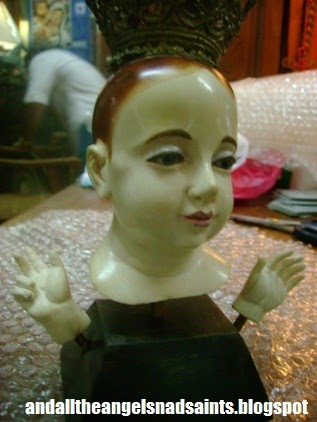
Last year, I made the rounds of Philtrade antique and repro shops and this Nino head and hands caught my attention. The hands were okay, but the billiard-ball sized Nino head was carved with a cloyingly cutesy expression complete with  pudgy cheeks and pouty lips, painted a garish pink.

It was the sheer size and heft of the ivory that struck me-- the head was one solid ivory mass. I remember a santo carver advising me to ignore the carving flaws of an ivory head: so long as the ivory is large and solid; it can be recarved and corrected.

When I sheepishly asked about the price, the dealer quoted a figure that sent me scurrying out of Philtrade. On my way out, I decided to text my offer—half of what she quoted. She texted back to tell me that “she needs to confer with her business partner ”. When I told her I was already in a taxi en route for home, she frantically said that she was accepting my offer.

And that’s how I came to own this ivory Nino.  For months, the head sat on its stand, while I figured out what to do with it. One day, I decided to take it to  Nick Lugue, Pampanga’s most accomplished santo carver, and asked him to make a body and a base for it. I was just too busy to even think about this project and didn’t even bother giving Nick specific instructions—except the design of the peaña, which I wanted copied from a book of Mexican colonial art.

Months after, I dropped in for another visit to find the base already done. It had a rococo design, gold-leafed and marbleized. The Niño body was almost finished too. The wooden body was classically carved, with one leg slightly bent on one knee, and a trademark chubbiness complete with a distended stomach and small ding-aling.


But it was the Niño head that floored me. That’s because Nick remolded the facial features—reducing the pudgy cheeks, refining the nose and the eyes, and reducing the size of the collagen-thick lips.


It looked entirely different from the Niño that I bought—more classical looking, less of the cutesiness. The new features of the child Jesus were painted on—the eyebrows were arched, the cheeks were given a soft blush and the blue eyes retouched. A few months after, the assembled Niño, now beautifully transformed,  looked like this:


The standing Nino measures about 17 inches tall; with the base, around 22 inches high. With the crown, it stands an impressive 28 inches.

With the carving  complete, I now was ready to have the ivory Nino dressed. So off I went to Dr. Raffy Lopez to discuss the preliminary vestment style I wanted. Initially, I just wanted a simple Nazareno colored velvet robe with transferred embroidery salvaged from an antique vestment of a Virgen del Carmen I have been saving for years.


Instead, Raffy suggested making a chasuble for the Niño on where he intended to transfer the antique metallic embroidery, so the design could be shown to the fullest. He also preferred using a thinner kind of fabric so the added embroidery could be more detailed—not possible on thick velvet. The work went rather fast on the chasuble and this was the progress of the work after just one week:

The design concept for the cape, on the other hand, was inspired by an old velvet belt I picked from an antique shop in India a few years ago, and which I happened to bring along in my visit to Raffy. I thought it would make a perfect belt for my Dolorosa, but it was just too long. The belt was intricately embroidered with unique quatre-foil panels, the centers of which were studded with glass stones.


While I was engrossed with the design style, Raffy was also thinking of ways to improve my Niño. He discarded the cheap-looking brass crown which came with the ivory, and produced from his full stock of santo accessories, a more appropriate, proper-sized silver crown plated in gold.

He then did final retouches on the facial features of the Niño, darkening the brows and the lids, and subtly refining the lips and the blush. Lashes would be added later.

Two more weeks after, the propitious call from Raffy came--my ivory Santo Niño was ready to be picked up! The result exceeded my expectations;  I never thought new ivory, when properly carved, painted and vested—could look as good as this:


I still have not changed my stand about genuine antiques, but this new ivory project has certainly readjusted my attitude towards collecting: today’s affordable treasures can be tomorrow’s fine antiques.


Wednesday, June 13, 2012

112. BEFORE STRANGE ALTARS


When devotional santos found their way into Philippine homes, they had their own special places atop mesa altars--altar tables--which became a standard piece of furniture in the homes of Filipino Catholic families. Further reverence was accorded these santos by putting them inside home altars--locally called urnas--not only to protect them, but also to mimic the church altars with beautifully designed retablos and nichos to house these religious figures.


Folk artisans crafted wooden altars such as these examples from different periods and imbued with distinctive styles. The first two examples above are from the Visayan region, similarly made with a sunburst topper, columns, legs and signature flanges (palikpik) with cut-out decorations. The urnas are crudely carved but brightly painted in contrasting colors. Such primitive altars were made from remnant wood pieces, including wood crate packaging that are sometimes imprinted with the brand name of the product.


Other common altar designs are these urnas with leafy, sinuous floral frontals, carved in low relief.  The characteristic rounded opening, and the simple rectangular base are consistent features of these urna types.


The niches are outfitted with glass-panelled doors, but a lot of these urna types are available in the market sans their doors.


The province of Bohol is known for its very distinctive 19th c. urnas that are easily recognizable by their vivid polychromed colors and their simple structure, with parts put together by pegs and joints. Each piece is carved in low relief, with floral and vegetal motifs concentrated on the two side panels anchored with columns, the topperboard and the base.


The removable base is multi-tiered, usually showing 3 gradas (levels). Detached bases with missing altars are often sold separately and are used by collectors for other decorative purposes.


I have seen a lot of these boxy urnas in northern Luzon, and they are a common sight in Manila antique shops. The above example is almost complete, except for a missing glass-panelled door. Note the serpentine-like decorative panels on both sides of the altar and the four columns that support the structure. The figures of Jose, Maria and Jesus are directly pegged onto the floor of the urna. The altar legs end in stylized 'clawfoot' forms.


An incomplete example of the same style is shown above, featuring a Madonna and Child. The decorative side panels and the door are missing, as these pieces were often just joined to the altar body using pegs and short nails and are thus, easily damaged or lost.


The urna of San Vicente Ferrer is also of the same type as the previous two. Note the serrated edges of the door, which has lost its glass panel, a common treatment artisans used in fashioning these folk altars. The roof is also missing--which may have been made of wood or tin.


From Bohol comes this more sophisticated urna, elaborated with oversized finials, the 'eye of God" topper, carved side trims and turned Greek-inspired columns. There are floral appliques on the top and base of the altar structure. The floor of the urna is trapezoidal in shape, giving it a more expansive look.


This next example is a finely crafted urna done in the neoclassic style and executed in heavy dark wood. The roof is glass-panelled, like the body. Lean Corinthian columns hold up the roof, supported by carved, gold-leafed brackets on the base. This must have housed an exquisite ivory santo.


From the 30s down to the 60s, commercial religious statuary shops offered these box-type wooden altars that were simply varnished and carved with decorative details such as Christ's or the Virgin's monograms, gothic design motifs, crosses. These streamlined, glass-panelled urnas were mass-produced, so one sometimes find the same design executed in different-sized versions.


Carved along gothic lines, such urnas feature pointed arches topped by crosses and trefoil forms. Many of these sturdy examples have survived today and  chances are, you'll find one or two in the current stocks of downtown Manila antique shops. Whether primitively-carved or commercially-crafted, these home altars represent not only the reverence of the people who bought them for their treasured santos, but also the skill, artistry and creativity of the Filipino artisans who lovingly made them.