Monday, April 9, 2012

105. MARIAN IMAGES FROM THE 1985 SANTOS-PCIB EXHIBIT


OUR LADY OF FATIMA & OUR LADY OF THE HEART

OUR LADY OF THE HOLY ROSARY, ANTIQUE PAINTING

SANTA MARIA MADRE DE DIOS, ANTIQUE IVORY

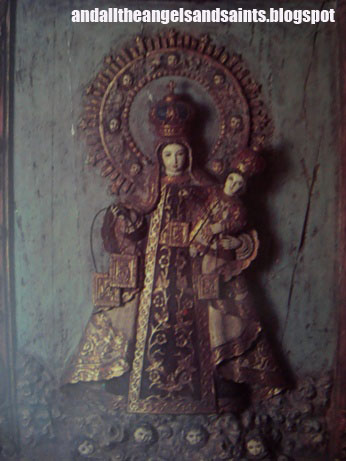
ANTIQUE BAS RELIEF OF OUR LADY OF CARMEL

OUR LADY OF GUADALUPE

OUR LADY OF THE HOLY ROSARY, ANTIQUE IVORY

OUR LADY WITH A SCEPTER, OLD IVORY

SAGRADA FAMILIA, ANTIQUE IVORY

NEW IMAGE OF MOTHER AND CHILD IN IVORY

(From "Kaarawan ni Maria: 1965 Marian Book", pp. 148-165. The images in the exhibit are from the collections of Mr. & Mrs. Primo Santos, Mr. Antonio Ozaeta, Mrs. Mary Gomez, Mr. & Mrs. Rizalino Mendoza, Mr. Anton Mendoza, Mrs. Angelita Cruz, Miss Patty Araneta, Mrs. Imelda Cojuangco)

Sunday, April 8, 2012

104. RETRO-SANTO: Ntra. Sñra de Lourdes

On 11 February 1858, Our Lady appeared to a farm girl named Bernadette Soubirous in Massabielle, Lourdes in France. The Virgin appeared to her dressed in white, with a blue sash and holding a rosary. This was to be the first of 1b apparitions. When asked by Bernadette to state her name on the prodding of a church authority, the Lady answered, “I am the Immaculate Conception”. Thus started a universal devotion to our Lady of Lourdes.

On 28 July 1858, the Bishop of Tarbes formed a commission to study the apparitions and after 3 years, the supernatural events were deemed genuine, that it was indeed the Blessed Virgin that Bernadette saw. A pastoral letter was circulated in 1862 that announced the findings.

It was almost 25 years later that the Capuchin Fathers came to the Philippines to introduce the devotion. In 1886, Fr. Bernardo de Cieza, Superior General of the Capuchins, requested Filipino sculptor Manuel Flores to carve the statue of Our Lady. Assisting him was the Capuchin, Fr. Antonio de Valencia, whose father was a renown sculptor in Spain. The 1.5 meter image was carved in the round, painted and outfitted with a gilded aureola, a crown, and rosary. It was first publicly shown for veneration in 1892. The Capilla de Capuchinos was newly-finished in 1898 when the Philippine-American War began. The fathers promised to dedicate the church to Her if Manila was spared, and indeed, the city was left untouched by the siege.

By the 1900s, the devotion was entrenched in the country, and a confraternity was organized under the counsel of the Capuchin superior. One important aim was to promote the definition of the 1854 dogma of Pius IX.

At the height of the War, the image was stowed for safekeeping at the San Agustin Church, Intramuros, the only church that remained standing after the bombing of Manila. In March 1945, the Lourdes Virgin was brought from the chapel of Santisimo Rosario of UST to the chapel of Sta. Teresita in Quezon City. It was finally installed in Lourdes Church on Retiro, Quezon City.

Feast Day: 11 February
Shrine: Our Lady of Lourdes Church, Q.C.

Tuesday, April 3, 2012

103.BURIED TREASURES, Along a Boulevard of Broken Dreams


I've been told by a lot of collector-friends that Aurora Boulevard in Quezon City has a lot of junk shops and second-hand stores that hold hidden treasures of every sort--religious artifacts included. I am familiar with the the place as my first job was in an office located along this road lined with interesting shops, sights and buildings—like Arcega’s—where one could shop for the finest bicycles, and of course, the Magnolia Ice Cream Plant that housed the famous dairy bar. Further down was Broadway Centrum, then a spanking new commercial complex.


That was way back in the late 1980s, and I have not explored that side of the boulevard since. Well, this Sunday, I decided to set off for a return adventure to the famed boulevard after over 2 decades just to check those junkyards my tipsters have been raving about.


In fact, Aurora had become unrecognizable—so narrow, dirty and looking unsafe—and here I am walking the stretch of the boulevard under the hot early afternoon sun. The intersecting streets still rang with familiarity—there’s Seattle, Boston, Manga—but Betty Go-Belmonte St.? Now, where are the junk shops?


At the far end of Monte de Piedad St., I saw heaps of organized trash and stuff strewn on the sidewalk. The front of his house was littered with old 1960s magazines and newspapers, bric-a-brac and paintings, paper documents, jugs and glasses, softdrink bottles, soda cases, old toys, 1970s calendar, ceramics, and every conceivable house junk known to Man. I knew I had arrived at the right place.


My heart always palpitates when I see never-before seen junkyards such as this, my kind of hunting grounds for antiques and collectibles. I was greeted by a hulking young man, who lifted the tarpaulin awning shielding the front of his house, further revealing more flotsam and jetsam. “Ah, we expected you”, he said, and “we were told of your collecting interests by dealers in Kamuning, so we've prepared some items that may be of interest to you.."


I was not prepared for the item he showed, which was to become my most wanted object of desire. It’s inconceivable that this treasure could even be found here.


In fact, I had even ignored this thing on the floor, casually placed inside a red shopping bag, lost amidst the trash and thrift shop stuff in the small, cramped apartment. "This here is an ivory Christ...", he said, "but the case is a bit dilapidated..."


Ivory? Sto. Entierro? He must be kidding. I peeked into the shopping bag and sure enough, inside was a small calandra (display casket) with wooden and glass parts that have started to separate--- it had to be secured with strings to keep it together.


Then lo and behold! Inside was the wooden body of a dead Christ—with an ivory head. I was stunned. Ivory Santo Entierros are so hard to find in the market, that I have only seen one for sale, which I eventually got, never mind if the Christ was made of terra cotta. The rest are in private collections.


Now this Sto. Entierro is of ivory—the head that is. Closer inspection revealed that the head is of solid ivory, with beautifully carved features.


The only drawback was the nose—it had been sliced off neatly. It’s intriguing to think that the ivory part was used as an anting-anting (amulet) by a Katipunero (Philippine revolutionist) or that it was cut by an insurgent to disrespect his aquiline-nosed colonizers.


But the wooden body was in good condition, the fingers complete, with just a few toe tips missing. Its wig had disintegrated many years ago, but even the skullcap was there. A few trips to my santero will easily resurrect the Dead Christ and restore it to its former glory.


Putting my great negotiation skills to work, I arm-twisted him into selling the photos, the folk santos and the ivory Sto. Entierro for one, neat package cost that I offered. He agreed—and he even threw one small crown for a santo as my buena mano bonus.


This Sto. Entierro, certainly, is my find of the year. Who would think that I will find this treasure buried in a junkyard, along a boulevard of broken dreams and damaged goods from old homes? And, did I tell you that he even led me to another giant stockroom across the street that was crammed with the same stuff from wall to floor. I am sure there are other spectacular antique finds there, but I’ll leave that for another day.


Meanwhile, if you happen to be walking along Aurora Boulevard—don’t forget to keep your eye on those heaps of junk littering the nooks and crevices of Monte de Piedad St. On that same street, lightning may strike twice, and, underneath the debris and detritus, you’ll be able to dig up your own find of the year!

Wednesday, March 21, 2012

102. My First Processional Santo: STA. MARIA DE BETANIA

by Ian Ocampo Flora


As child, I have always been fascinated by santos. Growing up in the conservative and rustic Sta. Rita town, these images of veneration are a constant in every facet of our community life as Roman Catholics.

My childhood is replete with memories of helping in the dressing of santos for the Holy Week procession or during novenarios for the feast days of various saints. I would always stand in owe whenever I see santos riding their magnificent silver carrozas at the old paglimbunan (processional route) in our town poblacion where they are flanked by a seemingly endless sea of candle lights.


Old clans in our town, aside priding themselves of having produced the most number of priests or being a long time member of a church laity organization, old families also pride themselves of being caretakers of the most exquisite heirloom santos that are the center of veneration during the Lenten week processions.


Even today, there has been a surge of interest in owning a processional santo in our town. But today, the ownership of processional images is no longer exclusive to the rich clans.

A couple of hairdresser friends have in fact joined the Holy Week procession last year which again awakened in me that childhood interest of having my own processional image. I have been collecting old santos and house antiques but have never gotten to acquiring my own processional image.

Though our clan is the caretaker of a couple of images, no one can claim sole ownership and decisions pertaining to the upkeep of the images are always decided by old members of the clan.
So in August of 2011, I started the preparation for my own processional image. I knew for a fact that having one requires substantial funds available along with constant consultation with santo enthusiasts to ensure that I would be guided in the right direction.

For the image, Presidential Merit Awardee for Ecclesiastical Art sculptor Willy Layug of Betis was the unanimous choice. There were other santeros that were suggested but most agree that Layug is by far more consistent in terms of quality and artistry of work. However, some collectors have already given me a heads-up about the price tag. Layug’s almost life-like works come with a price. Unmoved, I decided to test my luck.

Fortunately, in one tribute event for an artist that I was covering, I managed to bump into Layug and discussed with him my desire for an image. The discussion was frank and straight to the point; I stated to him my reasons for wanting an image and blurted out the “unrealistic budget” that I had at that time. Amazingly, he agreed!

The next day, I had an early morning meeting over coffee with Maestro Willy Layug at his home cum workshop in Sta. Ursula in Guagua's Betis District. I told him that I wanted an image of Mary of Bethany.

We discussed how the image would turnout. My inputs were primarily on the dimensions of the image. I wanted it tall; with Spanish features and with hair fully carved into the head (I had childhood fears of bald santos). The santa should be set in an andarol with hands, body and proportions following a santo specification that Layug had adapted from his recent trip to a workshop in Spain.

Regardless of his extremely busy schedule, Tatang Willy managed to squeeze time for the image in between his more important and bigger projects. I only visited him trice to look at the progress of the image and on my third visit what greeted me took my breath away. Willy did not fail to deliver for image was indeed beautiful.


Willy had it personally placed into its body and even threw in a base for the image which was not part of our earlier agreement. That same day, I came home with my very own santa.
I posted the pictures of the head on a social networking site and comments began coming in. Santo enthusiasts were eager to suggest ideas for the vestments and pukpok that would best fit the image.

I decided to skip work the next day and started working on the design for the halo and contacted names given by santo enthusiasts. For the pukpok, Patrick Guina Banal, a veteran of Marian Exhibits, wisely advised me to skip known artists and instead scout for the lesser known craftsmen in Apalit town.

I managed to get the service of a craftsman in Colgante, Apalit had my personally designed halo made for only P2,000 and managed to haggle for a medium-sized diadem for P1, 000.


For the vestments, I had the specifications of the image sent to a well-kown burdadera in Bulacan but was told that the santas vestments won’t be finished until May. Rop Syquia of Maimalan came to the rescue and orchestrated a viste hebrEa EnSeMbLe tHat would serve as my santa’s day-to-day clothing while awaiting the Bulacan vestments.


Photographer Ruston Banal managed to show up after the image was dressed and took majestic images of my new santa all set and ready for the coming Holy Week procession.


Days before the Holy Week procession, the image was already visited by a couple of santo collectors and enthusiasts who have seen her photos on a social networking site.


My Sta. Maria de Betania is now housed in a special room in our farm home in Sta. Rita. Each morning, I would stop by the room and spend a few minutes admiring her beauty realizing that despite the cost and trouble of worrying on how to give justice to a wondrous piece of religious art, she was all worth the effort.
******
STA. MARIA DE BETANIA
Owner: Ian Ocampo Flora
Sculptor:Willy Tadeo Layug
Halo and Diadem:Patrick Glenn Guina Banal
Vesturera: Rop Syquia(Viste Hebrea theme)
Photography: Ruston Banal
Creative inputs: Alex R. Castro, Jeffrey Popatco
Image details: Height is at 5' 7" (170 cm) (5' 10" or 178 cm with base) Spanish features, fully carved head with hair tied in a bun. Crescent gold band holds carved hair together. Proportioned upper body set in an andarol. Movable hands following a Spanish santo design. Halo design patterned after an antique Sta. Cecilia image.
Commission Date: August 2011 to March 2012

Sunday, March 18, 2012

101. Filipino Holy Week Practices: SALUBONG

By Armando P. Rubin
(Taken from 'The Philippines Herald Magazine', 17 April 1965 issue, p. 7)

PROSESION NG PASKO NG PAGKABUHAY, Pandaka, Maynila, 4 April 1926

One of the most enchanting of local traditions is the “Salubong” (meeting) which is actually a reenactment of the sequence or hymn for Easter Sunday: “Speak Mary, declaring what thou sawest wayfaring”. The entire procession at the first flush of dawn is an elaborate portrayal of “what Mary sawest”.

What takes place on Easter Easter morn is one of the most unique and beautiful dramatizations of the ‘meeting’ ever conceived. In many towns of Rizal, Cavite and Bulacan, just outside Manila, the colorful custom survives. Long before dawn, the village is astir with preparations for the spectacular event. Wit incredible ingenuity, the drama and pageantry of the miracle of Easter starts to unfold.

PROSESION NG PASKO NG PAGKABUHAY, Pandaka, Maynila, 4 April 1926

At early dawn, the “salubong” or meeting of the risen Christ and His Sorrowing Mother is reenacted. Two processions issue from separate church doors, one composed of males and headed by the figure of Christ, the other composed of females led by the image of the Virgin Mary. The processions converge on the town plaza, where the main rites take place.

Brass trumpets blare forth. As soon as the notes die down, a ceremonial dance called “bate” begins. This is performed by young girls on top of a platform facing the images. The dance is followed by the “tula” or declamation of verses in praise of the Virgin.

Immediately after the “birds” come sliding down along the wires, piercing a papier-mache heart which opens up to reveal a little girl or “angel” dressed in white, two of the birds glide along the wires onto a bag of confetti which they tear open with their beaks, spilling the contents on the dancers below.

In a series of rapid movements, the angel is lowered, lifts the veil from the Virgin Mary, is pulled up again while a censer is swung, perfuming the air. The Virgin Mary stands revealed in splendid glory, her rich robe sparkling in the sun.

The band plays on, and the little angel sings the “Alleluia”, all the while scattering rose petals on the images below, bringing this elaborate spectacle to a close. In the evening, the people flock to the last performance of the ‘senaculo’, which officially ends the Lenten Season.

THE SANTOS OF SALUBONG

The two principal images of the “Salubong” are that of the Risen Christ (Resurrecion) and the Virgin Mary (Virgen de Alegria).

FIGURES OF RESURRECTED CHRIST AND MARY, Pasko ng Pagkabuhay, Pandakan, Maynila.
Most antique “Resurreccion” images are small in stature, a little over 3 feet in height. It depicts the figure of Christ resurrected, right arm raised in blessing, the other arm holding his standard. He is usually shown bare from the waist up, displaying his wounds, and wearing an embroidered “tapiz”. He can also be shown caped and sashed, for modesty’s sake. The Christ figure stands on a cloud base to symbolize His rise and passage from his earthly death.

The shrouded image of Mary represents her at her moment of sorrow. When the mourning veil is lifted, we see her joyful expression, hence the “Virgen de Alegria” (regarded as the opposite of Virgen Dolorosa). She is shown standing, with clasped hands or crossed hands over Her chest. Most of the time, the standard image of the Immaculate Conception is used for this purpose.

100. SANTOS MILAGROSOS: Miracle-Working Saint Figures

Since time immemorial, Christian history is replete with extraordinary accounts of sacred images involved in unexplained and supernatural happenings—statues weeping, bleeding, walking and talking while providing divine cures for all sorts of diseases while converting sinners and bringing them back to the Christian fold. Through the years, there have also been reports of ‘miracles’ associated with Philippine santos as these photographic evidence show, creating mass hysteria in their time and developing cult followings that many continue to this day.

SAN PEDRO’S MIRACLE IN MALOLOS

In Barrio Tikay, Malolos, province of Bulacan, a spring miraculously appeared in the mid 1920s at the back of the ‘visita’ that was attributed to a San Pedro figure housed in the small chapel. The visita became a local shrine of some sorts, visited by devotees and the sick who bathed and drank the water from the site in the hope of finding a cure, much like the waters of Lourdes. The spring is still there to this day.

MANILA’S HIMALANG KRUS

On 23 March 1922, on San Juan St., Gagalangin, Tondo, Manila, a laborer split open a tree trunk and found the figure of a cross both faces of the split trunk. The crosses were clearly delineated on the tree trunk halves, showing two perfect crosses standing on their bases. The discovery of the crosses created quite a stir all over the city, and the trunks were eventually encased in metal sheets and glass, for public display to throngs of devotees who believed the event to be great miracle.

LAGUNA’S NUESTRA SEÑORA DE MOLAVE

In 1910, a resident of Sta. Cruz, Laguna was sawing a molave tree for his house construction, but was stumped when he could not cut the mulawin hardwood. With the aid of several workers, he managed to cut half the wood, which, to his surprise contained the outline of what appears to be the Blessed Virgin. He used the wood anyway, as house posts.

In two instances, however, he was saved twice by a mysterious voice from certain danger. The first was when he was roused from his sleep by this voice who warned him of a fire in the house. On another occasion, the same voice warned him of thieves barging into the house—which was successfully averted when the man woke up and drove the thieves away.

Soon, Laguna folks came flocking to his house to see the “Nstra. Sra. De Molave”. One man even offered P3,000 to buy it. It was also whispered about that Mons. Gregorio Aglipay, head of the Philippine Independent Church, even offered to build a church to house the sacred wood.

Thursday, February 23, 2012

99. A Providential Find: AN IVORY SANTO NIÑO

Antique ivory Sto. Niños are rare to come by in the local market because such pieces are always prized by families and are wont to be pass to the next generation of owners as tradition. I do have a couple of old Sto. Niños made of wood, and an antique ivory Niño Dormido (sleeping Christ Child), but a standing antique ivory Niño--classically carved and dressed--has always eluded me for decades.

That is why, I was a bit skeptical when I received a text from a Manila antique dealer who informed me that he had an antique ivory Sto. Niño available for sale. I visualized it to be another reconstituted image, probably an ivory Niño separated from a San Jose or a Holy Family tableau, redressed and put on an old peaña, passed off as an original piece.

But when he sent me a photo by phone, what I saw excited me. Though a bit grainy, I could see that the small Christ Child—with an ivory head and hands—was an original individual piece.

The figure is a classical depiction of the Infant Jesus, styled similar to the Sto. Niño de San Agustin, as deduced from the short, spread-out cape, the short tunic and the pair of pants, all with simple gold embroidery. Judging from the carving style, this is clearly a 19th century piece.

Striking too were the facial features of the Christ Child: sweet, innocent looking, with just a hint of the smile. The expressive face had set-in glass eyes, and sported a double chin with lines on the narrow neck.


Then there are the silverworks, which—though bent out of shape and blackened with age—were all surprisingly intact: crown, orb and scepter. They were finely detailed too, and when cleaned, the silver accessories still gleamed with their gold plating.

Missing was the base, as well as several ivory fingertips, flaws that are easy to fix. One foot had lost its tip but I quickly repaired that with a bit of epoxy clay.

I was lucky too---I was the first to see this lovely Niño which impressed me at first sight. It was well within my reach too, so a deal was sealed in less than half a day. By lunchtime, I had the antique Niño in my possession after a quick cab ride to Manila.

As always, this, I thought, was a perfect restoration project for Dr. Raffy Lopez, so off I went to his place to show off my new find, which he confirmed to be of 19th c. make.

I wanted him to follow the cut and style of the original vestments, which fortunately were kept with the antique piece. Raffy later used these as guides for the new set of clothes.The battered crown, scepter and orb were fixed by Dr. Lopez’s jeweler-friend, Noel Menguito, who confirmed they were of gold plated silver.

I wanted a simple base, perhaps a gold-leafed lotus type peaña, but Raffy prevailed on me to use a traditional and more ornate mortar-shaped base often associated with colonial Sto. Niños. I thought that kind of base is too bulky for such a small santo, but he assured me that it will be proportionately made for my 7 inch Niño, so I reluctantly agreed.

The restoration work took longer than the usual as Raffy was in the midst of having his house improved and refurbished as well. Besides, he had just finished a major exhibit at the Intramuros. After 2 months, a picture message of my Niño was sent to me by phone. It showed the image with repaired fingers, standing on a new base.

A week more, and the restoration was complete. The result was a regal-looking Sto. Niño, resplendent in red and yellow cape and a tunic made from vintage satin fabric.

For my newly-restored Sto. Niño, it was love at first sight, all over again. I am glad that I was at the right place, at the right time—but more importantly, the antique image was available at the right price. Oh, the workings of Divine Providence.


(Other pics courtesy of Romain Garry Evangelista Lazaro)