Tuesday, July 2, 2013

154. FINDING THE TRUE CROSS


Whether online or in antique shops, the most common religious antiques one finds for sale are crucifixes. Folk art crosses are fixtures in almost all antique fairs I’ve been to, characterized by plain wooden crosses and misshapen Christ figures. More sought after are the classically done tabletop crucifixes, with finely carved wooden Christs and with crosses trimmed with metal fittings.

Other than ivory crucifixes, the prices of such pieces have remained stable—in the range of about Php 7K- Php 15K. The demand is not as high as for free-standing santo as, maybe, for a collector, one good crucifix is enough.


I, myself, am not much of a crucifix fan, but when I see an outstanding example, I take a second look. Just like this example, recently purchased from my favourite antique dealer.

It came in a rather, shabby condition—dirty, dust-coated, with the corpus about to be detached from its arms. 


The dealer told me that the cross finials were of silver, but I couldn’t be too sure—they were blackened with age. So were the potencias and the crown of Christ too, which remained miraculously intact, all these years.


Despite these flaws, the carving of the figure was superb, right down to the gracefully draped loincloth of Christ, his taut and lean body, the elongated arms and hands (with a few missing fingers)and the fine strands of Jesus’long hair.


But what sold me was the haunting facial, pain-filled expression of Christ, made even more lifelikeby by his glassy stare. His mouth was open in anguish. How the carver managed to put such intense emotion into that small wooden face, I will never know.


For 3 days, I set about cleaning the crucifix, using Wipe Out and lots of cotton buds. More challenging was restoring the shine of the silver finials, which had ingrained dirt all over. At least two hours of metal polishing and dirt-scraping did the trick.


The corpus itself was easy to clean. After Wipe-Out, I lightly coated the body with brown shoe polish, which further deepened the “Nazareno”color of Christ and added a nice sheen to the lines.


The crucifix came with a damaged replacement base, but I had an unused stone base that was more appropriate to the piece. The mound was a bit small though, and not very stable, but it would have to do, in the meantime.


My dealer, by the way, also told me that the original owner of the crucifix claimed that the piece was the handiwork of Maximo Vicente’s talyer. You always take these revelations with a grain of salt, but regardless, this crucifix ranks as another one of my most wonderful finds, you agree?

Wednesday, June 26, 2013

153. Santo Stories: SAN PANCRACIO


One of the lesser known saints venerated in the Philippines is the young Roman St. Pancras (St. Pancratius, San Pancracio). Little is known about this young boy of 14 who was reared by a Christian uncle and who found martyrdom during the persecution of Diocletian who had him beheaded. San Pancracio’s cult became popular in England after St. Augustine of Canterbury dedicated his first church to the young boy saint. In the Philippines, the Paco Cemetery Chapel holds him as its titular patron.

 This saint has a very distinctive iconography. He is often shown in a centurion costume complete with leather sandals, knee-length tunic, draped with a red cloak to symbolize the blood of martyrdom. He holds a book with Latin inscription: "Venite Ad Me et Ego dabo vobis omnia bona." ( "Come to me and I will give you all that is good.")


His right index finger points heavenward indicating that the promise in the book he holds comes from God. Another emblem of his martyrdom is a palm leaf which he also holds close to his body. Large images of San Pancracio are rather rare in the country.


This particular all-wood example, about 48 inches tall, was found in a Bulacan antique shop. It is carved from light wood, with portions of the back hollowed out in two sections to make it lighter when borne in processions.

 Outfitted with glass eyes (one missing), he also has a vintage halo which may not be original to the piece. The original paint is intact with the usual age scruffs and minor paint loses. There are some damages to his fingers and to the base. I was told that this San Pancracio came from an old visita in Makati, but that could not be verified.
******


 O glorious St. Pancratius, 
I beg thee to obtain for me all the graces that I need, 
but especially health and work, 
so that I may appear before thee to thank God 
for the favors I received through your powerful intercession. 
Amen.

Sunday, June 16, 2013

152. A View to a Skill: PIECING A CRUCIFIXION BOTTLE PUZZLE


One of the more fascinating religious folk art that we adopted from the West are the so-called Crucifixion Bottles that were popular among whittlers and craftsmen in Europe and America in the 19th century. They are variations of bottled wooden whimseys that included the popular ships-in-bottle, a tradition that remains to this day.


Tradition has it that Crucifixion Bottles were made by Bilibid prisoners as part of their rehabilitation, starting at the start of the 20th century. Inside a bottle was constructed a whole Calvary scene, complete with the principal stick figure of crucified Christ shown surrounded by similar santo figures of Mary, St. John, the 3 Maries, and Roman soldiers. It was believed that prisoners passed the long lonely hours by skillfully putting together these disparate santo pieces inside a bottle, reflecting on Christ’s sufferings as they did so. Once finished, these bottles were sold as cheap religious souvenirs.


 One weekend, I was looking for antique bottles to add to my collection at my dealer’s Cubao warehouse when I saw this medium size clear bottle with what seemed to be dirty paper shreds inside it. A closer examination showed that it was an old crucifixion bottle as I could see disassembled stick figures inside, all mixed up with the flotsam and whatever jetsam was inside.

Of course, I asked the dealer a trick question, asking what the bottle originally contained—and he answered vaguely that it held some kind of a religious relic. Hence, he says, it’s more expensive than his other bottles—I could have it for a thousand bucks. Well, I ended up getting it for the same price as his regular bottles, and immediately went home with my find, lest my dealer changes his mind. I earmarked this for my week-end project—I am sure I could restore this old Crucifixion Bottle, I have done so in the past.


 Day One: I had to remove the contents of the 500 mL clear medicine bottle, which was consistent with other crucifixion bottles I have seen. With sloping shoulders and a wide, flat front and back side, these bottles were ideal for assembling sets of figures inside.


Using a long barbecue stick plus tweezers, I managed to remove the messy contents of the bottle. The dirty shredded paper were actually placed to hide the calvary base, although the more common fillers were cotton balls, to create a “heavenly effect”.


 Disentangled from this dirty mess were three Calvary stick figures made of softwood, consisting of the Crucified Christ (surprisingly complete!!), Virgin Mary and a Roman soldier (very rare figure!).


There were remnants of the Cross too—the anchor was intact, but the Cross itself was missing the main bar. I cleaned up the figures using a regular paint brush and reinforced loose elements (like broken base bar, the soldier’s sword and Mary’s cape) with gel glue. I also replaced the missing parts from wood scraps recycled from an old crate.


 Now, comes the most difficult part—assembling the pieces inside the bottle. I was prepared with an assortment of “tools”—mainly, barbecue sticks of different sizes, skewers, plastic paleta, tweezers, even bent paper clips! I had previously studied the order in which the parts were laid out on the bottle and I began with lining the inside bottom of the bottle with brown paper, which I glued using dabs of gel glue (perfect for such project, it doesn’t run quickly!) applied with the flattened end of a barbecue stick.

 Next, I assembled the cross bars—one bar at a time—a fairly easy thing to do as the bottle was still empty; you could still move things around and fasten them using the same barbecue stick-with-glue technique. As this was going to anchor the cross, the cross bars had to be locked and glued securely, which meant waiting for the glue to dry—overnight.

 On Saturday morning, I was ready to put the Roman soldier and the Mary figure inside the bottle. There were hole marks to guide me in positioning the figures. I knew that the soldier stood at the left of the Cross, while Mary stood in front (for all we know, this was a Magdalene figure!). For better visibility of Christ, I decided to relocate Mary on the right, where I had already punched a hole to slip in the figure, which had a peg on her feet, fashioned from a toothpick! Again, more waiting followed for the glue to set firmly.


 After lunch, I was all set to put in the spar of the cross, which I did successfully in one go. The T-bar was more of a challenge as it already had the dangling arms of Christ, attched with very fine nails. I had to force it down the narrow neck of the bottle, then, I had to balance the bar on the spar, and coax it into position. After several tries, I succeeded—the dovetailing was perfect! A few dabs of glue and the cross was up!

By late afternoon, the glue was sufficiently dry, so I pasted the rays of the cross (made from brown paper and trimmed with gold glitter) on the back , to further reinforce its construction. Next came another critical part of the assembly—putting the armless body of Christ onto the spar of the cross, then coaxing the two thin arms in place so that the ends could be inserted into the shoulder sockets of Christ.

One really needs a steady hand to do this as it entails balancing the body on the narrow cross. I lined the cross with gel glue then pushed Christ’s body using a pair of tweezers. Even with glue, Christ would fall from the spar of the cross; thank God, the paper burst broke its fall many times. 

The next problem was inserting the arms into the shoulder sockets. I had practiced this on the Christ figure outside of the bottle, and the arm fitted like a glove with one push. Inside the bottle, with less space to work on, it was very difficult. I would lift one arm using a slender stick, pull up the body with a skewer, and the body would fall, again and again.


 After a dozen tries and with my patience running out, I decided not to insert the arms anymore and opted to lay them on the cross, almost touching Christ’s body. From the front, one could see Christ hanging from the cross alright, but from the side, you could see that the arms are not exactly attached to the body. Oh well, that was my best effort.

 To ensure that the arms would not fall and remain in position, I dropped dollops of glue on the nails supporting them. Unlike before, I didn’t rush the drying of the glue; I let the glue set overnight. The next morning, after breakfast, I inspected my handiwork. I still was not happy with the way the arms have turned out, but I know, it could have been worse.


 The last steps included glueing the paper INRI sign on the cross, and covering the base with crumpled strips of very fine papel de japon. For added effect and to weigh down the flimsy paper strips, I dropped in a couple of mother of pearl flowers onto the base of the bottle. To keep the cross from moving, a toothpick was inserted into a hole on the top of the cross; the other end was then inserted into a cork (from an old wine bottle), which was the pushed into the opening which was then dabbed with glue, to seal the bottle permanently.

 It takes very little to creating bottled whimseys—one needs only an empty bottle, glue, a whittling knife, scraps of paper, fabric and wood. Anyone can actually do it, with just a bit of skill, patience and practice. Just take it from the Bilibid prisoners of old, whose rare folksy santo creations in a bottle now command thousands of pesos in antique shops—if you can still find one.

Thursday, June 6, 2013

151. CASA DE SANTOS: From a Buy and Sell Ad to a Trove of Sacred Treasures


Incredible how a simple ad posted on a free classified advertising paper—Buy and Sell Philippines—can lead me to a treasure house of antique santos in a nondescript San Juan neighborhood. It had  been my habit to scan the antique section of the weekly issue of Buy and Sell Philippines, and in 2005, one particular ad caught my attention. It was from a seller from San Juan, advertising a set of antique processional santos which she wanted sold as a lot for a whopping Php 475,000.

I am not easily deterred by such big ticket prices, as I had taken note that the ad had been appearing in previous issues for quite some time now, with no apparent takers. With nothing to lose, I ended up visiting the Seller's place, which turned out to be a small accessoria that had a narrow flight of stairs leading to the second floor residential area.

When she opened the door, a heavenly assemblage of large santos greeted me, two standing on the floor, another on top of a mesa altar. I couldn’t believe my eyes---here before me were three, beautifully carved images of Sta. Maria Salome, a complete San Isidro Labrador and a kneeling Cristo for an Agony in the Garden tableau. The dealer then recounted that these were owned by a family who had recently migrated to Canada. She was left with the task of selling these images as they could no longer take care of them.


One by one, I checked them out, noting their original outfits, the carving style and the patina of age. The image of Sta. Salome was particularly appealing; she had her original wig and was wearing her old rhinestone jewelry. Her censer though was missing. She was a tall santa, perhaps 54 inches tall, with a complexion that has become kayumanggi with age. What struck me upon seeing her were her pair of large, expressive eyes which, at one point, looked slightly cross-eyed ('banlag').


Next to her was a very large kneeling Cristo for an Agony in the Garden tableaux. This image had well-carved features, right down to the noodle-like strands of His full beard. It had a hallowed-out body to make it lighter when carried during processions. The only negative points were the hands--which seemed like replacements, and the absence of the Angel, which has long since disappeared.


The last of the santos was a complete San Isidro Labrador, which, although smaller (48 inches), had a fairly large base that had all the attributes present--the plowing angel with the cattle, and the kneeling landlord. The cattle was moulded from escayola or plaster of Paris.

I had to keep my emotions in check after assessing the santos, deferring my negotiations for another time, another visit. But my wonderment never ceased at the thought that, in this little accessoria, past a narrow, dingy eskinita lined with  intoxicated tambays lost in their drinking sprees, was this roomful of sacred treasure, precious santos, uncared for and forgotten, waiting for their next generous owner to come along.

(POSTSCRIPT: After much haggling, i finally got the Agony Cristo, which I felt was the best of the lot. I would have wanted to bring home Sta. Salome too, but my budget was good only for one santo. I was later told that Sen. Jamby Madrigal, whose mother was a formidable santo collector, snapped up both the Salome and the San Isidro santos. Today, I have fully restored this Agony Cristo, complete with His Angel, and the whole ensemble is processed annually in my home city of Mabalacat during the Lenten festivities)

Sunday, May 26, 2013

150. Retro-Santo: STA. LUCIA OF CALUMPIT, BULACAN

ALL EYES ON YOU. The sacred image of Sta. Lucia de Mata, patroness of Sta. Lucia, Calumpit, Bulacan. ca. 1920s.

Santa Lucia (b.283-d.304) or St. Lucy was but 14 years old when she was martyred for her faith by Paschasius, during the Diocletian persecution, this after being tortured by having her eyes gouged out. Because of this, she is invoked against diseases of the eyes. A popular saint in the Philippines, she is revered in Sta. Lucia, Ilocos Sur (where she is known as 'Apo Baket'),  Sasmuan in Pampanga (where the riotous Kuraldal is held in her honor every January) and Capalonga in Camarines Norte.

Sta. Lucia is also the patron of barrio Sta. Lucia in Calumpit, Bulacan, one of the town's oldest. Her 2-day December feast (Dec. 12, 13) is marked with a colorful street festival, with daily Masses and Novenas starting on Dec. 4. The fiesta is capped with spectacular firework displays.

The antique, de vestir image of Sta. Lucia enshrined in the church, is crowned and holds a palm of martyrdom and a dish on which a pair of eyes rests. It is reputed to be miraculous, as attested by many stories of healing--especially with regarsd to vision problems--through the centuries.

Tuesday, May 21, 2013

149. The Saintmakers: MARCELO NEPOMUCENO

 LA SAGRADA FAMILIA. Wooden representations of the Holy Family--Jesus, Mary and Joseph--carved in the round, made for private devotion. By Manuel Nepomuceno. Ca. 1910.

This beautiful devotional santo grouping depicting the Holy Family (La Sagrada Familia) is the handiwork of a largely-unknown 19th century sculptor, Marcelo Nepomuceno (b. 4 Sep. 1870/d. 7 Sep.1922). Born in Sta. Cruz, Manila to a woodcarver father, Pedro Nepomuceno, he learned to sculpt in his father's taller.

Largely self-taught, Marcelo learned religious iconography through books like Triunfo de la Religión de Jesucristo by Joseph Feuhrich and La Sagrada Familia by Felix Torres Ama.

As a member of the Centro de Escultores, an association of Filipino sculptors in the early 19th century, Marcelo was a contemporary of Bonifacio Arevalo, Graciano T. Nepomuceno (who might have been a relative), Eulogio Velarde, and Anselmo Espiritu. Like them, his early works comprised mainly of religious art which were often commissioned by clients and patrons. Very few of his works are known, even to his children, so this exquisite carving gives us a glimpse of his carving mastery.

Known for his controversial and unusual artworks, Marcelo once made a sculpture intended for display at the Exposición Regional de Filipinas in 1895. Entitled "Espiritu y Materia,", it showed a priest embracing a nude woman. It was never exhibited after religious groups protested. Another entry to the St. Louis Exposition in 1904 entitled "Trece de Agosto"showed a woman with a bolo warding off an eagle and a lion--which was interpreted to symbolize the two colonizers power over a people's quest for freedom. His non-secular works include award winning designs for Rizal Day floats. At least one work, "El Triunfo del Patriotismo Sobre la Muerte "(The Triumph of Patriotism over Death) earned a  Gold Medal.

Marcelo was married to Faustina Mijares who bore him ten children. One son, Marcelo Nepomuceno Jr. followed in his footsteps as a religious sculptor of note.

Thursday, May 9, 2013

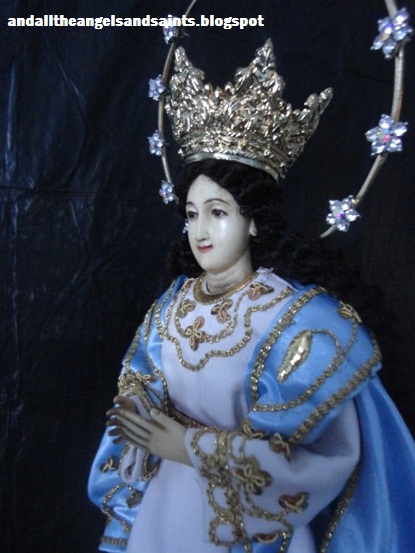
148. HAIL MARY! : An Immaculate Restoration


This old ivory santa representing the Immaculate Conception was part of a cache of antique ivories offered at a Quezon City shop. It had the worst condition of the lot-- wigless, eyeless, with a wire armature left arm about to fall and a soiled underdress. The metalworks and the vestment were all missing.


My attention was actually drawn to a more complete ivory San Jose housed inside a broken virina, and had, in fact, made up my mind to buy it.


But when the dealer offered to throw in the other santa for just a bit more, I accepted the offer and came home with not just one, but two antique ivories.


True to its appellation as “La Purisima Concepcion”, the figure was carved simply, the hands in the folksy “tinidor” style. The face has distinct Chinese features, with a calm and pleasing expression.


It is fortunate that she has retained her cloud peaña, set on a boxy base, which dates this possibly to the second decade of the 20th century.


After having personally cleaned the image and fixed its sagging arm, I sent it off for restoration, a process that would take a little over a month. My project brief included restoring the eyes of the santo and its metalworks—to be kept as simple as possible, and also rewigging her with jusi hair.


The gold-embroidered dress was to be kept simple too, with a minimum of draping and tucking. A light satin blue cape and the lightest blush of pink satin made up her vestments.


 La Purisima Concepcion finally came home this weekend, looking so different than when I found her perched on a shop table just a few months ago.


I am glad I got her, as she looks beautifullys blessed and full of grace once more.