Wednesday, January 2, 2013

133. THE ROAD TO CALVARY


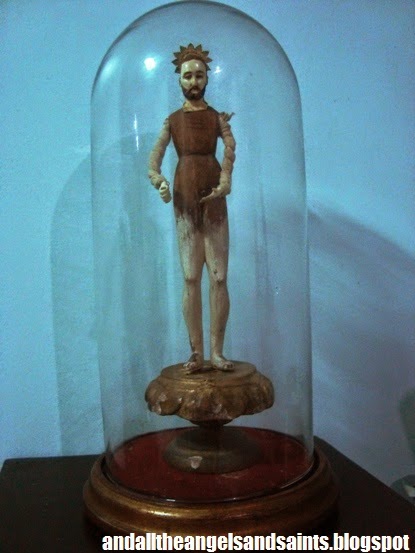
I have always wanted an antique ivory Calvario tableau for my collection, but their availability—not to mention their prohibitive cost, have thwarted this dream. The closest I could get to owning one was when I purchased in Apalit, this part-ivory Crucifixion set. One look and you will know that it’s been put together—the wooden Christ with one outstretched arm, actually is part of a 2-character tableau that included the now-lost figure of St. Francis embracing Christ.


Two ivory santos have been redressed and added to the crucifix-- San Juan and a Dolorosa—which originally was a Magdalena. The two had ivory heads and hands (many missing fingers though). The santos were crammed in a primitive urna, and it is in this state that I bought them, with the intent of separating the two ivory figures and putting them on separate bases. This was what I actually did, with the help of expert santo restorer, Dr. Raffy Lopez. I gained two individual ivory santos but now lost a tableau!


 I forgot about owning a Calvario tableau until, this year, I chanced upon this antique wooden crucifix that was so badly disfigured and messed up with silver paint. But I really didn’t care much for the wooden Christ—it was the silver grabado cantoneras that appealed to me. The crucifix was set on what seemed to be its original base that simulated a stoney mound. Since I could afford it, I bought the crucifix and had it immediately restored.


A month and a half later, the Crucifix was returned to me—and the painted restoration stunned me.


 The new encarna showed the exceptional carving of the figure—from Christ’s pain-racked expression to his bloodied physique—one of the finest I’ve seen. Raffy had given me an old wig that fitted the Cristo perfectly.


Rummaging through my own stock of old santo stuff, I found a small silver thorny crown that also matched the head size of my crucified Christ.


Meanwhile, at the recent Greenhillas Antique Fair, I found an almost complete set of silver fittings for a standard crucifix, including these INRI and the symbolic sun with a face, with a spring mount.


From another old crucifix, I salvaged 3 silver potencias, which were of the right size for my Cristo. I was rather pleased with the result.


It was at this point that I toyed with the idea of assembling my own Calvario —using this completed and fully restored crucifix as the focal point of the tableau.


The ivory San Juan and Dolorosa were almost proportional in size to the crucified Christ and I figured they could be re-set on the original stoney mound where they could stand flanking the dying Christ figure. In the past, I have seen many Calvarios that featured wooden Christs matched with ivory Johns and Marys, so I thought I could do the same here.


Again, I took the ivories to Dr. Lopez who dismantled them from their bases and staged them on the restored base which had been raised to half an inch, then refinished and repainted.


 The final step was mounting the crucifix on the mound—and the pleasing results are on this page. The road to recreating my own Calvario is done. Consummatum est!!

Tuesday, December 18, 2012

132. Private Devotions: CRISTO REDENTOR of Familia Llacer-Teotico

ENTHRONEMENT OF CHRIST THE REDEEMER OF THE LLACER-TEOTICO FAMILY, 20 October 1925.

A rarely-seen representation of Christ the Redeemer (Cristo Redentor) in a standing position, holding a cross, owned by the Llacer-Teotico family. It is possible that the Teotico side of the family is related to the acclaimed multi-awarded sculptor from Sta. Cruz, Manila, Domingo Teotico. He had a religious statuary shop along Palma St. in Quiapo.


Christ the Redeemer is carved in the round, and stands on a magnificent cloud base adorned with 4 cherubs. The plain cross he holds in His left hand stands out from the classically-carved image dressed in white robes wth decorative gilding on the edges. The other hand is raised in benediction. Normally, the exposed heart is not part of the iconography of Christ the Redeemer, but the sculptor probably took creative license and carved the sacred heart in relief.The most iconic image of Christ as the redeemer of the world is the giant marble statue in Brazil, which today is recognized as one of the world's seven wonders.


Christ is the world’s Redeemer, 
The lover of the pure, 
The font of heavenly wisdom, 
Our trust and hope secure, 
The armor of his soldiers 
The Lord of earth and sky, 
Our health while we are living, 
Our life when we shall die.

(--attributed to St. Columba)

Tuesday, December 4, 2012

131. WHAT CHILD IS THIS?


Before a Filipino santo online dealer fell from the good graces of ebay (he failed to honor legitimate winning bids of buyers, myself included, resulting in 18 negative feedbacks in one month), I was able to get this antique, 8-inch Niño of heavy wood—bald, with peeling paint and glass eyes blackened with age, making him appear pupil-less and eerily blind. The Child Jesus, in a semi-standing position with legs slightly bent at the knees, has his right hand raised in blessing. This arm was threatening to separate from the rest of his body, but other than that, all parts were intact, including his fingers.


 At first, I thought this must have been detached from either a Virgin Mary or a St. Anthony figure—except that the position of the legs, which are almost upright, does not indicate that he was seated. The back showed no hole from where a peg is often placed to secure it to the main image; instead, the Niño’s bottom has a small hole where a peg could be inserted to make Him stand. In fact, it came to me mounted this way.


I have seen standing Niños atop the book held by San Antonio, but this image is too heavy to be put in such a precarious position. It could not also be a Dormido--a sleeping Jesus-- for its eyes are wide open. I could only surmise that this is a small Salvador del Mundo in a lying down position. Besides, the soles of the feet were not carved flat, so he could not have possibly stood on a peaña; the hole in his bottom could have been used to hold him upright during the painting process.


 Done with my conjectures, I brought the Niño to Nick Lugue as a ‘finish-when-you-can-minor project’ alongside my more important commissions. It took awhile to have the small image repaired and repainted, but I was in no real rush, as I haven’t figured out what to do with it.


In the meanwhile, I found an embroidered strip of cloth from an old Dominican santo vestment, so I saved that for the Niño as I thought it would make a perfect tapiz. Putting my limited sewing skills to use, I managed to make the strip into a decent wrap-around for the Niño. Then it went into storage in a cardboard box for a months, as I was kept busy with my Mother’s lingering illness.


A week ago, I decided to skip lunch and check out Manila’s antique shops. Antique-hunting has a way of lifting me out of my depression, even if the effect is just temporary. It was at Padre Faura, at the shop of Floy Quintos, that I found this small, antique tiara encrusted with paste jewels, and engraved with the name of its previous owner, “Maria Purtran Hermana, Enero 6, 1924-1925”. I thought of my Niño, momentarily forgotten in a cardboard box stowed inside my book cabinet. I bought the tiara, vowing to complete my Niño project this weekend.

Saturday afternoon, I took out the Niño and started putting things together, outfitting it with a wig, a leftover from another project, and a necklace made from tiny old beads. The antique tiara was a bit big for his head, but a slight adjustment solved the problem. This was the result:


The last step was finding the right size urna for my restored Salvador del Mundo—or whatever Child was this-- and thank God, I had one in stock. You’ll never know when you need one.


So, there. Maybe I’ll put mother-of-pearl flowers when I find some, but in the meanwhile, you can consider this project successfully done and finished!

Tuesday, November 27, 2012

130. HOW I FOUND MY WAY TO SAN JOSE


Sunday is not exactly the ideal day to go antique-hunting in Ermita---most shops are closed—but since I have not gone to Manila in ages, I decided to go there one hot weekend afternoon, just to take in the sights and sounds of its streets that I have come to miss.

My aimless wandering took me to Mabini, Manila’s once-upon-a-time antique strip, that now only has a few crappy art galleries and curio shops to show. Surprisingly, Sieva’s Antique Shop past Padre Faura was open, and other than a hideous ivory santa masquerading as an antique on his front window, the crumbling shop yielded nothing. This premiere dealer of the 70s and 80s sure has really fallen on hard times—I peeked inside while he was deep in negotiation with a runner who was showing him some commonplace ceramic plates. On his near-empty shelf, I could see Coke collectibles, kitsch figurines, coins,postcards, pieces of jewelry, and that’s it.

Across the street, Nelly Enriquez’s shop has also been wiped clean due to the renovation of the building. There used to be a next door art gallery that had a stock of vintage paintings   that I often checked out; now that’s gone too.

At Padre Faura Shopping Mall, I had more luck. The shop of this Englishman dealer who has made Manila his home was open, so I snuck in to check the gazillion items there, arranged haphazardly, new, old, vintage, ethnic, moderne, etc. etc. In the end, I picked a strand of old colored beads. Floy Quintos’ Deus was closed but thank God for glass panelling! I peered through and I could make out some ivory images, a San Roque, I think. It was really sweltering so I headed next to M. H. del Pilar.

Arquiza Trade Center is on this street; it used to have  quite a number of antique shops upstairs, now all gone. I peeked at the shop of my suki, Ate Baby Urbano of Ruth-Cel Antiques, but it seemed her stock had not moved or changed one bit since my last visit.

I went farther down the road where I found a row of “antique shops“ fronting a seedy hotel. All the shops were closed, so I could only do window shopping. The shops carried mostly Orientalia--plates, jars, figurines, vases—all screaming 21st century. Others had ethnic stuff, obviously made just yesterday.

When I looked through the glass window of “Maynila Arts & Antiques”, I saw on a table,  a naked santo in a virina—it seemed like it was a San Jose, but I could not be sure if it was either ivory or bone. My heart skipped a bit, but all I could do was to get the shop’s contact number posted on the door, take a cab home and wait for Monday.


The next day, I called up the shop and a pleasant-voiced woman answered my questions regarding the santo. She said it was of ivory and that the price tag was so-and-so thousand, inclusive of the virina. Well, I said, I can’t be too sure about that, I really have to see the piece. The next day, on our lunch break, I made a quick trip back to the M.H. Del Pilar shop to see the santo up close.


It was a San Jose alright, but the carving was a bit folksy--still fine with me. The body, too, looked original to the piece. This is a low-end ivory piece, further evidenced by the base which was carved with shallow details. The face was a mask, and it was stained with some red gunk—hence it was hard to figure out the material. I was convinced that I could do better with this ivory and made an offer. She immediately renegotiated , but since I was so good in playing hard to get, I put her on a cliffhanger and took my leave.


Usually, I would let myself simmer for a few hours and see if my initial enthusiasm and interest would wane. It did not. Besides, after doing some pencil pushing, I though the price tag was fair enough. Why, even an antique dealer friend I consulted put an estimated value of about 35-40K for the whole ensemble. 
 

I made a final attempt to renegotiate, but the dealer was firm. So I tried again  for a value-added service: can she make a FREE delivery to my office? The answer was a resounding yes. A deal was struck and in two hours, she had my moolah, and I had my San Jose—complete with a base, a virina and a bonus—his tattered embroidered vestments wrapped in plastic. 


When I got home, the first thing I did was to clean the defaced santo’s head that was heavily stained. I used everything from cotton buds to a scraping knife, Windex and dishwashing liquid to clean the head, which revealed the material to be—ivory! And the face wasn’t as folk-looking as I expected it to be.


I did some minor touch-ups to the santo body, even painting on sandals on the wooden feet. I had some old santo vestments left over from my projects, so I thought of dressing up my San Jose. The violet robe was from an old tabletop Dolorosa and the yellow cape was from a San Juan, so the result was not exactly pleasing (the vestment was too short). The santo was thus immediately whisked off to my restorer, Dr. Raffy Lopez.


Raffy confirmed that the piece was indeed, ivory, and that I was lucky to get this santo that, though not perfect, was relatively complete. After choosing the colors of the vestments, I left the santo with him, twiddled my thumbs and waited for two and a half weeks. Then, it was time to go pick up my San Jose, and the final outcome looked like this:


My budget-friendly, newly restored ivory santo looked more expensive and presentable indeed. Everything was retained--from the base that had been given a new gilt, the metal halo, to the vestment embroidery that faithfully copied the original design. A few embroidery patches were salvaged for re-use. A flowered staff and a wig were the only other additions to complete this San Jose.


With a recent find like this, you bet I will never say "Never on Sunday" again.

Tuesday, November 13, 2012

129. Long Live the King: EL CRISTO REY


One of the more unusual santos I have seen is this 30 inch, wooden articulated figure representing Christ as King (“El Cristo Rey”). In the Philippines, Christ the King is commonly shown seated on a throne, wearing and holding the attributes of royalty—a tiered crown on his head, an orb on his palm and a scepter.


This Cristo Rey however, which probably dates from the early 60s, was carved in a standing position. One leg stood on the main base, while another is shown stepping forward, mounted on the lower level of the stand. One hand is raised in benediction, the other holds a blue orb. Overall, the santo was in good condition, saved for some facial nicks and dirt, which could be painted over. Missing was the wig and the crown. Surprisingly, the small orb held by the Cristo was carved in wood. The flaming heart was intact as well.


The Cristo, with its glass eyes, has a downcast gaze and quite an amiable expression. I have seen a similar standing statue of Christ the King in Vigan, documented in an old photo:


This became the basis for my santo restoration project, which I assigned to the prodigious Dr. Raffy Lopez. Metalworks were ordered from the workshop of Dodong Azares. It included a 3-tiered brass crown topped with a cross and a scepter.


 I had a deadline to beat—the image was scheduled for shipping to the U.S. as a devotional gift to a nephew, so the restorer and I agreed on a simple vestment consisting of red cape and a white tunic trimmed with simple embroidery on the hems of the sleeves, collar and the tunic itself.


 After 2 and a half weeks, the standing Christ was transformed from ragged to royal -- and was shipped in time to my nephew studying priesthood at the Catholic University of America.


Viva El Cristo Rey!

Tuesday, November 6, 2012

128. SAVING SALVACION

Perhaps, one of the most intriguing and unusual representations of the Virgin Mary is that of Our Lady of the Light. It is an advocation that is very popular in Italy, Portugal and Mexico, under the name “La Madre Santisima de la Luz”. In the Philippines, Nuestra Snra. De la Luz is venerated as the patron of Cainta, Rizal ("Ina ng Kaliwanagan"). But in this depiction, she is more popularly known as “Salvacion”.


What is so extraordinary about this iconography is the fact that it was inspired by a vision of a holy woman in Palermo, Italy in 1722. When my antique dealer called me, he had a hard time describing the image to me. First, the elements of the tableaux have become separated. But once he went on with his description, it became clear that what he had was a rare Salvacion tableaux—which had about 6 separate components. (Think of buying 6 santos for the price of one!)


The main image is that of the Virgin with a blue mantle, carrying Child Jesus in Her arms..


 Overhead, Two Flying Angels hold a crown aloft, ready to be placed on the Virgin’s head. The winged duo were ingeniously stuck into the top of the Virgin’s head with a wire.


To the left, a Kneeling Angel holds a basket of flaming hearts (now missing), as an offering to the Virgin..


To the left, a Man or a Soul is shown, being snatched away by the Virgin…


..from the jaws of Satan, (looking very much like a Garuda's face here) thus giving meaning to her role and title.


The Virgin stands on a horned base (tips of the crescent moon), and on a typical ensaymada cloud base, on which a Cherub rests.


When the tin plaque was found, there was no doubt about the identity of this fine ensemble from Bohol, but bought in Bulacan for a most reasonable price.


 In my entire collecting life, I have only seen possibly less than a dozen Salvacions. I have only 2 in my modest collection, but not as complete as this. The hardwood image, I confirmed later, was of heavy molave. Some week-end whittling and a few hours with wood glue, nails, pegs and paint---and the Salvacion was saved!