Wednesday, September 14, 2011

80. YOU'RE THE JUAN THAT I WANT

I can’t believe this 13 in. ivory San Juan found in Tiendesitas was passed up several times by many antique collectors. It had sat for too long at the Bernales Antique Shop—and had been relegated to a shelf full of repro santos and second-rate antiques.

When I asked about the piece, the girl manning the store told me that this ivory santo (which she couldn’t even recognize) had elicited a lot of inquiries and interest from prospective buyers, both here and abroad. In fact, she said, a U.S. customer had been calling her about his particular item. If that were so, I thought about telling her, why is this ivory Juan still here?

Well, as collectors know by now, when Tiendesitas opened a few years back, the arts and antique section was much ballyhooed as the place with the most number of dealers carrying the finest selection of antiques. Indeed, some of the shops in Mabini and Philtrade relocated to Tiendesitas with the hope of winning new clientele and doing good business there. Apparently, this did not happen; but it’s not easy to see why. The exorbitant price tags of antiques at Tiendesitas are the biggest turn-offs--prices often pegged according to the dealer’s whim rather than based on true market values.

When I finally asked about the price, I was already expecting the worse. To my surprise, she quoted something that I thought was very reasonable. When the shop owner arrived, I tried to have the price trimmed, but he was firm, contending that it was a good price to pay for a piece that’s relatively complete.

The most striking part of this ivory piece is the carved and gilded floral base, with the upper peana deeply carved with roses and the lower part with acanthus leaves. At first I thought that the base was a replacement as floral bases were often seen on female santas, but a closer inspection showed it to be original to the piece, as the feet, pegged to the base, showed no sign of having been transferred.

The clothing of San Juan was in bad shape, but the major embroidery was intact. Its violet satin cape had turned yellow while the green robe was in tatters. The santo was wearing a hoop skirt to keep the shape of his robes, which I thought was a nice detail. The santo head had lost much of the painted detail as its wig. The hands were intact, although one was missing a finger. The halo and other metalwork were all gone.

When I got home to Makati, I could not keep my mind off the San Juan, so I called the dealer and asked if they make free deliveries. He said ‘yes’, and by the time the afternoon ended, I had my ivory San Juan—my third ivory San Juan, in fact.

The next weekend, my San Juan was off to Dr. Raffy Lopez for his usual diagnostics. It turned out he had seen this santo in Tiendesitas before, and had even been interested, but he found it too short (just 10 inches + 3 in. base) for his taste. He took note of the well-made ornate floral base and he asked my permission to have it copied (permission granted). As usual, I discussed what I wanted with the San Juan. I wanted the embroidery from his old robes saved and transferred to a new vestment of deep green satin. I also wanted the base to be repaired and re-gilded.

When we took a look at the ivory hands, I noted that one hand was in a gripping position, so he could not have held a quill but a sprig of flowers (St. John’s Wort). Fortunately, I saw a small San Juan holding a similar branch at Floy Quintos’s Deus shop, so I just drew it from memory for Raffy to copy.

After two and a half weeks, Raffy finished the work and as always, the results of the restoration were startling:

The face of San Juan was repainted with details, and a painted wooden book was added—at no extra cost.

Raffy also stuck to the original embroidery design for the robe even as he recreated and supplemented the missing parts with more gold threads and sequins.

Friends have often asked how on earth I could still find reasonably-priced ivory pieces, such as this San Juan. I wish I knew the answer.

Serendipity? Being at right place at the right time? Charisma? Seeing how cash-strapped the antique industry is now, the only thing that is guaranteed to work is to flash—what else?—your cash. In the end, all things considered, the definition of a 'fair price' depends on how much you are willing to pay for the piece.

Sunday, September 4, 2011

79. SANTOS FROM THE SAN AGUSTIN CHURCH, II

Santos from the San Agustin Church, the mother church of the Augustinians who arrived in the Philippines in 1565. Built in the heart of Intramuros, this "permanent miracle in stone" survived the last violent war, and holds a unique and special place in the hearts of Manilenos. San Agustin is a veritable treasure house of ecclesiastical art, some of which are featured here:


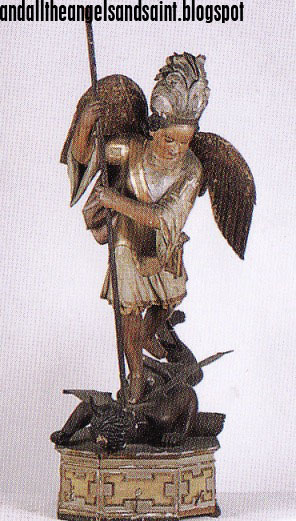
SAN MIGUEL ARCANGEL
St. Michael, the Archangel, battling the Devil. 19th c.


STA. MONICA
Altar-size image of St. Monica, mother of St. Augustine, at the Chapel of Sta. Monica.

ASUNCION
The Assumption of the Virgin Mary, brought by Enrique Delgado, OSA in 1888. Inscribed under the globe, "G. Becessa 1555".


SANTO CRISTO
Crucified Christ, previously attributed to Juan delos Santos, but now in question. Its Baroque qualities do not coincide with the time in which the artist worked. 18th c.


INMACULADA CONCEPCION
Ivory image of the Blessed Virgin, which used to occupy the niche on the top of the grand lectern at the choirloft.


SANTO CRISTO
A large figure of the Crucified Christ carved in wood, in a retablo formerly from the Legazpi Chapel. Frontal formerly from the sacristy.

SANTO NINO
The Christ Child depicted in a Captain General's uniform. He resembles the young Philip IV.

SAN MIGUEL ARCANGEL
An all-ivory tableau showing the Archangel Michael trampling the Devil. 19th century, given by the Augustinian Sisters of La Consolacion College of Manila. founded in 1883.

SAN LORENZO MARTIR
Ivory St. Laurence, the first martyr, wears a dalmatic. He was martyred by being roasted on a spit. Missing gridiron emblem. 17th-early 18th century.

CRISTO CRUCIFICADO
Large life-size wooden image of the Crucified Christ, which used to hang in what is now the sacristy. It was brought out during the novena for the souls of purgatory. It has jointed arms and the year 1770 is inscribed on its left shoulder.

VIRGEN DE LA CORREA
This magnificent ivory headed Virgin holds a cincture and carries the Christ Child in her other arm. 17th-early 18th century

(Photos from San Agustin: Art & History 1571-2000, by Fr. Pedro G. Galende O.S.A. and Regaladao Trota Jose. Hongkong: Solutions)

Thursday, September 1, 2011

78. RETRO-SANTO: Ntra. Sñra. De Monserrat

At the Chapel of San Beda is housed the image of Our Lady of Montserrat, one of the are representations of the Virgin seated on a throne with the Christ Child on Her lap. Both she and the Child Jesus wear crowns of gold. Her dark complexion has earned her the name “La Morenita” (the Dark One).

The image of Ntra. Sra. De Monserrat was first brought to the Philippines by the Benedictine Fathers in 1895, an exact replica of the small dark-complexioned statue of the famous Monserrat virgin venerated in the Benedictine monastery nestled atop the Monserrat mountain of Cataluña, near Barcelona, Spain. Monserrat means "sawn mountain" because the rocky mountain resembles the teeth of a saw from a distance.

According to tradition, the miraculous image was first known as La Jerosolimitana (the native of Jerusalem), since it is thought to have been carved there in the early days of the Church. The statue was eventually given to St. Etereo, Bishop of Barcelona, who brought it to Spain. In the 7th century, when the Saracens invaded Spain, the Christians of Barcelona heroically defended it for three years until they could hold out no longer. The image was brought for safekeeping to Montserrat, in a small cave on 22 April 718 and was discovered and placed in a small church that was soon built; this little church developed into the present church that was completed in 1592.

PICTURE SOURCE: Shrines of the Virgin Mary in the Philippines. A Catholic Guide Manual by Gaudelia G. Donato.
Photographs by Sr. Esther Maria, S. Sp. S. (c) 1975.


Of carved wood, the 3 feet plus statue is in a sitting position and has an elongated face and a delicate expression. Done in the Romanesque style, the Virgin wears a gilded tunic and cloak.Beneath the crown is a veil adorned with stars, squares, and stripes in subtle shades of color. The Virgin holds a sphere, while the other is extended in a graceful gesture. The Child Jesus sits on His Mother's lap and also wears a crown. His right hand is raised in blessing; His left hand holds an object that resembles a large pine cone. A cushion serves as the Madonna's footrest; she is seated upon a chair that has large legs and whose back is topped by cone-shaped finials. It was to this miraculous Lady that St. Ignatius Loyola offered his sword and dagger in 1522.

The replica was first kept in a small chapel in Tanduay. The devotion quickly spread as the same indulgences gained in her Cataluña shrine were also granted to visitors of the Manila chapel. To accommodate the growing number of devotees, the image had to be taken many times to the San Sebastian Church just to accommodate them. The image was transferred to the Chapel of San Beda when the school moved to Mendiola St. in 1926.

Patroness of Benedictine Monks in the Philippines, San Beda College
Feastday: September 8
Shrine: Abbey Church of San Beda College

Monday, August 22, 2011

77. Assembling Divinities: SAN JOSE AND NIÑO JESUS

An antique dealer in Padre Faura sent me this cellphone photo of two ivory-faced santos for my consideration. I was drawn, of course, to the San Jose, which, despite being just a mask and without hands and base (it had been put on an old polychromed base) showed some promise to me. The clincher, of course, was the price, which was more than reasonable—surprising for a shop that is known to have pricey stuffs.

I was already happy with my San Jose find, intending to have it restored. On my way out, I casually asked him to be on the look-out for a small ivory Niño. To my delight, he brought out another santo fragment—a small ivory Niño head that was set on a new, grotesquely chubby wooden body.

Immediately, I had an idea—what if I can have this San Jose assembled with a Christ Child instead? I checked the proportions and the two ivory faces were a match! For just a few thousands more, I went out of the shop with both a San Jose and a Niño Jesus!

To Dr. Raffy Lopez, I did go next, of course, the santo restorer who had been helping me fix my broken santos for years now. I brought with him an unpainted antique base which I had kept in my baul, and Raffy immediately sent this to one of his contractors for painting and gilding.

When he set the San Jose and the Niño on the repaired base—the two looked comfortable up there! The San Jose body quickly underwent restoration—new ivory hands were carved and set on wire armature arms. The Niño’s body was whittled down to its proper size. Meanwhile, work began on the vestments. We decided on an olive green color for the robe and a light brown colored cape for San Jose. The design drew inspiration from gothic lines.

As always, wigs and metalworks (halo, potencias and flowered staff) were ordered from the workshop of Dodong Azares. Just a few weeks later, the assembly was complete and the amazing results are shown on this page.

My San Jose and Niño Jesus are now encased in a hurricane glass shade (locally called “coca cola virina”) that I found separately in another shop, with a replaced base and topper.

I am glad I bought these santos, and even happier that I had them restored and preserved, and they are proofs that everything—and that includes even damaged, cheap, and seemingly ugly santos--have divine possibilities.

Sunday, August 21, 2011

76. PHILIPPINE RETABLOS

Images of saints were not only captured by Philippine artisans in 3-dimensional carved figures, but were also replicated in bas-reliefs on wood panels. Called “retablos”, these wooden works, often beautifully polychromed and showing multiple characters, Biblical events or episodes from a saint’s life were often hanged on church walls, although smaller ones were made for private devotion. Retablos represent some of the earliest examples of religious woodworks done in the islands during the colonial period.


ADORATION OF THE SHEPHERDS
From the church of Candaba, Pampanga, this 17th century retablo form part of a series of Nativity scenes rendered in polychromed molave wood. Luis Araneta Collection.


ADORATION OF THE MAGI
This retablo, evidently done by the same craftsman, is done with a more polished effort. The colors are more exciting and vivid and the similarity in the expression of the characters are peculiarities of images from Pampanga. Luis Araneta Collection.


SAN ISIDRO LABRADOR
St. Isidore, a popular saint figure in the Philippines, is invoked for good harvest by local farmers. This piece, from Bicol, is made from polychromed painted wood and dates from 1792. Richard and Sandra Lopez Collection.


GOD, ALMIGHTY FATHER
A quaint depiction of the all-knowing, all-seeing and patient God the Father surrounded by allegorical figures, including a white angels and a black devil weighing the souls of the dead. We see a just man giving alms and a sinner beating a victim with a club. Early 20th c., Paulino and Hetty Que Collection.


10TH STATION OF THE CROSS
This particular station, “Jesus Is Stripped Of His Garments”, is no longer included in the new Stations of the Cross approved by Pope Benedict in 2007. Polychromed wood, 17th c., Narva Church, Camarines Sur. Paulino and Hetty Que Collection.


SAN FRANCISCO DE ASIS
St. Francisco of Assisi, founder of the Order of Friars Minor (Franciscans) is shown offering salvation to humanity by dangling his girdle of rope to people including religious figures wallowing in a fiery lake. Carved from a single slab of wood, it dates from 18th c. and comes from Ligao Church, Albay.

Tuesday, August 2, 2011

75. ALL-SAINTS: From the Workshop of Dr. Raffy Lopez

A sampling of completed santos from the workshop ofDr. Raffy Lopez, the Philippines' leading ecclesiastical artist and vestment maker. Dr. Lopez restores old ivories as well as antique wooden statuaries. He can also create new ones, ivories being his specialties--from tabletop sizes to processional images.

SAN PIO QUINTO (Pope Pius V)
St. Pope Pius V, (or Michele Ghislieri)was Pope from 1566 to 1572 . He is notable for his role in the Council of Trent, the Counter-Reformation, and the standardization of the Roman liturgy within the Latin Church. Feast Day: April 30

SAN PEDRO APOSTOL
A restored antique piece, St. Peter is shown with his attribute--a rooster--in reference to the Biblical account where the cock crowed thrice after Peter's betrayal of Christ. Feast Day: June 29

STA. MARTA
An ivory image made after the likeness of the Santa Marta image of Pateros, which shows the saint holding a palm leaf and standing on top of a crocodile, instead of a dragon. Feast Day: July 29

STA. CATALINA DE ALEJANDRIA
St. Catherine of Alexandria wields her attribute--the sword--which she used to cut the head of Emperor Maxentius, shown underfoot. Her other emblem, the spiked wheel, or now known as the Catherine wheel, is by her side, the instrument of her martyrdom. Feast Day: November 25

STA. JUANA DE CUZA
This not-so-known saint, St. Joanna of Chuza, was a woman of affluence who gave financial support to Jesus Christ and was also present when His empty tomb was discovered. She was the wife of Chuza, the steward of Herod Antipas. This is a wooden processional saint. Feast Day: May 24

SAN FRANCISCO DE ASIS
St. Francis of Assisi, holding a cross, one of his attributes.He founded the men's Franciscan Order, the women’s Order of St. Clare, and the lay Third Order of Saint Francis. Feast Day: October 4.

SAN CLEOFAS
St. Cleophas, is the father of St. James the Less, husband of St. Mary Cleophas, and brother of St. Joseph. Feast day: Sept. 25

SAN JUAN EVANGELISTA
An exquisite santo representing St. John the Evangelist--with ivory head, hands and feet. The young apostle was present at Calvary, providing comfort to the sorrowful Virgin Mary. Feast Day: Dec. 27

SAN ANTONIO DE PADUA
A restored ivory likeness of St. Anthony of Padua in his traditional brown habit, holding the Christ Child, and some stems of lilies, to signify his purity. He is one of the Doctors of the Church. Feast Day: June 13