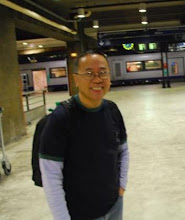
DR. RAYMUND FELICIANO, 43, is a clinical pathologist who currently teaches pathology subjects at St. Luke’s Hospital in Q.C.. A resident of Angeles, his paternal roots are in Mabalacat. Not only are we townmates, but we also discovered we went to the same small high school in the city—Chevalier School (although in my time, it was known as Sacred Heart Seminary). He graduated from the College of Medicine at UST in 1989. Over donuts, coffee and Coke, SSF sat down one afternoon with Dr. Feliciano to talk about his passion for photography, travel, religious processions and our revered Semana Santa traditions.
- - - - - -
Q: DOC, FIRST, ALLOW ME TO THANK YOU FOR COMING OVER ON A WEEK-END TO CHAT WITH ME ON SUCH A VERY SHORT NOTICE. WE REALLY APPRECIATE IT. THIS WILL BE A REVELATION TO YOU—BUT DO YOU KNOW, PEOPLE IN CYBERSPACE ARE ACTUALLY FAMILIAR WITH YOUR PHOTOS BECAUSE OVER 500 OF THEM ARE UPLOADED ON 2 FLICKR GROUPS—SEMANA SANTA FILIPINAS AND SANTOS: IMAGE OF FAITH?

DR. F: Well, a flickr member sounded me off that my Holy Week pictures daw are regularly posted on flickr, so I must thank you too for doing that. To be honest, I thought I was alone in my interest for religious processions and Holy Week imageries, so it came quite as a surprise when you showed me the flickr groups and the photo pools that contained my pictures. Ang dami palang santo enthusiasts. Yes, I did read about Semana Santa Filipinas in a recent Inquirer article. Now I have started making friends with complete strangers..
Q: WE ARE OF COURSE, AMAZED AT THE QUANTITY OF SEMANA SANTA PHOTOS YOU HAVE TAKEN AND AMASSED IN DOZENS OF ALBUMS..THE FIRST OBVIOUS QUESTION IS, HOW AND WHEN DID YOU START?

DR.F: I have always been a photography buff. In college, I took photographs which found their way in our school organ. This was in the late 1980s. I was just toting an instamatic camera then.. switched to a standard analog camera. If you noticed, yung earliest albums ko of Pampanga churches, from way back 1987-1989 yun. I wasn’t serious then, mga typical works lang yun of an amateur student photographer..
Q: BUT WHY THE SPECIAL INTEREST IN RELIGIOUS SUBJECTS?
 STO. ENTIERRO, Mabalacat, Pampanga
DR.F: Yung earliest recollection ko kasi was going to the Holy Week processions in Mabalacat, hometown ng late father ko. He used to take us there to watch the processions. Kahit konti lang yung mga santo, naaaliw din ako, kasi, puro antiques. Antique images hold some fascination for me. especially when they are in their carrozas..That opened my eyes to the enduring appeal of our religious processions.
Q: WHEN DID YOU START BECOMING SERIOUS IN PURSUING THIS HOBBY?
 STO. ENTIERRO, Samal, Bulacan
DR.F: I actually found inspirations from 2 things. Yung una, yung program na “Travel Time”, hosted by Susan Calo-Medina. I watched that program a lot, and got hooked on the interesting places they feature…yung mga provincial scenes. Then, I found this book “Simbahan”, written by Regalado Trota-Jose, which featured a “must-visit” list of different churches in the Philippines. It also had chapters on sacred art like santos, that piqued my interest. It was simply a matter of making my interests converge—travel, santo, photography. So, in 1993, I decided to embark on a yearly pilgrimage to different places, and to capture in pictures the different provincial Holy Week festivities.
 AGONY IN THE GARDEN, Polo, Bulacan
Armed with a copy of the “Simbahan” book, I systematically started to cover the 23 towns of Pampanga. I just commuted then, I traveled by jeep, by bus. I took pictures of churches first, often asking permission from the parish priests, o kung wala sila, from their secretaries. They allow me naman to take photos.
 LA PIEDAD, Paete, Laguna
After Pampanga, I went to Bulacan, then Laguna. I had to get myself a map as I was unfamiliar with most of the places outside of Pampanga. So, yun yung unang na-cover ko in 1993—Pampanga, Bulacan and Laguna.
 TANGGAL SA CRUZ, Malolos, Bulacan
The next year, 1994, I covered the Holy Monday procession in La Union and Ilocos Sur, then I went back south for the Holy Wednesday procession in Dasmarinas, Cavite, and headed home to Pampanga para naman sa Good Friday events.
 STA. MAGDALENA, Guiguinto, Bulacan
Q: WHAT IS THE SCOPE OF WHAT YOU HAVE COVERED SO FAR? HOW DO YOU FIND TIME FOR THESE? PLANNING THESE TRIPS MUST BE A LOGISTICAL NIGHTMARE..
DR.F: Down south, I have gone as far as Cebu, Bohol, Iloilo. Up north, I have gone as far as Claveria, Cagayan. My most recent photo trips this year were in Tabaco, Daraga and Legazpi, all in Albay.
 CRUCIFIXION, Molo, Iloilo
I have learned to plan these things in advance, so long before Holy Week, may itinerary ako. I have no qualms about riding a plane, at kung walang plane, a boat, or a jeep. Yung mga places to sleep over naman, thank God, wherever I go, may acquaintances at friends naman ako, so I usually get free lodgings..
 LA ULTIMA CENA, San Pablo, Laguna
Q: SURELY, YOU MUST HAVE A LOT OF INTERESTING SIDE STORIES TO TELL IN YOUR ANNUAL PHOTO ODYSSEY AROUND THE COUNTRY? CAN YOU SHARE THESE WITH US?
 STA. VERONICA, Paranaque
DR.F: Oh, a lot. Halimbawa, I was really excited to see the churches that were featured in Trota’s book, “Simbahan”. Using the book as a guide, I went to visit the pictured churches, but sadly, they are no longer as they used to be. Some of the rich, colonial architecture have been irrevocably altered as in the case of the churches in Moncada, Tarlac. Yung sa Cardona, Rizal also disappointed me. And the one in Jala-Jala. I was also shocked with the way the church in Montalban, Rizal was refurbished, wala ng air of antiquity, except for a couple of santos.
 VIRGEN DE LA SOLEDAD, Sta. Ana
I also have observed variances in local Lenten customs. Many practices have been “customized”. For example, yung oras ng prusisyons may vary. In Angeles City, 5 p.m., but in Sta. Ana, it is as late as 8:30 in the evening.
 PRUSISYON, Bacoor, Cavite.
Then, there are the quaint Palm Sunday processions in Maragondon, Cavite. All the santos associated with the Passion, including the Resurrected Christ, but excluding the Sto. Entierro, participate in the procession. Same for Polo, Valenzuela in Bulacan. The Church allows only the images of the Dolorosa and the Sto. Entierro on Good Friday, so that’s the only way the other images can come out in processions.
 GOOD FRIDAY SANTOS, Valenzuela, Bulacan
In Baliwag, a procession is held during the “Linggo ng Pagpapakasakit”. In Bulacan. Bulacan, there’s a Holy Tuesday procession. In Molo, Iloilo and Cabiao, Nueve Ecija, there a procession is held on Holy Thursday.
 SCOURGING AT THE PILLAR, Cabiao, Nueva Ecija
In 1994, I was lucky to have observed and photographed the last complete Bacolor procession. Because the following year, the lahar engulfed the town and the procession fell into disarray.
 STA. SALOME, Guagua, Pampanga
Q: WHAT ABOUT THE SANTOS THEMSELVES, WHAT ARE SOME OF YOUR INTERESTING OBSERVATIONS ABOUT RELIGIOUS IMAGES FROM DIFFERENT PARTS OF THE COUNTRY?
 DOLOROSA, Daet, Camarines Sur
DR.F: Oh, so many range of characters and expressions. In Balaoan, La Union, yung mga santos doon—from San Juan Ebanghelista to Sta. Magdalena--, may distinct Chinese features. I have seen smiling Dolorosas. Yung sa Tanay, Rizal, yung Dolorosa doon, gulat and expression. Yung sa Bacolor, halos puti na lang yung nakikita sa mata ng Dolorosa, with her upward gaze.
 DOLOROSA, Tanay, Rizal
Identifying santos now has become easier as most of the carrozas come with labels on which is written the santo’s name. I am pretty much familiar with the names of santos and tableaus, although occasionally, I am stumped with the usual Salome-Jacobe-Cleofe mix-up.
 RESURRECION, Angono, Rizal
DR.F: One would be Sasmuan, Pampanga with their antique santos and fabulous carrozas. Two, the antique images of the inland towns of Sta. Cruz, Marinduque. Three, the antique santos of Balayan, Batangas. Four, the images of Binan, Laguna. Five, the images of Vigan.
 TERCERA CAIDA, Balayan, Batangas
 JESUS MEETS HER MOTHER, tabletop tableaux. Binan, Laguna.
 CRUCIFIED CHRIST, Vigan, Ilocos Sur
DR.F: That has got to be the calandras of Sta. Rita, Bacolor, Sasmuan and Guagua.
 SASMUAN CALANDRA, Sasmuan, Pampanga
 GUAGUA CALANDRA, Pampanga
 DR.F: The Good Friday Dolorosa of Guagua, also those of Vigan, Arayat, Sta. Barbara in Iloilo and Mabalacat.
 DOLOROSA, Guagua, Pampanga
 DOLOROSA, Arayat, Pampanga
Q: BEST VERONICA?
DR.F: Sta. Cruz, Marinduque, Vigan and Mabalacat’s Veronica.
 STA. VERONICA, Mabalacat, Pampanga
 SAN JUAN, Meycauayan, Bulacan
DR. F: The San Juans of Meycauayan and Daet are my choices. The Magdalena of Meycauayan, Cainta, Arayat and Minalin. The antique Magdalena of Angeles has a one-of-a-kind headdress. For San Pedro, the ones of Lubao and Vigan.
 SAN PEDRO, Lubao, Pampanga
DR. F: For as long as I can. In fact, I have visited some places twice. Though next year, my travels are going to be limited. I have just lost my father this year, and so my available free time will now be dedicated to caring for my mother. Next year, I will limit my trips to nearby provinces. I am looking at visiting and photographing the processions of Capas and Concepcion towns in Tarlac.
 LA PIEDAD, Concepcion, Tarlac
DR.F: Thanks for the interest in my work. We are like classmates with a common interest for santos and Semana Santa traditions. See you next Holy Week!
 STO. ENTIERRO, Albay