Sunday, May 22, 2011

63. Santo Makeover: STA. SALOME GETS A SWEEP-OVER


I first learned about the image of Sta. Salome from my sister-in-law, Lulu Castro (nee Segovia), who, upon seeing my growing collection of processional santos, told me of their own special image that had been with their family for generations. It is that of Sta. Maria Salome, one of the holy women who were present at the Crucifixion of Jesus, and who later came to clean His tomb.


There are many versions of Salome’s history. It is said that she may have either been the younger sister or a cousin of the Blessed Virgin Mary. It can be said with greater certainty that she is the wife of Zebedee and the mother of the two apostles, John and James the Greater.

Traditionally, Sta. Salome holds a whisk broom. But in many places in the Philippines, she is also identified with Sta. Maria Cleofas, wife of Cleophas and mother of James the Less—who is depicted as swinging a censer. To complicate the situation even more, another Mary—Sta. Maria Jacobe—appears in Holy Week processions holding an incense boat. This has resulted in the transpositions of the three Marys’ attributes, and it is not uncommon to see a Salome image holding a censer and a Jacobe wielding a broom.

Which is why, when my sister-in-law recalled that their image once held a silver broom, I unknowingly corrected her—that what they have all along was, in fact, a Sta. Maria Cleofas, not a Salome. Of course, now that I know more, I also know better.


The story behind the Sta. Salome image of the Segovia family began in far-away Cadiz, in the island of Negros. The current owner of the image, Federico "Papang" Segovia Jr., had a great grandmother, whose name had long ago been forgotten, who bore a son who turned out to be very sickly. As a panata (vow), Papang’s lola promised to sweep the churchyard clean if her son got well from his many maladies. He did, and so the old lady not only kept her promise, but also had an image carved in the likeness of Sta. Salome, who kept Jesus’ tomb clean with a broom. She had this image processioned for many years, in gratitude for her answered prayers. The sickly son grew up to become a priest--Fr. Roman Segovia.


The image stands 51 inches tall, and was meant to be born on an anda. The face is lean and narrow, expressing quiet sadness with its half-opened mouth showing teeth and large sorrowful eyes. The nose is straight and long, with deeply-carved nostrils, while the neck had rings—minute details that are a sign of a carver’s remarkable skill.


The manikin-type body, while not as finely finished, is interestingly carved. There are portions in the back and lower torso where the wood was hollowed out—to keep the image light and easy to carry. The image stands on a simple , flat base with serrated trims, to be attached to the top of a presumably, more ornate anda. A silver broom, now lost, and a plain, stick-in halo (payong) were the only accessories of this family santa.


The image stayed in Cadiz, until the two old maid sisters of Papang's father, Federico Segovia Sr., took the image and brought it to Guimaras, Iloilo, where some family members relocated. Federico Sr. bequeathed the image to his son, Papang, and stayed in his care.The family image stayed in Iloilo, until it was retired when the processions ceased.


How Sta. Salome came to Pampanga was another fascinating story. When Papang Segovia joined the military, he rose to become a sergeant and was given provincial assignments and Angeles, Pampanga became his destination in the late 1950s. Fearing that with his absence, no one in the family could take care of Sta. Salome anymore, he decided to bring the image with him to Angeles. He dismantled the image and stowed the pieces in different suitcases, sailing to Manila with his dismembered family treasure in tow. From Manila, the image traveled with him to Angeles.

Angeles was one of the hot seats of the Huk movement then, a honky-tonk town with a reputation for terror and violence. But with the family protector with him, Papang felt safe in a strange new place. He would eventually meet and marry Imang Liling, a photographic model, and settled permanently in the city to raise a family of two boys and one girl—Lulu, my sister-in-law.

For over forty years, Sta. Salome was stored in its own urna in the utility room of the Segovia village residence in Angeles. Though hidden, it was never forgotten; people from Iloilo who made occasional visits to Angeles would ask every now and then about the santa’s whereabouts, not knowing it was safe and secure with the Segovias.


It was only a few years ago that I managed to see Sta. Salome up close. Her beauty was still discernible under thick layers of encarna and sloppy paint work which rendered her face, a chalky white. A finger had broken and some of the trims on the base had fallen off. Her frayed old abaca wig and tattered vestments were also in danger of disintegrating, and a replacement tin halo was not appropriate to this incredible, antique piece. I knew it was time for Sta. Salome to have a major and complete make-over.

It was easy convincing Lulu to have their family heirloom restored. After all, she was next in line to inherit the image. In Dec. 2007, she secured the image, and I turned it over to Pampanga’s leading ecclesiastical artist, Tom Joven, for restoration. It was a project that would take many months of painstaking restoration, beginning with the tedious process of stripping the layers of paint accumulated through the years--all by hand. In Salome’s case, she had over 3 layers of paint, and as each layer was removed, the finer details of the carving appeared.


Suddenly, the contour of her nose (which I initially thought was rather big), took on a more natural, refined line. Her facial features—her cheekbones, jowl lines, lips and teeth—became more clearly defined. Tom opted to use lightened natural skin tone for the face, as opposed to the whitish encarna of before. He likewise changed the arch of the brows to give it a sadder, more expressive look.


Here’s a before-and-after look of the Sta. Salome:


Bewigged with long, deep-brown colored curls and adorned with an antique rhinestone tiara, the restored Sta. Salome looked very lovely indeed. The pale, creamy colored complexion that is true to the period, suits her very well.


The new vestments, commissioned from Plumaria of Jerome de Jesus were another work of art in themselves. The mix of colors are very contemporary—sky blue for the cape, maroon for the skirt, cream for the bodice, gold for the edgings—but provide a contrast to the traditional styling that included even the mandatory embroidery, all done by machine.


Now all Sta. Salome needs is a broom and a halo—and she’s on her way to joining a Holy Week procession, perhaps next year! In the meanwhile, the Segovia Family are happy to have their heirloom family image back, in her restored glory.


I, too, was totally surprised at her incredible transformation-- Sta. Salome looked like a different Santa altogether. When I finally came to see and fetch her after months of anxious waiting, you could say the all-new Sta. Salome really swept my breath away!

Credits: Restoration/Encarna/Woodwork by Thom Joven, Vestments by Jerome de Jesus of Plumaria, Wig by Bella Francisco, Brassworks by Jeric.

Tuesday, May 10, 2011

62. HEIRLOOM SANTOS FROM ZAMBOANGA
Featured on this page are heirloom images of prominent families from the city of Zamboanga, many of which are still being processioned during the annual Semana Santa rites, following age-old colonial traditions.
******


(PHOTO CREDITS: All photos from "ZAMBOANGA HERMOSA: Memories of the Old Town" by Antonio E. Orendain II ed., Manila: Vera Reyes, 1984. Edited for this blog)

Sunday, May 8, 2011

61. Santo Stories: VIRGEN DEL PILAR OF THE VALENZUELA FAMILY

by John Michael V. Santos

The Virgin Mary, under the nomenclature "La Virgen del Pilar", appeared to Saint James the Greater on the year 40 beside the River Ebro in Zaragoza, Spain. The Virgin, who was then living in the Holy Land, was transported by angels to console the apostle in his hour of distress. The apostle was gravely saddened by the results of his labors in evangelizing the locals to the Church of Christ. The Mother of God appeared to him atop a jasper pillar which was carried by Angels. She ordered James to construct a Church in her honor which will house the Pillar.

Then and there, the Virgin promised the apostle that "The Pillar will stand from this moment until the end of time in order that God may work miracles and wonders through my intercession for all those who place themselves under my patronage". She then left leaving an image of herself atop the jasper pillar. Saint James constructed a church which was and still is under the patronage of Santa Maria del Pilar. The church was then built and Our Lady remained true to her words because the people started to believe the apostle and the good news of salvation that he brought with him.

The Virgin of the Pillar is hailed as the Reina y Madre de la Hispanidad (Queen and Mother of Spanish Culture) because on the 12th of October, 1492 (The Virgin's feast) Christopher Columbus discovered the New World to which the faith of Christ as well as the Spanish language would spread. Spain brought the devotion to its colonies, including the Philippines, and today, Our Lady of the Pillar has important shrines at the Sta. Cruz Church in Manila as well as in Zamboanga City.

In 2007, I finally decided to fulfill my dream, the dream of having our family’s own virgin, I did not foresee that realizing this dream would not be an easy road, that the seemingly simple decision to commission an image would also be a test of my faith in God and my devotion to His Mother. I chose the title Nuestra Senora del Pilar for it is the First Catholic Marian advocation and my grandmother's namesake whose birthday falls on the 11th of October, a day before the Virgin's feast.

I then commissioned the Virgen del Pilar from a famous sculptor in the Metropolis. Months and months passed but the Virgin's condition improvement was not as it was planned. I got broke by going to their atelier almost every week just to make sure that the Virgin will be finished in the soonest possible time. After a year, I decided to cancel the project for I could no longer afford to incur more losses.

I then sought the help of Philippines' leading Ecclesiastical Art Restorer, Thomas Joven for the continuation of the project which i thought, at that time, was a broken dream. Fortunately, my mentor and friend gladly accepted the job.

After a few months of conceptualization and careful execution, the Virgen came out vibrant and triumphant in an ensemble by Jerome de Jesus and his dynamic team from Plumaria Sacred Vestments.

Our family image, of hardy gemelina wood, is all of two feet, and stands on a cloud base 10 cm. tall and, which in turn, rests on a pillar 40 cm. high.

The image was solemnly blessed by Rev. Fr. Cesar Macariola, Parochial Vicar of San Juan Nepomuceno Parish in Malibay, on the 29th of May 2011 in the Valenzuela Residence.

Sunday, May 1, 2011

60. WINGED SAINTS--Protector of Filipino Homes in the Past

Text and photos by Linda B. Bolido

(Originally published on Philippine Daily Inquirer, 4 April 2004 issue)

An antique collection shows early Pinoy Catholics put their trust in saints who would now seem obscure.

It seems even religion is not impervious to the penchant for following what is uso. Almost 4 decades of collecting religious antiquities and this prominent lawyer, a resident of Quezon City who wants to remain anonymous for obvious reasons, has yet to add an image of the child Jesus to his treasure trove.

But then, his pieces are no younger than 50 years, and the Nino phenomenon—although sweeping—seems to be more recent vintage. Of course, given the current popularity of the Nino (not only is He seen everywhere, on dashboards, offices, wet markets and even beside Buddha, but the Ati-atihan, the traditional celebration of the Child Jesus’ feast day in Kalibo, Aklan, is likewise staged all over). His images will doubtless be among the collectibles soon.

The antique collection, which the lawyer says he started with the first money he earned while still a college (he bought a pair of angels in his native Bulacan for P50), seems to suggest 2 things: One, Pinoys have always been maka-ina, hence renderings of the Virgin Mother (or Mama Mary as many Filipinos prefer to call her) in her various appearances; and two, even in religion, the Pinoy’s “favorites” tend to change.

While the Nino may be many people’s current object of devotion, if not favorite doll—with costumes ranging from the sublime to the ridiculous—farmer, soldier/policeman, rock star, little prince, Constantino in a santakrusan, etc.—that if put together, will put to shame the wardrobe of Barbie’s ex, Ken—early Filipinos still put their trust on saints hardly heard of today.

Take San Vicente Ferrer. The collector has found out that the Dominican priest was a constant presence in Filipino homes in the early days, and was considered a bringer of good fortune and protector from illness.

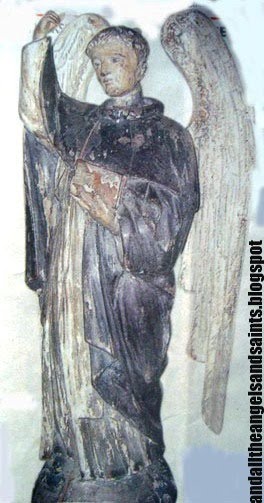
So popular was San Vicente in earlier times that the lawyer has at least 5 statuettes of the saint. The saint, also known as the Angel of the Apocalypse, is usually shown with wings. He was reportedly the patron of builders not so much for erecting physical structures but for helping rebuild and strengthen faith.

The Holy Family—Joseph, Mary and Jesus—seemed to be another favorite object of veneration. By the time the collector got the images, however, the Nino fever appeared to have been in full force that the child was often missing.

Another favored trio by earlier artists and religious was the Holy trinity of Father, Son and Holy Spirit. The collector was especially proud of a large painting of the coronation of the Virgin Mary after Her ascension to heaven, which used to grace the hall of some monastery.

Also occupying pride of place are images of Mary as the Lady of Penafrancia, patroness of the Bicol region, and Nuestra Senora de los Remedios, patroness of the Malate Church.

One of the oldest (over a hundred years old) and most expensive pieces he got was the Virgen de Porteria, which, as the name suggests, was often placed in the receiving area.

59. RETRO-SANTO: Nuestro Padre Jesus Nazareno of Quiapo

The most revered Jesus icon in the country is the centuries-old image of the Nuestro Padre Jesus Nazareno which resides in the minor basilica of Quiapo and whose history is intertwined with that of Manila’s premiere district. Also known as the Black Nazarene, the life-size, cross-bearing wooden Christ reached our Islands on 31 May 1606 by galleon from Acapulco, Mexico. Tradition has it that a fire that occurred on board the ship gave the image its dark, ebony complexion.

The Augustinian Recollects who brought the image here, enshrined the Nazareno in their church in Bagumbayan, until it was transferred to their bigger San Nicolas Tolentino Church in Intramuros two years later. Manila Archbishop Basilio Sancho de Santas Justa y Rufina mandated the transfer of the image to Quiapo Church in the late 1700s where it has rested on its altar ever since.

Veneration of the Nazareno started immediately especially among the poor and the common folk. Today, the devotion has spread across the nation, a unique expression of Filipino faith that has merited approval from two popes—Pope Innocent X who, in 1650, gave his blessing to the establishment of the Cofradia de Santo Cristo Jesus Nazareno, and Pope Pius VII who granted a plenary indulgence to all those who pray before the holy image.

The feast of the Nazareno falls on January 9, and this day is marked with major processions to mark the transfer of the image to the Quiapo shrine. Over the years, the rowdy, full-packed processions have resulted in casualties, injuries and even deaths of devotees. ale devotees, wearing maroon robes or shirts participate in the processions, but only the males are given the task of holding the ropes (namamasan) that pull the image’s carriage. It is believed that the towels or handkerchiefs that are wiped on the image are imbued with Jesus’s miraculous powers.


Hymn to the Black Nazarene of Quiapo
Composed by Lucio San Pedro

Nuestro Padre Jesus Nazareno
Sinasamba ka namin
Pinipintuho ka namin
Aral mo an gaming buhay at kaligtasan

Nuestro Padre Jesus Nazareno
Iligtas mo kami sa kasalanan
Ang krus mong kinamatayan ay
Sagisag n gaming kaligtasan

Nuestro Padre Jesus Nazareno
Dinarangal ka namin
Nuestro Padre Jesus Nazareno
Nilul’walhati ka namin
Nuestro Padre Jesus Nazareno
Dinarangal ka namin
Nuestro Padre Jesus Nazareno
Nilul’walhati ka naming!

Monday, April 11, 2011

58. THOMAS JOVEN'S DOLOROSA & STA. SALOME

New works from Mr. Tom Joven, one of the country's leading ecclesiastical artists and Pampanga's most accomplished restorer of sacred art. Here, contemporary carvings of the Dolorosa and Sta. Salome, owned by santo enthusiast Mr. Jeff Popatco of Guam, are painted in the popular Spanish style, achieved through the technique of encarnación, literally, “putting on the flesh”.

*****

MATER DOLOROSA

Mater Dolorosa or Mother of Sorrows is a central figure in Marian art depicting the Virgin Mary and the seven sorrows in her life (The Prophecy of Simeon, The Flight into Egypt, The Loss of the Child Jesus in the Temple, Mary Meets Jesus on the Way to Calvary, Jesus Dies on the Cross, Mary Receives the Body of Jesus in Her Arms, The Body of Jesus is Placed in the Tomb).

In artistic representations, the Dolorosa is shown in a sad and anguished mode by herself, veiled and dressed in black. In other representations the Virgin Mary depicted with seven swords piercing her heart, a reference to the prophecy of Simeon at the Presentation.


*****

STA. MARIA SALOME

Sta. Maria Salome is one of the “Three Marys” who served Christ during his ministry. She was the mother of St. James the Great and St. John the Evangelist, and was the wife of Zebedee. Mary Salome witnessed the Crucifixion and was among the women who came to clean Christ's tomb on Resurrection day, but found it empty. Hence, she holds cleaning implements as part of her attributes. In the South, she holds a broom, while in other parts of the country, she holds a censer. Her feast day is October 22.


(PHOTOS COURTESY of Mr. Tom Joven. PROCESSIONAL SANTOS from the collection of Mr. Jeff Popatco of Guam.)