Friday, February 25, 2022

351. On Exhibit: CRISTO A LA COLUMNA (Scourging at the Pillar)

This small, but incredible piece of religious folk art, came by  way of an antique dealer from Bulacan, who kept popping in at odd days in my Makati office, bearing all kinds of “antique finds”.

 One time,  without any advance warning, he went to show me an antique processional santo—in my office building, of all places. He wanted to go up my 23rd flr. Office, but I told him to wait at the Starbucks Café on the groundfloor. 

Simple carving characterized this Cristo
When I went down to meet him, he was casually seated outdoor, with a coffee at hand---and an almost lifesize statue of a bare Sta. Magdalena on his side. He was oblivious to the stares of people around him, so I asked him to put the image back into his van!

Silver potencias shaped like sun's rays

So the next time he called to say that he had an antique to show again, I told him to quit it! But he kept on waxing praises about how rare it was—Scourging at the Pillar carving—with silver  tapiz and potencias incised with ysot design, human hair wig, folksy carving that fits my taste—--which began to intrigued me. This time, I asked him to meet me at my Makati place, where our wheeling and dealing would be more discreet. 

The figure is painted in ashen white
When he did show me the piece, I was stunned at the powerful simplicity of the small carving, barely 32 inches tall, painted ashen white. 

This Cristo has an expressionless gaze

The face of Christ itself bore no trace of agony nor tension, what with his big, downcast but staring eyes and expressionless lips. He actually has carved short hair, but was meant to wear a human hair wig over it. He has large protuding ears, carved without much details.

Note the child-like fingers

In contrast to the plain-ness of the carving which is characterized by it folk art quality, its silver metal accessories are outstanding. The 3 potencias mimic the rays of the sun, very similar to the sun’s rays on the Philippine flag. They are decorated in ysot (etched) style.

 The silver tapiz, on the other hand, is made of hammered metal, decorated with trefoil flowers and leaves on a vine. The edges are serrated. A separate silver  bow with long tails  keeps the tapiz in place. It is also decorated in repousse technique.

Trefoil foliage on the pukpok tapiz
The antique Cristo a la Columna came in its own glass case over a newer wooden base of narra, that probably dates from the 50s.

Imagine, I had meant to dismiss this dealer because of his obstructive ways, and if I had done that today, I would have missed this fabulous piece of ancient Philippine sacred art. Smitten with this rare find, I lost no time in haggling with the dealer about its price, and we arrive successfully and painlessly with the final price tag. 

Since then, I have been offered much more by other antique dealers who recognize the quality of this Cristo at the pillar. I have no plans of letting it go. The only time this Cristo gets  out of my sight is when he is borrowed for a traditional Lenten Exhibit of the Carmelite brothers every March. At least, he gets to be seen and enjoyed by santo aficionados who truly appreciate the antiquity and naïve beauty of ancient Philippine santo art. 

**********


(This article is dedicated in memory of Bro. Anthony “Onie” Domingo (+), Carmelite brother, and curator at Carmelite Brown Scapular, who first chose this piece from my collection for his Lenten exhibit called Misericordes Sicut Pater in 2016. For the next 4 years, the Lenten Exhibit was held annually  at the National Shrine of Our Lady of Mount Carmel, Broadway, New Manila, Quezon City, until Bro. Onie’s untimely demise in August 2020. He is lovingly missed.) 

SOURCES:
All photos from Buenviaje PH, FB page
Anthony Doming FB page

Thursday, February 3, 2022

350. Winging his way from ebay to my altar: SAN VICENTE FERRER

The popular online bidding site, ebay, is very strict with the sale of ivory  on its site, and since 1990, you can no longer engage in the international trade or sale of new ivory. The sale of ivory items made before 1947 can be freely bought and sold, though importers and exporters need a permit. 

But even with these rules, ebay buyers tend to pass up on antique ivory santos, after considering all other factors, not to mention, risks. That was why, when I saw a Manila-based seller offering a few antique ivory pieces on ebay, I was rather skeptical if they would sell at all. True enough, they didn’t. 


One of the antique ivories that piqued my interest was a stunning 11 inch, San  Vicente Ferrer figure, with head and hands of ivory. It was fitted on a manikin body, and dressed in its original Dominican vestments, complete with a capuce (habit hood), in traditional black--which has faded to blue—and white. 

The habit is lightly embroidered with gold thread, and the short shoulder hood features a 6 pointed star-shaped flower repeated on the white tunic.

The 19th century ivory santo, as described in the original post, once belonged to a Catholic faithful who converted and became a born-again Christian, a religion which discourage the use of religious icons as objects of veneration. The antique ivory even bears a stamp of certification from the government that confirms its antiquity, which qualifies it for international sale.


San Vicente Ferrer is commonly depicted as a pudgy friar, with one hand pointing heavenward, with the other hand holding a book, to allude to his being a charismatic preacher. This santo, however, has an open palm in benediction. His right hand holds a tiny ‘leather-bound’ book, a nice detail, if I may add.

Missing was his pair of metal angel wings (San Vicente was considered as an angel), a halo and a globe base, in reference to his mission “to preach unto them that sit upon the earth, and over every nation, and tribe, and tongue, and people".

With the fine antique ivory unsold, I lost no time in contacting the dealer whom I knew all along—and concluded the sale online.

This San Vicente was one of my earliest ivory pieces that was worked on in 2001 by renown ivory restorer, Dr. Raffy Lopez. The first thing he did was to remove the gold embroidery from the fraying cloth, then transferring them on new satin. Using the old habit pattern, he replicated the distinctive vestment of the Dominican saint.

He had a pair of  brass wings plated in gold made, using an old pattern, and opted to have a “paragua” halo, to avoid punching holes on the santo’s outfit and body.

Finally, he had an appropriate  wooden globe base made, elevating the santo to a height of 15 inches. San Vicente Ferrer may be one of the most common santos that one can find in antique shops, but this ivory version remains special to me, not only because it was one of the very first ivory pieces that I got to own, but also because of the of the circumstances of how I acquired it—not from an antique shop, a collector, or a ‘runner’, mind you—but from the comfort of my own home-- online, in front of my computer!

Wednesday, February 2, 2022

349. A MINIATURE SAN JUAN EVANGELISTA

Miniature wooden santos –those measuring 8 inches or less, including the base—are a rare sight, so much so that there are collectors who specialize in them—like artist Claude Tayag. The standard for the carved figures alone is 6 inches, most often dominated by figures of the sleeping or standing Sto. Niño.

Less common are miniature figures of adult saints and divinities, like San Vicente Ferrer, the Blessed Virgin. Rare still are diminutive tableaus of the Sagrada Familia, San Roque and San Isidro.

Which is why, when a beautifully carved San Juan Evangelista popped up last year I the FB Marketplace, I lost no time in contacting the dealer ( a fellow Kapampangan collector!) and acquiring the piece.

The standing figure of San Juan is a shade under 6 inches tall, with a double base ending in an ochovado block that added another 2 inches to its height.

For a miniscule santo, San Juan is exquisitely carved and finished. True to his iconography, he is vested in a yellow robe with a green collared cape, holds a book, with only his quill missing from his other hand.


He was painted like a regular-size santo, gessoed, with his facial features  rendered using a very fine brush. His longish hair is parted in the middle, and swept at the back. His robe is decorated with tiny fleur de lis. Remarkably, the vestments show traces of gilding. The usual surface scruffs are typical of old santos, just like this

We can only surmise the reason why santeros were compelled to carve miniature santos. Maybe these were commissioned for children, or for smaller home altars. Or maybe it was a way of leveling up their skills, as carving intricate details such as  tiny hands and strands of hair were difficult to do. 

This San Juan may have been the result of such an exercise,  and we can all agree that the santero did very well, a very fine job indeed!


Wednesday, December 29, 2021

348. Sorrowful No More: AN ANTIQUE MATER DOLOROSA, REMADE.

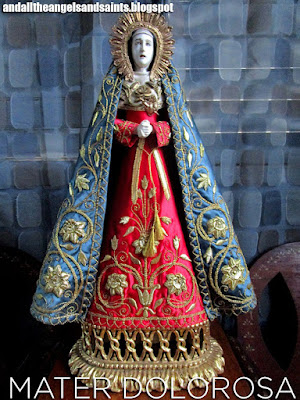
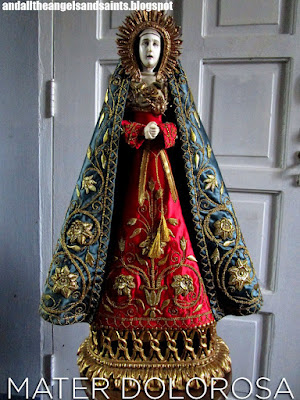
MATER DOLOROSA, COMPLETED

This Mater Dolorosa, made of antique ivory parts, is without doubt, my favorite because of its personal meaning to me. I was drawn to the Sorrowful Mother at the time my father was battling a fatal disease in 1998. When he passed away, I made a vow to acquire a Dolorosa image to be processed in our town during the Holy Week, in gratitude for his painless, peaceful transition.  I managed to find a vintage processional Dolorosa shortly after, and began a family tradition of participating in the annual Semana Santa prusisyons of our town. 

ALL WE HAD WAS AN IVORY HEAD...

...AS THE RESTORATION BEGAN.

I also wanted a version that we could venerate at home, perhaps an antique ivory piece, but by the early 2000s, complete, tabletop ivory images were becoming scarcer, and therefore pricier. I started searching for sacred images online—it was something novel at that time—so I was surprised to find an ebay Philippines site that had a few sellers of old items and collectibles. 

ANTIQUE HANDS WERE SERENDIPITOUS FINDS.

THE HEAD ACQUIRED A CARVED TORSO

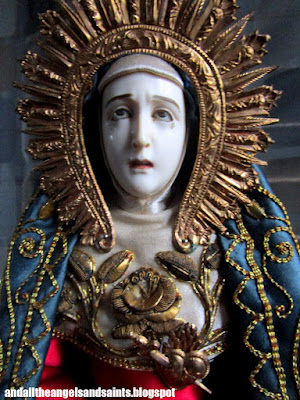
It was there that I met a local dealer, who turned out to be the brother of an officemate!. When I asked him offline to be on the lookout for an  ivory Dolorosa, he sent a private message to tell me, that he in fact has a solid ivory Dolorosa head. When I got hold of the picture, I was stunned, because it was an antique ivory head some three inches long, exquisitely carved, with open mouth, complete with glass eyes, complete with tiny crystla teardrop. It was of very high quality ivory, creamy white in color, without cracks and flaws. Unfortunately, that was all that he had—the clasped hands are missing, and so is the body, the base (peana), and accessories, right down to lost vestments, metal accessories and wig. 

ALL-NEW METAL AUREOLA

THE DOLOROSA ON HER PEANA

I just could not pass up this ivory head, so I got it and kept it in a velvet pouch for a year or so, before I finally took it to my restorer, Dr. Raffy Lopez. One look, and he confirmed that I, indeed, made a good decision as the ivory was excellent in all aspects. His only problem were the missing pair of ivory hands, as it’s almost impossible to find old parts of appropriate size. I had no choice but to settle for new replacement  ivory hands.

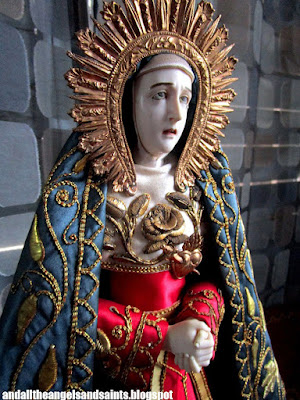
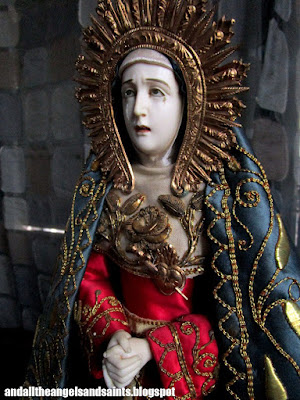
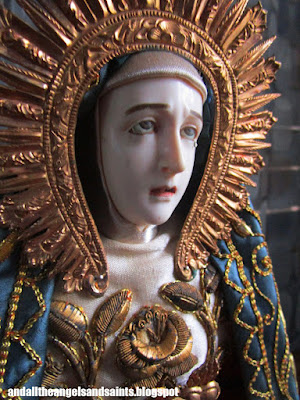
FINELY CARVED FACE REVEALS HER GRIEF

SALVAGED EMBROIDERY ON HER VESTMENT

 So I left the Dolorosa head with Dr. Lopez, not even bothering to ask for a timeline, as I don’t have one too. But two weeks later, he was on the phone again, sharing me about his excitement of finding a a pair of ivory hands—clasped hands—perfectly fitting the size of my Dolorosa. I can’t ask for better news! 

DETAIL OF THE FLORAL EMBROIDERY

BACK VIEW OF THE CAPE

With my full trust in Dr. Lopez, I just left him to his own devices—although he would contact me once in a while to confer about my personal choices—do I like her in pure black or maroon and blue? Do I prefer a floral peaña? He suggested to do away with the wig as she will be wearing a wimple, anyway. And he also recommended satin fabrics. 

THE COMPLETED IMAGE IS 22 INCHES TALL

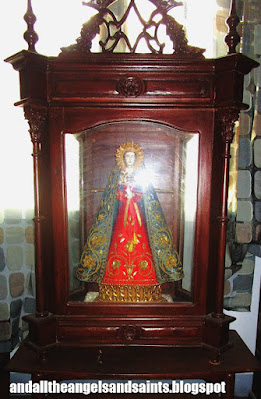
MATER DOLOROSA, IN HER URNA

While Dr. Lopez was restoring and completing the Dolorosa, I was also briefing a local carver for a customized urna in which to house my Dolorosa. Based on the completed height of the image (about 22 inches tall), I commissioned a Betis artisan to copy a wooden urna and its design, I found in an online antique site. He had to do it twice—because the first one he did was box shaped; I wanted the front to have 3 panels of glass, which will make it trapezoidal.


MATER DOLOROSA, IN HER URNA.

After three months, the antique Dolorosa head had a bastidor body, jointed arms, fully embroidered vestments, and a peana with  calado design. It was now a complete image, standing 22 inches tall, beautifully dressed on her gilded base. Inside her carved urna, the Dolorosa reposes, still sad but stunning. Only her new caretaker is sorrowful no more.

Wednesday, December 15, 2021

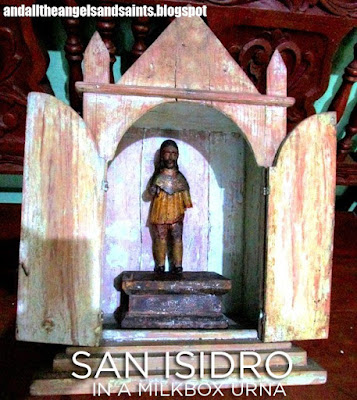
347. SAN ISIDRO AND HIS MILK BOX URNA

One of the most quaint folk art pieces I acquired just has to be this tiny San Isidro Labrador from Bohol, that was matched with a hand-made wooden urna, fashioned from an old wooden milk crate.

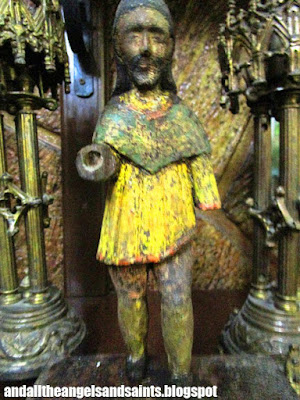
SAN ISIDRO LABRADOR BOHOL SANTO, 

The century-old San Isidro—a shade over 5 inches, excluding the base—is a typical Bohol piece with some of its brilliant polychromy still intact, all iconographically correct. He wears a green cape over a yellow tunic, with his boots on. He has missing hands, which once held a spade. 

The santo stands a mere 5+ inches tall

Despite the small rectangular base, there is a space once occupied by an angel plowing with a cow. The figure of the kneeling landlord is an optional element of the tableau, and he was left out in this representation, understandably because of the small dimension of the piece. 

Ordinarily, Bohol pieces were enshrined in folk urnas of the same qualities as the santo---small, brightly polychromed wooden altars embellished with relief carvings, raised by stair-shaped bases. This San Isidro, however, was found being displayed in an antique shop in a simple wooden urna, which stylistically does not match the Bohol style, but fits the santo’s size perfectly.

Wooden urna, handcrafted from milk crate

The small urna was ingeniously handcrafted from a milk crate—and the brand name can be found at the bottom of the urna to hide it—“Milkmaid Brand, Sweetened Condensed Milk". 

Milkmaid was an imported milk product, and it was first launched in the Philippines in the 1920s. By the 1930s, it was a successful brand, popularly known as “Marca Señorita”, because of the milkmaid brand character. 

Old Milkmaid ad, 1929

It was heavily advertised and promoted, and in 1929, Milkmaid even sponsored the search for the healthiest and cutest babies of the Philippines.

The urna itself, though simple in its creation, has many charming details. The “pediment’ is flanked by two “fence peg” spires. The double doors are hinged with wires, which were also used to make the latch. The boxy structure was attached to a 3-step stair base. 


 Its coating of white gesso or paint are still visible on the surface. Similar urnas made from commercial wooden crates were usually embellished with painted designs to make up for their plainness, but this example has no traces of color that I can see. In any case, San Isidro seems to be happy in his simple abode—after all, as a humble farmer-saint, he is used to a much harsher environment!