Showing posts with label La Naval. Show all posts

Friday, January 16, 2026

371. SAN MIGUEL ARCANGEL of Angeles City, Pampanga

SAN MIGUEL of the Evangelista Family, Photo: "Pisamban Maragul" book.

This 110 year-old image of St. Michael Archangel was commissioned in 1910 for the family of the prominent businessman Roman Bernardo Evangelista of old Culiat. The santo is depicted bearing a sword and helmet on his head, in the act of battle with Satan who is fallen and tampled underneath by the heavenly warrior. The San Miguel was intended for the La Naval celebration of Angeles.

Don Roman  Evangelista with wife Dona Francisca Dizon Dela
Resma , and their 2 older sons: David and Marcos  Ca. 1899 

The Evangelistas, known for their pioneering telecom business in the city, also owned the Sta.  Misericordia, a Holy Week tableau.The San Miguel image was bequeathed to Francisco and Domingo Evangelista upon the death of Don Roman, and successively passed on to their descendants.


The city of Angels also is home to other antique angel santos: El Santo Angel Custodio (Holy Guardian Angel, 1830, with Holy Angel University), San Gabriel Arcangel ( Jose Sanchez Family, 1916), and San Rafael Arcangel (Mariano V. Henson Family,1915).

As most of the Evangelista descendants have moved abroad, the carro and the image of San Miguel are both under the custodianship of the family of the late Jess Panlilio.

SOURCES:

Dr. Raymundo Feliciano Albums

Additional infor: Josel Evangelista Suarez

Pisamban Maragul: The Living Chrch of Angeles City, Nina Tomen in collabration with Bishop Virgilio David. Angeles City 2014


Friday, October 11, 2019

334. FROM PRAYERS FOR GOOD CROPS, THIS VIRGIN NOW HEARS APPEALS FOR BETTER GRADES, by Floy Quintos

NTRA. SRA. DEL ROSARIO, Panlilio-Santos Joven. Photo:Arwin Lingat

by: Floy Quintos
Reprinted from THE SUNDAY INQUIRER MAGAZINE , October 2, 2005 issue.

Lahar spelled death for the La Naval procession in Bacolor, Pampanga. This month, four La Sallians are bringing the tradition to the De La Salle Campus in Dasmarinas, Cavite so that students can begin their own tradition of homage to the Virgin.

The bucolic grounds of the Museo De La Salle in the Cultural Heritage Complex of the De La Salle campus in Dasmarinas, Cavite, are abuzz with student volunteers and museum personnel busy at work. Their task is a daunting one, perhaps a bit anachronistic in a campus where most of the students major in computer studies and nursing. They are restoring and assembling the largest extant 19th century “Carroza Triunfal” known, a massive yet graceful carroza of beaten silver.

For this October, the Nuestra Senora del Santissimo Rosario de La Naval of Bacolor, Pampanga comes home to the De La Salle campus in Dasmarinas. And here, every October from now on, she will ride forth again. One can almost hear Nick Joaquin rhapsodizing about his most beloved of Marian festivals.

And when she does, fours sons of De La Salle will have fulfilled a vow to rekindle a devotion to the Naval. They are Brother Andrew Gonzalez, FSC, two-time president of the De La Salle University System, who was just last week installed as the first President Emeritus; Brother Edmundo Fernandez, FSC, the youngest Brother Provincial of the De La Salle community in the country and Brother Armin Luistro, FSC, current president of the De La Salle University Manila and, quite recently, an active participant in national causes.


Providing a delightful counterpoint to this august company is Jose Ma. Ricardo Panlilio, or Joey, Executive Director of the Museo De La Salle and connoisseur of all things pertaining to 19th century Philippine Illustrado style. All four come from diverse backgrounds, but share a quiet devotion spread among the De La Salle students.

For Joey, 41, the image of the Virgin and the attendant St. Joseph, the massive and priceless carro and the very tradition of honoring the La Naval are, at once, a remnant of childhood and a symbol of a painful rite of passage into the real world. The image’s last custodian was his paternal grandmother, the late Luz Sarmiento Panlilio, a grand dame of Bacolor, Pampanga, and elder sister to the fabulous jeweler Fe.

“My childhood was greatly influenced by Inang Lucing,” says Joey. “I remember how the carro and the image of the virgen was the most important thing in her life. And how the entire year centered on the preparation for the November festival, which is when the La Naval was celebrated in Bacolor. My brothers and I were studying in La Salle and our immediate family was based in Manila. But every November just as the novena began, we had to come home. Inang Lucing would ask our parents to issue excuse letters. It was important to our family.”

FUN SIDE

Joey, from a very young age, took a great interest in the preparation of the carro. Weeks before, the pieces were taken out from the camarin or warehouse for polishing, reconstructing, repairing. “Inang would show me the lace and tissue that she had bought from her trips to Spain and involve me in the work. She would teach me the way the virgen must be dressed, the appropriate flowers, the appropriate music that the marching band would play. I just took to it naturally, it was all a part of my education in the traditions of the 19th century.”

But such archaic minutae also had a fun side. “Kapampangans are great eaters, and the day of the fiesta was one big celebration of Bacolor cuisine. We would wake at dawn to see the formal living room of the old house strewn with barongs. We would get into them and go to the high Mass. Then, we would come home to breakfast, a meal to which everyone in town was invited. At mid-morning, Segundo almuerzo, a heavy merienda was offered to all who had worked on the carro. Lunch was hectic because all the visitors from Manila would arrive, and it was a matter of Kapampangan pride that Inang offer them a table of the very best specialties.

NTRA. SRA. DEL ROSARIO in her Carroza Triunfal.

Then, at 3 p.m., another merienda for the latecomers from Manila. The parade would take place at around seven in the evening. And when we came home, there was a formal dinner in the main house, and food for everyone in the grounds below. It was exhausting, and even more so because at the crack of dawn the next day, my brothers would be herded into the car for the long drive back to school. I would stay an extra week to clean up and put everything back into place. My parents were not amused, especially my father. Looking back, I was really torn between two generations: Inang’s which believed in tradition, and my own family’s pragmatism and modernity!” His mother, the writer Lourdes Abad-Panlilio, once whispered to Joey, just as the carroza was sweeping past in all its dazzling grandeur, “You must always remember, hijo, the virgen was a simple woman.”

Joey looks back with little nostalgia and lots of pragmatism. “It was a feudal lifestyle, yes. But the one thing I most treasure about it is that it taught us to deal with everyone from all classes of life. It wasn’t this stereotyped ideal of having caciques and tenants at your beck and call. Everything was community-based. We worked alongside the people who worked for us. We decorated the carro together, we ate together, we marched in the procession together. It was for the Virgin, that was the way we thought about it. It was a dying tradition even then. But in Bacolor, the procession was a source of community pride.”

BENIGHTED TRADTION

Sadly as Joey grew into adulthood, he saw the gradual loss of interest in the benighted tradition. “It needed only the lahar to put an end to the procession, to that entire way of life.”

Joey and his siblings must have been ready to say goodbye to it in 1990, when the Pinatubo eruption covered most of Bacolor in lahar. But Inang Lucing, well into her eighties, had other plans. “I remember I told her that it would be difficult to organize an evacuation for the furniture and the household effects. She told me, “What furniture? All we really need is the carro.” It dawned on me that this feisty old woman had lived her entire life for only two things, her family and the virgen. We had to do it.”

CARVED ANGEL DETAILS,

Inang, Joey and his brothers and a few friends from Manila went back in a 10-wheeler truck. “She rode right up front next to the driver. We went back and tried to save as much as we could. Everyday, the lahar would rise a little higher, but we finally managed. On the long ride back, I started to complain. Inang was praying her rosary, but she stopped to say, “ at least we have somewhere to go. During the war, when I evacuated to the carro, there was nowhere to go.” That certainly said a lot about Inang and her character. WE brought everything back and put it into storage. However, there was no more community, no more old friends and neighbors. The entire structure that had made the procession come alive was gone. And there was nothing she could do about that.” Inang Lucing died in 1998, a shadow of her former self, but still an ardent devotee to the La Naval.

Brother Andrew Gonzalez FSC, former President of De La Salle University Manila, himself a descendant of the prosperous Arnedo-Gonzalez clan of Sulipan, Apalit, Pampanga, was no stranger to Kapampangan tradition. “But Brother is one of the most forward-looking men I’ve ever met. He admires the past, but he does not live in it. He knew we had saved all this stuff, he knew that it was in storage. He called me one day and said, “Put all your memories of childhood into a place where students can learn about them. You have a responsibility to the future generation. The Museo De La Salle was born.” As envisioned by Brother Andrew, it would be part of a cultural complex in the 27-Hectare De La Salle Dasmarinas campus, with the Aklatang Emilio Aguinaldo, the Campus Ministry Office and the Cavite Studies Center. All of a sudden, Joey who had been a practicing interior designer, had a new purpose in life. “It was no problem to get the family donate everything to the new museum. It was the least painful way to say goodbye to memories.”

WONDERFUL COUPS

Five years into operation, and the Museo De La Salle located in Dasmarinas, Cavite is not only one of the best-endowed museums in the country, it is also one of the most talked about. As Executive Director, Joey has managed some wonderful coups, such as important private donations, most notably the Guevarra Collection. His old-world tact and diplomacy, coupled with a wicked charm and serendipity, has gotten the museum many important bequests from the crème collectors. But it is his florid style of display, so true to the hyper-refined sensibility of the late 19th century, that make the museum truly unique.

“Still,” Joey says, “It lacked, in Brother Andrew Gonzalez FSC’s words, a spiritual center. Now that the museum is up and running, it seems the best time to bring out the Virgen again. It has been 14 years since she was last seen. But this time, it will be in a setting and at a time where she will give a different meaning to the festivities. And among young people who know nothing of Bacolor, Pampanga and the past, but who are ready to create their own traditions.”

NTRA. SRA. DEL ROSARIO

When the Virgen de la Naval of Bacolor rides forth again in the De La Salle Campus in Dasmarinas, Caviteon this month sacred to her and her devotees, there will be no more caciques and tenants, no proud matrons of feudal society, no children forced home from school to attend to her. Instead she will be pulled along by students who have volunteered for the honor of being her escorts. Perhaps, in Bacolor, she heard very different prayers - for better crops or kinder masters and cancelled debts. This time the prayers will be for exams, for careers, for much-needed jobs. No grand fetes, no groaning tables will mark her fiesta. Only the quiet admiration of a new community that is beginning something they can call their own. No need now for new jewels and crowns for this La Naval. 

Tuesday, April 24, 2018

311. SAN PEDRO APOSTOL OF ANGELES CITY, 1836


The early images of Angeles (early name: Kuliat), came mostly from the family and descendants of the founders, Don Angel Pantaleon de Miranda and Rosalia de Jesus. The two earliest santos—San Angelo Custodio (now enshrined at the Holy Angel Chapel) and Virgen del Rosario (in the central niche of the Holy Rosary Parish and used in La Naval celebration) date from the 1830.


By 1835, Kuliat had a Pio Quinto (Pius V) , San Juan (St. John), Sto. Domingo (St. Dominic), Magdalena Mary Magdalene), Nazareno (Nazarene), Apung Mamacalulu (Lord of the Holy Sepulchre), Manalangiñ (Agony in the Garden), Bayung Dacap (Arrest of Christ), Macagapus (Scourging at the Pillar), Desmayadu (Fainted Christ), Macalucluc Batu (Crowning of Thorns), Tercera Caida (Third Fall) and Sta. Veronica.


In 1836, the Sanchez Family, headed by the matriarch Fernanda Sanchez, had a processional San Pedro image made. A relative,  Casimiro Sanchez,  had earlier commissioned the image of Christ being crowned with thorns.


When Fernanda passed away, the image was bequeathed to heir Don Lorenzo Sanchez, who used to have a stately residence in front of the more famous Pamintuan Mansion. It was in his house that future president Manuel L. Quezon stayed when he attended the first anniversary of the Philippine Republic in 1899 as member of Aguinaldo’s staff. Designated caretakers were Jose Galán and Quiteria Espiritu.


Fernanda’s San Pedro, wrought by an anonymous craftsman, was accompanied by a silver rooster atop a 4-cornered column. The centuries-old image itself is masterfully carved with head gazing heavenward, with two keys dangling from his clasped hands. This San Pedro has a wide forehead, with more luxurious locks and a full beard.  The city’s San Pedro is rarely seen, but participates in the La Naval celebration of Angeles every October.


ALL PHOTOS COURTESY OF DR. RAYMUND FELICIANO

Friday, October 23, 2015

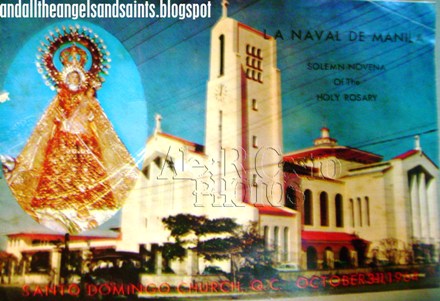
233. LA NAVAL DE MANILA SOUVENIR PROGRAMS

LA NAVAL SOUVENIR PROGRAM, 1957


LA NAVAL SOUVENIR PROGRAM, 1964

LA NAVAL SOUVENIR PROGRAM, 1970

LA NAVAL SOUVENIR PROGRAM, 1974

LA NAVAL SOUVENIR PROGRAM, 

Friday, October 9, 2015

232. Santos of La Naval: STA. CATALINA DE SIENA

STA. CATALINA DE SIENA. Antique ivory image
used in the La Naval procession of Our Lady of the Most
Holy Rosary, Sto. Domingo Church, Q. C. Credits: Saga of 
La Naval, Triumph ofa People's Faith, Dominican 
Province of the Philippines, 2007.
St. Catherine of Siena, (b. 1347.d. 29 April 1380), youngest of 25 children, joined the Third Order of St. Dominic and received the stigmata. She encouraged Pope Gregory XI to abandon Avignon for Rome, ending 70 years’ exile of the papacy from the city. Canonized 1461, Declared Doctor of the Church in 1970. Patroness of Fire Prevention. 


About The Image: The image of Sta. Catalina is housed at the Beaterio de Sta. Catalina. At the base of the image is inscribed: Donacion de la M.R.M. / Catalina de la Resurrecion/ Jez/ +13 unio 1853. This means that the image was donated before Mother Catalina died in 1853. When the Japanese destroyed the building on 28 Dec. 1942, the image was evacuated under the leadership of Fr. Francisco Sadaba O.P. of Letran. The air raid sirens threw the bearers in panic, who left the image in the street while they scampered for refuge at the Jesuit religious house in Intramuros. Eventually, everybody reached the University of Santo Tomas campus. The image is dressed in Dominicn’s habit.


Attributes: Crown of roses proffered by Christ, chosen over a crown of gold, heart in hand, rosary, book (referring to her work) and lily, symbol of virginity.

Sunday, October 12, 2014

208. OUR LADY OF THE ROSARY, Santissimo Rosario Parish, U.S.T.


OUR LADY OF THE ROSARY, Santissimo Rosario Parish, U.S.T. ca. 1960. 

 The 1960 celebration of the Feast our Lady of the Most Holy Rosary, from September 24 to October 2, was pacled with activities and marked with great pageantry, culminating in the grand procession of the images of Our Lady and St. Joseph in the late afternoon of Oct.2, Sunday. The Santissimo Rosario parish itself was erected on 2 May 1942, with its seat at the Students’ Chapel and Fathers’ Residence of the UST.

The first parish priest was the very rev. Fr. Emiliano Serrano O.P. U.S.T.’s close association with Our Lady of the Most Holy Rosary began just before Santo Domingo Church was firebombed in December 1941, at the heaight of war. The miraculous image of our Lady was transferred under military escort to San Juan de Letran. But with Letran also under threat, the image was transferred to the U.S.T.’s Students’ Chapel where Our Lady stayed as a refugee, until her enshrinement at her magnificent church in Quezon City, built in 1954.

 A replacement image was installed in the chapel, made of wood and carved in the round. It depicts a standing Mary, with the Christ Child on her left arm, while holding a rosary with the fingers of her right hand. The smaller-than-lifesize crowned image stands on a cloudy base adorned with flowers. 

The devotion to Our Lady never waned even with her transfer, but in fact, became even stronger, as people flocked to U.S.T. to implore her maternal assistance particularly in October. The 1960 solemn festivities were marked with daily masses, novenas, flower offerings and vigils.

Block rosary units, established early in the parish area, practiced the “recitation of the rosary in the “Rosario de la Aurora”(dawn rosary) procession. This devotion took place at 4 a.m. on the first Saturdays of the month—from May to October. The faithful, carrying images our Lady and their candles, assembled at the U.S.T. gate and marched in procession around the campus, singing Ave Marias and praying the Rosary.

 Today, the grandeur that was the pre-war Santo Rosario fiesta lives on, as more devotees from all corners of the Philippines gather every October to personally reaffirm their faith in the unfailing protection of their patroness, Our Lady of the Most Holy Rosary.

Friday, October 4, 2013

166. THE SANTOS OF LA NAVAL

The Virgin of the Most Holy Rosary, the most important Marian image in the Philippines commisioned by Gov. Gen. Luis Perez Dasmarinas, is closely associated with the Dominicans as it was to them that the image was entrusted after its completion in 1593. It was later enshrined at the Sto. Domingo Church.

As such, the venerable image is honored with annual processions participated in by carrozas bearing the likenesses of Dominican saints made with ivory head and hands. The age of the ivory images has not yet been ascertained, but most seemed to be from the 19th century. The first images to be made were those of Sto. Domingo and San Pio Quinto.


Santo Domingo Guzman, from a noble family in Caleruega, Spain was first a priest, then a Canon Regular in the Cathedral Chapter at Osma, He went on to found the the Order of Preachers ("Dominicans") , approved by Pope Honorius III in 1216. His iconography includes a dog with flaming torch in its mouth, based on her mother's dream. His name has become a pun for "domini canis" (God's dog) and "Dominicanus", or a Dominican priest. He is also represented with  star on his forehead, a vision seen by a godmother during his baptism. A staff and a rosary are also his attributes, as a legend states that the Virgin personally gave him a rosary. He died in 1221 and was canonized by Pope Gregory IX in 1234.


San Pio Quinto was born in Bosco, Tortona, Piedmont, Italy, in 1504, and baptized as Michael Ghislieri. He joined the Dominicans and rose to become bishop, grand inquisitor, and cardinal. Elected pope in 1566, he zealously implemented the decrees of the Council of Trent. He had the rosary prayed throughout the battle against the Turks at Lepanto until these were defeated; he instituted the fiesta of our Lady of the Victories, later changed to the Rosary, on October 7. Died on May 1, 1572, at the Vatican, April 30. Beatified 1672, canonized 1712.


The image of San Vicente Ferrer is one of the original images to join the La Naval processions. It survived the war by being kept in a vault at the Sto. Domingo Church. Standing under 5 feet, its metal accessories--banner, book and aurelo, are of silver.  Valencia-born San Vicente Ferrer joined the Order of Preachers at age 17, and became known as an "Angel of Peace" during turbulent times in Europe. Hence, he is represented as a winged saint. He gained fame as a charismatic preacher, and was miraculously understood by many people of different nationalities who listened to his sermons despite speaking in his native language. Thousands of Jews and Moors in Spain were successfully converted this way. A trumpet is also an attribute, referring to his preaching of the coming of Judgment Day.

Other La Naval santos: San Lorenzo Ruiz, Beata Juana de Aza, Beata Margarita de Castelho, Santo Thomas Khuong, San Juan de Capillas, Santa Rosa de Lima, Santa Ines de Montepulciano, San Vicente de la paz, Santa Magdalena de Nagazaki, San Juan Macias, San Martin de Porres, Santa Rosa de Lima, Santa Catalina de Ricci,  San Juan de Colona, San Luis Beltran, San Antonio de Florencia, Santa Catalina de Siena, San Alberto Magno, Santa Ines de Montepulciano, San Raymundo de Penafort, San Jacinto de Polonia, San Pedro Martir, Santo Tomas de Aquino, Santa Margarita de Ungria and San Jose.

Sunday, September 25, 2011

82. MANILA’S OLD VOTIVE FEAST: LA NAVAL

By Nick Joaquin
Philippine Quarterly, Vol. II No. 1—October-December 1961. p. 1-2.

(Nick Joaquin was a Rockefeller Foundation fellow in 1954. He won the Eugene Saxon Memorial Fellowship in 1955, the Palanca Prize in 1957, the Stonehill Award in 1958 and recently, the Republic Heritage Award. Many of his stories evoke the Manila of olden days. The feast of La Naval described here celebrates the victory over the Dutch armada which invaded the Philippines in 1646.)

The festivities began on the Saturday before the first Sunday of October. One went to Sto. Domingo to find the great image of the Virgin transferred from the Lady’s Chapel to the main altar and arrayed in gold robes and jewels.

In the afternoon, the novena began. The music of Santo Domingo was famous; the monastery had a fine boys’ choir and eminent friar musicians; and the novena of the Rosary was, in effect, a series of 9 superb sacred concerts. One heard polyphonic renditions of the Litany of the Virgin, old Castilian motets and, every evening, a different Salve, a different Tantum Ergo, sung to organ and orchestra. But the ceremonies always ended with the Despedida, the lovely hymn of farewell so associated with this feast. As the tiples went into the haunting closing phrases of the Despedida, a descending curtain slowly hid the radiant image of the Virgin, the bells rang.

Outside, in the patio, a band played, people clustered around the feria stalls to buy lanzones and roasted chestnuts, the internos from Letran and internas from Santa Rosa romped through the crowd, squealing with delight at the prospect of 9 nights with no study periods after supper.

On the morning of the 1st Sunday of October, before the high mass, the image of the Virgin was borne in procession from the Plaza de Santo Tomas to the patio of Santo Domingo. The morning procession commemorated the Battle of Lepanto in 1571, when Christian forces crushed the last attempt of Islam to conquer Europe. From this victory arose the Feast of the Rosary.

From a side portal of Santo Domingo emerged the carrozas of St. Pius V, the Pope of Lepanto and of St. Dominic. Then, though a cloud of incense, appeared the Santo Rosario, the most splendid image of the Virgin in the Philippines. (The image was carved in 1612 by a pagan Chinese sculptor who later embraced Christianity.) Down the street, past the Colegio de Santa Rosa, rode the Virgin, the crowds on the sidewalks falling to their knees as this image that had been the palladium of the city for three centuries passed by, in a rainbow of precious stones. (The gem of the Virgin’s brow, was, according to legend, wrested from a serpent.)

Into the patio flowed the procession, the bells pealing as the Santo Rosario entered the gothic portals of Santo Domingo, the lit chandeliers now illuminating the crown of the Virgin wrought of gold and jewels that had come as offerings from all over the country for the Virgin’s coronation in the early 1900s. (The Santo Rosario was the first image of the Virgin in the Philippines to be crowned canonically.) At the altar waited the Archbishop of Manila, or the Apostolic Delegate, to celebrate the mass of the victory of Lepanto, the victory in which Cervantes lost an arm.

During the first week of October, all Manila gathered, morning and evening, at the Dominicans, and Manila houses filled with visitors from the provinces who had come to attend the novena of the Santo Rosario but would stay the whole month, for after the Naval came the fiestas of Sta. Cruz and Binondo, once the city’s gayest celebrations. What Manileño can forget the old-time merriment of October in Manila?

The novena of the Santo Rosario ended on the second Sunday of October with the Feast of the Naval. This is one church feast special to the Philippines; it began in 1646, when a might Dutch armada sought to invade Manila but was routed in a series of 5 naval battles (from March 15 to October 3) by 2 decrepit galleons, the city’s only defenders. The victories were attributed to the Santo Rosario, to whose shrine at Santo Domingo the crews of the galleons had vowed to go on pilgrimage if they would triumph over the Dutch. Manila was saved; and the returning victors fulfilled their vow, marching barefooted from the gates of the city to the shrine of the Virgin. That was the 1st Naval procession, on an October day in 1646.

Six years later, the cathedral chapter of Manila decreed that the 5 victories of 1646 were “miracles vouchsafed by the Divine Majesty of God through the intercession of the Blessed Virgin, Our Lady, and the devotion to her Holy Rosary”. For four centuries now, Manileños have annually been reenacting the fulfillment of a vow made in 1646, when their city was saved through a small naval triumph that has become, for them, as magnificent and memorable as the victory of Lepanto.

On the afternoon of the Dia de La Naval, all roads led to Intramuros for the “procession of processions”, and a multitude lined the traditional route: from the Plaza de Santo Tomas to Plaza McKinley to Arzobispo to the faded grandeur of Calle Real. Above would be the wild dark skies of October, but the streets of Intramuros would be ablaze with light as, once again, across the ancient cobbles, moved the city’s ancient Queen, symbol of the traditions that once welded Manileñans into one.

Manila lost unity when Intramuros perished, and old palladium was borne away to another shrine, far from the city’s gates. The Feast of the Naval has not died, but much of its old glamour has vanished, now that one must go to Quezon City instead of Intramuros. The feast and the setting were one; they should never have been separated And October in Manila has ceased to be magical now that Intramuros and Sta. Cruz and Binondo have decayed into mongrel communities, without a common memory, a common tradition.

But one can still get an idea of what the Naval used to be. Two years ago, the Dominicans finally released all the old beloved images that used to accompany the Santo Rosario in the Naval processions in Intramuros. One can see them again now, in procession, in Quezon City, on the Day of the Naval---St. Vincent Ferrer with his wings, St. Thomas with his sun, St. Catherine of Sienna with her lilies, St. Dominic with his dog. Only one, the most dramatic of the images perished in the war: that of St. Peter Martyr, the image that provoked the most curiosity among the children, because St. Peter Martyr had a bolo through his head.

Now “exiles”, like Santo Rosario, in Quezon City, these lares and penates of the old Manila again emerge in October, after a long absence, to provoke wonder and nostalgia, on the feast called La Naval de Manila.

Sunday, June 6, 2010

13. RETRO-SANTO: Nstra. Sñra. Del Rosario de La Naval


Nuestra Senora del Santissimo Rosario de la Naval de Manila (Our Lady of the Most Holy Rosary) or simply called Virgen de la Naval is certainly one of the most historied Marian image venerated in the country today. The image dates back to the year 1593, and was carved by a Chinese sculptor commissioned by Gov. Luis Perez de Dasmariñas after his Moluccan expedition.


The making of the ivory image was attended with many miraculous happenings. While it was being carved by the Chinese non-Catholic artist, he supposedly heard a mild protest in Spanish: “no me des tan fuerte!” (don’t chisel me too hard). Subsequently, the Chinese converted to the Catholic faith. The image was then donated to the Sto. Domingo Church in Manila.


The Del Rosario image stands all of 56 inches, with head and hands in ivory. The face bears a distinct and delicate Oriental features. She is vested as a royal lady of the court of the Felipes, holding the Niño Jesus in her left hand and her scepter of authority in her right had.


Over a period of more than 4 centuries, the Virgen del Rosario has been lavished with precious jewelries, and the most famoust one rests in brilliance on her forehead. A “carbuncle”, old folks call it, which, legends say, was once carried by a serpent in its mouth. He would only remove his hold on the jewel when it would feed on milk, and it was in this manner that he was trapped and killed—while the great jewel was retrieved, to be use as an adornment on the Lady whose feet had once crushed the snake’s head.


But the most incredible story about this well-loved Marian image is woven around a series of 5 naval battles, two ships with 200 Filipino and Spanish sailors, one faith and one rosary. From March to October 1646, La Encarnacion and La Rosario, together with their crew, waged epic battles against the Dutch who always took flight and retreated—until their ultimate defeat. The victories were attributed to Our Lady whose image was ensconced in special niches of the ships, and the recitation of the Rosary before every skirmish.


When “galleons of miracles” returned to the city amidst tumultuous welcome, the crew walked barefooted to Santo Domingo barefooted, to pay homage to the Virgin who heard their prayers.

The country’s celebrated Virgin was canonically-crowned on 5 October 1907 under Pope Pius X, the first Marian image to be accorded the honor in the Philippines and in Asia. The centennial of its coronation, held in 2007, was marked with a grand re-enactment of Her crowning and a publication of the book, "The Saga of La Naval".


The Virgen de La Naval shrine is at the Sto. Domingo Church at Quezon Boulevard Ext., Quezon City. She is recognized as the patron of the capital city as well as the city of Angeles in Pampanga which has a church dedicated to her. Her feast is on October 7 (celebrated on the Sunday nearest the 7th) .