Showing posts with label woodcarvers. Show all posts

Wednesday, December 29, 2021

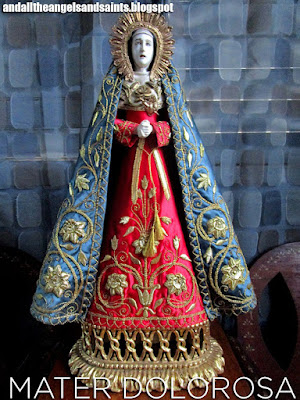
348. Sorrowful No More: AN ANTIQUE MATER DOLOROSA, REMADE.

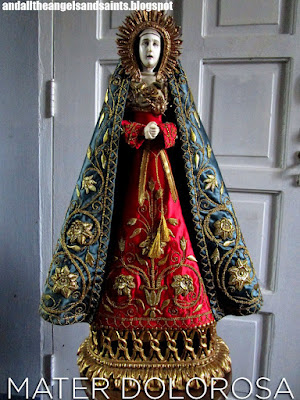
MATER DOLOROSA, COMPLETED

This Mater Dolorosa, made of antique ivory parts, is without doubt, my favorite because of its personal meaning to me. I was drawn to the Sorrowful Mother at the time my father was battling a fatal disease in 1998. When he passed away, I made a vow to acquire a Dolorosa image to be processed in our town during the Holy Week, in gratitude for his painless, peaceful transition.  I managed to find a vintage processional Dolorosa shortly after, and began a family tradition of participating in the annual Semana Santa prusisyons of our town. 

ALL WE HAD WAS AN IVORY HEAD...

...AS THE RESTORATION BEGAN.

I also wanted a version that we could venerate at home, perhaps an antique ivory piece, but by the early 2000s, complete, tabletop ivory images were becoming scarcer, and therefore pricier. I started searching for sacred images online—it was something novel at that time—so I was surprised to find an ebay Philippines site that had a few sellers of old items and collectibles. 

ANTIQUE HANDS WERE SERENDIPITOUS FINDS.

THE HEAD ACQUIRED A CARVED TORSO

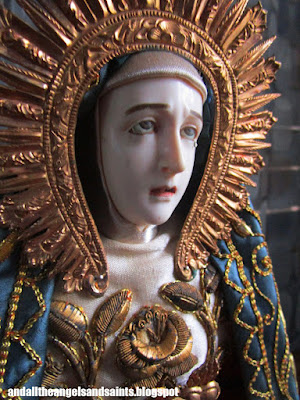
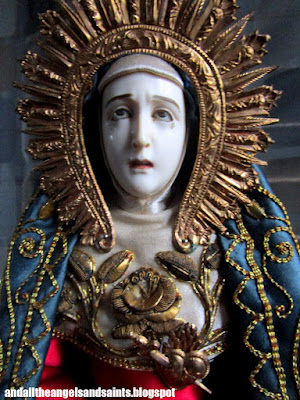
It was there that I met a local dealer, who turned out to be the brother of an officemate!. When I asked him offline to be on the lookout for an  ivory Dolorosa, he sent a private message to tell me, that he in fact has a solid ivory Dolorosa head. When I got hold of the picture, I was stunned, because it was an antique ivory head some three inches long, exquisitely carved, with open mouth, complete with glass eyes, complete with tiny crystla teardrop. It was of very high quality ivory, creamy white in color, without cracks and flaws. Unfortunately, that was all that he had—the clasped hands are missing, and so is the body, the base (peana), and accessories, right down to lost vestments, metal accessories and wig. 

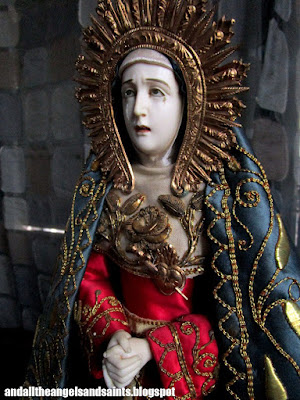
ALL-NEW METAL AUREOLA

THE DOLOROSA ON HER PEANA

I just could not pass up this ivory head, so I got it and kept it in a velvet pouch for a year or so, before I finally took it to my restorer, Dr. Raffy Lopez. One look, and he confirmed that I, indeed, made a good decision as the ivory was excellent in all aspects. His only problem were the missing pair of ivory hands, as it’s almost impossible to find old parts of appropriate size. I had no choice but to settle for new replacement  ivory hands.

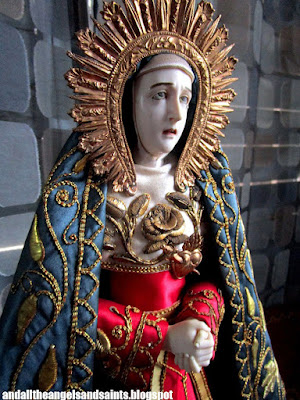
FINELY CARVED FACE REVEALS HER GRIEF

SALVAGED EMBROIDERY ON HER VESTMENT

 So I left the Dolorosa head with Dr. Lopez, not even bothering to ask for a timeline, as I don’t have one too. But two weeks later, he was on the phone again, sharing me about his excitement of finding a a pair of ivory hands—clasped hands—perfectly fitting the size of my Dolorosa. I can’t ask for better news! 

DETAIL OF THE FLORAL EMBROIDERY

BACK VIEW OF THE CAPE

With my full trust in Dr. Lopez, I just left him to his own devices—although he would contact me once in a while to confer about my personal choices—do I like her in pure black or maroon and blue? Do I prefer a floral peaña? He suggested to do away with the wig as she will be wearing a wimple, anyway. And he also recommended satin fabrics. 

THE COMPLETED IMAGE IS 22 INCHES TALL

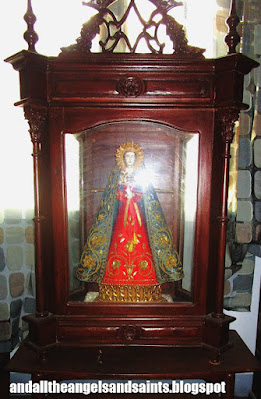
MATER DOLOROSA, IN HER URNA

While Dr. Lopez was restoring and completing the Dolorosa, I was also briefing a local carver for a customized urna in which to house my Dolorosa. Based on the completed height of the image (about 22 inches tall), I commissioned a Betis artisan to copy a wooden urna and its design, I found in an online antique site. He had to do it twice—because the first one he did was box shaped; I wanted the front to have 3 panels of glass, which will make it trapezoidal.


MATER DOLOROSA, IN HER URNA.

After three months, the antique Dolorosa head had a bastidor body, jointed arms, fully embroidered vestments, and a peana with  calado design. It was now a complete image, standing 22 inches tall, beautifully dressed on her gilded base. Inside her carved urna, the Dolorosa reposes, still sad but stunning. Only her new caretaker is sorrowful no more.

Friday, May 29, 2020

336. RELIEVES FROM THE MIGUEL GALVEZ COLLECTION

ANGEL RELIEVE, Miguel Galvez Collection

It is no wonder that one of the most avid collectors of antique colonial santos was the artist MIGUEL GALVEZ y Geronimo (b. 27 Sep. 1912/d.Nov. 1989) of  Paombong, Bulacan. He grew up in a farming family, who later ventured into "sukang Paombong" business when they lost their landholdings. Determined to help his family, the young Miguel went to Manila to work odd jobs in the home of his artist-uncle Teodoro Buenaventura. His uncle saw his drawing talent, trained him, and then took him to U.P. to sit-in through the art classes there, where he eventually was accepted after art teachers aw his work. 

An artist who painted in the conservative style, Galvez impressed professors, art critics and painters alike, and he 1940s was his heyday, and his works won prizes and were patronized by private corporations. Galvez also represented the country in international exhibits in Kuala Lumpur, Hawaii and Tokyo. 

By 1949, he had a flourihing gallery along Mabini St., where he made his art while accumulating antiques. Galvez cashed in not only on his paintings but also in selling old ceramics, colonial paintings,  furniture and religious folk art in the form of primitive santos, and relieves (woodcarving in relief)--examples of which are on this spread. 


SOURCE:
All photos from the Miguel G. Galvez Collection, asfeatured in Philippine Catholic Digest, 1965

Monday, September 3, 2018

324. Mother and Child of Ancient History: STO. ROSARIO


One of the most important and popular devotions in the Philippines  is centered on Our Lady of the Most Holy Rosary –or simply, Virgen del Rosario or Sto. Rosario, patroness of countless far-flung barrios, towns, cities and parishes in the country. It is a Dominican devotion that dates back to th 13th century and propagated throughout the world. It is no wonder that many home altars feature images of Sto. Rosario, showing the rosary-holding Virgin with her Child Jesus.


This century-old Sto. Rosario is one such example, carved by an artisan of extraordinary skill, in the classical style. The image was found in Bulacan, in a house demolition-cum-antique shop, part of a lot of antiques that the proprietor was trying to dispose. 


One look and you can tell that this is not the work of a folk santero, for it is exceptionally carved in classical 19th century style, with many wonderful details. It is surprising that this Sto Rosario was carved from softwood, given its quality. But then again, the soft, easy-to-carve material may have inspired and allowed the artist to put in more details.


This Sto. Rosario stands 16 inches tall, inclusive of the  plain,  squarish base with 2 frontal corners lopped off. The image alone is about 13 inches tall. Both Mother and Child are crowned with small parts missing, including their hands.  A small, hand-made rosary fashioned from coconut beads, could have been held in the Virgin’s right hand.

But that do not detract from the beauty and antiquity of this religious statue, which is heavily patinated and darkened with age.


The Virgin cuts a matronly figure, with a plumpish face and built. She stands with a bit of a hunch, her head in a frontal gaze, with facial features well-defined: from her full cheeks,  deep-set eyes, lips ending in a slight curl,  and neck rings. The Niño’s features are hidden in the thick patina, but it is also well-executed, with the Virgen  supporting Him precariously  with her left hand on His knee.


Wearing a cope-like cape that is buttoned on the neck, then draped and gathered on her waist, the Sto. Rosario stands on a cloud-like peana with feet showing, borne by a curly-haired cherub with downcast eyes. The paint has peeled off in her lower extremities, with the primer (gesso) showing, but with traces of gilt still visible.


Most of her back is covered by her lush, flowing hair that reaches down her knees. Hair strands are defined by shallow carving, more detailed on the side.  Whoever carved this work of devotional art should be happy to know that his Sto. Rosario-- a product of his skill and passion-- has survived all these years, cared for and loved by an antique collector.

Saturday, February 10, 2018

303. THE CARVINGS OF SAN AGUSTIN

Santo Tomas de Villanueva, bas-relief 18” x 24”.

Miguel Lopez de Legazpi officially established the colonial city of manila on June 24, 1571. He organized the local government and laid down the plans of what later would be known as Intramuros, the Walled City.

He was following the orders of the Real Audiencia in Spain during the reign of Philip II. “Highest among the design of His Majesty is the spreading of the Catholic faith”. Going into details, the royal ordinance instructed: “Alongsie the fortress, you should have a church built where Mss shall be held and nearby should be a house for the religious..”

Cherubs serving as column support for the lectern, carving 8” x 19”
Fires burned down the church and the two others that took its place. In 1599, the cornerstone of the actual church hich stands today was laid by the Mexican bishop, Pedro Gurto. The original plan was laid by Juan Macias, but he died before the church and the monastery were finally finished in 1607. Antonio Herera, an Augustinian lay brother who was supposedly a relative of the architect lf Escorial, took over and finished the work.

The present church is fully 371 years old an d has withstood earthquakes and invasions during the colonial era, profanation and bombings during World War II. In the final dys of the battle for the liberationof Manila in 1946, the church and the monastery became a refugee camp for nearly seven thousand people. When the entire Intramuros was razed by nearly 300 bombs that were dropped each day by American fighter planes, only San Agustin remained intact—a true miracle. A visible prayer, it stood alone amid a devastated city that once held as many as twenty equally old and beautiful churches.

Cherubs and dragons serving as column support for the base of the lectern, carving 12” x 9”
The façade of San Agustin Church is classic. Four twin columns support the gable with its rose window. A cross tops the central pediment. The beautifully carved main door depicts St. Augustine, patron of the church and of the order. Four granite lions, carved in the Chinese manner, guard the bases of the columns. They match the two granite lions at the entrance to the patio.

An odd note about the facade: one tower is notbly missing. It was taken down after it cracked during the earthquake of 1880. Which is a pity. From the tower hanged a most historic bell which rang only to announce good news—and very bad news, such as big fires which often engulfed the Walled City.

Purgatory, bas relief, 2 x 5”
The central nave is long and high, punctuated with circular windows through which the light streams in. Two side aisles led to ten chapels which were donated by the leading clans and families of Manila. One of these chapels is dedicated to Miguel Lopez de Legazpi,who died in 1572, only a year after he founded the city. He was buried in the church he provided first for and his remains have been kept in San Agustin ever since.

Beside the church is the monastery whose lower cloisters are now a museum housing a collection of colonial Philippine art. Among the pintings are huge oils that commemorate the life of St. Augustine, his mother St. Monico and other scholars and holy men who belonged to the Augustinian order.

Close up view of the pulpit’s panel.
The large refectory, with seventeenth-century frescoes on the ceiling, contains religious statuary and paintings as well as mission furniture from three centuries of the Spanish colonial era. The library contains books and documents of the once extensive San Agustin archives. Among those on display is a handpainted 17th century Missal, opened to the page of the Christmas Mass. From the windows of the library may be seen the botanical garden of father Manuel Blanco whose book (published in the 19th century) on tropical plants and flowers is a much cherished volume.

The finest examples of woodcarvings may be found in San Agustin; within the church and throughout the cloisters. Stunning is the choir—fro the carvings on its woodwork and on its furniture. The choir seats, done in the Renaissance style, are often enthusiastically called “jewels of art”. They are in hardwood with bone inlay. Consisting of 68 seats supported by colossal arches, it dates back to the 17th century, the work of artisans from Canton.

 Full-length view of the pulpit with canopy, bas relief
San Agustin is a witness to Philippine colonial history. The very first school in the country ws opened in its premises; it housed the first printing press; later it opened the first sanitarium. During the calamities, it was always a  refuge. But it was not spared from damage, sacking and looting. During the British Occupation of Manila in 1762, sacred vessels, religious art treasures and the library of more than 3,000 volumes with manuscripts and incunabula were stolen.

In San Agustin was held the first national synod in 1581 which is of utmost significance for it compelled the colonial government to abolish slavery. In San Agustin, too, was signed the capitulation of Manila from the Spaniards to the Americans in 1898. There is a particular irony here—from it was in San Agustin in 1581 that the legal bsis for the colony was calrified. It may truly be said that the most outstanding carving on San Agustin is the inscription of history itself on its very walls.

Friday, July 17, 2015

226. THE SCULPTORS OF STA. CRUZ

 By Eric S. Giron , Pictures by Resty Guevara 

Originally published on SUNBURST Magazine, February 1979 issue 


The Remarkable Story of the Santos Family that has been carving religious statues for three generations and still holds an annual procession for St. Ignatius that began nearly a hundred years ago.

 “From Father to Son, the Chisel is Passed on to Three Generations.”

 Art flourished in the late 19th century in Sta. Cruz, which became the cradle of the first sculptors, painters, silversmiths, engravers, and musicians.

 Sta. Cruz, then a barrio and not yet an arrabal (district) of Manila, ascended in importance as the home of the elite who acquired their wealth through business and industry.

 The entresuelo of the Paterno mansion bounded by Calle noria (P. Paterno today), P. Gomez, Sales and Carriedo rang with the hammers of silversmiths shaping out the finest jewelry under the supervision of Trinidad Paterno. Their jewelry was in demand in Manila and in the provinces.

 No. 12 and 37 on old Dulumbayan St. leading to the Arranque Market were jewelry shops that also manufactured altars and silver-plated carros for saints used in processions.

 Don Florentino Torres, in his “Memorias”(El Debate, October 19, 1924) recalled: “Romualdo Teodoro De Jesus was the best sculptor; the Zamoras had the most distinguished engraving shops; the brothers Torres, Valeriano and Victorio (among the first electricians of Manila) were the most celebrated scenographic painters who specialized in house décor; Maestro Teban taught the rudiments of music, although his surname was not remembered; he was a professor of various musical groups.”

The taller de escultura of the present-day Santos Family at V. Fugoso St. (Zurbaran)

 Sculpture during the16th century Spanish regime was the domain of Chinese craftsmen of Binondo. Antique ivory, silver or polychromed wooden images of Christ, the Virgin and saints show marked Chinoise influence in the eyes and other features. The skill of the Sangleys in church sculpture was mentioned by Bishop Domingo de Salazar in a letter to King Felipe of Spain in 1591.

 But in the 19th century, Filipino sculptors emerged in Sta. Cruz. The first sculptures of saints that were borne or pushed in all the provinces of the archipelago originated from the shops of Sta. Cruz and were famous as majestic figures, while the Virgin, female saints, cherubim and angels were beautiful”, Don Florentino wrote.

 Jose Rizal’s character, Capitan Tiago, in his novel “Noli me Tangere”, owned several images, among them, the Sacred Family of carved ivory, eyes of crystal, long lashes and blonde wavy hair which were neatly executed by the sculptors of Sta. Cruz”.

 Romualdo T. De Jesus, the sculptor mentioned by Torres in his “Memorias “ was an instructor of Rizal in the art. He attended Rizal’s re-interment at the Paco cemetery. Rizal was hastily buried in an unmarked grave outside the cemetery after his execution by Spanish rifles on Campo de Bagumbayan on Dec. 30, 1898. His family and the sculptor’s guild of which he was a member exhumed his remains and secretly buried them inside the cemetery. A cross was placed on his grave with the ineverted initials of his name – R.P.J.—probably to camouflage his true identity from Spanish authorities. The historical photograph of this memorable occasion is preserved by remigio Garcia, owner of Manila Filatefica (a printing firm).

 Up to 1893, the mestizos and natives of Santa Cruz and Binondo were organized into gremios (guilds) governed by a tribunal. The headmen, according to Felipe M. Roxas, who became a mayor of Manila from 1905to 1917 “took leading roles in public affairs and reaped the honors and privileges corresponding to their social status” which they showed off “ in public ceremonies and religious processions”.

Benigno Santos was the founder of a dynasty of sculptors who have left an indelible mark on the religious art of the country.

 One such headman, Benigno Santos, became a cabeza de barangay of San Ignacio in Sta. Cruz, a position which gave him jurisdiction over 50 to 60 families. As a cabeza, Santos acquired property in the area of Manggahan (P. Guevara), Sulukan (Zurbaran) and Anyahan (Mayhaligue). There was no Quezon Boulevard at that time. This area was referred to as bukid because of the thick talahib growth and the swampy portions planted to buyo (betel nut).

 But after the government purchased Santos’ properties at a minimal price based on the real estate tax, they evolved into the campus of the P. Gomez Elementary School and Osmeña Park, a children’s playground that is now the site of the Central Market.

 In the 1890s, Santos built a chapel on the lot now occupied by the P. Gomez school and a tiny schoolhouse where children were taught catechism. A Jesuit priest said mass at the chapel on Sundays and holidays. Santos initiated the celebration of the fiesta in his barangay. A procession was held with the patron saint, Ignatius of Loyola, as the lone reigning figure. The commemoration of the fiesta developed into a lavish yearly tradition.


 For the Sta. Cruz procession, the biggest in Manila in that era, Santos contributed four life-size images which he carved, of San Ignacio, San Pedro, the Panalangin (Christ Kneeling in Prayer in the Garden of Olives) and the awesome Christ with the hands tied to a stone pillar, which is still preserved by a son of Santos.

 Even when he was cabeza of San Ignacio, Santos resided on Calle Salcedo between Carriedo and Azcarraga in the heart of Sta. Cruz. Two doors were occupied by his taller de escultura where religious images were turned out of batikuling, a fine-grained white and malleable wood favored by sculptors, and carrozas gilded with ornate silver were manufactured.

 Santos learned the art of woodcarving from a Spaniard named Flores who carved the Tercera Caida or Third Fall of Christ for Sta. Cruz Church. There were five figures in the group, including the fallen Christ, Simon of Cyrene who helped him up, and Roman soldiers. The sculpture went up in flames when the church was burned during World War 2.

 For Quiapo Church, Santos executed The Death of St. Joseph, a sculpture that is missing today. He had the generous habit of making altars and images and donating them for free to churches in Bulacan and other provinces.

 The Santos family moved over to the house owned by Enrique Zobel on Calle Sales close to the laboratory of Botica Sta. Cruz and the residence of the eminent Dr. Ricardo Papa when Calle Salcedo and Calle Dulumbayan forking from it were expropriated by the government . The two streets were aligned to make the southern portion of Avenida Rizal. Calle Cervantes from Azcarraga to Sangleyes (Blumentritt) formed the northern extension of the new avenue. The jewelry shops and the talleres de esculturas on Dulumbayan transferred to Calle Platerias (meaning “silversmith shops”).

SANTIAGO SANTOS, the son of Benigno Santos, became a carver just like his father before him.

 Santos had ten children. He was married thrice. Santos’ sixth son (by his third wife) took to woodcarving at the age of fifteen. Santiago was schooled at San Beda College house at the Lady of Montserrat abbey on Balmes and Arlegui, the original building which is used today as a public high school.

 Santiago learned the basics of sculpture from his father. His knowledge of making designs for his work was self-learned. Santiago enrolled at the San Beda School of Fine Arts with the intention of professionalizing his craft. However, circumstances forced him to give up the course.

 When the Jones Bridge was constructed by architect Juan Arellano to replace the Puente de España wrecked by the typhoon in 1918, Santiago was connected with the firm of Vidal Tampingco and Martinez, and was contracted to make four statues at the north and south approaches. Vidal was the son of Isabelo Tampingco who made the sculptural murals of san Ignacio Church and the Archbishop’s Palace in Intramuros. He was a partner of Felix Roxas, the architect of both edifices. Additional murals were made by Graciano Nepomuceno. All were destroyed when Intramuros was savked during World War 2.

 Of the four pieces of magnificent pieces of sculpture, only one has been preserved. It is the symbolic figure of a woman as Filipinas, cradling a son in her arms, which now stands on Rizal Park near the monument of Jose Rizal.

 Aside from Romualdo T. De Jesus who lived on Oroquieta, Sta. Cruz, the contemporary sculptors whom Santos recalls were the late Maximo Vicente who had his shop on R. Hidalgo, near the footbridge crossing the estero; Cayetano and Isabelo Tampinco, who had their taller on the small side street in Quiapo now known as R. Hidalgo Extension; Irineo Cristobal on Echague; and Eulogio Garcia, whose shop fronted Quiapo Church.

 After a five-year stay at Arlegui, Santiago went to Cebu and opened a sculpturing shop on Calle Norteamericano (the name has changed since then) the only shop of its kind in Cebu then.

 In 1929, Santiago’s father became gravely ill. At his father’s bed, his sister Bonifacia whispered that the prodigal son, Ignacio, had returned. But Benigno Santos was too ill to hear anything and he died without communicating with his son.

 Of his father’s collection, Santiago said that the few that were left including small ivory images, were raffled off among his brothers and sisters. His youngest brother, Eustaquio, won the most significant work: Christ tied to the stone pillar by the Roman soldiers. The soldiers were burned during the war and only the Christ remains.

 Santiago left Home because his father scolded him for not finishing a piece of sculpture. Santiago said he was still making the design of the image when his irascible father flared up and hurled a piece of wood at him. Not knowing where to go, he visited a friend, Andres, the only son of Manuel and Pilar Benitez, at Arlegui. When he revealed he had left home, Andres’mother asked him to stay with them since she only had one child.


 Santiago’s sister, Mercedes, brought him unfinished pieces of woodcarving from his father’s shop which he worked on. His father knew of the arrangement but never spoke to him although Santiago knew the elder Santos once watched him as he carved on wood in Antipolo. There were reservations between father and son.

 In 1930, Santiago went into partnership with Pascual Herrera (his compadre who was in the photograph of Rizal’s grave at Paco Cemetery). They bought a deteriorating Chinese tienda on the corner of Zurbaran and P. Guevara and built in its place a small woodcarving shop in 1937. The Santos-Herrera shop prospered. Herrera died after the war in 1945.

 During his prime as a sculptor, Santiago made a carro shaped like a vessel for the Nuestra Señora de La Naval housed the University of santo Tomas Chapel of the Dominicans, now at Santo Domingo in Quezon City, and the carro of Tondo’s Santo Niño. These silver-plated works were disposed off at a bargain price of Php6,500 and Php7,000 respectively. He also produced a carro for the Santuario de San Juan at Blumentritt and for a chapel in Bacolod City, he made the Pieta. To Iloilo, he sent sculptures of saints to the De la Ramas, Guanzons and Villanuevas.

 Santiago’s wife, Margarita, died in 1955, shortly after completing their Silver Wedding Anniversary which was attended by Archbishop Rufino J. Santos. The children she left him were Alfredo (Ding, married to Consolacion Jorge), Caridad (Mrs. Alberto Anzures) and Manuel (married to Pacita de Vera). Santiago has two other children, Eriberto and Rosario.

 Santiago still resides in Zurbaran. He has close-cropped gray hair but he is still hale. Ocassionally, he carves ivory with a chisel but avoids wielding the sledge hammer at the age of 74.


 Santiago has turned over the chisel to his son Alfredo, The Santos family has an open offer to San Ignacio residents that they will carve any saint’s image of their choice for free provided they clothe the image and send for its participation in the procession during the annual fiesta. On Ding falls the burden of carrying out this vow.

 To date, there are 11 images paraded around during the barangay fiesta, all carved by the Santos family.Not even Quiapo, which has the most lavish procession during its January 9 fiesta, can top the number of images of San Ignacio. The San Ignacio procession, attended by the residents and brass bands, penetrates even the narrowest byways of the area. It has been held consistently ever since Cabezang Santos instituted it in the 1890s, except during the Japanese Occupation when times were hard and Filipinos were suffering.

 On an ordinary day, Ding Santos sits in a small shop where his father used to sit in Zurbaran, which has been renamed Valeriano Fugoso, after a former mayor of Manila. The area has metamorphosed from a grassy and swampy patch into a bustling commercial district where motor vehicles, tricycles rub fenders with carretelas and the multitude milling about all day.

 Ding creates out of whimsy cute Santo Niños, lovely Virgins, bleeding Sacred Hearts and delicate faces and hands out of ivory. His brother Manuel sprays and paints the finished images, attaches the crowns of silver and gold plating and garbs them in the rich velvet costumes embroidered with gold thread.

 Batikuling has become scarce. He supply from Laguna has run out and that of Mindoro is not always dependable. But Ding carries in in the tradition of his grandfather, his father and the Santa Cruz sculptors of yore.