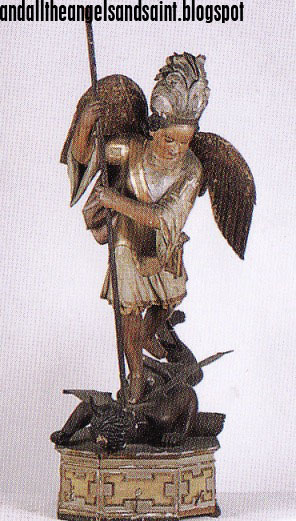
Showing posts with label Santo Cristo. Show all posts

Friday, August 29, 2025

366. Found Identities: THE CHAPEL SANTOS OF UBIHAN

Old photos of 3 Santos on their andas, 1922.

Stashed among my collection of religious photos are these 2 snapshots taken over a hundred years ago in 1922. On the back were short lines written by a Mother to his Son, David, updating him of the goings-on of some religious events happening in their place, which unfortunately, was not named. For over a decade, I have not been successful in identifying where these santos came from, as the real photo postcards have no postmarks.

The first photo shows a trio of images: St. Joseph with the Child Jesus, a Crucified Christ, and an Immaculate Conception, on top of individual andas (shoulder-borne platforms). The mother writes:

David:

Ang Retrato ng Señor ay hindi nakunan sa prosesion pagkat nĝ dumating ang kukuha ay tapos na ang prosesion, bukod sa rito, ng tang(g)apin ni Jacin ang sulat mo ay sa 11 nĝ Enero sa kaniang kasera. Yto na lamang at kahi(t) ma na wari pagpalain ka ng P. (oong) D. (iyos) at nĝ mahal na Virgen.   Ang iyong Yna

 (David, The picture of the Lord was not taken during the procession because by the time photographer came, the procession had already ended. Also Jacin received your letter on Januray 11 from his landlady.  This is all for now, and may you be blessed by the Lord God and our beloved Virgin.---Your Mother).

The second photo shows a picture of the Crucified Christ nailed on his Cross, outfitted with an opulent metal burst and paper flowers. The back has this handwritten notation:

David:

Pinagpilitan na ming pakuhanan ng retrato ang poon sapagkat bagong lubog na lahat ang kaniang kasangkapan na iyong makikita rito; sa pecha 27 ng Deciembre ng 1922.   Ang iyong Yna.

(David: We made an effort to have the picture of the Lord taken because all His metal  accessories that you see here have been newly re-plated; on this date 27 December 1922.)

Just last month, Robby de la Vega, a friend from Intramuros Administration, alerted me about the photos, informing me that they are those of the still-extant chapel santos of brgy. Ubihan of Meycauayan, Bulacan. The key was the date written by the mother—December 27---which is the date of the fiesta of the barangay patron—Sto. Cristo.

Checking online, I found the FB page of the “Sto Cristo de Ubihan”, which has posted pictures of the Crucified Christ in my old photo—and indeed, they are one and the same image. There were also fiesta photos of their images of  San Jose con Niño Jesus, and the Inmaculada Concepcion on new carrozas, as the andas in the old photos are long gone.

I also learned the Ubihan was one of the most remote barrios of Meycauayan which thrived on fishing and aquaculture as it was surrounded by rivers and fishponds. It was so named because ube plants used to be planted in abundance in the barrio. In 1882, Ubihan was plagued by cholera that decimated the population. So distant was the barrio, that revolucionarios used Ubihan as their hiding place. As such, it was constantly raided by Spaniards. The Americans burned the barrio in 1900 at the onset  of the Philippine -American War and once gain razed by the Japanese in the last world war.

Inspite of all these tragic calamities, both natural and man-made, Ubihan survived, and continues to thrive--certainly protected by their 3 Patrons who, after over a century are still very much around, cared for and revered by  the local faithful in gratitude for the blessings received and the salvation of their humble barangay in the most trying years of its existence. 

CREDITS:

MANY THANKS to Mr. Robby dela Vega of the Intramuros Administration

Photos from the "Sto. Cristo de Ubihan" FB Page

City Government of Meycauayan website:https://meycauayan.gov.ph/ubihan/


Tuesday, October 2, 2018

326. TATANG: THE SEATED CHRIST OF GUIMBA, by Fred J. Reyes

By Fred J. Reyes / Philippine Panorama, 15 April 1984
Photography: Joey de Vera

THE SEATED CHRIS OF GUIMBA

How “Tatang” Brought Peace and Prosperity to a Family in Nueva Ecija
In Guimba, Nueva Ecija, enshrined in a chapel beside a rice mill, is a life-size crucifix that has drawn throngs of devotees the past 6 years. People reverently refer to the fgure on the Cross as “Tatang”.

“Tatang” is no ordinary version of the Crucifixion. Unlike most other representations of the Holy Cross, Christ here is nailed on both wrists and feet. A block of wood juts out between the thighs, serving as a seat and propping up the upper portions of the body.

The most common crucifix shows Christ nailed on His palms and His feet, and His body pressed flat against the cross.

PHOTO BY JOEY DE VERA

Some Biblical researchers say that this could not have been the way Christ was crucified. His nailed palms, they say, could not have been sufficient to carry the rest of His six-foot frame and would surely have been torn loose after a short time on the cross. Thus, the seat-like projection between His thighs, which the Roman soldiers as an afterthought, both to prevent the palms from being torn apart and to prolong Christ’s agony.

These researchers further say that the French sculptor who made the first such depiction claimed he had seen it in a dream. This crucifix is said to be known in many parts of Europe as “the seated Christ”.


“Tatang”, as the seated Christ in Guilba is beter known among residents and visitors, was sculpted by a Filipino—Rey Estonatoc, who has a studio in Pag-asa, Quezon City. The wooden image shows so profound a suffering that many first-timer to the place, including wizened old men, have been seen crying unashamedly before it.

Rosario Divino Sta. Inez vda. De Santos, matriarch of the family which owns the chapel, says Tatang has brought peace and prosperity to her household and perhaps to hundreds of other people since His arrival there in 1978. She is particularly thankful for the change in the life of the youngest of her four sons, Fred, who she says was once a black sheep of the family.

Fred, she says, used to be unemployed but also was invoLved in some michief or other. “He used to bring nothing into the house but trouble, all kinds of trouble”.

At the height of Fred’s youthful escapades in early 1977, well-meaning friends succeeded in making him enter a cursillo. They had unsuccessfully tried to make him do so twice before.

When he finally attended one, he noticed, after a few sessions, a crucifix of the Seated Christ that had been brought into the cursillo house by a certain Delfin Cruz.

A wooden image of profound suffering.

It was the first time that Fred saw such a crucifix and his curiosity was aroused.When he asked around, one cursillista, Jose Dijamco, told him that as far as he was concerned that was the faithful reproduction of the Crucifixion. Impressed, Fred made a vow to have a replica of the crucifix someday.

Two weeks after the cursillo, Fred became a changed man he ceased to be the troublemaker that his family used to know and now went all over the barrios of Guimba doing apostolate work. In one of his sorties, a friend came up to him to offer a wo-and-a-half acre farm for cultivation. “It was my very first job offer,” says Fred,”and I readily accepted.”

He had just finished planting the farm to rice when a kumpadre offered him 4more hectares for cultivation. Again, he accepted. “Kaya, eto, umitim na ako, kakatrabaho sa bukid”., he now says, calling attention to his deep tan.

The harvest in both farms was bountiful. He reaped 105 cavans to a hectare , which set him off to a good start in the rice business.For the first time in his life, Fred says, he found fulfillment: “So this is how it feels to sweat and get rewarded for your own labor”, he recalls saying to himself.

Still, something seemed lacking in his life. Often thinking about it, he soon began to have dreams about the crucifix, sometimes with the Virgin Mary floating with it in the clouds. When he recounted his dreams to Dijamco, who by then had become his spiritual adviser, the latter reminded him of his promise to acquire a replica of the Seated Christ. N Fred’s request, Dijamco eventually found a sculptor to make one for him.

The crucifix was finished in October 1978, and Fred, along with Dijamco and a close friend, Cris Ang, drove in a van from Guimba to estonactoc’s studio in Quezon City to get it.“A storm was raging then”, recalls Ang. “But on our way back, it seemed to have calmed down.”

He also remembers that the crucifix they brought back with them attracted lots of curious (and awed) onlookers along the way, so that they had to stop a number of times to enable people to take a close look. As a result, it took them 8 hours, instead of the usual 3, to get back to Guimba.

The crucifix also seemed to have grown heavier, according to Ang. Only 4 people were needed to load it into the van in Quezon City but when they arrived in Guimba, 12 pairs of hands had to bring it inside the chapel owned by Fred’s family.

NAILED AND BOUND FEET. PROLONGING CHRIST'S AGONY.
Photo: Joey de Vera

Fred says his dream about the crucifix has never recurred since its arrival and he now feels completely at peace with the world. “I used to attend mass only 5 or 10 times a year and I stayed outside the church at that. Now I remember God through Tatang every day of the year.”

And instead of scaring people away during his days of mischief, Fred now seems to draw people to him—people in need of help, especially. But Fred doesn’t mind giving them help. “When you give to the poor, you’re fulfilling the tithe required by the Church.”

His mother, Rosario, who tends a small sari-sari store besides managing the family rice mill, says she is the happiest about the things that Tatang has done fro her sons and the rest of her family.

“We used to have every kind of problem, financial and other wise,” she says. “Now all these problems seem to have vanished. We’ve paid all our debts and sent our children to the best schools and have something lef to buy lands and other properties.”

Here 3 other sons—Renato, Oscar and Albert, who had their own “youthful flings” have also grown prosperous, apart from being law-abiding and God-fearing men. Oscar, a town councilman and military officer, assists at Mass every Sunday. A son of Fred and a son of Roberto are in the seminary, studying for the priesthood.

Matriarch Rosario vda. De Santos, with
granddaughters. Peace with the coming of Tatang.

Tatang, for his part, has become something of an institution in Guimba. Every now and then, people attribute “little miracles” to him. Sometime, in 1979, when a rift divided the town’s cursillistas, the statue,  made of hard ipil,  reportedly developed a crack on the face, from the forehead to the bridge of the nose. The crack was said to have closed only after the cursillistas had settled their differences.

The chapel, while privately owned,  is open to everyone, and Fred says, that like him, countless other people may have been moved by the seated Christ to change their ways.

He attributes to tatang all the good things that have happened to him and his family. “He is as powerful as the man-God he represents.”

Fred says, however, he never asked Tatang directly for the material things that he has now. “Ask him for anything, except material things.”

All that he prayed for, Fred recalls, was faith, fortitude and endurance in the “rat  race” of this world.

Monday, May 8, 2017

293. BARRIO SALUYSOY’S SANTO CRISTO AND SAN PEDRO: Then & Now

THE TWO SACRED IMAGES OF SALUYSOY, MEYCAUAYAN
In the ancient barrio of Saluysoy, in Meycauayan, Bulacan, there kept in the visita of the barangay, two old images revered since one can remember: the image of Santo Cristo (Crucified Christ) and San Pedro (Saint Peter).

Saluysoy, located adjacent to the heart of the town, takes its name from a slow-flowing gurgling brook which cut northwards at the eastern side of the original location of the barrio. “Saluysoy” means the sound of a brook’s steady water flow.  But when the water dried out, residents relocated to the west of the barrio where  a faster-flowing river was found. People dug up wells to ensure that they do not run of water anymore in their new place, which retained the name “Saluysoy”. The former abandoned site was named “Palanas”.

VISITA OF SALUYSOY
The barrio played a small, but significant part in the second world war. In 1941, when the Japanese Army broke through the USAFFE lines en route to conquering Manila, the barrio folks put on a gallant resistance that delayed the march of the invaders to the capital city by 11 days.

In the 1950s, it was said that indolence was unknown to the hard-working people of Saluysoy. Though small in size, the barangay thrived on many industries—shoemaking, wood carving, blacksmithing, goldsmithing, farming, fishing, and making of religious images.

It would seem that the two processional images were carved locally for the chapel, as the people were also known for being devout and religious. The chapel itself was rebuilt after the war, and at one time was considered to be the most beautiful in the whole province of Bulacan. It was fully funded through the efforts of “Samahang San Pedro”, a leading religious organization.

Today, Saluysoy is one of the more prosperous barangays of the city of Meycauayan, its prosperity driven by its jewelcraft and goldsmithing industries. Every year, the images of the barrio patrons—Santo Cristo and San Pedro—are brought out for processions during the May 4 barangay fiesta. San Pedro’s feast day is also observed separately by Saluysoy folks every June 29.

CREDITS:
Many thanks to Mr. Robby de la Vega for the photos and for the background on brgy. Saluysoy from the Historical Data Papers of Meycauayan

Tuesday, April 11, 2017

290. MAHAL NA SEÑOR of Caingin, San Rafael, Bulacan

MAHAL NA SENOR. A 1953 replica image of the
Crucified Christ of Caigin, after its blessing.

Caingin is one of 34 barangays of San Rafael in Bulacan, in fact, one of the largest of the town. It is the home to the very old  Caingin visita (chapel), which was believed to house an ancient, 18th century Crucifix, also believed to be miraculous. For this reason,  it is called the Parish of Santo Cristo, or the Crucified Christ.

THE ANTIQUE MAHAL NA SENOR.
Photo courtesy of Mr. Leo Cloma.

As expected,  the original “ Mahal na Señor Santo Cristo” was replicated by families and private individuals for their home devotion. One such image is this 1953 tableaux of the crucified Christ flanked by smaller figures of the Mater Dolorosa and apostle San Juan. The side figures are so proportioned to emphasize the Santo Cristo in the middle. 


The owner of this fine Crucifixion tableau is unknown. Currently, a replica of the Santo Cristo is used in the annual Holy Week procession.\

HAVE A MEANINGFUL HOLY WEEK 2017!

Saturday, June 6, 2015

223. Santo Stories: MISERICORDIA of the EVANGELISTA FAMILY, ANGELES


The Santa Misericordia of Angeles is owned by the Evangelistas of this city, known for their pioneering telecom business. It was commissioned by Don Roman Bernardo Evangelista and his wife Dona Francisca Dizon Dela Resma, along with another statue intended for the La Naval celebration—the image of San Miguel Arcangel.


 The Misericordia was completed in 1907 to honor the birth of the couple’s youngest son, Santos Evangelista, while the San Miguel, given to the eldest son, Domingo Sr., was inaugurated in 1916.


The Santa Misericordia, also locally known as “Macapacu Qng Cruz”or the Crucifixion, is a tableaux that depicts figure of the crucified Christ flanked by San Juan and the Mater Dolorosa. Interestingly, there are two other characters atop the ladder another horse-riding soldier positioned at the back of the cross.


With all these santo figures, the Misericordia looks more like another scene known as The Descent from the Cross (El Sagrado Descendemiento), in which San Nicodemus and San Jose Arimathea are shown bringing down the body of Christ from the cross. Could it be that the two figures on the ladder were later additions to transform the Crucifixion into a Descendemiento tableau?


 In the past, Angeles’ Sta. Veronica, for example, is converted into a Sta. Salome on Holy Thursday. I have also seen two-faced Virgins so that using the same body, the image can either be a Dolorous Virgin and a Joyful Virgin, with just a twist of the head.


When the Misericordia was completed, it was given to the care of Don Ramon’s only daughter, Leonora Evangelista (Panlilio) and the aforementioned youngest son, Santos. When the Evangelista siblings passed away, Jesus and Zon Gopiao, became the caretakers of the carroza.


When not in use, the santos and their carrozas are stored in a spacious room designed expressly for their safekeeping.


 Today, the children of Leonor-- Gerry, Mary Ann Panlilio Reyes and William Panlilio, plus the 3rd generation members of the clan—continue the family tradition of caring for these beloved family heirlooms. They regularly participate in the annual Lenten rites of the city of Angeles.

I wish to thank Mr. Ira Jay Evangelista for the pictures and Mr. Josel Suarez for the bacground of the images, both of whom are descendants of Don Roman Evangelista.

Friday, February 20, 2015

215, Santo Stories: STO. CRISTO OF PAKIL

 SANTO CRISTO DE PAKIL. The ancient image of the Crucified Christ in the church of Pakil, as it appeared in the 1950s.

 In the Franciscan-founded town of Pakil, Laguna, one can find an ancient, life-size crucifix venerated at the altar near the church’s entrance. The present church itself, dedicated to San Pedro de Alcantara, dates to 1732, a masterpiece in stone marked with florid ornamentation.


 The Santo Cristo de Pakil is an object of deep veneration among residents, but is also popular among the devotees of the Virgen de Turumba. The legs and feet of the Santo Cristo have all but darkened with age, and the habit of kissing the feet and the anointing of the santo’s extremities with perfume has persisted.


 The origins of the crucified Christ in Pakil is shrouded in mystery. It was said that an old man sought refuge in the town, begging the cura to find sanctuary in the church. The kind priest allowed him in, and the old man requested that he be given some carpentry tools so he could do some work for the church, in return for the hospitality.


 When the old man did not emerge from the room after some time, the door was forced open—and the priest found him gone. But inside the room was a splendidly carved image of Christ crucified, wonderfully wrought in wood and capturing the agony of the Lord in his passion.


 The image – known as Santo Cristo de Pakil—was enshrined in a retablo menor and is used every Holy Week for the Good Friday rites. As the arms are articulated, the figure of the Christ can be brought down from His Cross to be transformed into a Santo Entierro.


 In this form, the image is processioned on the streets of Pakil, followed by a band of violinists, musicians, singers and hundreds of devotees.

Tuesday, April 3, 2012

103.BURIED TREASURES, Along a Boulevard of Broken Dreams


I've been told by a lot of collector-friends that Aurora Boulevard in Quezon City has a lot of junk shops and second-hand stores that hold hidden treasures of every sort--religious artifacts included. I am familiar with the the place as my first job was in an office located along this road lined with interesting shops, sights and buildings—like Arcega’s—where one could shop for the finest bicycles, and of course, the Magnolia Ice Cream Plant that housed the famous dairy bar. Further down was Broadway Centrum, then a spanking new commercial complex.


That was way back in the late 1980s, and I have not explored that side of the boulevard since. Well, this Sunday, I decided to set off for a return adventure to the famed boulevard after over 2 decades just to check those junkyards my tipsters have been raving about.


In fact, Aurora had become unrecognizable—so narrow, dirty and looking unsafe—and here I am walking the stretch of the boulevard under the hot early afternoon sun. The intersecting streets still rang with familiarity—there’s Seattle, Boston, Manga—but Betty Go-Belmonte St.? Now, where are the junk shops?


At the far end of Monte de Piedad St., I saw heaps of organized trash and stuff strewn on the sidewalk. The front of his house was littered with old 1960s magazines and newspapers, bric-a-brac and paintings, paper documents, jugs and glasses, softdrink bottles, soda cases, old toys, 1970s calendar, ceramics, and every conceivable house junk known to Man. I knew I had arrived at the right place.


My heart always palpitates when I see never-before seen junkyards such as this, my kind of hunting grounds for antiques and collectibles. I was greeted by a hulking young man, who lifted the tarpaulin awning shielding the front of his house, further revealing more flotsam and jetsam. “Ah, we expected you”, he said, and “we were told of your collecting interests by dealers in Kamuning, so we've prepared some items that may be of interest to you.."


I was not prepared for the item he showed, which was to become my most wanted object of desire. It’s inconceivable that this treasure could even be found here.


In fact, I had even ignored this thing on the floor, casually placed inside a red shopping bag, lost amidst the trash and thrift shop stuff in the small, cramped apartment. "This here is an ivory Christ...", he said, "but the case is a bit dilapidated..."


Ivory? Sto. Entierro? He must be kidding. I peeked into the shopping bag and sure enough, inside was a small calandra (display casket) with wooden and glass parts that have started to separate--- it had to be secured with strings to keep it together.


Then lo and behold! Inside was the wooden body of a dead Christ—with an ivory head. I was stunned. Ivory Santo Entierros are so hard to find in the market, that I have only seen one for sale, which I eventually got, never mind if the Christ was made of terra cotta. The rest are in private collections.


Now this Sto. Entierro is of ivory—the head that is. Closer inspection revealed that the head is of solid ivory, with beautifully carved features.


The only drawback was the nose—it had been sliced off neatly. It’s intriguing to think that the ivory part was used as an anting-anting (amulet) by a Katipunero (Philippine revolutionist) or that it was cut by an insurgent to disrespect his aquiline-nosed colonizers.


But the wooden body was in good condition, the fingers complete, with just a few toe tips missing. Its wig had disintegrated many years ago, but even the skullcap was there. A few trips to my santero will easily resurrect the Dead Christ and restore it to its former glory.


Putting my great negotiation skills to work, I arm-twisted him into selling the photos, the folk santos and the ivory Sto. Entierro for one, neat package cost that I offered. He agreed—and he even threw one small crown for a santo as my buena mano bonus.


This Sto. Entierro, certainly, is my find of the year. Who would think that I will find this treasure buried in a junkyard, along a boulevard of broken dreams and damaged goods from old homes? And, did I tell you that he even led me to another giant stockroom across the street that was crammed with the same stuff from wall to floor. I am sure there are other spectacular antique finds there, but I’ll leave that for another day.


Meanwhile, if you happen to be walking along Aurora Boulevard—don’t forget to keep your eye on those heaps of junk littering the nooks and crevices of Monte de Piedad St. On that same street, lightning may strike twice, and, underneath the debris and detritus, you’ll be able to dig up your own find of the year!

Sunday, September 4, 2011

79. SANTOS FROM THE SAN AGUSTIN CHURCH, II

Santos from the San Agustin Church, the mother church of the Augustinians who arrived in the Philippines in 1565. Built in the heart of Intramuros, this "permanent miracle in stone" survived the last violent war, and holds a unique and special place in the hearts of Manilenos. San Agustin is a veritable treasure house of ecclesiastical art, some of which are featured here:


SAN MIGUEL ARCANGEL
St. Michael, the Archangel, battling the Devil. 19th c.


STA. MONICA
Altar-size image of St. Monica, mother of St. Augustine, at the Chapel of Sta. Monica.

ASUNCION
The Assumption of the Virgin Mary, brought by Enrique Delgado, OSA in 1888. Inscribed under the globe, "G. Becessa 1555".


SANTO CRISTO
Crucified Christ, previously attributed to Juan delos Santos, but now in question. Its Baroque qualities do not coincide with the time in which the artist worked. 18th c.


INMACULADA CONCEPCION
Ivory image of the Blessed Virgin, which used to occupy the niche on the top of the grand lectern at the choirloft.


SANTO CRISTO
A large figure of the Crucified Christ carved in wood, in a retablo formerly from the Legazpi Chapel. Frontal formerly from the sacristy.

SANTO NINO
The Christ Child depicted in a Captain General's uniform. He resembles the young Philip IV.

SAN MIGUEL ARCANGEL
An all-ivory tableau showing the Archangel Michael trampling the Devil. 19th century, given by the Augustinian Sisters of La Consolacion College of Manila. founded in 1883.

SAN LORENZO MARTIR
Ivory St. Laurence, the first martyr, wears a dalmatic. He was martyred by being roasted on a spit. Missing gridiron emblem. 17th-early 18th century.

CRISTO CRUCIFICADO
Large life-size wooden image of the Crucified Christ, which used to hang in what is now the sacristy. It was brought out during the novena for the souls of purgatory. It has jointed arms and the year 1770 is inscribed on its left shoulder.

VIRGEN DE LA CORREA
This magnificent ivory headed Virgin holds a cincture and carries the Christ Child in her other arm. 17th-early 18th century

(Photos from San Agustin: Art & History 1571-2000, by Fr. Pedro G. Galende O.S.A. and Regaladao Trota Jose. Hongkong: Solutions)