Showing posts with label Virgin Mary. Show all posts

Sunday, September 7, 2025

367. LA PURISIMA CONCEPCION de TABUÑGAO of Minalin

In the oldest barrio of Minalin, Pampanga, known today as Sta. Maria, one can find the revered and ancient image of La Purisima Concepcion de Tabuñgao, whose origin is wrought in a miraculous legend still told in this Kapampangan town. The barrio’s old name –“Tabuñgao”—refers to the 1609 discovery of the image, where people found floundering on the flooded river, a large, dried gourd (upo), or “tabuñgao/tabungo”.

The local folks fished out the floating gourd from the river which was near the ‘visita’ (chapel) they were building, and to their utter surprise—the tabuñgao, when opened, yielded an image of the Blessed Virgin.

Carved of wood, the small image depicts the Blessed Virgin Mary standing on a globe base with a snake coiled at her feet. She has a steady gaze, with the palms of her hands together in an act of prayer. Devotion spread from Tabuñgao, as the pueblo was established with the expansion of its frontiers.

Today, the present barangay known as Sta. Maria still has the visita or chapel that has been named after her. In the central niche of the altar, La Purisima Concepcion reposes, standing watch over Her people whom she has showered with an abundance of blessings.


In gratitude, the community have embraced her with love and lavish attention. Her designated camareros are the Intal Family and Nevil Pineda, a longtime devotee in charge of her vestments. 


In 2008, the “La Purisima Concepcion Festival” was organized to honor her on her feast day, Dec. 8. Replica images (festejada) of La Purisima have also been made for other devotional events including Marian processions, novenas and rosary crusades. She has also been gifted with rich vestments made by Borda de Oro, under the auspices of benefactor PJ Nepomuceno (+). 

Indeed, today, there is only one Queen who reigns in the hearts of Minaleños—La Purisima Concepcion de Tabuñgao.

 SOURCES:

Sta. Maria Archive Minalin (Nomer Pangilinan) FB page: https://www.facebook.com/stamariaarchive.minalin

Visitas ning Sta. Maria FB Page: https://www.facebook.com/visitasning.stamaria

La Purisima de Tabungao FBPage: https://www.facebook.com/lapurisima.concepcion.de.tabungao

Minalin Wikipedia, https://en.wikipedia.org/wiki/Minalin

Many thanks to Romel Zapata Tubig Jr, Tourism Officer of Mianlin, for the additional info.

Thursday, May 3, 2018

312. LA PIETA IN WOOD AND BONE: Grief and Gladness at the Philtrade Antique Pavilion


In the late 1980s, Philtrade in Pasay became one of the major antique centers in Manila due to its cluster of pavilions that were earlier envisioned to be venues of international expositions and trade shows. I was fortunate to catch the tail-end of the glorious antique collecting era, when shops were still relatively full of real, antique stuff.


Prices were already steep by then, and I would go to these exhibits simply to feast my eyes on the beautiful santos, and hope to find one that would fit my modest  Makati worker’s budget. Not only were the popular antique shops of Mabini represented at the Philtrade pavilion, but there were also smaller, independent antique sellers who rented out spaces to sell their wares.


It was in one such show that I found one of my favorite santo ensemble. I had actually put a down payment on an  ivory Virgin from Sieva Antiques, but when I returned for it the next day, it had been sold to another customer. The dealer thought I would not come back for the it-- a conclusion he arrived at, maybe because I was dressed in tattered shorts and T-shirt.


I was so livid at this deal gone awry, that when I came back to Philtrade to collect my refund, I decided to linger and check out the smaller, less populated stalls of the pavilion to forget my disappointment. It was in one of these holes-in-wall (I could not even remember the name of the shop) that I chanced upon a remarkable antique ensemble—an unusual La Pieta which depicts Mar and Jesus after the crucifixion. The tableau consists of the seated Sorrowful Virgin with a head and hands of bone, cradling on her lap a small, naively-carved wooden 5 in. Christ.


When found, they were without clothes, wigs and accessories, and the image of the Virgin seated on a plain, crumbling, wooden stump. They were obviously of lesser quality than the previously mentioned ivory Virgin, but how many in their collecting lifetime, has seen a La Pieta in wood and bone?


It was a no-brainer: I had to have this La Pieta. The dealer wanted PhP 7,500 for it, but I turned on my full negotiating power until I whittled the price tag down to Php 6,000. I  gave him the amount—which was basically the 5K refund plus the remaining 1K from my wallet—and La Pieta was mine.


It was only many years after—after having been acquainted with Dr. Raffy Lopez---that I had this bone and wood La Pieta restored at his atelier. The Sorrowful Virgin  had her features repainted, and one eye restored. Wigs and metal accessories were ordered, while new embroidered vestments were worked on. Finally, the woodworm-damaged base was replaced. The tableau was then encased in a glass dome—which actually was a glass globe of a hanging gas lamp.


In our old ancestral home, on a small circular table in the ante-sala, my antique La Pieta sits. I never thought that my disappointment  over a santo that got away would be quickly assuaged by this extraordinary find at a humble antique stall in Philtrade, turning my feelings of dismay to instant delight! Somebody must have pities me so much, he gave me, instead—La Pieta!

Saturday, August 9, 2014

202. "O BEAUTY EVER ANCIENT, EVER NEW"..: 2011 Ecclesiastical Art Exhibit , part I.


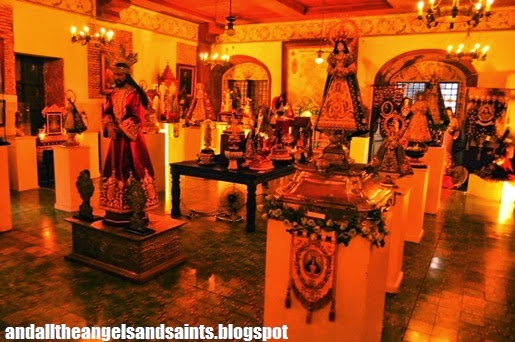
In celebration of the 440 years of the Augustinian presence in Manila, the San Agustin Museum requests the pleasure of your company at the blessing and opening of an eccesiastical art exhibit entitled "O, Beauty Ever Ancient, Ever New...". 12 November 2011. San Pablo Hall, San Agustin Museum, Intramuros, Manila.

EXHIBIT HALL

INMACULADA CONCEPCION

LA PURISIMA CONCEPCION

VIRGEN DE LA CORREA

SAN JOSE

LA PURISIMA CONCEPCION

SAN JOSE PATRIARCA

CRISTO CAUTIVO

LA NAVIDAD

EL BUEN PASTOR

 STA. ROSA DE LIMA

STA. MARIA MAGDALENA

Tuesday, July 15, 2014

200. DOLL OR DIVINITY?: The Mystery Figure That Became La Niña Maria

ALL DOLLED UP. A mystery wooden figure generously given to me that was initially thought of as a doll, became the young Mary, La Nina Maria, when fixed and assembled on a carved santo base.

One of the most intriguing pieces to come my way is this small, wooden figure of a young girl, no more that 5 inches tall. It actually belonged to a nephew of mine who was an avid collector of images too—and he sent the photo by phone, showing 2 small figures in the palm of his hand—that of a Nino Navidad and this girl figure, which, I concluded was a toy, maybe of composition or bisque.


My nephew, however, told me it was made of wood; there were a few doll makers who crafted dolls of wood—Schoenhut was one, famous for their circus figures as well as their dolls that were described as “indestructible”. My nephew knew that I collect antique toys and dolls, so he gave this girl doll to me, a generosity which I accepted.


My curiosity was further piqued when I received the doll—indeed, it was made of wood, but after awhile, I wasn’t sure if it was a doll at all. First, there were pegs on her feet, which meant that it must have stood on a base —just like a santo would have. Then, she was painted in the style of a santo, from her face with a pinkish blush to her painted torso and her feet with shoes painted on. Why, she even had on a silken blonde wig that had partially deteriorated and eyes outfitted with lashes! On her ears were a tiny, tiny pair of bejewelled earrings--real gold, so I was told--but which I still need to validate.


So delicately carved was the little wooden figure, evident in her very fine fingers. Her facial encarna was also intact, with just the slightest hint of color on her cheeks, similar to Latin American and Italian santos. Finally, unlike dolls which bore the maker’s name on its body, this wooden figure had no markings at all, wrought by anonymous hands.


I therefore concluded that this mystery figure was not made locally; and that, with a certain degree of certainty, it was not a doll. I informed my nephew of my belief that since the image came with the Niño, it could be a crèche (nativity) figure, part of a tableau that consisted of a group of people visiting the newly-born Christ Child.


I know that by tradition, the size of the image was disproportionate to the Niño, just so to emphasize the importance of Jesus above everyone else. But then my nephew told me that he got the Niño and the doll-like figure from 2 different sources—which dashed my theory.


I shared the photo with my santo restorer and I just casually asked if this mystery figure can represent the image of the young Mary—“La Niña Maria”, as she is fondly called. He responded with a resounding “yes””, this, despite my lingering doubts about her true identity.


I cleaned her up and fixed her fragile one-piece pink dress, mending tears and reinforcing the lace with an additional layer of vintage lace.


Then, I repaired the collar an added a ruff of lace as well. Why, even hand-strung a necklace of miniature antique beads with a pearl pendant for her to wear! When I set her on a vintage peaña, why it did look like a Santa!


The finishing touch was when I found a vintage crown I saved from some forgotten restoration project and set it on her head—“La Niña Maria” came to life!!


 I will perhaps, never know if I have a sacred figure or a plaything, but that is all immaterial to me now. What I do know is I have an antique treasure in my hands, worthy of salvation and safe-keeping, a source of personal joy and fascination for me, for years to come.