Showing posts with label crucifixion bottle. Show all posts

Monday, June 30, 2014

199. CROSSES: A Heritage of Art and Religion

by Santiago A. Pilar 
The Philippine Star, 
Monday, April 30, 2001 


 On April 6, Friday, before the Holy Week, the Ayala Museum on Makati Ave., Makati City, inaugurated ‘The Art of the Cross’, an art exhibit featuring crosses. The show will go on until June 30, roughly coinciding with the traditional Christian season of Eastertide.


For the folks who reach a spiritual high from the Visitas Iglesias they made during the Semana Santa, this is the fix that will keep them up there. And, of course, if you are a cultural buff in search of rare, centuries-old items, or simply, pieces of scholarly interest, then ‘The Art of the Cross’is a must-see for you.

Unfortunately, the museum was closed during the Holy Week, so the show opened to the public again only on Tuesday , April 17, the museum’s first working day after the holidays.


To complement the exhibit, the Ayala Museum has also prepared a set of lectures given by the country’s top authorities in the Spanish colonial cultural field.

The first of these, appropriately, was “Weave!”, delivered by Elmer Nocheseda on the morning of April 6.
Nocheseda is the guy who can tell you all about the many styles and techniques of weaving the palaspas, the crosses fashioned of young palm fronds blessed by the priests on Domingo de Ramos (Palm Sunday).


On the afternoon of April 6, ‘Holy Week, Filipino Style’ was the topic of Ateneo social scientist Dr. Fernando N. Zialcita.

 The other parts of the lecture series are: ‘Subli: Laro at Panata’ given by U.P.professor of music history, Dr. Elena Rivera-Mirano, last April 28, 3-5 p.m.; ‘Viva Santa Cruz’, to be given by the highly respected Dr. Nicanor G. Tiongson on May 5, also 3-5 p.m. On May 12, also 3-5 p.m.,jewelry expert Ramon Villegas will talk about ‘Heirloom Crosses’.

An exhibit on crosses is certainly something that does not need so much justification in this country which is predominantly Christian.

And even if the depiction of images of Christ, Mary and the saints may be a practice exclusive to Roman Catholic and Eastern Orthodox Christians, the custom is not altogether so strange as to shock or offend those who are not in favor of it.

In the name of art and culture, we have accepted the relevance of Buddhist and Hindu images have to our Chinese and Indian friends.
We have also been so used to almost daily allusions to, or representations of, Venus, Adonis, Hercules and other members of the Greco-Roman pantheon such that we have hardly seriously thought of these personages as deities revered in pagan Greek and Roman times as fervently as we do our God and Christian spiritual beings.

 Filipinos in general have never had any difficulty in accepting the Roman Catholic culture of iconism, perhaps because image-making was a custom rooted in pre-Hispanic Philippine life.

The cross motif has also been present in the country even before the Spanish coming. Crosses formed part of the repertory of designs incised on excavated pre-Hispanic earthenware. The textile specialist Sandra Castro points out that many ethnic groups in the Philippines like the Mandayas, Mangyans and Bilaans, have also utilized cross motifs in their traditional weaves.

‘The Art of the Cross’ is focused on the corss as a motif in Philippine Christian art particularly as a result of the Spanish presence for more than 300 years in the country.


Sourced from private collections, as well as from the museum’s own, the examples in the show range from small types, like pieces worn bodily as jewelry accessories to life-size or relatively big ones used as focal images in both church and home altars.

The small ones were mostly worn hanging from the neck or pinned to the shirt or blouse to function as amulets or protection against evil and misfortune.

Objects using the cross design or motif, of course, evolved into precious pieces of jewelry, as they became fashioned out of gold or silver and encrusted with expensive stones like diamonds, rubies and pearls.

Many places in the Philippines became the hub of jewelry-making during the colonial days as the demand grew for for elegant bodily adornments specially crosses.

Among these places are: Laoag, Ilocos Norte; Vigan, Ilocos Sur; Meycauayan, Bulacan; and the districts of Santa Cruz and Quiapo in Manila. These centers even developed processes and techniques as well as styles and designs uniquely their own.


An example of an indigenous ornamental design is the sinan-siit exclusive to Ilocos and Cagayan smiths. As the Ilocano term implies, the motif resembles tinythorns (tinik in tagalong) soldered to jut out from the body of the cross usually of chiselled openwork.

It may have been inspired by the crown of thorns worn by Christ during his Passion, an object which artists and artisans have depicted as something fashioned from a variety of prickly cacti like those growing in the arid Ilocos terrain.


 The cross as a common shape is a simple intersection of two lines. In Christian art and religion, however, it is an artistic rendering of an upright post with a traverse beam, the contraption to which condemned persons in ancient times were transfixed (tied with ropes or nailed) as a form of capital punishment.

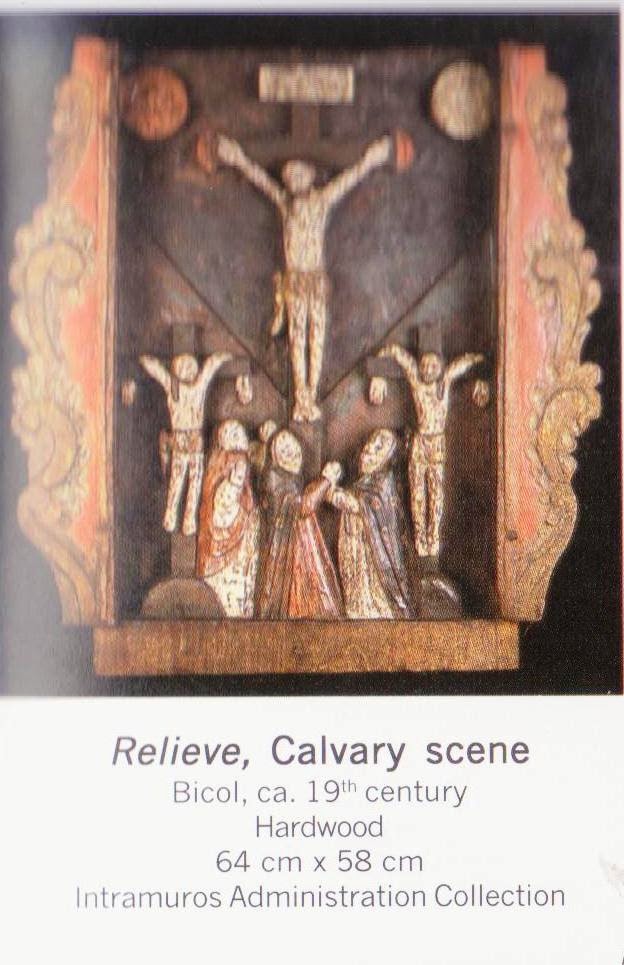
It is the central symbol of the Christian faith, crucifixion being Christ’s humiliating manner of death through which he redeemed the world from eternal damnation. Crucifix is the word we use for the object that includes the corpus or body of Christ hanging on the cross. Crucifixion refers to the punishment and a Crucifixion scene of Christ iften does not depict him alone but the entire Mt. Calvary scene.

 The Ayala Museum exhibit affords us with a rich experience of the Philippine Christian or more specifically. Local Roman Catholic interpretation of the crucifixion of Christ.

Like any of the subjects of Christian image-making before realistic portraiture and photography were developed, all these representations were just products of the artistic imagination.

No object from the time of Christ is still in existence to tell us how he or his mother and his disciples looked like. As a reflection of the human imagination, the Philippine interpretations of these Christian themes, illustrate how we have accepted and imagined the Christian experience.

Across Philippine art history, these images vary depending on the mental and/ or spiritual intelligence of their makers, their skills as artists and the materials they used to express this. As products of a continuum, these objects requires an understanding of the same factors in order for us to fully appreciate their artistry or their relevance to that particular point in time (what century? what region? who was the specific artist?) in which they were made.

 The show features about 30 objects inviting us to ask questions ranging from the practical to those specifically dealing with art historical issues and interests. How were these made?

And indeed, we marvel at the complexity and intricacy of workmanship of some, like the metal and ivory pieces. Who made them? Why didn’t the carvers and smiths who made them sign them just like the one-of-a-kind religious sculptures we see nowadays. What are the sources and influences of their styles? My favorites in the exhibits belong to two types.

One is the crucifixion scene in slim liquor bottles. For one, the bottles themselves are antiquities since this is a genre that flourished in the early part of the 20th century. The greenish bottles are particularly pleasant to the eyes

This genre traces its beginnings to Victorian glass globe table pieces containing flowers and elaborate multi-figure scenes. The bottled crucifixion scene is a form of prison art. (Today, prisoners still make bottled art but their subjects are mainly galleons and rural scenes).

 I used to be puzzled about how the entire crucifixion tableau could be inserted inside a bottle with a mouth so small until someone pointed out to me that all the materials were placed inside via an opening at the bottom of the bottle which was later on soldered again.

This tableau often consists of a Christ on the cross, Mary and Magdalen or John (and sometimes there are the three crosses of Mt. Calvary) plus an appropriate setting of mountains and trees. For realism, the face and limbs of the figures may be made of polychromed wood, while other parts make use of materials that imitate the textures and colors needed.

The second type that I like is the classical crucifixions, whether carved of ivory or wood. This is a form of urban art giving us an idea of how master carvers in Manila, Paete, Laguna and Vigan or San Vicente, Ilocos Sur, interpreted Christ on the cross as inspired by Renaissance and Baroque prototypes.

Many examples from the 16th to the early 20th centuries, have been preserved. We know that the Chinese-looking Christs date to the earliest period of the colonization. By Chinese-looking, we mean slit eyes, small nose, small thin lips and lanky limbs. The more sinitic, the earlier.

Christ’s features become more and more Caucasian and also more and more formal in approach as the carvers also change in their training, that is, from apprenticing in the talleres or workshops to professional tutorship under the Academia de Bellas Artes.

 Pre-20th century cult or devotional objects in the Philippines were seldom signed. These pieces were generally not regarded as art despite their evidently high artistic quality. The awareness of human participation in the creation of a saintly image would certainly distract devotees in the performance of their devotional activities.


Towards the later part of the 19th century as the Philippines awoke to the formidable ingenuity of its artists, we witnessed a changing situation. In the show, look for the three examples of classical crucifixions I am describing here and which illustrate this change.

The first of these and the earliest is a highly realistic representation of Christ done around 1850. It is illustrated in this article. Christ’s depiction corresponds to the miniaturistic sensibility in painting in which all aspects of the subject are realistically depicted to the minutest detail.

 In this crucifix, Christs’s body is made of tinted wood and his features are painted with realistic reasons. He is equipped with hair made of curled fiber, a crown of thorns of beaten metal and an elaborately tooled loin cloth.The author is unknown.

I have encountered several examples of this style, apparently done by one person, but unfortunately, the pieces could never be traced to their maker or his descendants who could inform us who he was. I am inclined to believe that his environment dictated this situation of anonymity. The artist belonged to that period in which his work was not considered as a work of art but simply an object of devotion.

 The second example is a classical ivory piece identified as by Leoncio Asuncion (1813-1888). Leoncio belongs to the famed artistic Asuncion clan that produced the exquisite portraitist Justiniano and the religious painter mariano. The attribution to Leoncio is correct because the piece came from the artist’s descendants who donated it to the Ayala Museum. In this case, we witness a situation of vigorous artistic awareness.

Asuncion’s Christ is very Caucasian in features and when placed beside the anonymous piece mentioned above, its realism appears to lack force and dramatic intensity.

 The third example was done in 1890. Its merits lie specially in the fact that it is so far the only known surviving work of the acclaimed sculptor, Marcelo Nepomuceno (1871-1922).

Marcelo’s work definitely lacks the realism of the anonymous as well as the Leoncio Asuncion piece. The piece also takes on a more secular tone and shifts to Magdalen’s lament.

The artist’s focusing on the repentant Magdalen and not on the mystery and drama of the redemption presages the wordliness and materialism of our times.

All photos from "Art of the Cross: A Philippine Tradition", by Sandra B. Castro. Catalog Exhibit, Ayala Museum. 2001.

Sunday, June 16, 2013

152. A View to a Skill: PIECING A CRUCIFIXION BOTTLE PUZZLE


One of the more fascinating religious folk art that we adopted from the West are the so-called Crucifixion Bottles that were popular among whittlers and craftsmen in Europe and America in the 19th century. They are variations of bottled wooden whimseys that included the popular ships-in-bottle, a tradition that remains to this day.


Tradition has it that Crucifixion Bottles were made by Bilibid prisoners as part of their rehabilitation, starting at the start of the 20th century. Inside a bottle was constructed a whole Calvary scene, complete with the principal stick figure of crucified Christ shown surrounded by similar santo figures of Mary, St. John, the 3 Maries, and Roman soldiers. It was believed that prisoners passed the long lonely hours by skillfully putting together these disparate santo pieces inside a bottle, reflecting on Christ’s sufferings as they did so. Once finished, these bottles were sold as cheap religious souvenirs.


 One weekend, I was looking for antique bottles to add to my collection at my dealer’s Cubao warehouse when I saw this medium size clear bottle with what seemed to be dirty paper shreds inside it. A closer examination showed that it was an old crucifixion bottle as I could see disassembled stick figures inside, all mixed up with the flotsam and whatever jetsam was inside.

Of course, I asked the dealer a trick question, asking what the bottle originally contained—and he answered vaguely that it held some kind of a religious relic. Hence, he says, it’s more expensive than his other bottles—I could have it for a thousand bucks. Well, I ended up getting it for the same price as his regular bottles, and immediately went home with my find, lest my dealer changes his mind. I earmarked this for my week-end project—I am sure I could restore this old Crucifixion Bottle, I have done so in the past.


 Day One: I had to remove the contents of the 500 mL clear medicine bottle, which was consistent with other crucifixion bottles I have seen. With sloping shoulders and a wide, flat front and back side, these bottles were ideal for assembling sets of figures inside.


Using a long barbecue stick plus tweezers, I managed to remove the messy contents of the bottle. The dirty shredded paper were actually placed to hide the calvary base, although the more common fillers were cotton balls, to create a “heavenly effect”.


 Disentangled from this dirty mess were three Calvary stick figures made of softwood, consisting of the Crucified Christ (surprisingly complete!!), Virgin Mary and a Roman soldier (very rare figure!).


There were remnants of the Cross too—the anchor was intact, but the Cross itself was missing the main bar. I cleaned up the figures using a regular paint brush and reinforced loose elements (like broken base bar, the soldier’s sword and Mary’s cape) with gel glue. I also replaced the missing parts from wood scraps recycled from an old crate.


 Now, comes the most difficult part—assembling the pieces inside the bottle. I was prepared with an assortment of “tools”—mainly, barbecue sticks of different sizes, skewers, plastic paleta, tweezers, even bent paper clips! I had previously studied the order in which the parts were laid out on the bottle and I began with lining the inside bottom of the bottle with brown paper, which I glued using dabs of gel glue (perfect for such project, it doesn’t run quickly!) applied with the flattened end of a barbecue stick.

 Next, I assembled the cross bars—one bar at a time—a fairly easy thing to do as the bottle was still empty; you could still move things around and fasten them using the same barbecue stick-with-glue technique. As this was going to anchor the cross, the cross bars had to be locked and glued securely, which meant waiting for the glue to dry—overnight.

 On Saturday morning, I was ready to put the Roman soldier and the Mary figure inside the bottle. There were hole marks to guide me in positioning the figures. I knew that the soldier stood at the left of the Cross, while Mary stood in front (for all we know, this was a Magdalene figure!). For better visibility of Christ, I decided to relocate Mary on the right, where I had already punched a hole to slip in the figure, which had a peg on her feet, fashioned from a toothpick! Again, more waiting followed for the glue to set firmly.


 After lunch, I was all set to put in the spar of the cross, which I did successfully in one go. The T-bar was more of a challenge as it already had the dangling arms of Christ, attched with very fine nails. I had to force it down the narrow neck of the bottle, then, I had to balance the bar on the spar, and coax it into position. After several tries, I succeeded—the dovetailing was perfect! A few dabs of glue and the cross was up!

By late afternoon, the glue was sufficiently dry, so I pasted the rays of the cross (made from brown paper and trimmed with gold glitter) on the back , to further reinforce its construction. Next came another critical part of the assembly—putting the armless body of Christ onto the spar of the cross, then coaxing the two thin arms in place so that the ends could be inserted into the shoulder sockets of Christ.

One really needs a steady hand to do this as it entails balancing the body on the narrow cross. I lined the cross with gel glue then pushed Christ’s body using a pair of tweezers. Even with glue, Christ would fall from the spar of the cross; thank God, the paper burst broke its fall many times. 

The next problem was inserting the arms into the shoulder sockets. I had practiced this on the Christ figure outside of the bottle, and the arm fitted like a glove with one push. Inside the bottle, with less space to work on, it was very difficult. I would lift one arm using a slender stick, pull up the body with a skewer, and the body would fall, again and again.


 After a dozen tries and with my patience running out, I decided not to insert the arms anymore and opted to lay them on the cross, almost touching Christ’s body. From the front, one could see Christ hanging from the cross alright, but from the side, you could see that the arms are not exactly attached to the body. Oh well, that was my best effort.

 To ensure that the arms would not fall and remain in position, I dropped dollops of glue on the nails supporting them. Unlike before, I didn’t rush the drying of the glue; I let the glue set overnight. The next morning, after breakfast, I inspected my handiwork. I still was not happy with the way the arms have turned out, but I know, it could have been worse.


 The last steps included glueing the paper INRI sign on the cross, and covering the base with crumpled strips of very fine papel de japon. For added effect and to weigh down the flimsy paper strips, I dropped in a couple of mother of pearl flowers onto the base of the bottle. To keep the cross from moving, a toothpick was inserted into a hole on the top of the cross; the other end was then inserted into a cork (from an old wine bottle), which was the pushed into the opening which was then dabbed with glue, to seal the bottle permanently.

 It takes very little to creating bottled whimseys—one needs only an empty bottle, glue, a whittling knife, scraps of paper, fabric and wood. Anyone can actually do it, with just a bit of skill, patience and practice. Just take it from the Bilibid prisoners of old, whose rare folksy santo creations in a bottle now command thousands of pesos in antique shops—if you can still find one.