Showing posts with label antique ivory. Show all posts

Thursday, April 30, 2026

373. APO IRO! APO IRO! Discovering the Year-Long Cult of St. Peter in Apalit, Pampanga, by Ross M. De Leon

(Transcribed from the magazine article published on Weekend Malaya 20 Sept. 1987)

By Ross M. de Leon, Photos by Zek Barroso & Jolly David

Apalit town becomes exceedingly alive from June 28 to 30 every year. It is when the whole town becomes one and celebrate the feast of Sta. Peter whom folks lovingly call Apo  Iro. Actually, the people get busy as early as May when the fiesta committee members start mounting the bamboo poles for the buntings.

That the Apaliteños put their minds and hearts in the fiesta event is eveident in the buntings alone. The colors are well-chosen, the hangings have identical shapes and sizes.Arranged very close to each other, the buntings would look like one bg canopy. If one views it from the window of a century-old two-storey house, it turns into a magnificent rainbw that dips somewhere in the Pampanga River.

With a band playing fiesta tunes and people coming in with their glorious smiles, the scene takes a different appeal. It is as if time hangs suspended for three days and everyone is reborn. Nothing occupies the people’s attention except to give their best to Apo Iro. The life-size image in pure ivory is 287 years old. It is the only on in the country which sits on a throne.

Most of us are familiar with St. Peter in an upright position holding a rooster and keys. But Apo Iro of Apalit is a magnificent Prince of the Church in papal robes. Fr his feats, he wear a three-tiered crown symbolic of his being a first Pope. He has a scepter, a huge cross around his neck, a ruby ring and keys. On other days, Apo Iro wears a simple, priestly robe, not the old pajamas and baseball cap he used to. “A pope would never appear in public wearing pajamas, would he?”, asks Rick Badenhop who is married to the camarera, Erlinda Sazon-Badenhop.

Through the Years. It is Linda’s ancestors, specifically Don Pedro Armayan Espiritu, who bought Apo Iro t the country. Don Pedro got the image done in Spain including its original crown, scepter, ring , keys, necklace , cross, the fisherman’s shoes in pure slver. All those have remained intact since Apo Iro’s arrival in 844 at the old home of Don Pedro in Alauli, Apalit. Don Pedro transferred it to a bigger house in Capalangan and has stayed there ever since.

St. Peter’s shrine in sitio Capalangan, Apalit, Pampanga

From 1974 till now, Apo Iro has been under the care of Dña. Elisa Sazon, a direct descendant of Don Pedro. The old lady died in May this year which made her daughter Erlinda, the new camarera.

The family has undertaken the awesome task of being host to Apo Iro’s numerous visitors throughout the year. But it is on his feast day when the preparations are even bigger. Linda, a well-known dentist, is not daunted by the responsibilities for she has fund the perfect partner  in Rick. The latter is a busy executive of Equitable Bank and has accepted Apo Iro graciously as part of his life.

The very old Spanish home of Rick and Linda opens its doors to everybody ob Apo Iro feast day. Rick reveal as , “we have to hire no less than 40 cooks to feed the devotees for free.” About 10 to 20 cavans of rice are needed each year, four large pigs, 300 peces of chicken, 40 kilos of beef, and a jeepload of bihon and not less that 30 cases of softdrink are consumed. “Of course, there are other ingredients and other items butthose are the staples. The cash donation may reach up to Php 15,000 but we always add Php20,000 to that”, declares Linda.

Devotees expecting miraculous cures for rheumatism, asthma, and other ailments.

Aside from which, the family spends over Php3,000 for the coconut oil which the devotees request. Then there’s the maintenance of the chapel and the garden built in 1981 which come from the Badenhop’s purse. “We will keep the tradition the way Linda’s parents and ancestors did it. You cannot just close the shrine for lack of fnds. We believe that Apo Iro will help in every way,” says Rick without hesitation.

The Badenhop’s faith in the miraculous power and generosity of Apo Iro is echoed by the devotees who flock by the thousands. Maria Santos, a 68 year old resident of Caloocan, and her whole clan come yearly in 4 jeepneys. There are 80 of them and they have been faithful to Apo Iro for the last six years. “Lahat kami pati dalawang apo ko, pinagalig ni Apo Iro,” remarks Aling Maria, a furniture shop owner.

Aboard the barge are Apo Iro and the Virgin Mary on their 6-hour  fiesta time journey to the Apalit Cathedral.

She herself goes down the river when the fluvial procession begins. The woman explains, “Dati hindi ako makalakad dahil sa rayuma sa pareho kong paa. Pero simula nang magdebosyon ako kay Apo Iro, gumaling na ako.” In between fiestas, Alig Maria usues coconut oil to massage her feet. “Mabilis ang ginhawa. Ganon din kapag nagbabad ka sa ilog na dinadaanan ni Apo,” came the simple declaration of faith. Her two grandchildren were rid of their asthma again through the water and oil from Apo Iro.

There’s Felisa Cabildo Albina who is now 73 years old and widowed. She began her panata at 17. Aling Feling’s eyesight was failing because of cataract, “pero iniligtas ako ni Apo Iro.” She used to suffer from hypertension and severe headaches. But she does not look her age nor does her illness seem to bother her when she dances on the street with other devotees. This, they do, when Apo Iro leaves the shrine for the población and on the day that he returns.

Felisa Albina, 73, has been dancing for Apo since 1921.

The dancers bring with them all kinds of leaves but especially guavaleaves. “Kahit anong halaman basta isinama kayApo Iro nakagagaling,” relates Aling Feling. “Pakulo ka lang ng tubig at yoong dahoon pag may sakit ka ng tiyan, ulo o lagnat at tiyak na wala.”

For this year’s festa, however, there were signboards requesting devotees not to destroy the plants. Rick points out, “They can get the leaves but nothing should be uprooted. We spend a lot in the upkeep of the plants.”

Miracles? Another devotee of Apo Iro is 14-year old Nicomedes Estrella of Iba. He was only 4 years old when he got leukemia and his parents were told that he would die soon. Once, when he was delirious, he told his father, “Itay, dalhin mo ako kay Apo Iro.” He and his parents stayed in the chapel for two weeks after which Nick recovered for good. He is now a healthy teener who for the last 10 years has been spending the last 3 days of June with Apo Iro.

Aling Maria, Aling Feling and Nick are only three of the tousads of devotees who greet Apo Iro on his feast. They wait rain or shine till Apo is brought out from the chapel and down into the river. The chanting of “Apo Iro, Apo Iro!” is awesome, the kind that makes your hair stand on its end and sends shivers down your spine. There is a marvelous rain of petals, confetti and leaves followed by a thunderous applause. Dancing on the street continues as Apo Iro is carried to the river by the Knights of St. Peter.

Devotees Mary Indiongco, Knights of St. Peter Macario Vargas 
and Amado Arceo with Dr. Erlinda Sazon-Badenhop in front of the
287-year old Apo Iro.

Despite the gaiety, the festivities do nt turn into a circus that would lessen the solemnity of the event. More people await Ao Iro at the river where he takes a barge. From Capalangan, he is transferred to a bigger, more splendid float at the point where the Calumpit and Pampanga Rivers meetfor his 6-hour journey to the Apalit población.

The fluvial procession is a sight to behold, a powerful feast of colors for photographers. The large float carrying Apo Iro and and the Blessed Mother is followed by smaller bancas, barges, etc. all filled with people. The banks are lined with more devotees who immerse themselves in the water for everyone believes that this is the only time of the year when the water becomes curative through Apo Iro.

A vigil and procession are held at the Apalit cathedral for a day when Apo Iro returns to the shrine in Capalangan. The return journey is awaited with greater joy and enthusiasm as if the Apo left the sitio not for a day, but for years. Dancing, dousing of water, and feasting are the order of the day. The folks stay till late at night in thanksgiving, for their belove Apo Iro is back and safe.

Thursday, August 14, 2025

364. Lump in My Throat: SAN BLAS in Ivory

SAN BLAS (St. Blaise), the bishop-martyr of Sebaste, in Armenia, is not familiar to many Filipinos, except perhaps in Sebaste (yes, namesake of the bishop’s episcopal see!), Antique, or in Bangar, La Union and Villasis, Pangasinan, two municipalities with barangays named ‘San Blas’.


Apparently, in Pampanga, a prominent family from Guagua are devotees of San Blas, as they keep an exquisite ivory figure of the saint invoked against throat diseases, that has afflicted some members in their clan.

This ivory santo belonged to a couple who ran a successful popular and successful meryendahan in the town. They often lent their image unselfishly to people in the community with various throat issues, who, after touching the revered image, crossed themselves on the neck as they pray for relief.

According to a legend , San Blas saved a boy who had a fish bone stuck in his throat-- just one of the many miracles that he wrought. That led to him being adopted as the Patron Saint of people with throat ailments.


When the childless couple passed away, the image was bequeathed to a niece, an unamarried public school teacher. She cared for the image until she retired and passed away just this year, ahead of her remaining elder sister.  As of yet, the next caretaker of San Blas has not been named.

Typical of many classically carved santos, this San Blas has a manikin body, but has been redressed, his original bishop’s vestments now long gone. His most common iconography includes a mitre (also replaced) and a crozier. Other depictions of him in art includes an iron comb—an instrument of his torture, and a candle, in reference to a candle brought to him in jail. Images of him holding a martyr’s palm are rare.

The feast of San Blas is celebrated every February 3.

 MANY THANKS TO : MR. JERRY PUNZALAN SAGMIT for the information and photos.

Friday, July 25, 2025

362. The Ivory Image of Parañaque's SANTA VERONICA

The processional ivory image of STA. VERONICA, is a representation  of the woman who offered a cloth (likely her veil)  to Jesus so He could wipe His face on the way to His Crucifixion, and on which His likeness was miraculously imprinted on the cloth.Though not mentioned in the Bible, the scene of the meeting endures in Catholic tradition in the Sixth Station of the Cross, "Veronica Wipes the Face of Jesus."

Parañaque’s Sta. Veronica has a head and hands crafted from high quality white ivory, This 2008 photo documentation of the santa shows her in a replacement  purple vestment embellished with gold-colored thread embroidery, for the Lenten procession of the Parish of St. Andrew.

She holds a “birang”, with the face of Christ imprinted three times that shows signs of fading due to age. The original “Veronica’s Veil” is believed to exist today in the Vatican and is considered one of the most treasured relics of the Church.

Photos from Dr. Raymundo Feliciano Albums in the care of the Center for Kapampangan Studies.


Sunday, July 2, 2023

357. THE SANTO COLLECTION OF THE MUSEUM OF PHILIPPINE ARTS AND CULTURE, San Fernando, Pampanga

Museum of Philippine Art and Culture, San Fernando

An invitation from Mrs. ANDREA DIZON DOMINGO to the launch of her foundation’s MUSEUM OF PHILIPINE ARTS AND CULTURE, was an event certainly not to be missed by the staff of the Center for Kapampangan Studies, and that included me. Though many remember her of late, as the Chairman and CEO of PAGCOR (Philippine Amusement and Gaming Corporation), she was also at some point,  a commissioner of the Bureau of Immigration and a Pampanga congresswoman.

A cabinet-ful of antique santos

But I remember Mrs. Domingo as an owner of a well-know antique shop in Intramuros—GALERIA ANDREA—and who later put up a swanky branch at the LRI Plaza in Makati. I was a habitue of her antique shop that was always full to the rafters with antique santos, exquisite colonial jewelry, paintings, blue and white jars, and pottery diggings—all tastefully displayed under glass or organized on shelves and walls. 

Ivory Sto. Nino flanked by San Jose and Sta. Maria

I only have one santo purchase to show after all my frequent visits to her shops— an armless Santo Niño with a bone face on a globe base. I was content with browsing at her shops as she had probably one of the most select antique pieces in Intramuros. So, when I learned that she was opening a museum, I had no doubt that it will be nothing less than the best—I had already in my mind the quality and diversity of pieces she will be showcasing.

An ivory Calvario scene.

I had expected a small museum in a San Fernando subdivision, but I was floored when I saw it was in a huge 2-story building with expansive spaces. She explained that the building was a re-purposed ballroom dance hall that she had built at a time when she took up the hobby, and wanted a venue for other dance enthusiasts.

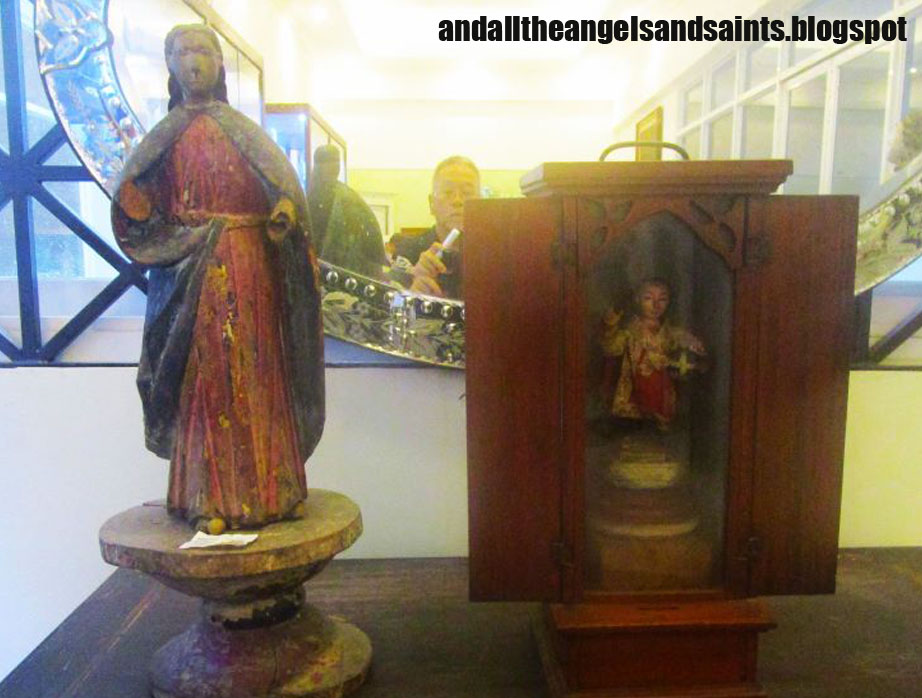
A folk Virgen and Sto. Nino in a box urna

Entering the well-lit, cavernous hall were walls and walls of paintings from past and present masters, presidential merit winners, Mabini painters,  and National Artists, a virtual who’s who in Philippine art history. Outside of Manila, this museum has perhaps the largest assemblage of paintings done by National Artists—works of Amorsolo, Ang Kiukok, Botong Francisco, hang side by side with the paintings of Magsaysay-Ho,  Edades, Joya, and Legaspi. 

A cabinetful of antique santos

In another wing, the rooms displayed pre-colonial artifacts like bul-ols, oriental trade jars, potteries from various diggings, tribal art and textiles. 

More santos on display.

But of course, the one room that piqued my interest most was the santo collection in a wing of its own. The most precious ones—including the valuable ivories, were shown in well-lit floor to ceiling glass cabinets. The amazing exhibit featured mostly folk santos, many left overs from her antique shops, but still of impeccable quality no less. The antique santo collection is featured in these photos.

L-R: Ivory San Juan Bautista, and a pair of wooden San Roques

The MUSEUM OF PHILIPPINE ART AND CULTURE is set to open fully in July. It is located along the highway of San Fernando, brgy. San Agustin, next to Ramar Village, and across St.  Scholastica Academy. 

A gathering of Virgins and Sto. Ninos

A Sto. Nino among Virgenes

Ivory santos of the most precious variety

More ivories for the eyes to feast on.

The Ivory Section of the exhibit

Folk antiquities

Of wood and ivory.

A trio of charming Sto. Ninos

Inmaculada Concepcion

A wide-eyed San Pedro

Sagrada Familia in ivory

Inmaculada Concepcion

San Miguel Arcangel


A Bohol Sto. Nino and matching urna

Virgen del Rosario

Thursday, February 3, 2022

350. Winging his way from ebay to my altar: SAN VICENTE FERRER

The popular online bidding site, ebay, is very strict with the sale of ivory  on its site, and since 1990, you can no longer engage in the international trade or sale of new ivory. The sale of ivory items made before 1947 can be freely bought and sold, though importers and exporters need a permit. 

But even with these rules, ebay buyers tend to pass up on antique ivory santos, after considering all other factors, not to mention, risks. That was why, when I saw a Manila-based seller offering a few antique ivory pieces on ebay, I was rather skeptical if they would sell at all. True enough, they didn’t. 


One of the antique ivories that piqued my interest was a stunning 11 inch, San  Vicente Ferrer figure, with head and hands of ivory. It was fitted on a manikin body, and dressed in its original Dominican vestments, complete with a capuce (habit hood), in traditional black--which has faded to blue—and white. 

The habit is lightly embroidered with gold thread, and the short shoulder hood features a 6 pointed star-shaped flower repeated on the white tunic.

The 19th century ivory santo, as described in the original post, once belonged to a Catholic faithful who converted and became a born-again Christian, a religion which discourage the use of religious icons as objects of veneration. The antique ivory even bears a stamp of certification from the government that confirms its antiquity, which qualifies it for international sale.


San Vicente Ferrer is commonly depicted as a pudgy friar, with one hand pointing heavenward, with the other hand holding a book, to allude to his being a charismatic preacher. This santo, however, has an open palm in benediction. His right hand holds a tiny ‘leather-bound’ book, a nice detail, if I may add.

Missing was his pair of metal angel wings (San Vicente was considered as an angel), a halo and a globe base, in reference to his mission “to preach unto them that sit upon the earth, and over every nation, and tribe, and tongue, and people".

With the fine antique ivory unsold, I lost no time in contacting the dealer whom I knew all along—and concluded the sale online.

This San Vicente was one of my earliest ivory pieces that was worked on in 2001 by renown ivory restorer, Dr. Raffy Lopez. The first thing he did was to remove the gold embroidery from the fraying cloth, then transferring them on new satin. Using the old habit pattern, he replicated the distinctive vestment of the Dominican saint.

He had a pair of  brass wings plated in gold made, using an old pattern, and opted to have a “paragua” halo, to avoid punching holes on the santo’s outfit and body.

Finally, he had an appropriate  wooden globe base made, elevating the santo to a height of 15 inches. San Vicente Ferrer may be one of the most common santos that one can find in antique shops, but this ivory version remains special to me, not only because it was one of the very first ivory pieces that I got to own, but also because of the of the circumstances of how I acquired it—not from an antique shop, a collector, or a ‘runner’, mind you—but from the comfort of my own home-- online, in front of my computer!