Showing posts with label Cebu. Show all posts

Saturday, November 19, 2016

273. A COLORFUL ARRAY OF CATHOLIC SAINTS, by Rodolfo Y. Ragodon

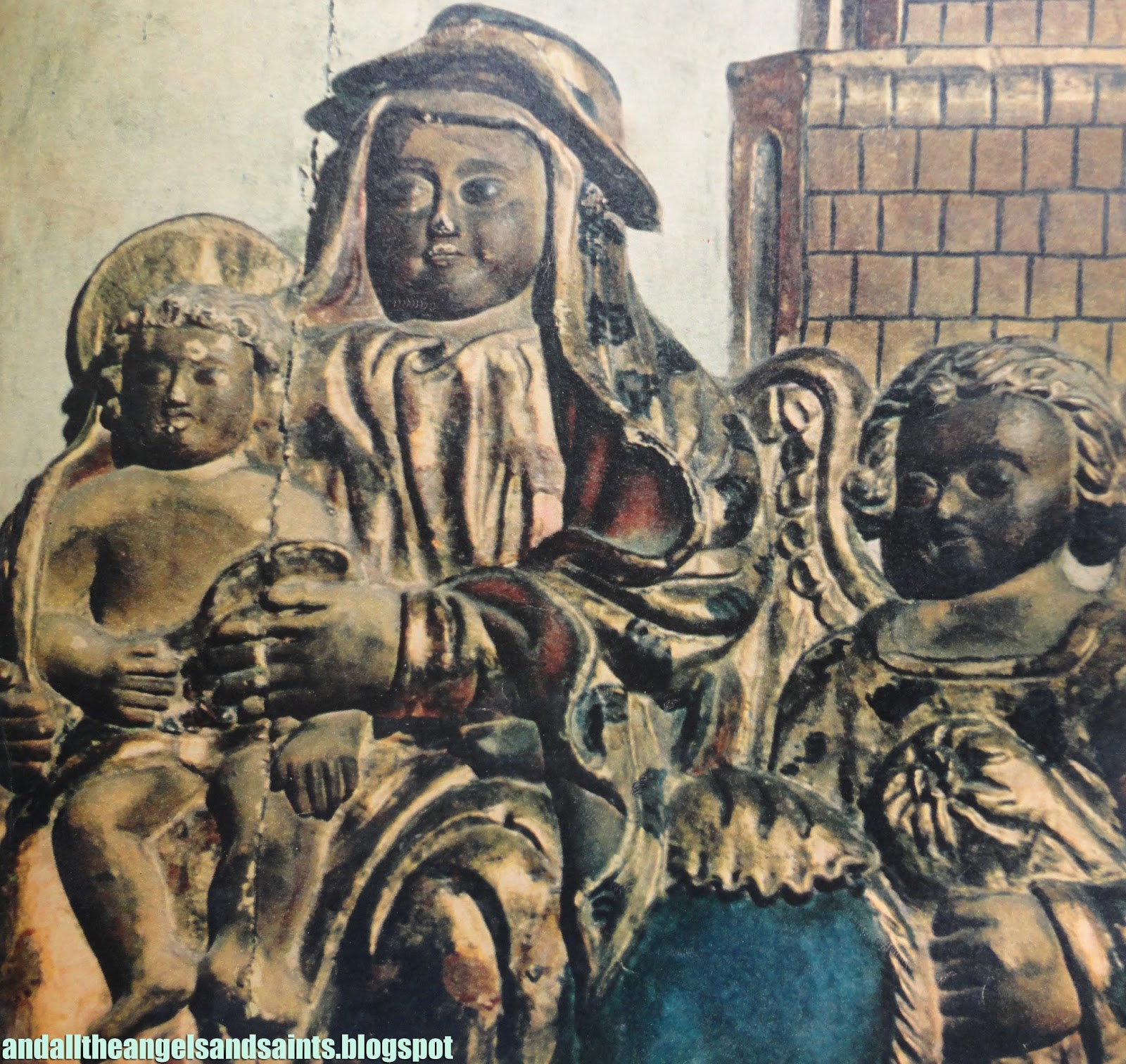
FOLK RELIEVE of the Virgin and Child Jesus, with angels in attendance.
Excerpted from a 1965 Sunday Times Magazine article 
by Rodolfo Y. Ragodon 

Exhibit of Religious Art in Cebu IV Centennial Festivities Traces Evolution of Filipino Christian Way of Life 
ANTONIO BANTUG, one of the early santo collectors in the Philippines.
The biggest collection of Philippine artifacts from primitive religious images to icon-like paintings and some of the best representatives of contemporary arts have been gathered this year in Cebu for exhibition in commemoration of the 4th centennial celebration of the Christianization of the islands.

A CONGREGATION OF FOLK NINOS

This collection of religious arts revolves around the Filipino way of life, its customs and mores; in other words, it traces the development of our Hispanic culture today from the time that our forefathers embraced the Christian way of life. These artifacts—many borrowed from private collectors and from the collections of the National Museum—are mostly wooden images that date back to as far back as the 17th century.

ECCE HOMO BUST, Bust of Christ, centuries-old.
The early images carved by Filipino artisans, though crude and primitive, are just as significant. The number of sculptured images which adorn the early churches in the country came from Mexico through the galleon trade.

A GROUPING OF PRIMITIVE SANTOS
The intricately carved images mostly come from Central Luzon, especially from the province of Pampanga. Some of these images were carved from hardwood like molave or kamagong. The zeal for collecting these age-old artifacts of religious images spread only after the war.

PROF. GALO OCAMPON Painter
National Museum Director, UST Professor
However, collectors like the Bantugs, the Pardo de Taveras and the Hidalgos were among the few Filipinos who took notice of Philippine arts during the Spanish period.

The flowering of the Filipino sculpture during the Spanish regime came in the 19th century.The factors that brought about the development include the natural skills of the native carvers, the presence of competent critics and the arrival of well-made images from Spain and Mexico.

Monday, April 18, 2016

247. PHILIPPINE SANTO NIÑOS: Stunning, Startling, Surprising!


The Filipino is a child at heart, which explains the widespread devotion to the Holy Child Jesus in the Philippines. It also explains why—on His annual festival in January, owners of Niño images, led by members of the Congregacion del Santisimo Nombre del Niño Jesus, give rein to their unbridled child-like fantasies as they take out their images for procession.

Along Roxas Boulevard, scores of Sto. Niño statues, of all shapes and sizes and bearing various titles and appellations, could be seen on their floats, dressed and decorated in the most wondrous varieties—from regal to riotous, fancy to flamboyant—all guaranteed to dazzle, startle and surprise.

In the 1994 edition, there were Bambinos like these, inspired by Italian-style representations of the Child Jesus..

There were little Niño that came shielded from the elements in spectacular Baldochinos such as these..

This pair of cute pair were dolled up as—the Pope. One was wearing the Papal Miter and the other, a golden Papal Tiara.

Only in the Philippines can one see the Holy Child in the national costume for men—the Barong…

 Attracting extra attention were these Infant Jesus statues attired in Ethnic Regalia…

 Strange as it may seem, there were Niños garbed as Warriors, ready to do battle…

Meanwhile, there were a couple of Sleeping Sto. Niños, oblivious to the noisy, adoring crowds..

A trio of little Jesus figures were borne on Horses—one, carried by a chariot flown by the mythical winged horse, Pegasus, and another, led by kiddie cocheros…

Still others were presented using Musical-Themed backdrops, like the Las Piñas Niño that featured a bamboo organ, and another Holy Child, being serenaded by a guitar-playing figure.

There were overly-decorated floats overflowing with flowers, blooms, petals, leaves and fruity décor, totally overwhelming the poor little Holy Child—you could scarcely see Him!

Thank heavens, there still were a few familiar Santo Niños that many could recognize among those in the procession—like this replica of the much-revered Santo Niño of Cebu whose depiction remains true to the original, thus inspiring true reverence!

Friday, May 22, 2015

222. WHERE HAVE ALL THE SANTOS GONE? part II

IMMACULATE TRANSACTION. This spectacular Immaculate Conception of over 3 feet, appeared for sale on ebay from dealer "robacus" or "losantiguos", who was allegedly involved in church theft sometime in 2003-04.. The case was later dismissed.


This spread of fabulous santos appeared on the ebay page of Rory Bacus, who sold antique santos under the name "robacus" and "losantiguos". After some objects were found in his house, the Cebu archdiocese sued the dealer for fencing various religious artifacts in October 2003.


In April of the next year, a decision was handed down by the Cebu Regional Trial Court dismissing the case against Bacus.


Regional Trial Court Judge Ireneo Lee Gako Jr., in a Feb. 20 order, exonerated  Bacus of the charges of violating the Anti-Fencing Law. The court also ordered the release of 278 religious icons and artifacts to Bacus.


The dismissal of the case greatly disappointed Church officials who expressed their disgust over the outcome of the case. Fr. Carlito Pono, head of the Commission on the Cultural Heritage of the Church, admitted that while some of the parishes that reportedly lost icons had refused to cooperate, others could not find any evidence to prove ownership of the stolen items.


While the case was dragging, Bacus returned to eba,  although this time around, his posted items were smaller, primitive santos--the kinds one can readily find in downtown Manila antique shops.


Ninos, such as these, obviously carried by bigger santo figures like San Antonio, Virgen del Rosario, etc. were also listed on ebay. Some were sold, others withdrawn for sale even after a winning bid had been placed. The dealer sent explanatory messages to the effect that the item had been sold in an antique fair and that he had forgotten.


The noted antique dealer, Rory Bacus, passed away, sometime in 2013. The whereabouts of his remaining antique santo stock remains unknown.


Thursday, April 23, 2015

220. WHERE HAVE ALL THE SANTOS GONE? Part I

HEADS WILL ROLL. All these exquisite antique santo heads from the Philippines were auctioned off on ebay, by the controversial antique dealer, Rory Bacus. The fate of unsold santos remain unknown. 

One of the most controversial dealers of Philippine religious antiquities was the late Rory Bacus of Cebu, who listed his business as an exporter-importer of woodcarvings. In the early 2000s, Rory Bacus, under the name "robacus", posted regularly on the international auction site, ebay, many religious artifacts, examples of which are shown here on this page.


Bacus has been associated with the loss of many old religious images from Cebu parishes, which includes figures of Virgen Dolorosa, Baby Jesus of Mount Carmel, San Jose, Nazareno and Sta. Monica, from the Santa Monica Parish in Dalaguete, Cebu.


These, along with 158 icons, including 58 crucifixes and other sacred artifacts, were recovered in a raid conducted in the house of Bacus in late April 2003. Bacus had also been allegedly involved in the disappearances of many images from different churches in and outside Cebu.


In October 2003, the Archdiocese of Cebu charged the noted antique dealer of fencing various religious artifacts. Included in the complaint at the City Prosecutor’s Office was an affidavit of Rosa Navarro, the treasurer of the Badian pastoral council who testified that she was able to recognize a cherubim icon, among the  icons seized by the police from Bacus’ house in a previous May 2003 raid.


On April 25, 2003, prior to the serving of the search warrant, the police were also able to retrieve ten antique religious icons at a house in Guizo, Mandaue City, reportedly owned by Bacus. Agapito Torrentira, councilor of Inabanga town in Bohol, and barangay captain Emiliano Divino, of the same place, came to Cebu and identified two of the icons recovered as among those stolen from barangay Cambitoon chapel, of the town.


A second police raid conducted later yielded  the images of San Isidro Labrador, San Agustin, and Our Lady of the Immaculate Conception, verified by the 2 Bohol officials as items stolen from their place.Carcar residents, Josefina Roldan, Angeliza Tanodtanod, and Silvina Francisco had also stated that they had identified another icon from Bacus, as the one stolen from a chapel in barangay Perrelos of the town.


However, Bacus’' lawyer had earlier questioned the search that the police had conducted, arguing that they used a general warrant, which was not specific as to what objects will be searched. The lawyer also contended that the police were not able to establish that icons seized were indeed stolen, as alleged. She said those icons could not be declared as illegally possessed if there is no evidence to show these were stolen somewhere. (TO BE CONTINUED)

Sources: http://www.philstar.com/nation/226051/cebu-archdiocese-sues-antique-dealer
All pictures were grabbed and saved from actual postings on ebay between 2000-2003.

Wednesday, September 11, 2013

163. Retro-Santo: SAN GUILLERMO ERMITAÑO

SAN GUILLERMO, the antique processional santo of Laoag on his decorated carroza, on the occasion of  his feast day in 1932, which coincided with a Marian Congress. Dated 14 February 1932.

San Guillermo Ermitaño ( St. William the Hermit), founded the Williamites (Gulielmites) branch of St. Augustine. He was born in France but led a life of immorality even while he was married. His conversion started when he was said to have an audience with Pope Eugene III who advised him to make a pilgrimage to Jerusalem as an act of penance for his sins. After 2 years, he returned to Italy and became a hermit in the woods near Pisa, before moving on to Monte Prumo and in 1155, in the desert of Maleval. He is often confused with San Guillermo de Aquitania (St. William, Duke of Aquitaine).

San Guillermo is often depicted holding a skull to symbolize man's mortality, and a crucifix, upon which he reflected on Christ's passion as a hermit in the desert. Sometimes, he is shown holding a penitent's whip. He died on 10 February 1157 (his feast day) and was beatified in 1202.

He is the patron saint of several Philippine towns including Laoag City (Ilocos Norte), Magsingal (Ilocos Sur), Talisay (Batangas), and Passi City (Iloilo).

Wednesday, March 20, 2013

143. JOSE DAKOYKOY, THE DEAF SCULPTOR OF CEBU

Philippine Free Press, 12 December 1936 p. 32
 By Sol H. Gwekoh


Hard at Work. Surrounded by saints, he always keeps good company.

Where physical defects have been a handicap in the pursuit of happiness and livelihood to a great many unfortunate individuals, to Jose Dakoykoy of Cebu City, they have been a blessing in disguise and an indispensable factor in the attainment of his chosen work.

The fourth son of a family of seven, he accidentally became deaf at an early age. He comes from a family known for its musical talent and artistic taste. His brothers are all musicians, having inherited the art from their father, Marcelo, who attended to the choir of the Augustinian order in the Santo Niño church in Cebu. They now furnish church music and religious music for the traditional and popular novenas in the southern islands.

 Although Jose is deaf, he has not given up his love for art. He embraced early the painting and sculpturing lines, in which, though no Michaelangelo, he does well. From his eldest brothers, he learned to master the brush and palette as well as the chisel.

As a result, for the last 30 years, he has been furnishing Cebu and the neighboring islands with his pastels or miniature images of the different religious characters connected with the life of Jesus Christ in different stages. The rich and the aristocrats as well as the poor go to him for their Belens, especially shortly before Christmas. 

He also does interior decorating and portrait ainting, and designs decorative fancy objects. He works fast and alone throughout the year in his own home which he constructed out of his earnings as a painter-sculptor. Quiet and reserved, Jose leads a peaceful and simple life. To him, cockfighting and gambling, and drinking are mere frivolities.

He is a determined bachelor. Simple and humble as he is, relatively few know of his real talent. Contented with His Art Unschooled in the art and technique of his profession, he is contented and at ease working with crude instruments, principally with a small, sharp knife for shaping objects, and the chelepads of crabs for carving delicate features of images.

From religious and illustrated calendars, he copies his models. From September to December, he is kept busy until late at night when orders for belens from different provinces have to be delievered before the Yuletide season. An ordinary belen of 30 figures sells at between P40 and P60, while the more elaborate, which have bigger characters, cost as much as P150; part of the amount he receives for his productions is distributed to his relatives on Christmas Day.

 Now 54, he still plays native songs—the popular and melodious balitaws—on the guitar, especially at night to comfort him in his solitary life.

Thursday, February 23, 2012

99. A Providential Find: AN IVORY SANTO NIÑO

Antique ivory Sto. Niños are rare to come by in the local market because such pieces are always prized by families and are wont to be pass to the next generation of owners as tradition. I do have a couple of old Sto. Niños made of wood, and an antique ivory Niño Dormido (sleeping Christ Child), but a standing antique ivory Niño--classically carved and dressed--has always eluded me for decades.

That is why, I was a bit skeptical when I received a text from a Manila antique dealer who informed me that he had an antique ivory Sto. Niño available for sale. I visualized it to be another reconstituted image, probably an ivory Niño separated from a San Jose or a Holy Family tableau, redressed and put on an old peaña, passed off as an original piece.

But when he sent me a photo by phone, what I saw excited me. Though a bit grainy, I could see that the small Christ Child—with an ivory head and hands—was an original individual piece.

The figure is a classical depiction of the Infant Jesus, styled similar to the Sto. Niño de San Agustin, as deduced from the short, spread-out cape, the short tunic and the pair of pants, all with simple gold embroidery. Judging from the carving style, this is clearly a 19th century piece.

Striking too were the facial features of the Christ Child: sweet, innocent looking, with just a hint of the smile. The expressive face had set-in glass eyes, and sported a double chin with lines on the narrow neck.


Then there are the silverworks, which—though bent out of shape and blackened with age—were all surprisingly intact: crown, orb and scepter. They were finely detailed too, and when cleaned, the silver accessories still gleamed with their gold plating.

Missing was the base, as well as several ivory fingertips, flaws that are easy to fix. One foot had lost its tip but I quickly repaired that with a bit of epoxy clay.

I was lucky too---I was the first to see this lovely Niño which impressed me at first sight. It was well within my reach too, so a deal was sealed in less than half a day. By lunchtime, I had the antique Niño in my possession after a quick cab ride to Manila.

As always, this, I thought, was a perfect restoration project for Dr. Raffy Lopez, so off I went to his place to show off my new find, which he confirmed to be of 19th c. make.

I wanted him to follow the cut and style of the original vestments, which fortunately were kept with the antique piece. Raffy later used these as guides for the new set of clothes.The battered crown, scepter and orb were fixed by Dr. Lopez’s jeweler-friend, Noel Menguito, who confirmed they were of gold plated silver.

I wanted a simple base, perhaps a gold-leafed lotus type peaña, but Raffy prevailed on me to use a traditional and more ornate mortar-shaped base often associated with colonial Sto. Niños. I thought that kind of base is too bulky for such a small santo, but he assured me that it will be proportionately made for my 7 inch Niño, so I reluctantly agreed.

The restoration work took longer than the usual as Raffy was in the midst of having his house improved and refurbished as well. Besides, he had just finished a major exhibit at the Intramuros. After 2 months, a picture message of my Niño was sent to me by phone. It showed the image with repaired fingers, standing on a new base.

A week more, and the restoration was complete. The result was a regal-looking Sto. Niño, resplendent in red and yellow cape and a tunic made from vintage satin fabric.

For my newly-restored Sto. Niño, it was love at first sight, all over again. I am glad that I was at the right place, at the right time—but more importantly, the antique image was available at the right price. Oh, the workings of Divine Providence.


(Other pics courtesy of Romain Garry Evangelista Lazaro)