Showing posts with label altar. Show all posts

Thursday, June 4, 2026

374. LA INMACULADA CONCEPCION OF MALOLOS

The deeply-revered image of La Inmaculada Concepcion (Immaculate Conception) of Malolos is enshrined at the main altar of the Cathedral-Basilica Minore dedicated to her name. It s a pre-war image done by a native carver, Teodoro Ople, who overcame his humble beginnings—he was an orphan—to become a skilled artisan of note. The image was modeled from the well-known Marian painting of Bartolomé Esteban Murillo,” La Inmaculada Concepcion de los Venerables”

In Murillo's painting, Mary is dressed in a white robe with a blue mantle, her hands crossed over her chest, with a crescent moon at her feet, and eyes raised heavenwards. Her pose-- right knee bent and her weight on her left leg—accentuates the undulating  rhythm of the composition. A crescent moon encircles her hidden foot, under voluminous layers of white fabric. 

FEAST OF IMMACULATE CONCEPTION, 1950s

Ople’s depiction minimizes the bent foot, to create a more frontal stance, enhanced by the rhythm of the folds and drapes of Her robe and mantle.

MALOLOS TOWN FIESTA, 1954

The beautifully-sculpted wooden figure of the Immaculate Conception was canonically crowned on 10 March  2012, as granted by Pope Benedict XVI. A flight of steps were built leading to the altar so the image could be touched by devotees. 

Photo: CHURCHES, BASILICAS & CATHEDRALS in the PHILIPPINES (CBCP) 

A vicaria (replica) image of the Virgin is used for processions while the precioys original image remains in the church for safekeeping. Malolos’ Immaculate Conception is one of the most photographed Marian image in the country, a testament to the profound devotion of Filipinos to the Blessed Mother.

SOURCES:

Diocese of Malolos website: https://dioceseofmalolos.ph/patroness/

 Churches, Basilicas & Cathedrals FB Page

Wednesday, December 29, 2021

348. Sorrowful No More: AN ANTIQUE MATER DOLOROSA, REMADE.

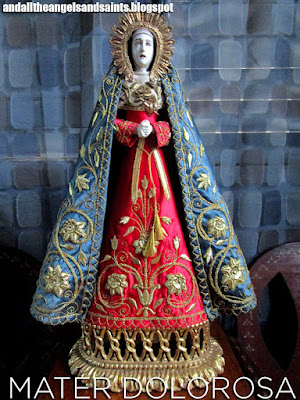
MATER DOLOROSA, COMPLETED

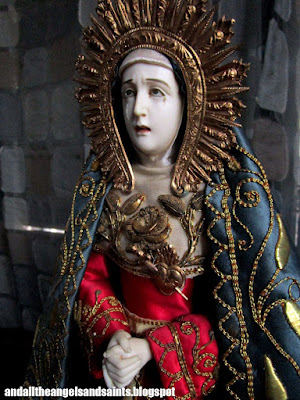
This Mater Dolorosa, made of antique ivory parts, is without doubt, my favorite because of its personal meaning to me. I was drawn to the Sorrowful Mother at the time my father was battling a fatal disease in 1998. When he passed away, I made a vow to acquire a Dolorosa image to be processed in our town during the Holy Week, in gratitude for his painless, peaceful transition.  I managed to find a vintage processional Dolorosa shortly after, and began a family tradition of participating in the annual Semana Santa prusisyons of our town. 

ALL WE HAD WAS AN IVORY HEAD...

...AS THE RESTORATION BEGAN.

I also wanted a version that we could venerate at home, perhaps an antique ivory piece, but by the early 2000s, complete, tabletop ivory images were becoming scarcer, and therefore pricier. I started searching for sacred images online—it was something novel at that time—so I was surprised to find an ebay Philippines site that had a few sellers of old items and collectibles. 
ANTIQUE HANDS WERE SERENDIPITOUS FINDS.

THE HEAD ACQUIRED A CARVED TORSO

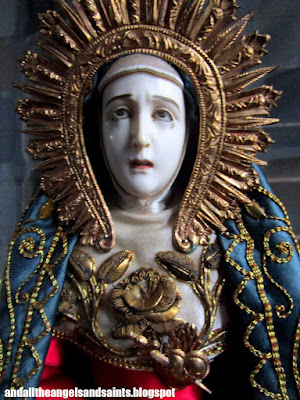
It was there that I met a local dealer, who turned out to be the brother of an officemate!. When I asked him offline to be on the lookout for an  ivory Dolorosa, he sent a private message to tell me, that he in fact has a solid ivory Dolorosa head. When I got hold of the picture, I was stunned, because it was an antique ivory head some three inches long, exquisitely carved, with open mouth, complete with glass eyes, complete with tiny crystla teardrop. It was of very high quality ivory, creamy white in color, without cracks and flaws. Unfortunately, that was all that he had—the clasped hands are missing, and so is the body, the base (peana), and accessories, right down to lost vestments, metal accessories and wig. 

ALL-NEW METAL AUREOLA

THE DOLOROSA ON HER PEANA

I just could not pass up this ivory head, so I got it and kept it in a velvet pouch for a year or so, before I finally took it to my restorer, Dr. Raffy Lopez. One look, and he confirmed that I, indeed, made a good decision as the ivory was excellent in all aspects. His only problem were the missing pair of ivory hands, as it’s almost impossible to find old parts of appropriate size. I had no choice but to settle for new replacement  ivory hands.
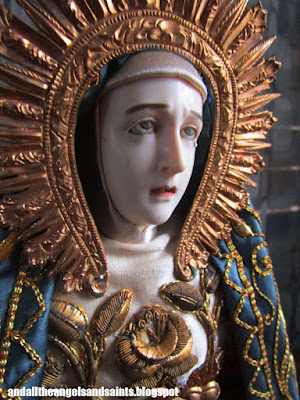
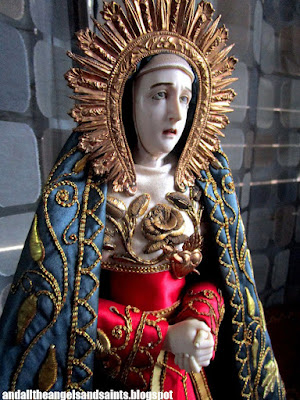
FINELY CARVED FACE REVEALS HER GRIEF

SALVAGED EMBROIDERY ON HER VESTMENT

 So I left the Dolorosa head with Dr. Lopez, not even bothering to ask for a timeline, as I don’t have one too. But two weeks later, he was on the phone again, sharing me about his excitement of finding a a pair of ivory hands—clasped hands—perfectly fitting the size of my Dolorosa. I can’t ask for better news! 

DETAIL OF THE FLORAL EMBROIDERY

BACK VIEW OF THE CAPE

With my full trust in Dr. Lopez, I just left him to his own devices—although he would contact me once in a while to confer about my personal choices—do I like her in pure black or maroon and blue? Do I prefer a floral peaña? He suggested to do away with the wig as she will be wearing a wimple, anyway. And he also recommended satin fabrics. 
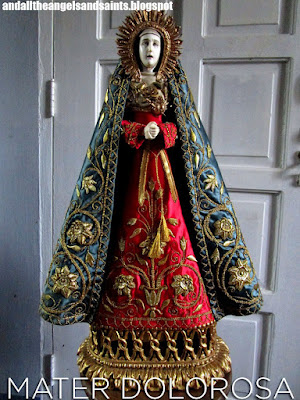
THE COMPLETED IMAGE IS 22 INCHES TALL

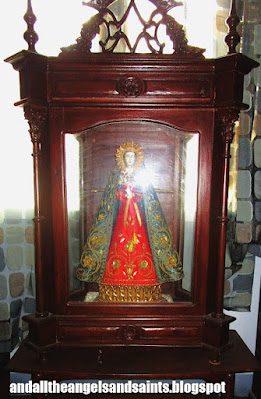
MATER DOLOROSA, IN HER URNA

While Dr. Lopez was restoring and completing the Dolorosa, I was also briefing a local carver for a customized urna in which to house my Dolorosa. Based on the completed height of the image (about 22 inches tall), I commissioned a Betis artisan to copy a wooden urna and its design, I found in an online antique site. He had to do it twice—because the first one he did was box shaped; I wanted the front to have 3 panels of glass, which will make it trapezoidal.


MATER DOLOROSA, IN HER URNA.

After three months, the antique Dolorosa head had a bastidor body, jointed arms, fully embroidered vestments, and a peana with  calado design. It was now a complete image, standing 22 inches tall, beautifully dressed on her gilded base. Inside her carved urna, the Dolorosa reposes, still sad but stunning. Only her new caretaker is sorrowful no more.

Wednesday, December 15, 2021

347. SAN ISIDRO AND HIS MILK BOX URNA

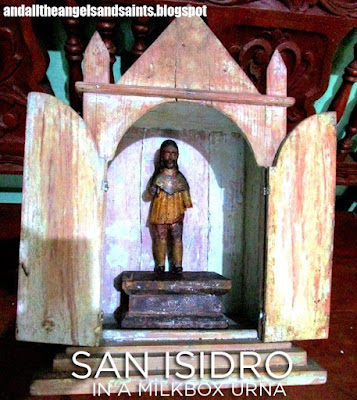
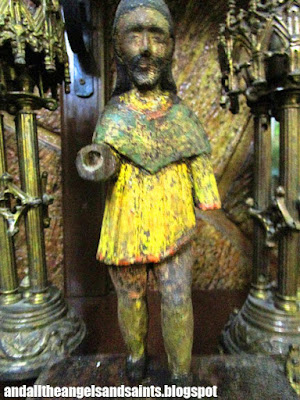
One of the most quaint folk art pieces I acquired just has to be this tiny San Isidro Labrador from Bohol, that was matched with a hand-made wooden urna, fashioned from an old wooden milk crate.

SAN ISIDRO LABRADOR BOHOL SANTO, 

The century-old San Isidro—a shade over 5 inches, excluding the base—is a typical Bohol piece with some of its brilliant polychromy still intact, all iconographically correct. He wears a green cape over a yellow tunic, with his boots on. He has missing hands, which once held a spade. 

The santo stands a mere 5+ inches tall

Despite the small rectangular base, there is a space once occupied by an angel plowing with a cow. The figure of the kneeling landlord is an optional element of the tableau, and he was left out in this representation, understandably because of the small dimension of the piece. 

Ordinarily, Bohol pieces were enshrined in folk urnas of the same qualities as the santo---small, brightly polychromed wooden altars embellished with relief carvings, raised by stair-shaped bases. This San Isidro, however, was found being displayed in an antique shop in a simple wooden urna, which stylistically does not match the Bohol style, but fits the santo’s size perfectly.

Wooden urna, handcrafted from milk crate

The small urna was ingeniously handcrafted from a milk crate—and the brand name can be found at the bottom of the urna to hide it—“Milkmaid Brand, Sweetened Condensed Milk". 

Milkmaid was an imported milk product, and it was first launched in the Philippines in the 1920s. By the 1930s, it was a successful brand, popularly known as “Marca Señorita”, because of the milkmaid brand character. 

Old Milkmaid ad, 1929

It was heavily advertised and promoted, and in 1929, Milkmaid even sponsored the search for the healthiest and cutest babies of the Philippines.

The urna itself, though simple in its creation, has many charming details. The “pediment’ is flanked by two “fence peg” spires. The double doors are hinged with wires, which were also used to make the latch. The boxy structure was attached to a 3-step stair base. 


 Its coating of white gesso or paint are still visible on the surface. Similar urnas made from commercial wooden crates were usually embellished with painted designs to make up for their plainness, but this example has no traces of color that I can see. In any case, San Isidro seems to be happy in his simple abode—after all, as a humble farmer-saint, he is used to a much harsher environment!

Wednesday, October 10, 2018

327. THE ALTAR SANTOS OF SAN GUILLERMO CHURCH, Bacolor, Pampanga


The venerable San Guillermo Church, in the former capital of the Philippines, Bacolor, is a beautiful legacy of the Agustinos who built the church in 1576 on land donated by Don Guillermo Manabat, town founder. Completely destroyed by an earthquake, it was rebuilt in 1897 by Fray Manuel Diaz.

SAN GUILLERMO CHURCH,
wikimedia commons
The gilded retablo mayor, and the side retablos are intact—despite being half-buried in the lahar inundation of 1995 triggered by the Pinatubo eruption. They are profusely carved with baroque and rococo designs, and the richness of the details are better seen now that they have been beautifully restored. Inside the nichos are various antique  Augustinian santos from the colonial period. These, too, have been restored, repainted, and regilded under the supervision of the late Thom Joven, Pampanga’s most eminent ecclesiastical artist.

Now a tourist attraction, the San Guillermo Church continues to be a place of worship, a witness to the history and old glory of Bacolor, acclaimed for its arts and artists, hence the sobriquet—“Atenas ning Pampanga”-- the Athens of Greece.


Thursday, December 22, 2016

278. ALTARS OF THE NATIVITY

ALTAR OF THE NATIVITY. Mabalacat Church. Photo by Dr. R. Feliciano

The whole Christendom celebrates the birth of Jesus with great joy and mirth, but nowhere is it celebrated with more pageantry than in the Philippines. Churches and communities prepare by staging the Nativity Scene before the altar, to be reflected on during the Simbang Gabi.

BACOLOR BELEN, dressed by the late Thom Joven.Photo: T. Joven

Some churches with side altars already containing belen images need only to clean and spruce up the figures. But those churches without lifesize images of San Jose, Sta. Maria and Nino Jesus, have to source them out from families, or make do with what they have--converting generic looking saints into the Holy Family.

A RECONSTITUTED BELEN, Staged using separate individual santos.
 Photo by Rainier Sexon

But that is not the only challenge; there is the stable that needs to be built,  plus the manger and all the "props" that would make the Nativity scene looks more authentic--animal figures, mostly sheep, goat, cattle.

SMALL ESCAYOLA CHURCH BELEN. Photo by Lulot Ruiz.

The Nativity scene takes inspiration from the accounts of the birth of Jesus in the gospels of Matthew and Luke. The narrative describes an angel announcing Jesus' birth to a group of shepherds who then went on to visit the humble site, where they found the Child Jesus in a manger. Matthew's story includes the presence of the 3 wise men who were guided by the star to the stable, hence, these characters are likewise included in the tableau. 

NATIVITY SCENE with the 3 Magis, Photo by Leo Cloma

St. Francis of Assisi is credited with making the first Nativity Scene in 1223 to shift emphasis to Christ rather than gift-giving. In the Philippines, those in charge of staging the Belen take great efforts to make the tableau truly artistic. All sorts of materials go into the making of the stable--cut bamboo, old house parts, sawali, palm leaves, outlumber posts, old capiz windows.

BARASOAIN CHURCH BELEN, Photo by Leo Cloma

The scenography is fashioned from crumple brown paper then painted to simulate stones and boulders, then further decorated with pieces of pottery, flowers and greeneries, The floor is strewn with hay and then the stable is anachronistically festooned with lanterns and Christmas lights

ESCAYOLA BELEN. Photo by Leo Cloma

Elaborate belens also include an animated Star of Bethlehem--a lit lantern that can swing into place through the use of pulleys--to the center of the tableau, which is the highlight of the Midnight Mass. After the Mass, the Baby Jesus is taken out of the manger for the traditional kissing of its feet or cheeks--the Pahalik.


BELEN IN AN ILOCOS CHURCH, Dressed in Filipiana. Photo: Leo Cloma

Distinctive nativity scenes and traditions have been created around the world, but they have not escaped controversy---mostly issues on propriety (characters are sometimes made to wear outlandish costumes), extravagance, and accuracy (like the presence of non-Biblical characters).

MABALACAT CHURCH BELEN, Photo by Leo Cloma

But whether we like it or not, the Belen is here to stay. Like the Christnas tree, parol, noche buena and aguinaldo, Christmas is not Christmas without the traditional nativity scene to inspire awe and devotion of Christ--not just during the holidays, but for the whole year through!

MERRY CHRISTMAS, EVERYONE!