Showing posts with label Francisco Vecin. Show all posts

Friday, April 7, 2023

355. A Penitent Redeemed: STA. MARIA MAGDALENA

STA, MARIA MAGDALENA, RESTORED 2005

The circumstance of how this beautiful Sta. Maria Magdalena image was delivered to me was one for the books. I had been working with a Bulacan dealer for sometime, when he called to say that there was an antique santa in the market available, but I had to decide fast whether to get it or not. To make my decision faster, he offered to bring it to me in Makati, where I lived and worked.

MAGDALENA, in its original state, when acquired

Intrigued, I told him to pass by for me by lunchtime, hitch with him in his van, go home together to my nearby studio where I can better check out the santa. Some 2 hours later, he was on his cellphone to tell me of his arrival at my office building. I hastily rushed down the elevator from my 23rd floor office, got out of the main door---and there, seated at the groundfloor Starbucks Café was my dealer, next to an old, naked, wigless santa, and which has started to attract the stares of the café patrons, building tenants, businessmen, visitors, and passersby! In a loud voice, he said: “Eto na ang Magdalena mo, boss…what do you think?”

MAGDALENA, with a wan and white complexion.

“I think you need to put back the santa in your van NOW!”, I  muttered under my breath, while turning red with embarrassment. Just as a crowd had begun to gather around the santa, the dealer grabbed the wooden figure, stowed it in the van, and sped away with me to my place, just 5 minutes away.

MAGDALENA'S HEAD, before and after re-encarnacion

I’ve never been so stressed at the thought of the commotion we caused at that café. But all that dissipated when, in the privacy of the closed van, I took a closer look at the penitent saint.

STA. MARIA MAGDALENA, under restoration

Even in its state—paint gone pale and peeling, a vertical crack running down the body, shaky base, plus the usual dings, nicks and scratches—this Sta. Magdalena was a real beauty, with a long face face slightly frowning in restrained grief. Her mouth was slightly open, curled downward in sorrow, showing teeth. The slightly long neck featured 3 shallowly-carved neck folds that almost looked like a 3-strand necklace.

STA. MAGDALENA, under restoration

On the other hand, her ghostly white hands and slender fingers, and her bare feet were well-carved and defined. There was the slightest hint of plumpness in her body, characteristic of old female santas. This processional image was not exactly tall, only 52 inches, including the base.

REPAINTING THE PENITENT SAINT

The dealer and I struck a deal, wrote him a check, and Sta. Maria Magdalena was mine to keep. But it didn’t stay long with me either, for just a scant week after, I delivered the Magdalena to the atelier of Mr. Francisco “Kiko” Vecin, Makati’s eminent collector and santo restorer. His workshop was just across my street, near the Makati City Hall, and the schedule for its restoration was drawn up in no time at all.

THE SAINT AND HER BLONDE-BROWN LONG LOCKS

As the santa was complete, I thought restoring it would be a breeze. Other than the crack on the body,  no major repairs were really necessary. What took long was the repainting of the santa that took some 3 months to finish. A friend of mine suggested that I stick to the original paleface kind of encarna, commonly seen in old Semana Santa images. I opted for a more natural complexion that is more Filipino, rather than the fair, pinkish Caucasian type.

STA. MAGDALENA, CROWNED

Mang Kiko commissioned veteran encarnador Eddie Mabaquiao Sr. to handle the repainting, which took forever to do. But the wait was all worth it, as the santa’s expression came real and alive with his brush. The magnifical restoration of Sta. Maria Magdalena was completed in late 2005.

VESTMENT BY LOPEZ ATELIER

Even long before it was finished, a member of our local pastoral council had saved a place for me 2006 Holy Week procession. The reservation, however, was not for a Magdalena, as the town already had one—but for broom-wielding Sta. Maria Jacobe. The idea was to transform this Magdalena into a Jacobe, by having her hold a broom—which was very much possible with the grasping position of her fingers.

OLD EMBROIDERY RECOVERED AND
USED FOR MAGDALENA'S VETSMENT

This threw me into panic, as I had not really planned on having vestments and metal accessories made just yet. Dr. Raffy Lopez came to the rescue by quickly making a light blue half-cape and a matching light fuschia tunic decorated with old gold embroidery. I designed a pukpok broom handle executed in plated brass by Jeric Canlas, inserted with tambo reeds. A new brass crown that I had been keeping went to the head of the santa, which looked obviously bigger. With that the primera salida of this Sta. Maria Magdalena finally took place in 2006—in the guise of  Sta. Maria Jacobe! I soon had ambivalent feelings about that practice.

PRIMERA SALIDA, as Sta, Maria Jacobe, 2006

That was the first and last time this antique santa came out, eventually replaced by my in-law family’s antique Jacobe. But when a second Magdalena I owned suffered a similar fate, I have vowed not to allow these “conversions” to happen again.

In one corner of our covered porch today stands a glass case, in which the cloth-covered antique image of Sta. Maria Magdalena reposes. It has not been seen since 2006, and I intend to keep it that way. It is very much in keeping with a penitent saint who spent part of her life as a hermit in a cave on a desert—away from prying eyes. Her life continues to give us an example of how no person is beyond the saving grace of God, so—by the same token, no broken santo  should be left unsaved too.

STA. MARIA MAGDALENA, Castro Family


Tuesday, November 23, 2021

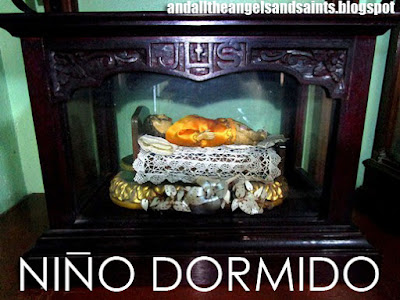
344. A NIÑO DORMIDO FROM BOHOL FINDS A NEW HOME

THE SLEEPING CHRIST CHILD, personal collection

The image of the sleeping Jesus in sacred art is drawn from His birth in Bethlehem, where He was born in a manger and wrapped in swaddling clothes. It was St. Francis of Assisi, of course, who perpetualized that depiction when he put up a manger in a church.

NINO DORMIDO, from the Francisco Vecin Collection

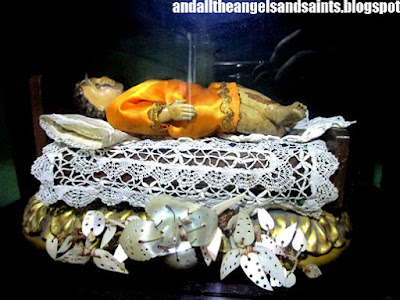
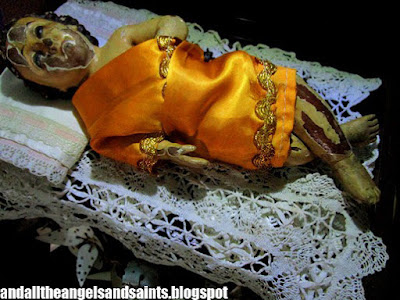
NINO DORMIDO, on a repurposed doll's toy bed.

The sleeping Christ Child has been the subject of many artists through the centuries, often represented naked, consistently shown with eyes closed or half-closed, with charming poses—tiny finger in His mouth or pointing to His head,  a Hand raised in blessing,  cheek resting on a palm, with straight, bent and crossed legs. In painting and sculpture art, the sleeping baby is shown in different settings---lying on a manger, on a pastoral landscape, on a flaming heart, or adored by the Blessed Mother,

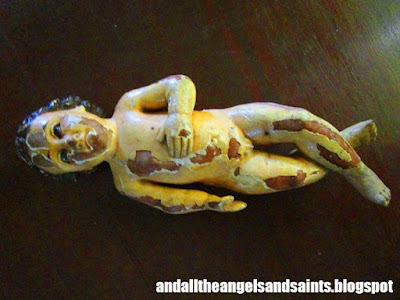
NINO DORMIDO, note the unusual crossed legs.

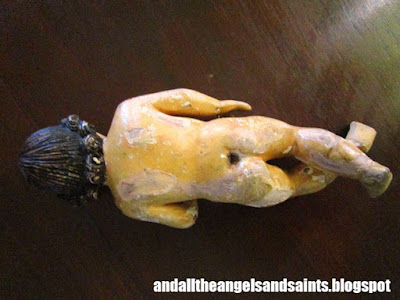
The hole on the back was where a stick was placed to
support the Nino Dormido while painting.

The most prized sleeping baby Jesus are made of ivory, known as “Niño Dormido”,  which today, are so precious, that they command astronomical prices in auctions, that is, if you can find one. Generally, Niño Dormidos of ivory, come in small sizes for home devotion—with average sizes ranging from 6 to 8 inches. The images are commonly displayed nude to show off the ivory, but many are dressed in gold-embroidered raiments, complete with gold or silver caps, belts and sandals studded with gems.

NINO DORMIDO, Provenance: Bohol

As equally appealing are the locally-carved wooden Niño Dormidos. Though not as expensive as ivories, these antique wooden figures of the Christ Child are much rarer to find, as the traditional Sto. Niño had a more popular following.

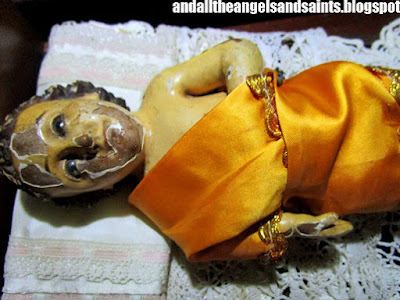
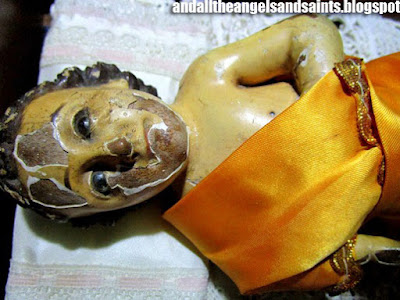
The Nino Dormido has its original (but flaking) encarna

This wooden Niño Dormido is one such fine example of religious folk art. It comes from the Francisco Vecin Collection, who owns many of these miniature wooden examples. It is carved from heavy wood, just a little over 7 inches, and is Bohol-made, with its original (now flaking) encarna. I acquired this from him sometime in 2006, when I was still working in Makati, and I was pleasantly surprised that Mr. Vecin let it go.

A CLOSE UP VIEW, reveals open glass eyes.

This Niño Dormido is outstanding in every respect, classically carved with baby features, curly locks, and a plumpish body. Though small, his thick droopy eyelids are outfitted with glass eyes, making him look more awake than sleepy.  This Dormido is one of those rarer versions that show the Baby with crossed legs, as if to foreshadow his Crucifixion.

I decided to keep this Niño Dormido in its “as found” condition, and tried to look for an appropriate bed for it. For years, it laid on a vintage 4-poster toy wooden bed that was too short for him, and encased in an urna that I had asked a furniture shop to make, patterned after an old one.

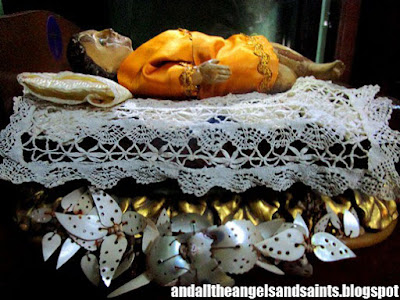
The Nino sleeps on a piece of antique European lace,

It was only lately that I found another vintage toy bed of the right size ( but with more modern features, alas!). I covered the bed up up with antique laces, and made a flat pillow, and propped it on a new peaña that I no longer use—so that will do for the moment. The final touch is the addition of a spray of wired “lagang” flowers, hoping that it will add to the antique look that I wanted to recreate.

The Sleeping Christ Child is represented in many art forms.

It may not be authentic, but at least this Niño Dormido from Bohol has a new and better home. In the future, I will probably have a new “resting place” made, although I have not figured out if it’s going to be a daybed, a manger, a 4-poster (definitely, not a sofa!).

The Nino's bed rests on a vintage gilded peana,

And what do you think of the idea of having a silver cap and a belt? Well, let me see.. I will sleep over it!.

Friday, December 27, 2013

178. NATIVITY NIÑOS

 WHAT CHILD IS THIS? A large, 15 inch antique Nativity Nino from Guatemala, with a short haircut (Personal Collection).

Christmas is a time not just for bringing out Nativity sets but also for heirloom figures of the reclining Infant Jesus, to be put on display at home--wrapped in swaddling clothes, and placed in a makeshift manger, often under the Christmas tree. In the early hours of Christmas, just after the Christmas Eve mass, the carved figure of the Child Jesus (Bambino, Niño de la Navidad) is taken out from the belen, to be kissed by the faithful as an act of reverence on the occasion of His birth. A spread of antique and vintage "Nativity Ninos" are on this spread .

ON MARY'S LAP IS SLEEPING. A contemporary Bambino, carved in wood from the Vecin Workshop, just 6 inches long. (Francisco Vecin Collection).

WHOM ANGELS GREET WITH ANTHEMS SWEET. A century-old, anatomically-correct Nino, with pronounced Chinese features. He wears a silver diadem and holds an or, now lost. One finger is stuck in his mouth.

WHILE SHEPHERDS WATCH ARE KEEPING. A 14 inch sleeping wooden Nino, with clenched fists, of vintage make. (Francisco Vecin Collection)

THIS, THIS IS CHRIST THE KING. An ancient Nino from Bohol, carved from heavy wood, with its original encarna, now peeling with age. It is just 8 inches long. Its legs are crossed. (Personal Collection)

WHOM SHEPHERDS GUARD. An antique Nino of lightwood, with feet repaired, 7 inches long (Personal Collection).

AND ANGELS SING.An old, lifelike carving of the Child Jesus with full hair and defined musculature. 8 inches long. (Francisco Vecin Collection)

HASTE, HASTE TO BRING HIM LAUD. A miniature Bambino, 6 inches long, of contemporary make, from the Vecin Workshop. (Francisco Vecin Collection)

THE BABE. An antique figure of the sleeping Jesus, with a stocky body and crossed legs. A superb folk example just 6 inches in length. (Francisco Vecin Collection)

THE SON OF MARY. An old Belen figure of the Child Jesus, put on display during the holidays at Our Lady of Grace Church, Mabalacat City. Devotees kiss this image after the Midnight Mass.

Wednesday, September 18, 2013

164. For Pete's Sake: THE SAVING OF SAN PEDRO APOSTOL


 Sometime in 2006, my Makati santero, Mr. Francisco “Kiko” Vecin called me up to ask if I was interested in acquiring a vintage San Pedro Apostol that someone had brought to his shop. Carvers, collectors, dealers and sellers often bring all sorts of santo stuff to his Makati talyer—most to fix, others to just dispose, as Mang Kiko, too, was a formidable collector of antique santos. 


At that time, I had already taken an interest in Holy Week santos, so after work, I decided to drop by his shop to see the santo. I was a bit disappointed that San Pedro was just 44 inches high, its body a bit stiff and crude. The arms were not even articulated. It came with a carved rooster—St. Peter’s attribute -- that had incorrect proportions—it was squat and stout, and stood on a solomonic-like pole, attached to a plain, rectangular base. I didn’t even think that the santo was a perfect match for such a poorly-carved, featureless rooster.


When I inspected the head, the name of the carver, which I had now forgotten, was inscribed on the neck. Mang Kiko told me that the carver made the piece in the early 70s, which, to me, was too recent as I favor only antique pieces. The thing that was going for this particular image was its high degree of craftsmanship; its carved details, following classical tradition, were outstanding. San Pedro’s facial expression was uncannily hyper-realistic. I made an offer, which Mang Kiko communicated to the seller. The moment I left his shop, however, I was becoming lukewarm about San Pedro.


Would I also deny this santo, who, in turn, denied Christ not once, but three times in His time of Passion? But too late-- the next day, Mang Kiko called to say that the Seller had agreed to my offer. I mustered enough gumption to ask Mang Kiko, if he could renegotiate with the seller to lower further his price, given the santo’s less-than-desirable size, age and condition. I could sense Mang Kiko’s growing frustration—but, bless him, he made one more attempt to talk to the seller with my second, lower offer.

To my amazement, the Seller, who must have been in dire financial fix, agreed! So that’s how I came to bring home San Pedro where it languished in a room in my house for months, then years. I saw no need to have it restored as our town already had a Holy Week San Pedro.

Over three years later, I was at the place of Pampanga's best-known master restorer, Tom Joven, discussing a project when the subject of this particular San Pedro came up. Apparently, Tom had seen a photo of it posted online and thought it was good enough to be completely restored. I took up his offer and brought San Pedro to him, with no particular timetable in mind.

My only requirement was that the santo’s arm be made articulated and that the rooster be separated from the santo. I also asked that the column on where the rooster rested be changed into a pillar.


 I happened to find a silver-plated rooster on ebay which was sized better to match San Pedro, so I asked Tom to replace the image’s original wooden rooster with this metal figurine.

San Pedro was left with Tom at around June of 2008; I was hoping it would be finished in time for my January 2009 birthday, but when that day came and went, I just completely forgot about it.

So many things have happened since then—I went away on a month-long trip, my mother got sick and then passed away. I was not able to track the progress of the work, as I had more pressing things in mind.


Eventually, I received a text from Tom: San Pedro is done, at last. My first glimpses of the apostle-saint was through these photos sent on facebook.


 I was completely stunned by the transformation. The swarthy, gritty face of San Pedro has been replaced by an encarna done in the Italian religious painting tradition, marked by a pale complexion and highlighted with a pinkish blush. The carved hair and beard, once dark, were lightened.


The arms have also been articulated; the rooster replaced by my metal figurine on a new, more streamlined, yet graceful column.


Metal accessories have also been prepared by Tom—from the small beaten silver-plated halo and two keys—iconographic attrbutes of the saint, one key to open the gates of heaven, and the other, for the gates of hell.


 I didn’t have vestments made yet for San Pedro, but I scrounged around and borrowed pieces here and there from my other santos, so that I could visualize how he would look like, robed and dressed.


The results are in the next few pictures:


The santo that I nearly passed up turned out to be quite a handsome work of sacred art, ready to inspire devotion to those who look up to this apostle-saint who eventually became our first Pope.


I am glad I had the santo restored, even if it felt like it took forever. Like the selection of a new Pope, it was worth the wait. Viva il Papa! Viva Apung Iru!