Showing posts with label bone. Show all posts

Sunday, May 12, 2024

359. SAN ISIDRO LABRADOR: A Bone to Pick, A Santo to Fix


Some 15 years ago, I was driving in the direction of Lubao when I found a row of stores along the road, and one instantly caught my eye: “PRINCE SECOND HAND-LUMBER and Antique Shop”.  Of course, I had to stop. When I came in, I was met by a young couple, and their little boy, who was carrying an old silver-plated monstrance. I asked if the monstrance was for sale, and the father said, it is, but right now the boy wouldn’t let it go, as he was “playing prusisyon”, walking around the room, holding the monstrance, pretending to be a priest in a procession.

The father said to give him a few minutes while he talk with his son—Prince--who, at that point was adamantly holding tight to the monstrance and would not let it go In the meantime, he said, please feel free to check the other stuff in his warehouse.

Thank God, the big piles of lumber from demolished old houses were separated from the “antique” section of his shop, that included vintage furniture, aparadors, salvaged architectural details and iron grills. I noticed a few religious items there: an escayola Buenviaje in its own urna, a framed communion certificate.

There must be more where they come from, I thought to myself. And sure enough, when I opened a comoda, an inner shelf revealed something extraordinary—a naked santo, with a thin manikin body, outfitted with a solid bone head and hands! 

One look, and I saw a vision of San Isidro Labrador holding a farm implement. The shop owner entered the room at this point, ending my reverie. “Oh, you found the old doll”, he said. I corrected him by saying that the figure is, by all indications, a santo. “Ah, I didn't know it's a santo! That means it will be a little bit more expensive then”, he continued. Me and my big mouth.

When he mentioned the price, well, it wasn’t bad as I imagined it to be! In fact, I could pay for it now! So that’s how I got the bone-faced San Isidro home.

The next work week, straight to the taller of Dr. Raffy Lopez the santo went. The 10 inch high santo, he said, was finished well, considering it was bone, a medium difficult to carve as it is brittle, breaking easily. This does not allow the carver much leeway to carve in finer details, which explains why bone santos do not have well-delineated faces and hands, looking stiffer, more folksy than their ivory counterparts. But this did not diminish at all the charming quality of this piece.

There was a possibility too that the santo was originally a San Jose, as it was found without identifying elements associated with San Isidro, like an ox, kneeling landlord, a plowing angel. But Dr. Lopez was confident he could recreate San Isidro’s likeness using this bone figure, even without those iconographic parts.

The first thing he need to do was to look for a proper base for it, and he found one—a folksy painted mortar base with remnants of green and dull yellow colors. Once he had that, he started his work on the bone santo, a process that took a month.


When, finally, he revealed SAN ISIDRO LABRADOR, the results were dramatic as seen from these photos. Only the lips needed to be defined, as the bone head still had its original glass eyes and painted beard. A new jusi wig and an old halo from the doctor’s collection topped the head of the santo.


The deep yellow satin cape and the knee-length drab green tunic complemented the colors of the base, which raised the santo’s height to about 16 inches tall. The gold embroidery was limited to the hems of the cape and the lower part of the tunic, fitting for a male saint.


The restores San Isidro sports knee high, leather boots, fashioned from soft imitation leather scraps. His left hand clutches a new, long-handled shover made of wood and tin. As the santo was tall and narrow. I had a customized glass case made for him, similar to Japan-made glass doll cases.

I only have 5 bone santos in my collection, and this restored San Isidro is one of the more special ones because of the story of its discovery, finding it by mere happenstance. 

Oh, and the silver monstrance? I got that too, the next day, pried off from the hands of Prince by his father, while he lay sleeping. I wonder what happened when he woke up. He should be about 18 years old now—is he pursuing a priestly vocation? I wouldn’t be surprised if he did.

Friday, December 3, 2021

346. FROM JOHN DOE TO ST. JOHN: An Antique Bone Santo Transformation Story

A BONE TO PICK. A nameless santo found in Ermita

I only remember hazy details of how I got this santo with head and hands made of bone. What I can only recall was that, I got this from one of the dealers in Ermita perhaps in the 1990s, when I started becoming drawn to ivories which I could not afford. 


Nobody knew who he was, as it was without clothes, metal accessories, wig and base that may have otherwise given us clues to his identity. Because it was affordably priced, I purchased this nameless santo and became a sort of a stand-in piece, as in my mind, it was the next best thing to owning a more valuable ivory. 


The antique male santo has quite a young, but expression-less face. It looks like it had been carved from cattle bone—square-jawed, with pronounced cheeks, but a finely detailed nose. There is a certain flatness to the carving, perhaps because bone tends to be brittle. 


Even with his painted features, he look so stoic, with lips pursed. He stares with bulging glass eyes and a blank gaze, The fingers are unremarkable, carved almost “tinidor-style”, with open palms. The bone head (a half-mask, actually) and hands are assembled on a wooden body with the usual jointed arms.

The closest santo that vaguely fills this male santo type is San Juan, the young apostle and apostle.  His most common iconography shows him holding a quill and a book—but this santo’s hands just jut straight out from his wooden arms. 

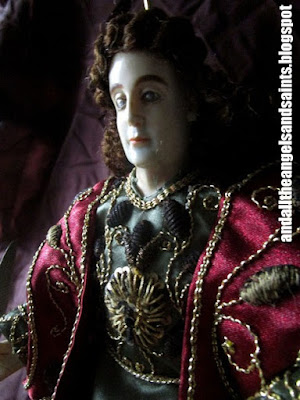
And so I decided  San Juan Evangelista he shall be.  Creating the look was my favorite ivory restorer, Dr. Raffy Lopez, who salvaged old embroidery from his “baul” of santo supplies, and incorporated them with new embroidery he designed on green and maroon satin. He also provided his “peaña” or gilded base, plus his wig. 

I contributed the paragua-style halo (which is a bit big!), and pukpok artisan gave me a new, silver-plated quill pen, which looked more like a sword than a feather quill. There was no way of having the right hand with an open palm hold it, so I just secured the pen with putty.  

FROM JOHN DOE TO ST. JOHN

After more than 25 years, still have this antique bone santo, even if, year after year, I keep telling myself to dispose it. The reason probably why I am hesitant to let it go is because of the interesting back story attached to the piece---of how a John Doe santo became a John the Evangelist santo!

Thursday, May 3, 2018

312. LA PIETA IN WOOD AND BONE: Grief and Gladness at the Philtrade Antique Pavilion


In the late 1980s, Philtrade in Pasay became one of the major antique centers in Manila due to its cluster of pavilions that were earlier envisioned to be venues of international expositions and trade shows. I was fortunate to catch the tail-end of the glorious antique collecting era, when shops were still relatively full of real, antique stuff.


Prices were already steep by then, and I would go to these exhibits simply to feast my eyes on the beautiful santos, and hope to find one that would fit my modest  Makati worker’s budget. Not only were the popular antique shops of Mabini represented at the Philtrade pavilion, but there were also smaller, independent antique sellers who rented out spaces to sell their wares.


It was in one such show that I found one of my favorite santo ensemble. I had actually put a down payment on an  ivory Virgin from Sieva Antiques, but when I returned for it the next day, it had been sold to another customer. The dealer thought I would not come back for the it-- a conclusion he arrived at, maybe because I was dressed in tattered shorts and T-shirt.


I was so livid at this deal gone awry, that when I came back to Philtrade to collect my refund, I decided to linger and check out the smaller, less populated stalls of the pavilion to forget my disappointment. It was in one of these holes-in-wall (I could not even remember the name of the shop) that I chanced upon a remarkable antique ensemble—an unusual La Pieta which depicts Mar and Jesus after the crucifixion. The tableau consists of the seated Sorrowful Virgin with a head and hands of bone, cradling on her lap a small, naively-carved wooden 5 in. Christ.


When found, they were without clothes, wigs and accessories, and the image of the Virgin seated on a plain, crumbling, wooden stump. They were obviously of lesser quality than the previously mentioned ivory Virgin, but how many in their collecting lifetime, has seen a La Pieta in wood and bone?


It was a no-brainer: I had to have this La Pieta. The dealer wanted PhP 7,500 for it, but I turned on my full negotiating power until I whittled the price tag down to Php 6,000. I  gave him the amount—which was basically the 5K refund plus the remaining 1K from my wallet—and La Pieta was mine.


It was only many years after—after having been acquainted with Dr. Raffy Lopez---that I had this bone and wood La Pieta restored at his atelier. The Sorrowful Virgin  had her features repainted, and one eye restored. Wigs and metal accessories were ordered, while new embroidered vestments were worked on. Finally, the woodworm-damaged base was replaced. The tableau was then encased in a glass dome—which actually was a glass globe of a hanging gas lamp.


In our old ancestral home, on a small circular table in the ante-sala, my antique La Pieta sits. I never thought that my disappointment  over a santo that got away would be quickly assuaged by this extraordinary find at a humble antique stall in Philtrade, turning my feelings of dismay to instant delight! Somebody must have pities me so much, he gave me, instead—La Pieta!

Friday, May 23, 2014

196. ST. LOUIS Of FRANCE: The King Who Would Be Saint

ST. LOUIS, KING & CONFESSOR. A small figure of the King of France, rendered in bone, stands 6 inches high, on a wooden base. Ca. 1900s. Personal Collection.


I graduated from Saint Louis University in Baguio City, Northern Philippines, and in the whole time I was there, I really never bothered to find out about the saint after whom our school was named. There was a confusion of some sorts as to who the real patron was; our university exam booklets for example, has the profile of San Luis Gonzaga (St. Aloysius Gonzaga) of Italy illustrated on the cover. Then, there is the university seal (Sword and Shield) which is described as having the "stylized lily associated with St. Aloysius Gonzaga, the patron of the school".


The school, however, was founded by CICM (Congregatio Immaculati Cordis Mariae) missionaries from Belgium, so they could not have chosen a Italian saint for its patron. It made more sense to name the school after a French saint--King Louis of France. He was born in 1214, in Poissy, France to parents Louis VIII, and Blanche, daughter of Alfonso VIII of Castille.


He was barely 12 when he lost his father, so his mother assumed the regentship and took over in raising her Louis, instilling in him the virtue of holiness in his thought and deeds. At 20, he married Margaret, the daughter of Raymond Berenger, Count of Provence, with whom he had 11 children. Two years later, he took over the reins of the government of France.


He headed several crusaded, but in 1238, he was captured by Mohammedans but was able to return to France. He attempted another crusade in the East in 1267, but this time, he would never return. In 1270, he caught a sickness in Tunis and died after receiving the last sacraments.


In his reign, Louis had a vision to make France as the most eminent of all Catholic nations in Europe. He built religious edifices like the famous monsatery of Royamount and the convent of Maubuisson. He was responsible for the purchase of the Holy Crown of Thorns relics from the Eastern emperor at Constantinople. He heard Masses twice a day, and was surrounded with priests during his travels. He outlawed usury, forbade private wars between his feudal vassals and was renowned for charity.


This representation of him--an ebay find--was carved from a singular piece of narrow bone that resembles ivory. The slim figure is carved in the round and shows the crowned royalty holding a book. Other attributes include a sword and a shield representing his authority. He is often attired in royal robes with golden fleur-de-lis (the "stylized lily" described in our university's crest). The carving is signed with the name of the maker, "Louis Plesey", a namesake of the saint.


St. Louis is the patron saint of barbers and grooms, and is invoked against the death of children. The royal saint's feast day falls on Augut 25.