Showing posts with label Laguna. Show all posts

Monday, March 13, 2017

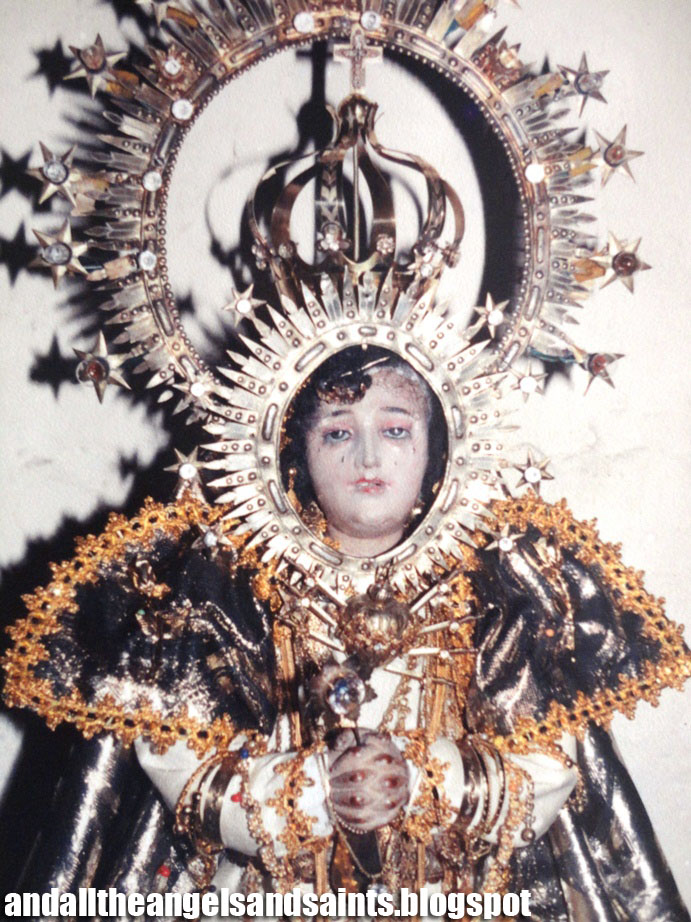
287. VIRGEN DOLORES DE TURUMBA of Pakil, Laguna

THE MIRACULOUS VIRGIN OF PAKIL.
In the year 1640, several fishermen saw a statue floating on the waters of Laguna de Bay. Seeing that it resembled the statue of of the Blessed Virgin, they tries to bring it to Pakil, but they could not do so because it was too heavy.


Some of the old folks of the town gathered on the shore were about to begin their traditional devotions to Our Lady. As they sang the words of the “Turumba” (a song and dance tribute that often results in people “trembling and falling down in great joy) , the image became light enough to be carried in procession. The people enshrined the image in the church and called it ‘Our Lady of Turumba’ .


Every year, on the third day after Easter, the faithful honor her with seven consecutive novenas. The image stands 85 cms high,with its face and hands made of ivory. It depicts Our Lady of Sorrows, showing her heart pierced with seven swords and a golden handkerchief in her hand. She is clothed in rich silk material with rhinestones, and she wears a blue mantle, a gold bracelet and a golden crown.

PHOTOS COURTESY of: Dr. Raymund Feliciano

Article reprinted from  “2nd Marian Congress Philippines Souvenir Program, 1954.
NOTE:  The image is actually made of wood, not ivory head and hands, as the original article reported.

Friday, September 2, 2016

265. SANTOS FROM THE VILLA ESCUDERO MUSEUM


The Villa Escudero Museum in Laguna houses some of the most beautiful and valuable collection of antique santos of inconceivable styles in the Philippines. Built like an old church, the museum is part of the 800 hectare sugar plantation estate founded in 1872 by Don Plácido Escudero and his wife Doña Claudia Marasigan. Son Arsenio shifted to coconut farming in the 1900s and began a burgeoning coconut industry in the area.


 Together with his wife, Dona Rosario Adap, the successful agro-industrialist built their hacienda residence in 1929 on their expansive estate that straddles three towns in in two provinces: San Pablo City (Laguna), Tiaong, and Dolores (Quezon).


 In 1981, their children opened the estate to the public and evolved it into a resort that has become a favorite tourist attraction for both local and domestic tourists. It has since become a showcase of Philippine culture and traditions in a charming rural setting, giving the visitor a unique hacienda life experience—from carabao rides, folksy entertainment to outdoor dining with the waters of Labasin Falls lapping at your feet.


 But Villa Escudero’s crown jewel is undoubtedly its museum that features the eclectic collection of Don Arsenio and Rosario amassed from their hobbies and from their travels here and around the world. The objects include a dizzying array of excavated and trade porcelain, tribal, domestic, wartime, and religious antiques and memorabilia.


 In 1987, the collections found a permanent home in the church of the hacienda that was constructed in the old Spanish colonial style. Antique colonial santos and the finest examples of ecclesiastical art are the centerpieces of the Villa Escudero Museum.


There are majestic carrozas of all shapes and sizes bearing processional saints of the Holy Week. These participate in Lenten processions held in San Pablo City annually. There are santos in wood and in ivory, some exhibited behind glass, and some, in reassembled antique church retablos salvaged from old churches.


 Don Conrado Escudero, an heir, has added more antique santos in wood and ivory and other sacred art pieces to the collection through the years. Santos can also be found in the Escudero private chapel where the departe members of Escudero families are interred, as well as inside the magnificent Escudero residence itself.


 A selection of the Villa Escudero santos are on this spread. Access to the Villa Escudero Museum is included with the entrance fee to this distinctive hacienda resort, the first of its kind in the Philippines.


Friday, February 20, 2015

215, Santo Stories: STO. CRISTO OF PAKIL

 SANTO CRISTO DE PAKIL. The ancient image of the Crucified Christ in the church of Pakil, as it appeared in the 1950s.

 In the Franciscan-founded town of Pakil, Laguna, one can find an ancient, life-size crucifix venerated at the altar near the church’s entrance. The present church itself, dedicated to San Pedro de Alcantara, dates to 1732, a masterpiece in stone marked with florid ornamentation.


 The Santo Cristo de Pakil is an object of deep veneration among residents, but is also popular among the devotees of the Virgen de Turumba. The legs and feet of the Santo Cristo have all but darkened with age, and the habit of kissing the feet and the anointing of the santo’s extremities with perfume has persisted.


 The origins of the crucified Christ in Pakil is shrouded in mystery. It was said that an old man sought refuge in the town, begging the cura to find sanctuary in the church. The kind priest allowed him in, and the old man requested that he be given some carpentry tools so he could do some work for the church, in return for the hospitality.


 When the old man did not emerge from the room after some time, the door was forced open—and the priest found him gone. But inside the room was a splendidly carved image of Christ crucified, wonderfully wrought in wood and capturing the agony of the Lord in his passion.


 The image – known as Santo Cristo de Pakil—was enshrined in a retablo menor and is used every Holy Week for the Good Friday rites. As the arms are articulated, the figure of the Christ can be brought down from His Cross to be transformed into a Santo Entierro.


 In this form, the image is processioned on the streets of Pakil, followed by a band of violinists, musicians, singers and hundreds of devotees.

Thursday, November 21, 2013

173. Santo Stories: STA. FILOMENA, Biñan's Incorruptible Saint

TWO FILOMENAS. Filomena Almarines (b. 1913- d. 1938), the incorruptible milagrosa, and the Sta. Filomena image enshrined in her tomb. The figure was donated by Filomena's childhood friend.

There is an image of Sta. Filomena (St. Philomena) enshrined in the tomb of a namesake from Biñan, Filomena Almarines. The two have nothing in common except a common name, but for the people of Laguna, their Filomena is also worthy of veneration as a saint.

 Filomena Almarines was born on 6 July 1913 in San Antonio, a barrio of Biñan, Laguna, the daughter of farmers. She was said to be a saintly young woman, prone to introspection. At age 25, she died on 13 August 1938, some say, of emotional stress. She was buried at the Biñan Municipal cemetery. 

When her own father died in 1947, Filomena’s tomb was opened with the intent of gathering her bones to give way to her father’s body. But great to everyone’s surprise when, upon opening her coffin, the workers found her body undecayed, her face as fresh as the day she was buried, and even her burial dress intact.


People immediately proclaimed her a saint, owing to her incorruptibility. Devotees trooped to her tomb, miracles were supposedly wrought (e.g. candles melted on her tomb to form the face of Jesus), and Filomena’s wonder-working powers were reported in American newspapers. Holy cards of “Sta. Filomena” were produced and sold as souvenirs to pilgrims from all over the Philippines who came to Laguna to visit the “milagrosa”.

A local cult quickly developed and persisted till the early 50s. A childhood friend of Filomena caused an image of Sta. Filomena to be carved, which was subsequently installed in her tomb.

Sta. Filomena’s own life story is clouded with mystery, starting with the discovery of the remains of a young girl in the catacombs of Priscilla in Rome, on 24 May 1802. The tomb bore the Latin inscription, “Filu mena”, translated as ‘daughter of light’.


Over the years, Filomena’s life story was pieced through the 1833 visions received by Mother Maria Luisa de Gesu, a Dominican tertiary. Filomena came from a noble family; her father had been a prince. Converted into Christianity, the family went to Rome. There, she attracted the attention of Diocletian, whose advances she spurned. This resulted in her martyrdom.

Her image depicts that of a young girl, no more than 15 years old. She holds the instruments of her martyrdom: an anchor which was used to drown her to no avail, a pair of arrows pointing downwards, and a javelin. Sta. Filomena is the patron of young girls and is also invoked by those in desperate situations.

 As for the Filipina “Sta. Filomena”, she continues to rest at the Biñan cemetery, now renamed as Sta. Filomena Cemetery.

Oldtimers and tourists intrigued by her story continue to pay a visit to the tomb of this “marilag na paraluman at milagrosang santa ng Biñan, Laguna: Bb. Filomena Almarines”.

Thursday, September 20, 2012

124. SANTOS FROM THE CHURCHES OF SAN PABLO

An altar-ful of santos from the Diocese of San Pablo and its Churches. From the book edited by Chit Lijauco and photographed by Mon Acasio. (c) 2000 by the Diocese of San Pablo.

 SAINT GREGORY THE GREAT. From the church of San Gregorio Magno. The patron saint of Majayjay, he was elected Pope in 590 A.D., the first Benedictine to occupy the highest position in the Catholic hierarchy.  He was resposible for the Gregorian chant. Feast Day: March 12.

 ST. BARTHOLOMEW. From the church of San Bartolome de Apostol. One of the 12 apostles of Jesus. Tradition holds that he preached in the East and died a martyr's death in Armenia, being flayed alive for having won converts to the Lord Jesus.. Feast Day: August 24.

 ST. PETER ALCANTARA. From the church of San Pedro de Alcantara in Pakil. The town's other patron is the Ntra. Sra. Dolores de Turumba. Feast Day: October 19.

 VIRGIN OF GUADALUPE. From the church of Our Lady of Guadalupe in Pagsanjan. Fray Agustin de la Magdalena donated the first image of the town patron, Virgen de Guadalupe in 1687. A new image was crowned in 1947 by Bishop Obviar. Another image was donated by the Basilica of the Ntra. Sra. de Guadalupe of Mexico in 1958. Feast Day: December 12.

 ST. JOHN NEPOMUCENE. The second patron saint of the town of Pakil is the martyr San Juan Nepomuceno. Feast Day: December 11.

OUR LADY OF O. From the Church of Our Lady's Nativity in Pangil. The image of the pregnant Virgin and the Christ Child were sent by King Carlos II to Pangil in 1764 as sign of his gratitude. Feast Day: December 18.

SAINT ANTHONY OF PADUA. From the church of San Antonio de Padua in Pila. The Franciscan patron is housed in the first Antonine parish in the Philippines (est. 1581). The town's other patrons include San Roque and Virgen de las Flores. Feast Day: June 13.

SAINT ROSE OF LIMA. From the church of Santa Rosa de Lima in Santa Rosa. The Peruvian santa, whose devotion was begun by Dominicans who first ministered in the area in 1792. Feast Day: August 23.
SAINT JOHN THE BAPTIST. From the church of San Juan Bautista in Calamba. The church where Dr. Jose P. Rizal was baptized was rebuilt after WWII. Feast Day: June 24.

SAINT PAUL. From the magnificent domed Cathedral of San Pablo in San Pablo. The first hermit is the patron of the town, although images of San Francsico de Asis and San Agustin are displayed prominently on the church facade. Feast Day: January 15.

Tuesday, July 26, 2011

73. Santo Stories: ANG MAHAL NA SEÑOR NG PAETE

(Excerpted from the article , Ang Mahal na Señor, English translation “Mire of Heaven” by Elmer Beltran Ingles. Original Filipino text by Manuel Baldemor. The Paete Phenomenon, p. 43-44, by San Santiago Apostol, Foundation of Paete, 1991)


According to town historians, the Catholic image of the dead Christ is the oldest, most miraculous and the most important of all images. It is said to have come from Mexico and the oldest-known saint in the stone church of Paete.


Before Lent, it is blessed with incense and daily and nightly prayers are offered. It is bathed with wine and the liquid is kept in small bottles to be distributed to devotees. The used wine becomes sacred and is believed to be a good cure for any ailment.

The Jesus Christ figure also receives the biggest amount of donation from devotees from all over the land. Donations are in the form of blankets, silk clothing and pillows. Excess donations are given to the church to be used as altar mantles or clothes for sacristans. The clothes and pillows are often borrowed for use of sick persons or those afflicted with grave ailments.


While the vigil for the dead Christ is in progress in te house of the recamadero (the keeper of the image), Catholics and even Aglipay take turns in kissing the hands and feet of the image. Men with devotion or personal pledges go on shifts in carrying the image in the procession. The feel the weight on their shoulders if their sins against God and their fellowmen are grave. It is said to be lighter when volunteers do it in gratitude for past blessings. Newly circumcised boys serve as support group with the wooden poles which they used to steady the float during the procession. After the Good Friday rites, everyone is invited to the house of the recamadero for a yummy bowl of sotanghon ( a variety of noodle) and hot biringhi dipped in refined sugar.

Tuesday, May 31, 2011

66. A PROCESSION OF MOVING SAINTS IN PAETE

By Carmen A. Navarro (originally published in The Chronicle Magazine, 29 June 1963, pp. 44)

Paete is a little town nestled at the foot of Sierra Madre ranges and locked by Laguna de Bay. It has no wide plains, not topographical greatness. Rather, it is a town by the road between highland and water. Its history is the unraveling of a way of life rendered starkly simple by a lack of physical grandeur. Crowded in by mountain and bay, Paeteños looked within themselves and found there, their greatness.

Thus, to know Paete, a town founded in 1580, fifty nine years after the historic date of the rediscovery of the Philippines in 1521, is to know a past that belongs to the present. For the accumulation of that deep human experience of a people steeped in self-awareness is tradition.

It is they who have kept the heritage of a unique custom of a “living saints” procession every Holy Thursday for the last two hundred fifty years by passing it to their younger kin with an unwritten will that the observance shall be without dichotomy between ceremony and belief.

In the past, Eugenio Quesada, a Paeteño who has written his memoirs in the form of a narrative of the town says:

“Holy Thursday was the biggest day of the week, for on this day, the procession was the largest because the ‘pasion’ or carrying of the cross in the different stages was shown and not only that, the meeting of Jesus and his mother Virgin Mary was re-enacted”.

During this re-enactment, the author notes that the town people who actually cried as though in pain, may have projected their own grief and the tediousness of their own lives in one packed moment of religious compassion.

American and German tourists who visited the town during the celebration remarked that it is perhaps the near realism of the drama that moves the spectators to such an experience. The tender scene of a sorrowful mother who breaks loose from the hold of tough soldiers to embrace her son, faithfully issued by vocal animation from living persons and movements through an intricate mechanism gives semblance of the real. The mechanism found within the statues is as old as the celebration, two hundred fifty years ago.

The second meeting place takes place in the upper portion of the town, in the Ilaya, almost in front of the small church called Ermita. It is the re-enactment of St. Veronica who meets Jesus with a piece of cloth on which our Lord imprints his face. St. Veronica in turn shows the printed face to the Virgin Mary, heightening her grief. The procession goes through all of Paete’s little streets, the menfolk bowed, the women in black, and the children sobered, singing in lamentable tones: “Populo meus quid feci Tibi” (O my people, what have I done to thee?).

A period of mourning marked by both interior and exterior silence trictly observed at the penalty of being called a Jew begins when the procession finally winds up in church for the tenebrae.

To the Paeteños, Holy Thursday celebration is not a ceremony but an element of their identity, just as woodcarving and lanzones tending are.

Woodcarving is the lifeblood of Paeteño culture which started in pre-Spanish times when the first group of Malay inhabitants happened to have a penchant for chiseling figures with a ‘apet’. In 1882, that penchant reached a golden age when Mariano Madriñan received a diploma and a medal of honor from King Alfonso XII of Spain for his Mater Dolorosa, a work of art exhibited at the International Exposition held in Amsterdam, Holland and Paete’s woodcraft found its wayin European palaces of kings and doors of Cathedrals. After a period besieged by idleness and oblivion, Paete woodcarvers in 1960 enjoyed a renaissance when the late Pope John XXIII commissioned them to make the statue of San Martin de Porres for the canonization rites. The Renaissance ay be completed when the Php75,000 worth of Paete woodcarving will be exhibited in the 1964 New York World Fair.

Paete’s economic framework remains inimical to contemporary economic schemes. Peculiar to her modest geography, her people who have remained oddly faithful to social justice. Land which was parceled among their grandfathers remains in the hands of their descendants, with the same size, the same fruits, never coveting, never wanting, year after year, generation after generation.

Like tradition, Paete merely stays.