Showing posts with label colonial santo. Show all posts

Wednesday, June 17, 2026

375. SANTOS DE PALO: The Household Saints of Puerto Rico

Featured in this excerpted article are selections from the exhibition “Sants de Palo: The Household Saints of Puerto Rico, organized by guest curator, Yvonne Lange, and shown at the Museum of American Folk Art in N.Y. from Jan. 1992-April 1994. The objects in the exhibition were drawn from the collection of Alan Moss Reveron of New York City.


By just viewing the religious artistic expressions of many Puerto Rican santeros, one can see the intertwined past of two countries, by comparing the similarities and the contrasting differences with the santo carvings of the Philippines, which, like Puerto Rico, was Spain-owned, steeped in Catholicism, introduced by their colonizers. 


Like Filipino carvers, santeros were untrained, and often worked from their imagination or by using old religious prints as guides for the saint’s iconography. Majority of the output were folksy in style, rather naïve, though a few were close to realistic—with better proportions, and superb painting,


The major difference is that, many of these Puerto Rican santeros were known and well-documented, while early Filipino artists remain anonymous. Most Puerto Rican samples average about 8” in height, while Filipinos examples show a wider range of sizes, from miniatures, tabletops, to processional and church size-images.


There are also expected differences in the representation of subjects, due to local devotions. A Filipino would be able to recognize, for example, a Puerto Rican-carved San Antonio de Padua or San Miguel., but perhapans, not Virgen de Monserrat or La Trinidad; the common Puerto Rican version shows 2 human forms (God, Son) and a dove representing the Holy Spirit. Filipino examples prefer showing a trio of look-alike persons.


Like the Philippines, the art of the Puerto Rican santero represents a rich and a varied legacy of imagery and artistic expression, often looked as a vocation, and not a trade.

SOURCES OF PHOTOS & INFO:

“Santos de Palo: The Household Santos of Puerto Rico” Exhibit Catalog, © 1991, The Museum of 61 West 62nd St., N.Y., N.Y. 10023.

Tuesday, October 30, 2018

328. THE SANTOS OF SAN AGUSTIN CHURCH, Intramuros

A TRIO OF ANTIQUE SAN ROQUE IN A RETABLO FRAGMENT


One of the grandest churches in the Philippines is also one of the most visited in Manila—the San Agustin Church,  founded by the pioneering Augustinian order and the third structure built on the site. It was completed in 1607, based on the design of Juan Macias, and originally named Iglesia de San Pablo. Over the years, the colonial church suffered from the Bristish sack of Manila in 1762, and a series of destructive earthquakes that toppled one tower in 1880. It was turned into a concentration camp during the 2nd World War by the Japanese and sustained major damages, leaving the monastery in ruins. It was rebuilt after the war and the monastery was restored as a museum in the 1970s, which houses some of the most incredible ecclesiastical artifacts. The museum grounds are regularly utilized for exhibits of religious art, including the anique santo collection of noted collector Don Gregorio Araneta. 
**********
SAN AGUSTIN

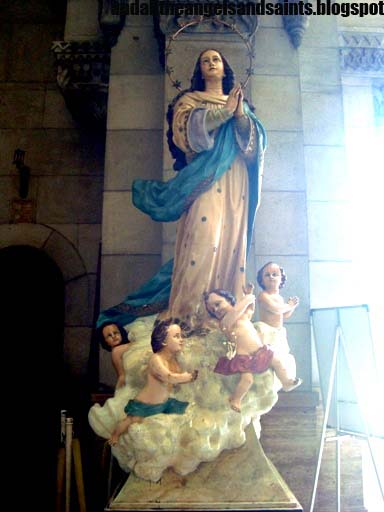
INMACULADA CONCEPCION

SAN AGUSTIN

ST. PETER, a copy of the bronze statue in the Vatican

ECCE HOMO, from Cebu, on exhibit

STO. TOMAS DE VILLANUEVA

SAN JUAN DE SAHAGUN

STA. MONICA

NTRS. SRA. DE LA CONSOLACION Y CORREA

STA, RITA DE CASCIA

STO. SEPULCRO

SAN JOSE Y NINO JESUS

CALVARIO

VIRGEN DELA CORREA PAINTING

SAN AGUSTIN

SAN ESTEBAN MARTIR

JESUS CARRIES THE CROSS, ICON

SAN AGUSTIN

CRUCIFIXION OF CHRIST AT CALVARY

SAN MIGUEL ARCANGEL

STA. MONICA

CRUCIFICIXION OF CHRIST

Sunday, September 3, 2017

300. MY FIRST SAN ROQUE


San Roque (St. Roch of Montpellier)-- along with  San Vicente Ferrer, San Isidro Labrador, San Jose--are perhaps the most popular santo devotions in the early days of our Christianization, this, based on the abundance of images carved in their likeness.  San Isidro was a natural choice for an agricultural country, while San Jose, well, he was Jesus’ father. The winged San Vicente was known as an “angel of the Apocalypse”, and angels, too,  appear in the iconographies of  San Vicente and San Isidro Could it be our fascination with heavenly winged messengers  that drew Filipinos  closer to these saints?


A more plausible explanation was that our islands and its people were prone to widespread epidemics. The cholera pandemic that killed a million people in Russia hit the Philippines in 1858. The great cholera epidemic would happened again in 1882 and from 1902-1905 that claimed over 200,000 lives.  In the course of time, we have had severe outbreaks of  smallpox , typhoid fever, malaria and tuberculosis.

Our Spanish colonizers, in order to facilitate their evangelization, introduced us to San Roque, his life and his works---how he ministered to the sick in plague-ridden Italy, until he got ill himself. He retreated to a cave where a dog came to bring him bread for sustenance, and licked his wounds that healed them. After his death, an angel was said to descend from heaven, holding a tablet which he laid on the head of the saint. On it was written a prayer, which declared that anyone who calls on San Roque will be spared from  any pestilence.


Because of this, the friars urged the Filipinos to invoke the saint against epidemics and “peste”, cholera, most specially.  People also dropped down on their knees to appeal to San Roque to cure their skin ailments, relieve the pain of bad knees, and keep their dogs healthy.

I can’t even remember what particular shop I brought my first antique San Roque. I do know that I got it in the early ‘80s from one of the stores in Mabini Art Center, then one of the ‘antique’ enclaves of Ermita. I paid exactly Php 170 for this primitive folk example,  which came complete, although its head seemed to have fallen off and then reattached at some point. I guess this was why I got it for that bargain price, as you can get a perfect set back then for Php 300.


The 12 inch., rather thin San Roque stands on a plain, rectangular base, adding ¾” of an inch more to its height. His head sits askew on its shoulders; I had thought it was due to the bad restoration, but I had the head properly re-attached since, and it seems it was really carved with an awkward tilt. The saint’s eyes are bulgy, the beard full, and the mouth is wide.

Wearing a pilgrim cape and a short tunic, San Roque is shown lifting the hem high to reveal the wound on his left knee. There is quite a distance between his pointing finger and the location of the wound though. Note also how rough the folds of the tunic are carved,


He holds a staff with his right hand—I lost the original staff when one of his fingers broke—the one that secured it in the first place. What he now holds is a replacement fashioned from a bamboo barbecue stick. In place of a carved water flask, I just hanged a tiny metal bell.

The unimpressive angel—carved from a narrow piece of wood—stands 7 inches, and no longer has its tablet. It could have been made of tin, on which a native ‘oracion’ would have been handwritten. The native dog has broken one rear and one front foot, but  it has still the ‘pan de sal’ firmly between his teeth.


I have kept this San Roque for some thirty years—unappealing it might be—primarily for sentimental reasons. I bought it at a time when I had the audacity to start a relatively expensive hobby, while struggling to make a living.  The thought of acquiring better quality santos was farfetched from my mind, I had no choice but to buy only what I could afford—often the headless, armless, imperfect ones--the kind Mabini dealers regularly pass up. In all those years that I’ve had San Roque with me, I have neverbeen visited by any pestilence nor  afflicted by a malady of the serious kind---except perhaps, antique addiction!

Thursday, June 8, 2017

295. ALL ‘S FAIR IN LAL-LO, by Nancy T. Lu


By Nancy T.Lu
Sunday Times Magazine, 28 Sept. 1968, p. 38-41

Experienced collectors with a discriminating eye for genuine museum pieces are wont to spot them all over the archipelago whether be in some isolated, weather-beaten ruins, or in some unexplored nooks of private homes. Because many a Cagayan artifact was not meant to be kept unseen, a number of these cultural treasures which can easily swell he Cagayan pride recently left their forbidding enclaves to undergo maximum public exposure in Lal-lo, the site of the Cagayan Provincial Fair.

The preliminaries involved in the ostentatious display of Cagayan’s cultural heritage demanded concerted efforts including no less the governor’s personalized attempts in convincing the reluctant citizenry to loan the valuable family heirlooms they have been hoarding all this while in the privacy of their homes for the provincial exhibit. Which true-blooded Cagayano dared refuse Governor Dupaya’s request when she made it a point to call on the selected families personally? Repetitious assurances of security precautions had to be made in many cases to assuage the concerned individuals’ anxiety over the loss or damage that may befall their cherished properties.

Thus, the the cultural relics were brought in from all over Cagayan. And thus began also the pressing problem of identifying, sorting out, and classifying the numerable items comprising Cagayan’s cultural wealth. While the mian responsibility was delegated to the committee on relics, artifacts and antiques, a supervising authority was wanting. Invitation was extended a museology expert and soon enough, Fr. Jesus Meriño, O.P., of the U.S.T. Museum of Arts and Sciences flew in as the givernor’s special guest from Manila.

The enthusiastic Dominican friar took one look at all the collected objects laden with dust of the centuries and proceeded to single out slowly the “real wonders of art”. Taking care to jot down the outstanding features of the unique antiques as he went about rummaging for more of Cagayan’s historical possessions, he decided to direct the obliging engineer and helpful architect to classify and arrange the artifacts according to three general divisions: 1). People. Life and History, 2). Home, 3). Church.

Grouped along with the first category were tablewares imported from all over Eirope. There were eighteenth century chocolate cups of Spanish make. Some porcelain plates were German-made as a sopera all the way from Vienna. Certain chinawares had designs that connoisseurs would easily detect as rough British imitations of the fine, delicate artistic Chinese strokes. Gracing the opening of the Cagayan Fair with her very presence, the First Lady was reported to have taken fancy to a platter with a dent for gravy.


An alert guard constantly kept close watch over one of those contemporary glass showcases showing private collections of international coins and currencies. For security reasons, these precious personal belongings had to be locked away elsewhere every night. And for the same reason the owners chose to remain unidentified by name throughout the duration of the cultural exhibit.


Spanish Attires
Sweeping feminine attires of the Spanish era came in different colors tha had faded unevenly with the times. Nineteenth century camisas, panuelos and sayas that lay almost completely forgotten there in dust-colored trunks  and spider-webbed chests that had seen better days were put out once more ahere a fairly strong whiff of air caused that distinct smell of age to permeate the atmosphere. But a real item for Ripley’s Believe it or Not was this sable-hued tapis with romantic Castilian verses woven in white silk thread all over it. Father Meriño obligingly translated the love poem as a love-stricken lovers’ reproach to his loved one never to forget that he is unhappy if should forget him. The Spanish priest volunteered  a surmise that he must have been jilted by the girl. Apparently, the boy must have asked his sister to weave the chiding message into the tapis he later gave his girlfriend as a sentimental gift immortalizing his affections for her. Father Meriño further concluded from the numerous misspelled words that the poetic lover must have been a native and not a Spaniard.

The first recorded museums of old found in Egypt and Greece were reported to have been temples which held community treasures mainly religious in nature. Even today, votive objects for propitiatory purposes constitute a greater bulk of solicited artifacts in the traditional repositories all over the world. By sheer coincidence or otherwise, the recently tagged Artifacts Building found in the Tabacalera Compound in Lal-lo was once a convent-chapel servicing the Lal-lo community. Surviving the earth tremors of the seventeenth century, it had since been converted into some other more mundane use. Nevertheless, the indisputable cracks effected by the earthquake remain visible as the original concrete structure never really gave way to complete renovation. The only incongruous touches contradicting its otherwise incontrovertible claim to antiquity rest in the rust-free galvanized iron roofings and the wooden additions  still fresh with paint. Furthermore, the dimly-lit interior was not stripped of its sacrosanct air.


“I simply directed the architect and the engineer to give a particular portion of the building a semblance of a chapel,” Father Meriño said. “How they would go about it I left it to their discretion for what really mattered was that they should project a suggestion of an improvised altar with all the essential elements that should go with it. It was a pity, however, that the 3-tiered altar could not be reconstructed as such because the ceiling did not extend upward high enough.”

From Tuao, lying ion the boundary of Cagayan and Mountain Province,  had come the curious elements of a once magnificent altar.  For one reason or another, the severely-damaged church of Tuao was neglected for a time by the people and eventually, its gilded altar was exposed to the elements. It took a prudent parish priest to go out of his way to salvage whatever was left of a once beautiful place of worship. Dismantling the whole construction, he proceeded to keep the columns  and the wings of the altar under his house where they would be safe.


Mishandled
Instances of mishandling of the high-priced artifacts were not exactly unheard of. Father Meriño bewailed, for instance, how too much cleaning of the wings of the altarby eager individuals caused the parts of the altra to be deprived of the gold-plated designs of flowers and leaves. The traces of gold sheen came off when the clay beneath got wet and gave way.

Of the twenty one columns chiseled along the pseudo-classic artistic plan, three were not in pairs. Then, too, a number of these elaborated designed columns were as there should be thirty six columns all in all. Also nowhere to be found were the indispensable connecting beams of the altar.

Each pillar was carved from the trunk of the sturdy narra tree. Father Meriño concluded that the columns must have been carved by native artists well-trained in the Spanish tradition. But who supervised these artists? He asked. Could it have been the parish priest who was known to have been an artist himself?


Just as attractive was the seventeenth century century retablo from the Camalanlugan church where it served as a screen shielding the interior of the church from the outsiders. Formed from nine enduring narra trunks, the unique relief depicted Our Lady of the Rosary as an intercessor for souls in purgatory. The curious thing about it, however, was in its representation of souls as differentiated from angels flying about freely with wings. The penitent souls ascending into heaven all by themselves were without wings. In had to look closely to see the striking difference.

As borne by the subdued tones of colorings and enamel, artistry was prominent in this work of art. While the planning and drawing , the panorama and the general idea were unquestionably Spanish, the carving itself was adjudged as Chinese,

However, on the whole, the wide array of displayed objects could not boast of outstanding or fine artistry. In several instances, the anonymous creators of these solid figures manifested an obvious lack of artistic academic training. The feet either went out of line thus producing an abnormal effect or the head suggested strongly a mournful absence of a sense of proportion, In one case, the crucified Christ could have passed with fairly good remarks from sharp critics except for the flaw that took the shape of an oversized crown of thorns.

But that was not what really counted. In spite of it all, these classified works of art
Do have a place in national repositories known as museums. They make even more interesting subjects of study.


Trooping in
And so they trooped in—the people from the remote towns all ver Cagayan valley and even the residents of the neighboring provinces. Artifacts galore turned out to be part of Lal-lo’s treat for the day. Garbed in motley attires, they took a close look at Cagayan’s treasured belongings vying for attention: medium sized saints molded along the traditional poses whether it was st. Peter portrayed as a penitent in a sixteenth century carving or St. Thomas Aquinas crushing the malignant church heresies aptly represented by a vicious serpent with seven venomous heads; from Tuao, a sixteenth century pedestal highly suggestive of Kalinga art; round brass candlesticks belying Kalinga influence also; the primitive-looking sitting figure of Our Lord of Patience—an object of special devotion during the sixteenth and the seventeenth centuries; the priceless ivory images of the Blessed Virgn Mary and the crucified Redeemer of mankind; priestly vestments from Valencia, Spain, such as the chasuble and the dalmatic all sporting embroidered designs in silk and gold threads.

For objects closer to home , there were chairs from Vienna, a dining table reportedly 265 years old; an antiquated creaking trunk, an austere rattan and wooden bed; a harp and even a strange-looking escribania or writing desk with several minute drawers.

The enterprising organizers who set about introducing a pleasantly stimulating aura of culture consciousness not just to an exclusive sophisticated clique but to the public at large had fanned the clamor for a permanent repository of valuable artifacts. The idea then was for the government to subsidize an aesthetic refuge—call it  a museum—where privately-held relics could be brought for safekeeping. Here, too, experienced personnel, trained to engage in research, curatorial and library work will know how to handle best the delicate works of art so that the artistic heritage of a people may be preserved.

Meanwhile, Lal-lo’s Artifacts Building if converted permanently into a veritable showcase of Cagayan treasures portends well for what may , in the long run, emerge as a flourishing cultural institution for the Cagayan inhabitants. It certainly has the prototype shapings of a provincial museum in the making. And who could have thought of a more fitting place than Lal-lo, with its historical background and interesting topography?

The millennium for complete recognition of the the importance of a museum may not have arrived in the Philippines, but many a Cagayano will certainly not object to Lal-lo, nce the provincial capital, as the site where a sanctuary of Cagayan pride will find a lasting place.

Wednesday, April 26, 2017

292. OLD PIECES FROM HEAVEN AND HELL: Luis Ma. Araneta’s Venerable Virgins

Text and Photostyling by Felice Sta. Maria
Photography by Ben Laxina, Originally appeared April-June 1980 issue

Collecting is addicting: Luis Ma. Araneta started out as a young boy saving his father’s cigar bands and today owns among the finest assemblages of Philippine paintings, religious sculpture and houseware.

During World war II.Araneta’s involvement as treasurer and fund raiser of a guerilla unit was discovered. While imprisoned in the looter’s cage between incarcerations at Fort Santiago, Araneta was visited regularly by Don Alfonso Ongpin who braved the hecklers to inform his collector friend on who was disposing what treasure. Araneta purchased several pieces in this manner. Gifted with sentiment and a passion for the past, he recalls that fellow connoisseurs of the postwar era through the 1960s thought him mad for redeeming battered santos.


DIVINA PASTORA
Painted wood with glass eyes and hair eyelashes, 62 cm.
Among the most lovely and charming interpretations of the Virgin Mary is the Divine Shepherdess, based on the metaphor of Chirst the Godd Shepherd who lays down His life for His sheep and who seeks out the lost of the flock.Araneta’s high relief was carved from wood—the Virgin from one solid piece, the angels from separate pieces later pegged into place. In keeping with Biblical contest, angels are pure spirits despite their masculine names; the duo hovering above the Virgin are sexless. Artists worked estampitas, engravings and a few sculptural examples as models; santos were displayed on altar tables pushed against a wallor in wall niches. Both conditions de-emphasize the importance of carving a realistic backview. The face of this santo is European and far removed from naïve, popular renditions made by untrained carvers or by members of a family for their own use. Both Mother and Infant have glass eyes with lashes. A metal crown, symbolic of Mary’s reign as queen of heaven, threatens to slip over her head. Even if it were veiled: her regal rank is exaggerated just as the crown id of unrealistic proportions. Other Divina Pastoras are depicted not only with characteristic shepherd’s staff. But a wide-brimmed hat and costume of an Alpine lass.

Santo-collecting began as a salvaging effort. After Liberation, island churches lay in disarray. As ivory hand fell from wooden arm, and decapitations continued, substituting modern images for old ones seemed th natural remedy. Many a churchman felt obliged to remodel and beautify his parish. As new plaster of paris statues appeared on altars, antique ones were turned into kindling or buried in unmarked graves; others have turned up as parts of chicken coops and fences. Parishioners followed suit, some even leaving heirloom images to survive uncared for on home altars.


MOTHER AND CHILD
Ivory and polychromed wood. 41.5 cmfigure with an 11.5 cm. detachable base.
Whereas the featured Divina Pastora is European in rendition, this santo exemplifies Chinese standards of loveliness. Both Mother and Child have ivory heads and hands joined to wooden bodies. Collectors say that old statues carved by the Parian artisans (and later their descendants no longer confined to the Chinese quarters after 1860) have “bulging eyes”, although other santos reveal their Oriental craftsmanship because of epicantic folds. There are their signs: beauty rings run along the long, swanlike neck; the Virgin’s face is an exaggerated oval; and the fingers of both images are long and tapering.

The Holy Child may have been an afterthought since the babe hangs miraculously without aid from the Virgin’s graceful hands. This santo is Eurasian: the Oriental figure is clad in a western farthingale typical among royalty of the early Renaissance. Rendition is highly sophisticated with a head-to-body ratio of 1:8 , much more than the natural physical proportions of the times. Both images have holes in which haloes or crowns could be attached. The composition detaches from the cloud-and-cherub base; the plain bottom-most brown base is a recent addition.

As the cultural value of santos became clear to the public, old images acquired escalating commercial value. By the mid-1960s, cocktail and creative circuits decreed it fashionable to own Chinese porcelain and Sta. Ana diggings as well as a representative number of limbless, many times decrepit and unidentifiable wooden images; bejeweled ivory-faced dolls evolved the epitome. Chaplains and caretakers were enticed to part with church fixtures as competitive buyers offered new, and sometimes questionable substitutes, in payment. Religious art collectors and imaginative interior designers took to recycling altars, parts of santos, pews  and the like.


These santos depict the evolution of religious sculpture from the naïve to the sophisticated as well as the growth of Marian devotion. Mary is multi-faceted : virgin mother, heavenly queen and mankind’s hope. Her cult finds its roots in the Holy Family. The Philippine-carved Ntra. Sra. Del Rosario is a naïve sculpture-in-the-round made from a heavy solid piece of wood. The folk interpreted their saints and virgins and Jesuses as they thought fitting. This rendition combines the Immaculate Conception’s crescent moon with the Del Rosario prayer beads. The Imaculada is done in an advanced popular style; amorini such as those on the base  are characteristic of Imaculadas from Bohol, Negros, Laguna, and Batangas. The Virgin of Caysasay served as local prototype for Imaculadas. In 1570, the Manila diocese was created and put under the protection of the Imaculada;  only in 1854 was the Imaculada Concepcion defined as a dogma of faith. Imaculadas are usually depicted above a globe or a crescent moon, with their hands in prayer.

Images are either ecclesiastic or secular, and function in processions or on altars. Araneta has the entire range. T is difficult to determine the provenance and date for each and every piece, a collector is sure only if he has first-hand data on his side. But Araneta’s staff records what it can. Aside from the approximately 1,500 catalogued objects including antique paintings, salakots, furniture, kitchenware, silver and porcelain, Araneta has at least 500 santos.

There are approximately 100 statues of Virgin Mary in his mansion-museum. First-floor wings contain specially built section for Our Lady of the Rosary, Immaculate Conception, Mother and Child, and the Divine Shepherdess. Heaven and hell surround the visitor,; cherubs gaze down along with elaborate icons; there are paintings, estampitas, and books on the life of Mary as well as Roman Catholic saints and martyrs.

The Collector reads the life of one saint a day. When asked by a firned what he wul save from the ultimate deluge, Araneta pointed to his favorite santo: a gold-dressed Nuestra Senora del Rosario dangling a delicate set of prayer beads and encased in an antique virina.


These two santos were purchased in Mexico. The Del Rosario is symbiotic virgin, again combining crescent moon with rosary. The mother and child is a sophisticated treatment of a traditional theme. Despite attempts at classical finesse, the sculptor failed to master the effect of wind on the virgin’s garments. Strangely, there is a gold cross on this santo; the Latin cross was not a Christian symbol until after the Christ Child grew and was crucified.

The Virgin Mary is a Filipino gauge for feminine beauty: “Marylike was once the college- girl cliché for gentle lady propriety. Among the most available sangos for sale on the market are Del Rosarios, Imaculadas, and Del Pilars. Hyperdulia remains intense; Filipinos are intimate with their saints—what more then with the Mother of Christ, who appeals to the traditional importance accorded family units and the matriarchal title. How many miracles are attributed to the Holy Queen! She has turned away the Chinese and Dutch invaders from Philippine shores, protected galleon runs, stemmed off typhoons, headed the sick, and appeased the heartbroken. Women, and even men, such as Araneta, are named Maria in her honor.

Dulia reaches back into the early years after the Crucifixion when martyrs were secretly paid homage in the Roman catacombs by followers who laid palms on their corpses, and after burial on their graves. When Mary died, she was idealized. Clement of Alexandria encouraged using pagan symbols in the second century. During the reign of Cosntantine, Christianity was accepted and the building and ornamentation of churches began. Representations of the Virgin Mary were among the earliest, including those of Christ and the Family. In 787 A.D., he Council of Nicaea allowed the veneration of images in answer to Emperor Leo the Isaurian’s attempted iconoclastic schism.


MOTHER AND CHILD, 22 cm.
It is not uncommon to find an antique figure clad in new clothes such as the one pictured ; a meticulous collector like Araneta, however, commissioned garments that resembled the frayed, authentic one, down to the gold thread. Many antique processional santos are still found with their wardrobe complete although hey are in various stages of decay. Old folks believe harming a santo or its clothing will bring bad luck.

Throughout the Medieval Age, Marian devotion continued; eleventh century chivalry is in fact and offshoot of the Virgin;s cult that has helped elevate woman (whose status suffered tremendously from Eve’s recorded curiosity). It was only in the 13th century, however, that Marianology crescendoed: the Assumption, Immaculate Conception and Intercession were philosophically highlighted by the Spanish thinker Ramon Llul (1235-1315); Scotus of England provided theological buttressing.

Renaissance art glorifies Mary; by the 17h century, cloth garments, glass eyes, real hair and jewelry were used in creating baroque santos also referred to as flamboyant. Throughout Europe, ivory faces and hands were pegged into wooden bodies and transformed into elaborate images for church and home veneration, figures lost in ornamentation.

Ornate santos, as well as  a number of classical renditions, are usually enclosed in a fine glass dome or giant candles shade. Both protective cases are called virina in the Philippines. The term is likely a corruption of vitrine, which in Spanish means not only a glass and wooden showcase (the vitrine became a highly popular piece of furniture in Europe from the 17th through the 19th centuries for displaying Chines finds, antiques and Victorian knick-knacks). Although new virinas are available, they are thicker than antique ones and come in plastic as well as glass. Bell-jar like covers grew popular after the Suez Canal opened in 1956 and facilitated the export of fragile European ware to Manila; travel time was cut in half. Virinas appear in various sizes—from those for miniatures to large ones that can house an entire Holy Family complete with magnificent glass entourage of palm trees, people and animals blown individually in the mid 1800s by Bilibid prisoners.

Slender giant hurricane shades that bulge out at their middles accommodate solo saints because of their slender proportions. Candle covers, like te dome versions, fit perfectly to an elaborately carved wooden base that is usually gilded; the tube type’s top is sealed off by a removable and an equally elaborate, matching wooden crown. Clocks, secular sculpture, beadwork and silk flowers were likewise displayed dust-free under glass covers, particularly during the Victorian era when a profusion of decoration ruled interiors.

Much of the Araneta collection is in wood, this having been the popular medium. The priests themselves,  Chinese artisans and a vast number of Filipinos are responsible for wooden santos.


IMACULADA CONCEPCION
Glass and wood-encased engraving, mounted on silk.
30 cm x 24.3 cm x 4.1 cm.

Collectors refer to the simplest renditions as naïve or popular. Untrained carvers knew little of anatomy; their images add the most basic attributes of the chosen saint to a very rigid, usually symmetrical and extremely unhumanlike body. Improvisation is common; folk santos combine what is genre with imported doctrine.

An unschooled worker’s guide was whatever example the local curate could offer: costly image bought in on a galleon from Mexico or Spain, a tiny one tucked away by a zealous missionary who foresaw his needs in the sculptureless Orient, but more commonly estampitas, escapularios, and prayer book engravings. The result of the non-artists’ endeavors are highly imaginative representations of how early converts envisioned God, the Church, Purgatory, Heaven, Hell and the super humans that became saints.

The folk carved hard, medium and soft woods with whatever tools were available. Collectors point out that when a knowledgeable buyer hefts a possible purchase at an antique shop, he is not just checking for kinship with the image; heavy woods are rare today and buying a substantial santo carved from a solid block lessens the chances of owning a reproduction.

While flamboyant images hide their material in an attempt at realism, sophisticated santos do not. Done with more skill than naïve images, a sophisticated or classical piece, is a sculptural creation; in the case of ornate santos, “decoration” to quote Fernando Zobel de Ayala, “is the statue itself, not classical styles”.