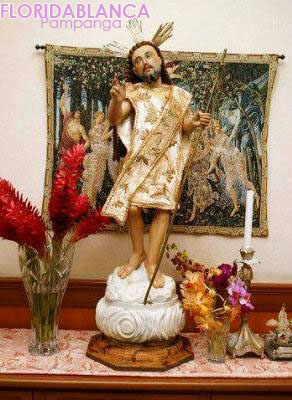
Holy Week in the Philippines culminate in the pre-dawn Easter rite called “Salubong”—a pageant that dramatizes the reunion of the Risen Christ with His Blessed Mother. The religious figures are separately borne on andas or on carrozas, followed by a segregated crowd (men follow the Jesus icon, women, that of Mary) and the two processions converge together, resulting in the meeting of Mother and Son.
PHOTO: JEJOMAR ROBERTO
YAPTINCHAY-GANA Family. PHOTO: MARK POTENCIANO
Photo courtesy of Dr. Raymund Feliciano
One of the highlight is the undraping of the Virgin’s black mourning veil by an “angel”—performed by a chosen young girl dressed with angel wings. The Virgin is then called the Nuestra Señora de Alegria ("Our Lady of Joy"), and the joyous rites are capped with a shower of flowers from other participating angels.
DYCHITAN FAMILY, from 1903. Photo courtesy of Jerry Punzalan Sagmit
Photo courtesy of Jvlian P. Liongson
Photo courtesy of Dr. Raymund Feliciano
The figure of the Risen Christ, on the other hand, is also called Cristo ng Muling Pagkabuhay or Resurrecion. He wears a loincloth, sometimes with a cape or a sash, and holds his standard in His left hand and His right hand, raised in benediction.
Photo courtesy of Jose Talapagobra FB page.
Photo by Alex R. Castro
Photo courtesy of Dr. Raymund Feliciano
On Christ's head are tres potencias, symbol of His faculties. He stands on a cloud base, fancifully called "ensaymada" base, especially the antique ones, for the resemblance to the swirly pastry.
Photo courtesy of Mr. Leo Cloma
Photo courtesy of Mr. Jejomar Roberto
Photo by Yuu Miyamoto FB page
Traditionally, the images of the Risen Christ are small—antique ones seem to have a standard size of 39 inches.
That’s because Christ is meant to be shoulder-borne on a wooden platform, which can be maneuvered easily to move back and forth, or to lean—so that the Christ figure can be made to appear like it is animated, leaning or nodding when it meets the statue of Mary.
Photo from Nuestra Senora de Loreto picssr page.
Photo courtesy of El Rey-Guapo FB page.
Photo courtesy of Mr. Leo Cloma
The Risen Christ is then enshrined in the altar for the Easter Mass to remind us all of the doctrine of Christ's resurrection and of the reward of life after death.
Photo courtesy of Romain Garry Evangelista
Photo courtesy of Dr. Raymund Feliciano
Resurreccion of Villa Escudero
On this pages are images of the Resurreccion, from different towns and provinces, many still used for the festive Salubong easter rites.
Every year, in January, Quiapo becomes the center of fervent
religious attention during its fiesta. The devotion revolves around a dark,
life-size, cross-bearing image of Nuestro Padre Jesús Nazareno (Poóng Itím na
Nazareno) that is enshrined in the district’s minor basilica.
Photo courtesy of Dr. Raymund Feliciano
Photo courtesy of Dr. Raymund Feliciano
The image comes out thrice in a year—on New Year’s Day,
on January 9, and on Good Friday. The Januaray 9 “prusisyon” is the largest of
the three, when the re-enactment of the image’s solemn transfer (Traslacion) to
the basilica from its original location in what is now Rizal Park.
Photo courtesy of Dr. Raymund Feliciano
Photo courtesy of Dr. Raymund Feliciano
Religious veneration of the Nazareno—so-called because Jesus
is identified as having come from Nazareth, in Galilee is profoundly rooted among Filipinos who identify with Christ’s
sufferings as represented by the statue.
Photo courtesy of Dr. Raymund Feliciano
Alex R. Castro Photo
The black Nazareno image was brought here in a Mexican
galleon which sailed from Acapulco. It was carved by an unknown Mexican
sculptor in the mid-1600s. Its dark color
is not due to the black fumes of votive candles, or to being scorched by fire
that occurred in the galleon as widely
believed,--but because of the dark mesquite wood used.
Photo courtesy of Dr. Raymund Feliciano
Photo courtesy of Dr. Raymund Feliciano
Because the Nazareno had attained national popularity as
early as the 18th century, it has inspired replicas all over the
country. The older and more popular copy belonged to the Recoletos, but this was
destroyed during the last War.
Photo courtesy of Froilan Guanzon
Photo courtesy of Dr. Raymund Feliciano
Today, practically every church in every Philippine town
has a Nazareno image, many of which are also antiques. Outside of Quiapo, there
are similar “Traslacion” processions
being carried out, using official replica images—like the one in Cagayan
de Oro.
Photo courtesy of Dr. Raymund Feliciano
Photo courtesy of Dr. Raymund Feliciano
Overseas, copies of the Nazareno could be found in
Australia and in parishes in the United States, where Filipinos gather to
process their images around the church grounds.
Photo courtesy of Dr. Raymund Feliciano
While Quiapo has become the focal point of homage to Christ,
the Nazarene, its fiesta has also become a season for all men, for all
Filipinos, a nation of worshippers still coming to grips with the conflict of God-inspired rituals and
human chaos.
MAY TATLONG HARING NAGSIDALAW. 3 Kings Parish, Gapan, N.Ecija
Time was when the Feast of the Epiphany or 3 Kings was a fixed date—January 6—which also
marked the end of the Christmas season. With the 1969 revision of the General
Roman Calendar, the date has become variable,
celebrated on the first Sunday of January.
THE 3 KINGS, part of the Nativity Set of the Three Kings Parish, Gapan, N.E.
Gapan, Nueva Ecija has the distinction of having a parish
named after the 3 Kings—and, together with the Virgin Mary as Divina Pastora,
are considered patron saints of the city—even if the biblical Magi are not
saints.
THE ANTIQUE IMAGES OF GAPAN'S TATLONG HARI.
There are at least three sets of the kings known in Gapan—the antique,
dressed festejadas that are processioned every January 6, the all-wood images
in the altar of Nativity, and a set of devotional images of the Adorable
family, now in the U.S.
VIEW THE 3 KINGS PROCESSION HERE:
In the Philippines, the 3 Kings were looked at as
gift-givers, the way Americans looked at Santa Claus. This began in the Spanish
times when the “Dia de los Tres Reyes Magos” was celebrated in Filipino homes
with feasting, merry-making and gift-giving. Children would leave their buffed
shoes all in arrow outside their rooms to find them stuffed with gifts the next
morning—courtesy of the 3 Kings!
CASA ESPANOL'S TRES REYES MAGOS, in horseback, Manila. 1935.
The Spanish community kept the custom alive, even after the
Americans introduced their own Christmas, through the efforts of Casino Español
de Manila, a socio-civic-recreational club founded in 1844 for Spaniards living
in Manila. On January 6, Spaniards dressed like Melchor, Gazpar and Balthazar,
take to the streets lined with Spanish children to distribute gifts.
JUAN SOUCHEIRON, as Baltazar, 1935.
Instead of
camels, the Kings ride horses, wending their way as children cheer. To this
day, Casino Español has continued to celebrate the 3 Kings’ gift-giving
tradition without the pompous street parade, limiting the activities at the
Casino de Español grounds. The Feast of
3 Kings is also known as “Araw ng Matatanda” in the Philippines.
Sources:
Vanishing Christmas Tradition, "FilipiKnow" by Alex R. Castro
“Celebration of 3 Kings”, The Philippine Free Press, 12 December 1936, p. 28-29
Many thanks to Reichardt Lionel (Richard Dino) and John Kevin Ligon for the use of their 3 Kings photos from their facebook page.
youtube: Three Kings procession, Gapan City, uploaded by nejournal, 5 January 2009. Three Kings of Gapan
The devotion of Filipinos to their Catholic religion does not only revolve around the church and its rituals but also on images of veneration known as "santos". Introduced during the Spanish colonial times, santos, often of wood or precious ivory, are sacred to most Filipinos, lavishly processioned during Lent, fiestas and other holidays. Whether they be products of unschooled hands or of trained master carvers, santos have come to be cherished as part of every Filipino family's home. Through new and old santo articles & reprints, vintage photos, personal stories and interviews, this blog honors these treasured images of faith and celebrates the exuberant art of the Filipino santero that still lives on today.