Showing posts with label Manila. Show all posts

Tuesday, October 30, 2018

328. THE SANTOS OF SAN AGUSTIN CHURCH, Intramuros

A TRIO OF ANTIQUE SAN ROQUE IN A RETABLO FRAGMENT


One of the grandest churches in the Philippines is also one of the most visited in Manila—the San Agustin Church,  founded by the pioneering Augustinian order and the third structure built on the site. It was completed in 1607, based on the design of Juan Macias, and originally named Iglesia de San Pablo. Over the years, the colonial church suffered from the Bristish sack of Manila in 1762, and a series of destructive earthquakes that toppled one tower in 1880. It was turned into a concentration camp during the 2nd World War by the Japanese and sustained major damages, leaving the monastery in ruins. It was rebuilt after the war and the monastery was restored as a museum in the 1970s, which houses some of the most incredible ecclesiastical artifacts. The museum grounds are regularly utilized for exhibits of religious art, including the anique santo collection of noted collector Don Gregorio Araneta. 
**********
SAN AGUSTIN

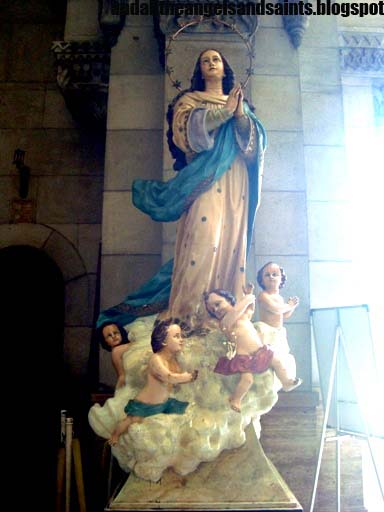
INMACULADA CONCEPCION

SAN AGUSTIN

ST. PETER, a copy of the bronze statue in the Vatican

ECCE HOMO, from Cebu, on exhibit

STO. TOMAS DE VILLANUEVA

SAN JUAN DE SAHAGUN

STA. MONICA

NTRS. SRA. DE LA CONSOLACION Y CORREA

STA, RITA DE CASCIA

STO. SEPULCRO

SAN JOSE Y NINO JESUS

CALVARIO

VIRGEN DELA CORREA PAINTING

SAN AGUSTIN

SAN ESTEBAN MARTIR

JESUS CARRIES THE CROSS, ICON

SAN AGUSTIN

CRUCIFIXION OF CHRIST AT CALVARY

SAN MIGUEL ARCANGEL

STA. MONICA

CRUCIFICIXION OF CHRIST

Monday, September 24, 2018

325. A Folksy Warehouse Find: SAN JOSE AND NINO JESUS


Oh, the things you find in a warehouse! Yes, this San Jose with his little Niño—carved from a single piece of wood—was found in a dusty warehouse of demolished house parts and old lumberyard materials. It was such in a sorry state—with paint peeling, base cracked, and features that are hardly recognizable.

But I thought the 15.5 inch santo looked promising underneath that layer of dust and grime. It had all the characteristics of a true primitive--carved with shallow features, painted with bright colors to cover up the stiffness of the figure. 


There are little details that added much to the appeal of this peace which I got next to nothing. The fact that it was totally fashioned from one piece of softwood wood, including the base, was remarkable, as the symmetry of the piece was almost perfect. Why, the silhouette looks almost like an awards trophy for some contest!


San Jose, himself, looks younger, what with his very sharp, pointed beard and straight black hair. His tunic features a collar while a bow knot is neatly tied high above his waist, as opposed to a simple cord. His robes are painted yellow (which has become grrenish with age) with chicken feet-like prints, typical of Visayan santos. The santo tapers down to the simple, squarish base, with corners lopped off.


Child Jesus on the other hand, looks like an afterthought, ramrod-straight in the arm of San Jose. It almost looks like standing, not seated in a cuddle.

All this San Jose needed was a thorough cleaning and a quick trip to a neighborhood painter to make it more presentable. A light coat of varnish to fix the paint was the final touch to this folksy warehouse San Jose and his little Niño—now fit to be displayed in my house!

Tuesday, July 24, 2018

319. SAN RAMON NONATO: The Unborn


The fairly-popular saint, San Ramon Nonato, was delivered by ceasarian section in 1204, as his mother died during childbirth. Thus, his last name –non natus—not born. Due to the nature of his birth, he is invoked for safe childbirth by mothers and midwives. The saint joined the Mercedarian order in Barcelona, under San Pedro Nolasco, whom he succeeded.


San Ramon went to Algeria to ransom slaves, offering himself as hostage for their release. While there, he converted several Mohammedans that caused his capture and torture. On his return to Spain in 1239, he was named Cardinal by Pope Gregory IX, but died on his way to Rome.

He is often depicted wearing a the habit of a Mercedarian, wearing a cardinal's red mozzetta. He is also shown  holding a monstrance and a palm symbolizing his martyrdom.


This chapel-size Philippine San Ramon Nonato, stands 18 inches tall (missing a base). It shows the saint wearing the red short cape of a cardinal. He is outfitted with glass eyes. He retains his original monstrance made of tin on his right hand. The santo, with its original paint,  was purchased from Cristobal Antiques at the Mabini Art Center in the 1980s.


In Latin American art, he is shown with a padlock on his lips. This is in one reference to a legend that  San Ramon continued to preach the Christian faith while imprisoned, so his lips were sealed by his jailors  who bored a hole through saint's lips with a hot iron, and attached a padlock to silence him. Because of this, he is also invoked against false accusations, lies, gossip, slander, ill talk and secrecy of confessions.


There are several parishes in the Philippines under the patronage of San Ramon Nonato, including the parish of Su-ay in Negros Occidental and in Sorsogon City. There is also a shrine dedicated to him in Tagas, Daraga. Albay.  Feast day: August 31.

Sunday, April 15, 2018

310. Santo Stories: KAMBAL NA KRUS OF TONDO


On March 23, 1922, Crispino Lacandaso, a young carpenter, was chopping wood from a felled, hundred year-old sampalok (Tamarindus indica) tree on a vacant  lot at 1885 Juan Luna Street, Gagalangin, Manila. 


After much difficulty, the laborer managed to cleave the trunk in two. To his amazement, he saw a dark cross on a base, imprinted on both halves of the wood. The discovery of the twin crosses—Kambal na Krus—was considered a miracle, and instantly created a sensation among devout Catholics in the area.


The pieces of wood were subsequently encased in glass, and later, installed in a small chapel that was built as a shrine where devotees  could come to venerate the sacred twin crosses. One piece is a bit larger than the other, but both are adorned with burst of metal rays or rostrillos, and draped with embroidered cloth serving as capes of sorts. 


The trunks, which have darkened with age making the crosses less visible, flank a carved figure of crucified Christ. The chapel continues to be a center of pilgrimage and has been renovated many times, the last one as recent as 2013.


The Chapel's Discovery Day is on 23 March, but the actual celebration is held on the 3rd Sunday of March. During the fiesta, many people flock to the Chapel to venerate the crosses, showing gratitude for the past year's blessings. The Kambal na Krus Chapel is also a favorite visita iglesia pilgrimate site during Maundy Thursday.


SOURCES:
"KambalnaKrusChapelTondojf9663 06" by Ramon FVelasquez - Own work. Licensed under CC BY-SA 3.0 via Wikimedia Commons - http://commons.wikimedia.org/wiki/File:KambalnaKrusChapelTondojf9663_06.JPG#mediaviewer/File:KambalnaKrusChapelTondojf9663_06.JPG

Sunday, September 3, 2017

300. MY FIRST SAN ROQUE


San Roque (St. Roch of Montpellier)-- along with  San Vicente Ferrer, San Isidro Labrador, San Jose--are perhaps the most popular santo devotions in the early days of our Christianization, this, based on the abundance of images carved in their likeness.  San Isidro was a natural choice for an agricultural country, while San Jose, well, he was Jesus’ father. The winged San Vicente was known as an “angel of the Apocalypse”, and angels, too,  appear in the iconographies of  San Vicente and San Isidro Could it be our fascination with heavenly winged messengers  that drew Filipinos  closer to these saints?


A more plausible explanation was that our islands and its people were prone to widespread epidemics. The cholera pandemic that killed a million people in Russia hit the Philippines in 1858. The great cholera epidemic would happened again in 1882 and from 1902-1905 that claimed over 200,000 lives.  In the course of time, we have had severe outbreaks of  smallpox , typhoid fever, malaria and tuberculosis.

Our Spanish colonizers, in order to facilitate their evangelization, introduced us to San Roque, his life and his works---how he ministered to the sick in plague-ridden Italy, until he got ill himself. He retreated to a cave where a dog came to bring him bread for sustenance, and licked his wounds that healed them. After his death, an angel was said to descend from heaven, holding a tablet which he laid on the head of the saint. On it was written a prayer, which declared that anyone who calls on San Roque will be spared from  any pestilence.


Because of this, the friars urged the Filipinos to invoke the saint against epidemics and “peste”, cholera, most specially.  People also dropped down on their knees to appeal to San Roque to cure their skin ailments, relieve the pain of bad knees, and keep their dogs healthy.

I can’t even remember what particular shop I brought my first antique San Roque. I do know that I got it in the early ‘80s from one of the stores in Mabini Art Center, then one of the ‘antique’ enclaves of Ermita. I paid exactly Php 170 for this primitive folk example,  which came complete, although its head seemed to have fallen off and then reattached at some point. I guess this was why I got it for that bargain price, as you can get a perfect set back then for Php 300.


The 12 inch., rather thin San Roque stands on a plain, rectangular base, adding ¾” of an inch more to its height. His head sits askew on its shoulders; I had thought it was due to the bad restoration, but I had the head properly re-attached since, and it seems it was really carved with an awkward tilt. The saint’s eyes are bulgy, the beard full, and the mouth is wide.

Wearing a pilgrim cape and a short tunic, San Roque is shown lifting the hem high to reveal the wound on his left knee. There is quite a distance between his pointing finger and the location of the wound though. Note also how rough the folds of the tunic are carved,


He holds a staff with his right hand—I lost the original staff when one of his fingers broke—the one that secured it in the first place. What he now holds is a replacement fashioned from a bamboo barbecue stick. In place of a carved water flask, I just hanged a tiny metal bell.

The unimpressive angel—carved from a narrow piece of wood—stands 7 inches, and no longer has its tablet. It could have been made of tin, on which a native ‘oracion’ would have been handwritten. The native dog has broken one rear and one front foot, but  it has still the ‘pan de sal’ firmly between his teeth.


I have kept this San Roque for some thirty years—unappealing it might be—primarily for sentimental reasons. I bought it at a time when I had the audacity to start a relatively expensive hobby, while struggling to make a living.  The thought of acquiring better quality santos was farfetched from my mind, I had no choice but to buy only what I could afford—often the headless, armless, imperfect ones--the kind Mabini dealers regularly pass up. In all those years that I’ve had San Roque with me, I have neverbeen visited by any pestilence nor  afflicted by a malady of the serious kind---except perhaps, antique addiction!