Showing posts with label Nazareno. Show all posts

Tuesday, November 16, 2021

343. NAZARENO OF THE DUMPSTER : Restoration Extreme

NAZARENO OF QUIAPO, AFTER ITS RESTORATION.

Since I retired, I have gone easy on buying old, slightly-flawed santos for restoration. I can sense that my santo-mania have subsided a bit, which is good, but not my compulsion for taking on santo projects. I know a good challenge when I see one.

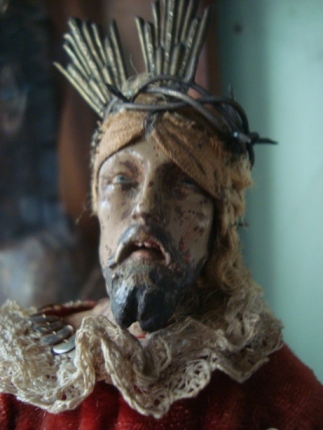
THE VINTAGE NAZARENO, AS FOUND.

Take this dismembered Nazareno for instance, depicting the Black Nazarene of Quiapo.. I had gone to a neighborhood garage sale where I bought an antique filing cabinet. As I was talking to the homeowner, I noticed he was holding a plastic bag that contain some wooden santo body parts.

ALL WRAPPED UP FOR THE TRASH,

I knew it was a vintage Nazareno, the types that were commercially sold, perhaps, in front of churches back in the 1950s and 60s. When I asked to take a look, he said, “Oh, this is a santo that came from an altar that I already sold. It’s been broken in pieces, damaged beyond repair, so that’s why I am throwing it out,”.

“Can I have it?”, I asked. “I’ll save you a trip to the garbage dump”.

NAZARENO PARTS, cleaned and sorted.

So not only did I take the cabinet home, but also a dis-assembled naked, wigless Nazareno without a base and feet. The torso had separated from the rest of his body, and the cross, just like the figure’s fingers, was broken. The head had miraculously survived, made of escayola, typical of mass-produced midcentury Nazarenos. Likewise, the Nazareno’s tin potencias and crown of thorns were intact.

NAZARENO PARTS, glued and assembled.

When I finally had the chance to clean and assemble the pieces, I was surprised that about 90% of the figure were still there, albeit in horrible condition. I knew this Nazareno can be salvaged, but I don’t think I can do it alone, so I took it to the nearby House of Saints, whose manager, Mr. Regie Honrada is a formidable collector of images himself.

RECONSTRUCTED HEAD, BODY & CROSS

I think only he could understand why on earth I would want to restore a santo with that seemingly-hopeless condition. So, he agreed to do a sympathetic restoration of the piece to retain its integrity as an antique.

STAGING THE RECONSTRUCTED SANTO

When I came back for it after a month, Regie had added the Nazareno’s missing feet, carved a new left arm as the damaged part was beyond repair. The head and its features had also been repainted and reglued to the body. The Nazareno now rests on a plain solid wooden base, stained and varnished.

SALVAGED VESTMENTS, used in restoration.

The most wonderful part was that, Regie did not charge me a centavo for the work he did, he was just glad to help. As for Jesus’s vestments, I brought along some old, embroidered santo robes that I saved from my other restoration projects.

IN YELLOW VESTMENTS, later re-dyed,

Unfortunately, the robe and the cape were of faded yellow satin, once worn by an ivory santo. When vestment-maker Paul Candaza attempted to dress the Nazareno using them, they actually fit, but the color was really not appropriate.

OLD SANTO ABACA WIG, recurled.

So what I did was to dye the robe maroon red, using good old fashion “jobus” powder. I did the same for a small abaca wig, dying it black and re-curling it using toothpick as rollers. I did away with the cape and after vesting the image and making minor adjustments, the result was this—

Before & After PHOTOS, NAZARENO RESTORATION

I thought this unusual Nazareno restoration project was quite a success. From a santo destined for the trash, it has now become a treasure, fit to grace any altar of any home.

NAZARENO, with re-dyed maroon vestments.

NAZARENO, in re-dyed maroon vetsment.

NTRO. PADRE JESUS NAZARENO, restored

MANY THANKS TO: Mr. Reggie Honrada of House of Saints, Mr. Paul Candaza

Sunday, January 8, 2017

280. A NATIONHOOD OF NAZARENOS

JESUS NAZARENO OLD ESTAMPITA,

Every year, in January, Quiapo becomes the center of fervent religious attention during its fiesta. The devotion revolves around a dark, life-size, cross-bearing image of Nuestro Padre Jesús Nazareno (Poóng Itím na Nazareno) that is enshrined in the district’s minor basilica.

Photo courtesy of Dr. Raymund Feliciano

Photo courtesy of Dr. Raymund Feliciano

The image comes out thrice in a year—on New Year’s Day, on January 9, and on Good Friday. The Januaray 9 “prusisyon” is the largest of the three, when the re-enactment of the image’s solemn transfer (Traslacion) to the basilica from its original location in what is now Rizal Park.

Photo courtesy of Dr. Raymund Feliciano

Photo courtesy of Dr. Raymund Feliciano

Religious veneration of the Nazareno—so-called because Jesus is identified as having come from Nazareth, in Galilee is profoundly  rooted among Filipinos who identify with Christ’s sufferings as represented by the statue.

Photo courtesy of Dr. Raymund Feliciano

Alex R. Castro Photo

The black Nazareno image was brought here in a Mexican galleon which sailed from Acapulco. It was carved by an unknown Mexican sculptor  in the mid-1600s. Its dark color is not due to the black fumes of votive candles, or to being scorched by fire that occurred in the galleon  as widely believed,--but because of the dark mesquite wood used.

Photo courtesy of Dr. Raymund Feliciano

Photo courtesy of Dr. Raymund Feliciano

Because the Nazareno had attained national popularity as early as the 18th century, it has inspired replicas all over the country. The older and more popular copy belonged to the Recoletos, but this was destroyed during the last War.

Photo courtesy of Froilan Guanzon

Photo courtesy of Dr. Raymund Feliciano

Today, practically every church in every Philippine town has a Nazareno image, many of which are also antiques. Outside of Quiapo, there are similar “Traslacion” processions  being carried out, using official replica images—like the one in Cagayan de Oro.

Photo courtesy of Dr. Raymund Feliciano

Photo courtesy of Dr. Raymund Feliciano
Overseas, copies of the Nazareno could be found in Australia and in parishes in the United States, where Filipinos gather to process their images around the church grounds.


Photo courtesy of Dr. Raymund Feliciano

While Quiapo has become the focal point of homage to Christ, the Nazarene, its fiesta has also become a season for all men, for all Filipinos, a nation of worshippers still coming to grips with the conflict of God-inspired rituals and human chaos. 

Sunday, December 18, 2011

91. Friday's Find Is Loving & Giving : JESUS NAZARENO

I took Friday off last week as I thought I needed a longer weekend to recover from the stress of writing, presenting, pre-producing and shooting a couple of commercials. I had not planned on going out on that day—until my Plaridel dealer texted me about some items in his shop “that may be of some interest to me”. I usually dismiss nebulous messages like this—in the past, a dealer had sounded me off about “great vintage paintings” he had, but when I rushed to check, they were just awful paper prints.

But thank God for MMS.
In a few minutes, I received a text photo of the stuff he had in his shop and I knew right away that these were indeed, special, interesting items. So, after lunch, I hopped into my car and drove to his Bulacan shop, a good 40 kms. away. I was pleased with all the items shown to me--I got most of them. But my best and most exciting find yet was not even on display at his shop. It was actually taken out from a room when I was done checking the initial batch of santos on the shelf.


The last santo shown to me turned out to be a small 10 inch., but exquisitely detailed Nazareno in its original urna of narra wood. One look and I was smitten by the impeccable craftsmanship of this santo, which, relatively remained in good condition after all these years.


Surprisingly, the velvet dress is very simple—it has none of the heavy embroidery associated with the vestments of expensive santos, with only sequins, metal appliqués and lace to trim it.


It had an underskirt made of cheap abaca. Yet, from the looks of it, this santo is a notch level in quality than other old Nazarenos I’ve seen.

The face alone has a very human-like, sorrowful expression, complete with an open mouth that shows teeth, amazing details considering that the head is just about the size of a lanzones fruit. The unusual blue eyes—mere slits on Jesus’ face—are of glass.


The santo has lost its outermost dusky brown encarna complexion, although traces of brown paint can still be seen on its legs. The secondary encarna of lighter shade is what remains on His face. Clearly, the carver who made this was a gifted and a highly-skilled artisan.


Then there are the metal accessories made of real silver. It had all the accoutrements of a Nazareno—from the silver slippers, tres potencias, crown and bambalina neck chain, while the cross came complete with cantoneras.


The only missing piece was the silver belt. Undressed and unwigged, the wonderful detailing of the Nazareno were further revealed.


The anatomy was precise—from the torso all the way down to his delicately carved feet. The articulated arms were meticulously jointed at the shoulder and the elbows, allowing the limbs to move 360˚.

The posture of the small santo is accurate, as tradition depicts the Nazareno kneeling on his left knee, His body slightly angled by the weigh of the cross.


The figure is mounted on a realistically-painted “stoney” base framed by golden wood moldings. I can’t wait to have this Nazareno restored—all it needs is a new wig, a belt replacement, a new undergarment and a set of embroidered vestments.


And how much did I spend for my fabulous Friday find? I can’t say I got the cheap. But it's not every day that you find 4 quality santos in one shop, all in one day--and al available for the taking. The Nazareno piece itself is fantastic find, and just needs a bit of tender loving care to restore it to its original state. Now I know why they say with glee-- “Thank Good It’s Friday!”.

Sunday, May 1, 2011

59. RETRO-SANTO: Nuestro Padre Jesus Nazareno of Quiapo

The most revered Jesus icon in the country is the centuries-old image of the Nuestro Padre Jesus Nazareno which resides in the minor basilica of Quiapo and whose history is intertwined with that of Manila’s premiere district. Also known as the Black Nazarene, the life-size, cross-bearing wooden Christ reached our Islands on 31 May 1606 by galleon from Acapulco, Mexico. Tradition has it that a fire that occurred on board the ship gave the image its dark, ebony complexion.

The Augustinian Recollects who brought the image here, enshrined the Nazareno in their church in Bagumbayan, until it was transferred to their bigger San Nicolas Tolentino Church in Intramuros two years later. Manila Archbishop Basilio Sancho de Santas Justa y Rufina mandated the transfer of the image to Quiapo Church in the late 1700s where it has rested on its altar ever since.

Veneration of the Nazareno started immediately especially among the poor and the common folk. Today, the devotion has spread across the nation, a unique expression of Filipino faith that has merited approval from two popes—Pope Innocent X who, in 1650, gave his blessing to the establishment of the Cofradia de Santo Cristo Jesus Nazareno, and Pope Pius VII who granted a plenary indulgence to all those who pray before the holy image.

The feast of the Nazareno falls on January 9, and this day is marked with major processions to mark the transfer of the image to the Quiapo shrine. Over the years, the rowdy, full-packed processions have resulted in casualties, injuries and even deaths of devotees. ale devotees, wearing maroon robes or shirts participate in the processions, but only the males are given the task of holding the ropes (namamasan) that pull the image’s carriage. It is believed that the towels or handkerchiefs that are wiped on the image are imbued with Jesus’s miraculous powers.


Hymn to the Black Nazarene of Quiapo
Composed by Lucio San Pedro

Nuestro Padre Jesus Nazareno
Sinasamba ka namin
Pinipintuho ka namin
Aral mo an gaming buhay at kaligtasan

Nuestro Padre Jesus Nazareno
Iligtas mo kami sa kasalanan
Ang krus mong kinamatayan ay
Sagisag n gaming kaligtasan

Nuestro Padre Jesus Nazareno
Dinarangal ka namin
Nuestro Padre Jesus Nazareno
Nilul’walhati ka namin
Nuestro Padre Jesus Nazareno
Dinarangal ka namin
Nuestro Padre Jesus Nazareno
Nilul’walhati ka naming!