Showing posts with label santo. Show all posts

Monday, August 18, 2025

365. SAN ISIDRO LABRADOR: When Vintage is Valuable

When I saw this 32 in. image of San Isidro Labrador on FB Marketplace, I thought it was an antique, crafted to perfection by an artist who seemed familiar with Spanish-style carving and religious iconography.That was until more close-up photos were shared, and I saw the still-sharp cuts and edges which bore tell-tale signs that the figure was not one. There certainly were attempts to make it look old like the effects of paint loss, missing hands, and attributes like the shovel or the sickle—symbols of the saint's work. One foot was also broken.

As the santo was advertised on FB marketplace

To soften and smoothen the look, traces of white talcum powder can be still seen in the crevices, mimicking dried layers of old gesso. Probably, which was why it remained unsold for days, ignored by true-blue antique collectors.

But age to me, while important, is not always the reason why I am attracted to newer santos of this kind. It's the excellent execution of this San Isidro that got me—presented alone on a base—without the plowing angel and the kneeling Don Vargas that one often sees on tableaus. Seldom do you see vintage santos of impeccable quality such as this one. 

This, surely was a product of a learned carver who knew his stuff well—from the way he accurately posed the saint with one hand on his chest,  while holding, on the other hand,  an iconographic  farm implement, now missing.

His carved costume depicts the common outfits of peasants in old Castile: a tunic with buttons that adjusted it to the chest, short breeches, high boots (or leggings) close to the knee, and a jacket collar, sometimes decorated with a frill.


The artist paid great attention to the minute detail--from the delineation of the saint’s hair, the creases on his forehead and sallow cheeks, to his windswept hair and tunic, and the folds of his boots.


I contacted the seller and made a few inquiries; he told me the San Isidro came from Samar, and that it was carved from 2 separate woods—the base being made of santol. He asked me what my plans were—will I restore it? Repaint it? He said it looked good as is. I said I don’t know yet. I made an offer, he made a counter offer, and the deal was sealed.

In a day and a half, the San Isidro arrived at the courier’s office for me to pick up. I wasn't prepares for its weight--it was very heavy, I had to drag the huge box to my car. When I opened the box back home, there it was---San Isidro Labrador---it was exactly how I imagined it to be---except for its denseness and extreme weight ( close to 10 pounds on a bathroom scale). I was later told it was ironwood (local name, mangkono).

I was in for another surprise  when a separate bubble wrap revealed  his pair of hands—they were not missing after all. That, along with a broken fragment from one boot. The holes at the bottom of his feet were outfitted with short metal tubes, to provide extra support when the image was attached by pegs on the base. That rather new feature proved that San Isidro may have been made in just the last 2 years or so, new by antique collectors' standards.

I decided to make a replacement for his lost farm implement. Using found objects at home, I created San Isidro’s long-handled shovel from a rattan stick, whittled down to the right circumference, to create a pole handle.  A rusty, mini-hand spade provided the metal spade, while its wooden handle  was joined to the tip of the stick to serve as a handle grip. A metal strip cut from an old liquor cap was ringed around the joined parts. The long-handled shovel was distressed and aged by rolling it over the stove flame, then brushed with mahogany stain.

The santo was not without flaws, with many nicks and dings, plus the usual cracks, so I had to fix these with a variety of  fillers--plastic wood for the cracks, and epoxy clay to fill in bigger gaps. 

One arm and left leg of San Isidro were a bit wobbly so I had to detach them to see the problem.  It turned out that the dowels or pegs used to connect arms to the body and the feet to the base have come apart. When all the parts have been secured properly, I found out one peg would no longer fit into the hole on the base; the position of one foot had moved a bit in the  regluing process. I had to open up the hole and dig in a bit deeper to fix my mistake.

The whole ensemble was then polished with bees wax which evened out and darkened its color to a deep brown-black and gave it a rich mellow sheen. Though a vintage piece, San Isidro appears much better now--looking more venerable, and more valuable than ever! 


Many thanks to Mr. Jay Consunji Capistrano for this beautiful piece, and for the use of his FB Marketplace photos.

Tuesday, May 23, 2017

294. VIRGEN DE GUADALUPE: From an Image on a Tilma to a Sculpted Santa

VIRGEN DE GUADALUPE, from the workshop of renown
Kapampangan carver, Nick Lugue, 2002

The apparitions of Our Lady of Guadalupe to a Catholic convert, Juan Diego, an Aztec Indian of Mexico, began in Tepeyac Hill in 1531. There, the 57-year old Juan was told by the Lady to inform the Bishop what he has seen.  Juan Diego succeeded only in talking to the Bishop on his second visit; in turn, the Bishop advised the native to ask the Lady for a sign to prove that she was indeed Mary. In Her next apparition.the Lady asked him to gather roses growing on top of Tepeyac Hill, which Juan Diego collected and wrapped in his tilma, a cape made of cactus fiber.


After the Lady arranged the roses, she sent back Juan Diego to the Bishop. Appearing before the religious leader, Juan Diego let fall of the roses wrapped with the tilma. But it was not the blooms that stunned the Bishop, for there,impressed on the tilma, was the picture of the Blessed Mother—just as the native described Her.


Upon his return to the village, Juan Diego was surprised to find a sick uncle cured, who told him of his meeting with a young woman bathed in soft light. This Lady told him She had sent his nephew to see the Bishop with a picture of herself.  She then told Juan Diego’s uncle that she and the image be called “Sta. Maria de Guadalupe”. It was clear that She was one and the same woman--the Blessed Virgin--seen by both Juan and his uncle, the same one whose likeness was now on the tilma.


Thus began the spread of the worldwide devotion to the Virgin of Guadalupe. The devotion is centered on the tilma with the miraculous imprint of the Virgin’s image that shows no sign of being painted or sketched. It is enshrined in the basilica of Our Lady of Guadalupe, which has become the most popular religious pilgrimage site in the Western Hemisphere.


For centuries, attempts have been made to replicate the image sculpturally—and it has always been a challenge to represent the image tri-dimensionally, as it has quite a complex iconography.


The Lady stands upon a crescent moon, in reference to the woman of Rev. 12:1 who has symbolically the "moon under her feet",  a symbol of her perpetual purity. An angel supports her,  a testament to her royalty. The Lady’s mantle is blue-green or turquoise, the color of eternity and immortality. The limbus or gold border of her mantle is another sign of nobility. The stars on her mantle are indicative of her supernatural character and her personage as  the Queen of Heaven. They are the pre-dawn stars of the winter solstice that appeared on the morning of 12 December 1531.


The bow, tied high around her waist, is a  symbol of new life. Its  position and the slight swelling of the abdomen indicates that the the Lady is infanticipating,  almost ready to give birth, which would further confirm her identification with the woman of Rev. 12 who is about to deliver her child. The whole figure is surrounded by a strange light, a mandorla, with scalloped edges.This representation, crafted by award-winning religious sculptor Nick Lugue of San Vicente Apalit, was commissioned by a patron from Batangas, who donated the 4-foot image to a local church where She now reposes.

SOURCES/REFERENCES:
Picture of the Guadalupe Virgin:http://www.patheos.com/blogs/holyrover/2017/05/03/with-the-virgin-of-guadalupe-in-mexico-city/
Pictures from Don Sevilla III, Nick Lugue

Wednesday, November 2, 2016

271. STA. FILOMENA OF ALCALA, CAGAYAN

STA. FILOMENA, enshrined in the ancient brick church of
Alcala, Cagayan--the widest church in the Philippines
Sta. Filomena (Filia + Luminus , daughter of light, aka St. Philomene), was a martyr-saint whose remains in the catacombs of Priscilla were discovered in May 1802.

TOMBSTONE INSCRIPTIONS, found on the tomb of Sta. Filomena
On the three stones that sealed the tomb, were the inscriptions: "LUMENA - PAX TE - CUM FI" (“Peace be to you, Filomena”), followed by these symbols: two anchors, three arrows a palm, and a lily.

STA. FILOMENA, VIRGEN y MARTIR
Antique print
Her remains were removed to Mugnano del Cardinale in 1805, where several miracles caused her devotion to spread. Credited to her was the healing of Venerable Pauline Jaricot in 1835. It was Saint John Vianney was instrumental in popularizing her cult.

MARTYRDOM OF STA. FILOMENA
Antique print,
In 1833 a Neapolitan nun had a vision in which the saint revealed that she was a 13 year old Greek princess, martyred by Roman Emperor Diocletian. Though venerated by many Popes (she was canonized in 1837) and her feast observed in some places, Sta. Filomena was never included in the General Roman Calendar for universal use.

In Feb. 1961, the Holy See had her name removed from all liturgical calendars that mentioned her. This order did not call into question her existence or sainthood, nor prevent popular devotion to the saint.

ST.PHILOMENE CHURCH, Alcala, Cagayan
source: wikipedia.com
In the Philippines, an ancient church in Alcala, Cagayan has become the seat of her local devotion—the church of Sta. Filomena (St. Philomene Church).

The Spanish colonial brick-red church is regarded as the widest church in the Philippines, and the largest in the Archdiocese of Tuguegarao at 67 m in length, 24 m in width, and 12.5 m in height. Construction began in 1881 under the term of Fr. Casamiro Gonzalez, which was completed by Fr. Pedro Perez.


 Enshrined in the altar is the revered image of Sta. Filomena, an old de vestir image, dressed in her vestment and holding a palm of her martyrdom. The origins of this image is not known. Sta. Filomena, is the patroness of young girls, babies and youths.

STA. FILOMENA NOVENA
composed by St. John  Ma.Vianney
Besides Alcala, Cagayan, she is also the patron saint of several Philippine places such as Sibonga (Cebu) where a fiesta is held in the first week of August). There are also barangays named after her: Sta. Filomena in Iligan City, Guagua (Pampanga) , Cordillera Adminstrative Region, Alegria (Cebu), San Pablo City and Siquijor.

Saturday, May 28, 2016

252. THE SANTO COLLECTION OF DOM MARTIN OSB

SANTO BAMBINO OF ARACOELI,

Edgardo Ramon Gomez comes from the prominent Hizon Family of San Fernando, Pampanga who made a name for himself in the Philippine fashion world as "Gang Gomez". The New York-trained Gomez was known for his classic, hand embroidered creations that made him the toast of high society misses and matrons.

No wonder, he was acclaimed as one of the country's top young designers in the 70s,  along with Inno Sotto, Ernest Santiago and Auggie Cordero. But at the peak of his career, Gomez surprised everyone when he closed his Manila atelier to join the Monastery of the Transfiguration in faraway Malaybalay, Bukidnon.

Today, as Dom Martin de Jesus Gomez, OSB, he remains true to his calling as a monk--teaching classes, helping run the affairs of the school. he has also channeled his designing talents to creating vestments using indigenous materials. His religious calling has also prompted him to look again at his sacred art collections, precious reminders of his unwavering relationship with God, now kept at the family's ancestral home in Pampanga.

NINO DE LA NAVIDAD in a basket.

AGNUS DEI on top of a book, perhaps from St. John.

THE HOLY CROSS, used in Good Friday processions.

MATER DOLOROSA, antique ivory in virina.

HOLY CHILD JESUS, carved wood.

CRUCIFIED CHRIST.

SAINT JOSEPH WITH CHILD JESUS, in virina.

THE VIRGIN, STANDING ON A HORNED BASE.

OUR LADY, IN A PRIVATE ORATORY.

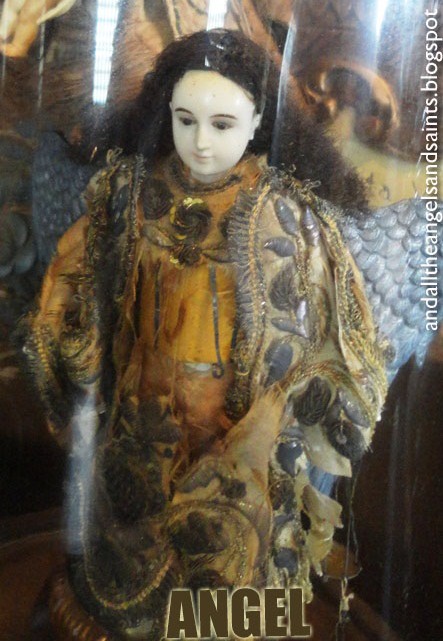
IVORY ANGEL, with silver wings

Wednesday, May 4, 2016

249. The Seraphic Doctor: SAN BUENAVENTURA of Mauban, Quezon

SAINT OF GOOD FORTUNE. San Buenaventura
These photos were sent to me by a santo aficionado who chanced upon a group of devotees preparing this antique ivory santo for procession in a church and in a place that he could not even recall. He hastily snapped these pictures then only remembered being told that the santo’s name was San Buenaventura, a saint that is rarely heard of or even seen in the Philippines. It turned out that the place was in Mauban, Quezon, with San Buenaventura as the town's patron saint. 


San Buenaventura (St. Bonaventure), born in Tuscany in 1221, was a Franciscan cardinal, theologian and Doctor of the Church. He got his name when, as a sickly boy, he was cured of his illness through the prayers  of St. Francis of Assisi, who exclaimed “O Buona Ventura!” (Oh, good fortune!) upon seeing him recover.


Inspired by St. Francis, he became a Franciscan at age 22 and taught theology. He became a Minister General of the order in 1257 and in the course of his life, he was known for his spiritual writings that earned him the name “the Seraphic Doctor”.  He received the degree of Doctor, together with his friend St. Thomas Aquinas, in Paris.


Named as Cardinal by Pope Gregory X one year before his death, he was also appointed as Bishop of Albano.  He died while he was assisting at the Second Council of Lyons, on 15 July 1274.


ICONOGRAPHY:
 St. Bonaventure is often depicted in statues and drawings wearing a Cardinal's hat and the bishop's crosier (shepherd's staff), a miter, and sometimes a crucifix. In some, he wears a mezclado—his cardinal’s red pellegrina worn over his Franciscan habit. His other attributes include the Church, in reference to his being a Doctor, and a quill—for his writings. His feast day is July 15th.


The image is currently enshrined at the Parish of San Buenaventura in Mauban, Quezon. A similar church dedicated to San Buenaventura is located in Balangkayan, Eastern Samar. If any of you, dear readers, know more information about this particular San Buenaventura, please send me a message through this blog.


PICTURES COURTESY OF MR. BONIE MERCADO.