Friday, August 9, 2019

333. CLAUDE TAYAG AND HIS WATERCOLOR SANTOS


CLAUDE MOISES TAYAG (b.1956), of Angeles City,  is not only a talented artist, furniture designer, sculptor, book author, columnist, award-winning chef and cultural activist—but his early interest included collecting antique santos. Not just any santo, mind you, but folk santos—the more naïve, the better. And they had to be of the right size too—no more than 8 inches.

The artist, who is known for his watercolors, immortalized his santos in a folio called “Imahen”, which came out in 1989. Of his 12 watercolor prints in the folio, the santo scholar Esperanza Bunag Gatbonton wrote: “Claude Tayag, by choosing to reanimate the work of the Filipino image carvers, has succeeded in catching our attention, persuading us to take a second look at these santos. Through his eyes, we recapture the carver’s creative impulses. We wonder anew at their perspicacity and talent”.


Three decades after the folio was published, Tayag has recently come up with book that compiles most of his watercolor works” “CLAUDE TAYAG: Watercolors 1974 to Present”. The book, recently launched last 12 July 2019 also had a counterpart exhibition which many of his original watercolor santos in his first folio, as well as new santo paintings were exhibited. Shown here are a selection from the exhibit.

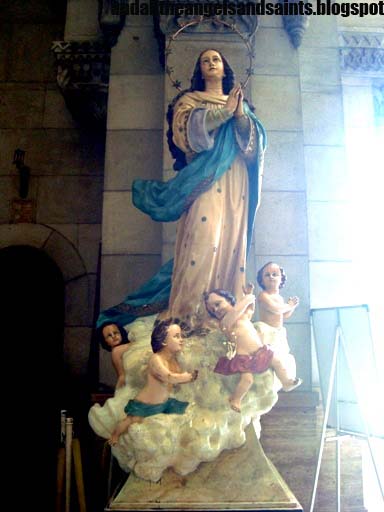
INMACULADA CONCEPCION

SAGRADA FAMILIA

SAN ISIDRO LABRADOR

SAN JOSE Y NINO JESUS

SAN MIGUEL ARCANGEL

SAN PABLO

SAN ROQUE

SAN ISIDRO LABRADOR

INMACULADA CONCEPCION

STA. MONICA

STO. NINO

STO. NINO

Monday, July 22, 2019

332. Santo Stories: STA. VERONICA of SAN MATEO, RIZAL


San Mateo, Rizal has perhaps, one of the most organized Lenten processions in the region, with a little over 20 santos participating, a mix of the old and new. The oldest image is believed to be that of the STA. VERONICA, the woman who wiped Jesus’s face with a towel that cause His likeness to be imprinted on the cloth.
 
STA. VERONICA, Holy Tuesday, 2016
The processional image was originally owned by couple Victoriano (Maestro Bito) and Andrea Santos. The image, which had been carved in Pangil, Laguna in the 1800s, and which had participated in the early processions there, was brought to San Mateo in the 1930s, as Bito’s  wife hailed from there. Their STA. VERONICA has since been a regular participant in the annual Lenten rituals in the historic town.
 
STA. VERONICA, April 2019
When the Santos couple passed away, the image of STA. VERONICA was left in the care of their daughter, Mrs. Rosita Santos-Manahan. When, in her old age, she found it difficult to tend to the image, she passed it on to her only child, Tessa Jasminez-Manahan, who, with her family, has been caring for the antique image ever since.
 
IN PROCESSION, 2019
The processional image shows the santa with a roundish, almost glum face. The sudarium that she holds unfolded with both hands, and which bears the painted impressions of the 3 Holy Faces, has been periodically changed.
 
TESSA JAZMINES, current caretaker, in glasses
All other original accessories, are still intact and complete, from her jewel-encrusted corona and paragua, brass appliques, right down to her beautiful, silver paneled carroza. Preparing her has become both a family and a community affair, a responsibility that daughter Tessa has come to love and embrace.
 
STA. VERONICA, 2012
SOURCES:
Tessa Jazmines FP Page
Debosyon at Kasaysayan: Ang Mahal na Araw sa Bayan ng San Mateo, Parokya ng Nuestra Señora de Aranzazu. Souvenir program, 2001.

Tuesday, July 16, 2019

331. THE WEEPING LADY OF AMORSECO, San Fernando, Pampanga

OUR LADY OF AMORSECO

The persistent belief that images of Jesus, saints and particularly, the Virgin Mary might become animated and imbued with the power of movement has been espoused since since the olden times. This is also true for some non-Christian figural statues.
 
AMORSECO VIRGIN, 

Sightings of weeping, blinking and moving statues of the Virgin have been reported in such places as Vietnam, Ballin-spittle, County Cork, Akita in Japan, and of course, in the Philippines, attracting wide interest from zealous devotees. For example,  the ancient image of the Apo Caridad of Ilocos has also been reported as having been found sometimes with amorseco burs stuck to the lower hem of the dress—a proof, devotees say, that the revered Marian image went out unseen for walks.
 
AMORSECO mysteriously covers the Virgin's face.

In a small subdivision school in San Fernando, Pampanga, small image of the Blessed Virgin has been similarly creating a stir in the region since unexplained things began happening in early October of 1987.  The sacred image, not even a foot tall, was acquired a month earlier by dry goods dealer Lhoree Lee from Mrs. Rosalio C. Toledano, who had trade it to Lee in exchange for fabrics.
 
A PRAYER CARD TO THE AMORSECO VIRGIN

Strange events attended the transfer of the image to the Lee residence like the smell of roses and candles that permeated the place, which the family first dismissed. But on October 9, amorseco (cogon flowers) burs began appearing and sticking on the hair of the image, increasing in coverage every day to include the whole face and our Lady’s vestment.
  
AMORSECO VIRGIN

On October 13, the tiny statue began to weep. Lee, believing that these were divine signs, consulted with then Archbishop Oscar Cruz on    what to do. Meanwhile, people started coming in droves to see the Virgin—now known as Our Lady of Amorseco.

The Virgin then began to send messages through the school caretaker, Romeo G. Pabustan, who has since become her medium. Portent of her arrival is the scent of flowers that permeates the chapel where it is kept. During these times, Pabustan goes under a trance and begins writing our Lady’s messages and calls for prayer.
 
OUR LADY OF AMORSECO

The miraculous image is enshrined at Our Lady of Amorseco House of Prayer which has drawn thousands of visitors, including media personalities, showbiz people,  church leaders, government officials and high society VIPs. It is also a center for outreach programs and many religious crusades.
 

SOURCES: 
”Maria, Sumulung Ca”Crusade. 20th Year Anniversary of Our Lady of Amorseco. Souvenir program October 9, 1987-October 9, 2007.
flickr photo" Dexter Ian Mallari,Harry Bernardino, 

Wednesday, June 5, 2019

330. THE TRANSPORTED DEVOTION OF BACOLOR'S VIRGEN DE LOURDES TO CABIAO, NUEVA ECIJA

CABETICAN;S LOURDES IN CABIAO, N. E.
Cabiao is a town in Nueva Ecija where Kapampangan is still widely spoken. That’s because it used to be a part of the province of Pampanga, until it was annexed to Nueva Ecija, along with  Gapan, San Isidro, Cabiao and Aliaga around 1848.

As such, many original Kapampangan families can still be found there, still speaking their mother tongue and living the ways of their  own culture. The Kapampangans were clustered in a place called Likod—so named because it was located at the back of the church—and it was here that the extraordinary devotion to Our Lady of Lourdes of Cabetican, Bacolor was introduced and propagated.
 
THE RELIGIOUS PRINT OF LOURDES
In  barangay Maligaya, a chapel now stands, where, a small, antique print of the Cabetican Lourdes can be seen atop the altar, framed in silver. The story of how this revered object of veneration came to Cabiao is told and printed on a small tarpaulin poster that hangs on the iron grill gate of the chapel.

In the 1930s, a Kapampangan woman named Gertrudes Dizon-Castañeda, had a reputation for seeing visions. Her granddaughter, Lucita Castañeda-Vivas, recalls that her Impong Tuding was often seen talking to herself, or so it seems. But in fact, her Impo claims that she was conversing with an old woman, whom she alone could see.

THE LOURDES STORY AT THE CABIAO SHRINE
 One day, this old woman, as the story goes, asked her to go to Cabetican in Bacolor to look for a particular picture of a lady there —and to bring it to Cabiao. Impong Tuding obeyed her order, and even though she had no idea how to go to Bacolor by herself, she reached the barrio on the feast day of our Lady of Lourdes.

After walking all over the barrio, Impong Tuding found the picture of the lady. She was sure it was the right one, as she could not take single step after she had beheld it.  But by then, she had run out of funds to pay for the print, so she sadly returned to Cabiao without it.

To her amazement, when she got back to cabio and began unpacking, she discovered the small print of the Lady among her belongings, bearing the caption : ING MAPAGMALA NANG LARAUAN NING NUESTRA SEÑORA DE LOURDES. Daralangiñan da qñg Santuario Cabetican, Baculud (Pampanga)
 
VIRGEN DE LOURDES BY FLORES
Our Lady of Lourdes became the patroness of Cabetican in 1906, when the populace was hit by a pestilence. The devotion was brought to the Philippines by Capuchin fathers, who had a church built in 1892 in honor of our Lady of Lourdes. Sculptor Manuel Flores was commissioned to make  a statue of the Virgin, who appeared to shepherdess Bernadette Soubirous in a grotto in Massabielle, France in 1858.
 
         ANTIQUE PRINT BASED ON VIRGEN DE
         LOURDES OF THE CAPUCHINS
The people of Cabetican asked for intercession from Virgen de Lourdes for the healing of the sick and to end the plague, which resulted in many miraculous recoveries.  A religious book to mark the miracle was printed by the printing press of Proceso Pabalan Byron entitled: “ING MALA NING VIRGEN LOURDES 1906, CABETICAN, BACULUD, CAPAMPAÑGAN. Qñg Mipnung Lugud Ampon Pacamal Mecopia ya iti qñg Imprenta nang  Proceso Pabalan Byron a Sinulat nang Jose Crisostomo Soto a Metung Munaman Sacsi qñgMesabing Mala Iniang ing balen Baculud Mirasnan ya qñg Salut …Ñgening Ala ne qñg Tau ing Sucat Ipanulu qñg Dios carin Panintunan”
 
LOURDES PRINTS, bhy Byron, and an unknown lithographer
(Translation: “The Miracle of the Virgin of Lourdes, 1906, Cabetican, Bacolor, Pampanga. By all the goodness and love, we caused this story to be published in the printing press of Proceso Pabalan Byron, written by Jose Crisostomo Soto, one the witnesses to the miracle when Bacolor was hit by pestilence. Now that the cure is no longer in the hands of the people, it is in God that we search for a cure. ) 
THE ALTAR OF LOURDES AT BRGY, MALIGAYA
That’s how the religious print of the Virgen  de Lourdes of Cabetican found its way to Cabiao, and for awhile was kept in Impong Tuding’s nipa hut. She hanged it on her wall and the picture inexplicably began to get wet. The more she wiped off the wetness, the wetter the picture got. Word went around the barrio about this unexplained that was deemed as a miracle, and soon people began flocking to Impong Tuding’s hovel to pray to Virgin de Lourdes from Cabetican.

The duplicate image of our Lady of Lourdes and the sacred but tattered print are now housed in a shrine that was built through donations to accommodate the faithful and the pilgrims who go there. The roof and ceiling were added in 1993.
 
THE LOURDES SHRINE, FRONTAGE
Descendants of Impong Tuding are the caretakers of the shrine; they keep the premises clean, as well as sell candles for devotees to light. Cabiao and Cabetican, together with their Kapampangan faithful, have now been united by one Lady, who continue to shower them with blessings and graces, wherever they may be.

Sunday, January 6, 2019

329. BAGUIO'S ANTIQUE TRADE, TODAY.


The antique fever that swept Manila in the 1960s and 70s prompted the rise of numerous antique shops in such places as Vigan, Lucena, San Pablo, Iloilo, Bacolod and Zamboanga.  Though old Vigan was a primary source of antiques, what became the major antique trade center in the north was Baguio City. After all, Baguio had a ready market for these fine collectibles, home to many affluent families with large homes, and hordes of out-of-towners and international tourists looking for one-of-a-kind souvenirs.


The modern Maharlika Shopping Center and Marbay Building that rose  in the city’s famous market district became the home of popular antique dealers, known even to Manila buyers. Dealers like Felipe Estacio, Eddie Marcelo, and  Alicia Serrano set up shops there. Estacio also had a big branch along the highway leading to Benguet.


Pinky Garcia, a researcher who discovered early the marketability of ethnic antiques from the northern highlands like Kalinga furniture, weapons and bulols, set up her PNKY shop there. Daisy Gomes Locsin specialized in the black baskets of the Mountain Province that were a hit with American collectors. Soon, even Kapampangans like Francisco Lacap, trooped to Baguio to open their business in the summer capital.


When I was a student in Baguio in the mid to late 70s, the Marbay shops were all crammed with antiques and artifacts of the most bewildering and amazing variety.  Wooden and ivory antos were sold alongside bululs and anito figures. Spanish colonial trinkets and tribal heirloom beads could be easily had for the right price. There were old Ibaloi costumes, headgear, tribal wear, silver and gold jewelry pieces, primitive clay ware.


One would tire himself out just looking at thousands of Oriental plates, bowls, and jars, blue and white, Martabans, Sawankhaloks and Celadons. My interest in antiques was fired by my periodic visits to these stores, but alas, I could only afford the old gin bottles that were sold at 50 pesos each, discounted to 20 if you got more. Larger pieces like cabinets, almarios, tocadors and dining sets  could even be delivered for a small fee to Manila and any point in Luzon.


Even when I was already working in Manila, I would find time to drop by at these shops in the 1980s, during business trips. My last visit was in 2004, when I had to mount an event for a client at La Trinidad. With the antique trade dying in Manila, I knew it would not be long that Baguio’s supply would dry out too. 


Fifteen long years after, I returned to Baguio for another short visit—and of course, I was surprised at the changes the city had undergone. The mountain tops were crammed with houses, the city overpopulated. Burnham Park was one big parking lot and Session Road  teemed with pedestrians. There were overhead walkway that covered the city's landmarks, and tall structures that hid the cityscape, and for a few minutes, I could not locate Marbay, 


When I found it, I gave in to my urge to check my former haunts—and these pictures tell the sad story of Baguio’s antique trade. Less than a dozen hole-in-the-wall shops now populate the shopping center. I went there a little after 9 a.m., so many of the unites were still closed. I just peered through the glass walls and found a few genuine antiques sold side-by-side with many reproductions like furniture, Chinese ceramics and newly-woven baskets, cleverly aged with soot and wax polish.


The most popular shops—Tucucan—where I got my first antique santo for 90 pesos sometime in 1978—was still there, with a large stockroom on the upper floor, mostly reproduction antique furniture. Then, there was Globel’s Antiques, still hanging on, with an assortment of odds and ends. I looked around, but I could not feel the same skipping of my heart beat in my visits some 40 plus years ago, when the world and I were younger.


“All things must pass”,  Beatle George Harrison once sang, and I guess this is true for Baguio’s once bustling antique trade. It had its heyday, and I was glad and grateful for that vanished time, for “mine eyes have seen the glory”.
(ALL PHOTOS BY ALEX R. CASTRO)

Tuesday, October 30, 2018

328. THE SANTOS OF SAN AGUSTIN CHURCH, Intramuros

A TRIO OF ANTIQUE SAN ROQUE IN A RETABLO FRAGMENT


One of the grandest churches in the Philippines is also one of the most visited in Manila—the San Agustin Church,  founded by the pioneering Augustinian order and the third structure built on the site. It was completed in 1607, based on the design of Juan Macias, and originally named Iglesia de San Pablo. Over the years, the colonial church suffered from the Bristish sack of Manila in 1762, and a series of destructive earthquakes that toppled one tower in 1880. It was turned into a concentration camp during the 2nd World War by the Japanese and sustained major damages, leaving the monastery in ruins. It was rebuilt after the war and the monastery was restored as a museum in the 1970s, which houses some of the most incredible ecclesiastical artifacts. The museum grounds are regularly utilized for exhibits of religious art, including the anique santo collection of noted collector Don Gregorio Araneta. 
**********
SAN AGUSTIN

INMACULADA CONCEPCION

SAN AGUSTIN

ST. PETER, a copy of the bronze statue in the Vatican

ECCE HOMO, from Cebu, on exhibit

STO. TOMAS DE VILLANUEVA

SAN JUAN DE SAHAGUN

STA. MONICA

NTRS. SRA. DE LA CONSOLACION Y CORREA

STA, RITA DE CASCIA

STO. SEPULCRO

SAN JOSE Y NINO JESUS

CALVARIO

VIRGEN DELA CORREA PAINTING

SAN AGUSTIN

SAN ESTEBAN MARTIR

JESUS CARRIES THE CROSS, ICON

SAN AGUSTIN

CRUCIFIXION OF CHRIST AT CALVARY

SAN MIGUEL ARCANGEL

STA. MONICA

CRUCIFICIXION OF CHRIST