Thursday, March 30, 2017

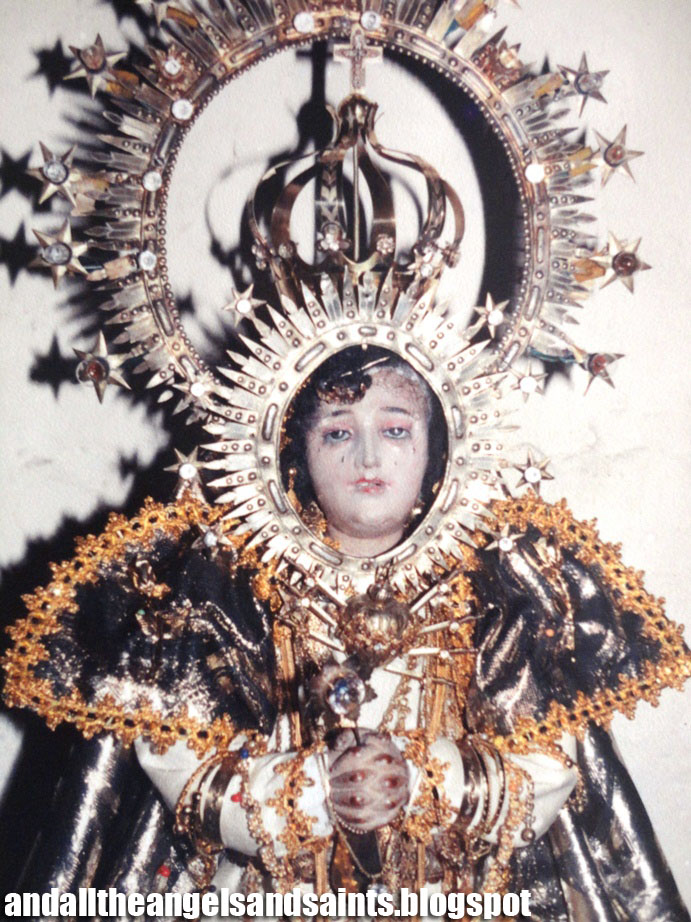
289. COLLECTING ANTIQUE PHILIPPINE SANTOS THE HARD WAY

THE SANTO SEEKERS, Mario Mercado and Lorna Montilla.
Condensed from the original article: "COLLECTING FILIPINIANA THE HARD WAY" ,  first published in Chronicle, 1962.
By C.V. Pedroche

City-bred duo tramped backward towns in Panay to find wealth of artifacts and reliquaries

 Two young people, Mario Mercado and Lorna Montilla, are doing something few others have done: they are collecting old religious images, relics and other Filipiniana the hard way. And they are doing it for love.

With them it is not the collector’s cold-blooded mania for owning and storing precious odds and ends; it is with deep sense of conviction that somehow they will find again the Filipino soul in these bukbok-eaten, noseless, armless, and–in some instances–headless relics of our country’s past. These two dedicated enthusiasts are not swivel-chair collectors.

Having very little money, they cannot afford to wait for precious art items to come their way through profit-conscious agents. They have decided that the cheaper–through more dangerous–way to get their art pieces is to go out and look for them right at the source.

 To Mario who is barely twenty-three this is the right way–the only way. He is hunter, explorer, boxer, writer, painter, amateur archaeologist, photographer, mountain-climber all rolled into one masculine, nervous personality. Lorna is wiry. And she is game. City-bred, she has always pined for the wide open spaces. And she has found in Mario a tough companion who knows his way about both in city and mountain fastnesses, in caves and dark-room. She asks for no quarters. And Mario gives none. Both young, they have no patience with restraint. Nor convention.


Once they had agreed on their itinerary they set out to fulfill it. The first place they decided to explore was Panay where Lorna comes from. After only a few weeks’ stay in the mountain regions of this province they returned to civilization with several crates filled with the most astounding assortment of ancient religious images, shards, plates, vases, jars, daggers, skulls, and yellowed manuscripts. 

SAN VICENTE FERRER, TWO MARIAS AND ONE STO. NINO.

Mario says they have barely scratched the surface. They intend to return soon and continue digging. Lorna walked hundreds of kilometers with Mario and laughingly admits it was no picnic. She dug as fast as furiously as did Mario and the hired hands. She sweated it out, knowing that beneath the rolling knolls lie a pile of priceless artifacts which might give a clue to the history of our country–or at least of that part of our country. Hopping from one hill to another limbered up Lorna’s city legs. But, she said, it was worth all the pounds she lost.

 A Religious Colony in Old Jaro 

 Jaro’s ruins betray the death of a vast religious colony, in the words of Mario. Its foundations are intact but its walls are deadly gray, moss-covered and weed-choked. Paintings inside its churches have somehow survived, murals have been retouched, betraying the inexpert hands of native artisans.


Attempts at sculptures abound in these ancient houses of God –but these, too, reveal the awkward groping for expression of unschooled artists.The two next took in Iloilo, Molo, Tigbauan and Oton which, Mario says, has been almost completely devastated by the convulsions of the earth. 

But, he adds, there was something this violence could not kill –the beautiful palm-lined beaches and the sweet tender coconut meat on which they often had to slake their thirst and hunger.

Primitive Sculptured Statuettes 
Collecting the religious images proved to be less strenuous but as interesting as digging for artifacts. The people are deeply religious, Mario says, and they keep in their houses–even in the humblest huts–wooden images carved hundreds of years ago by their forebears. Soon the the temporary headquarters where our explorers kept their finds began to fill up with all kinds of wooden images–sculptures that show attempts at reverence and form, though utterly awkward beyond description, sometimes comic in an openly honest though unconsciously satirical way.

 The religiosity of these people can be best judged by the number of images they keep in their huts. There were crucifixes and extra-long, extra-short, extra-massive Christs with the bewildered eyes of dolls, or with Mona Lisa smiles, with blood oozing out in geometric pattern on their sides, and many such interesting features peculiar to primitive works of art.

 The statuettes are so old they ooze bukbok from tiny holes on their heads and bodies, so frail that they break into pieces with the slightest fall. Since they look so ugly and mutilated, the town priests have refused to allow them to be carried around during processions–or to bless them during fiestas. So the people have kept them in dark corners of their homes–where the two collectors found them. 

STO. NINO, SAN NICOLAS, SAN RAMON, SAN ANTONIO

How they secured these relics is quite another story. Sometimes the people just flatly refused to part with them however tempting the offer that had been made from them. In most instances they accepted new mass-produced plaster images in exchange for their priceless ones.

 After a while, though, people began to suspect the two. Stories were circulated about how they were spies or that the images they gave away were loaded with time-bombs or some such secret weapons meant to exterminate them. An old woman warned the people of Tigbauan who sold their statuettes to the strangers or exchanged them for plaster ones, that their departed ancestors would haunt them for thus desecrating these heirlooms by giving them away indiscriminately.

 Meanwhile the two daring young explorers are getting restless once again. Already the city dust is getting under their skin and their limbs are beginning to get flabby with inaction. In a few weeks, they assure us, however, they will be out again exploring in parts unknown. What they will bring back this time will be quite another story.

Tuesday, March 21, 2017

288. SANTO SIGHTINGS IN TIENDESITAS ON A RANDOM DAY, 2011


VINTAGE STA., VERONICA Processional Santa.
When Tiendesitas, a shopping complex located within Frontera Verde in Pasig on 26 Sep. 20015, it was met with much hoopla. After all, it was envisioned to be a budget-friendly shopping destination (“tiendesitas” means a cluster of little shops), with specialty “villages” that sold fashion, native food, pets, plants and other novelties.

VINTAGE STO. SEPULCRO
Of course, for santo collectors, the opening of the “Antique Village” was a welcome section of Tiendesitas, another happy-hunting ground for antique santos, all in one location.

VINTAGE CRISTO DE LA PACIENCIA
Indeed, the early list of shops that could be found there included well-known names like Sarimanok (Henry Wee), Laong-Laan Antiques (Yanga), Unang Panahon (Esposos), 888 Noble Antiques and Henry Babiera—who was instrumental in getting the shops together at the new shopping hub.

VINTAGE RESURRECION
The shops did not disappoint, as the prices were relatively reasonable (the shops were not air-conditioned and the location—along C5—was then considered very far). But when access and generation of traffic became major issues, the shops started to close—and the “antique village” shrank in size to give way to more lucrative businesses.

NEW IVORY-FACED MANIKIN SANTOS
Tiendesitas deteriorated to the point that the antique shops were reduced to a handful. Eventually, as the area became more developed commercially, Tiendesitas was upgraded by the developers in 2014, adding buildings, second-level shopping places, escalators and airconditioning. The business climate improved with its relaunch and today, Tiendesitas has 450 traders from all over the Philippines.

ANTIQUE SAN VICENTE FERRER IN URNA
However, the same cannot be said of the antique shops. The dwindling supply of quality items forced more closures and for the remaining shops to carry lower-quality antiques and reproductions—a sad statement that the glory days of the Philippine antique trade is really gone.

ANTIQUE SAGRADA FAMILIA IN URNA
In March 2011, a few years before its renovation, a walk around the antique village of Tiendesitas yielded these santo offerings from select shops still operating in the complex.

ANTIQUE SAN YSIDRO & SAN ROQUE

VINTAGE STO. ROSARIO IVORY

ANTIQUE IVORY PURISIMA

ANTIQUE STO. ROSARIO, now in R. Lopez Collection

ANTIQUE BONE SAGRADA FAMILIA IN VIRINA

OLD INMACULADA CONCEPCION

Monday, March 13, 2017

287. VIRGEN DOLORES DE TURUMBA of Pakil, Laguna

THE MIRACULOUS VIRGIN OF PAKIL.
In the year 1640, several fishermen saw a statue floating on the waters of Laguna de Bay. Seeing that it resembled the statue of of the Blessed Virgin, they tries to bring it to Pakil, but they could not do so because it was too heavy.


Some of the old folks of the town gathered on the shore were about to begin their traditional devotions to Our Lady. As they sang the words of the “Turumba” (a song and dance tribute that often results in people “trembling and falling down in great joy) , the image became light enough to be carried in procession. The people enshrined the image in the church and called it ‘Our Lady of Turumba’ .


Every year, on the third day after Easter, the faithful honor her with seven consecutive novenas. The image stands 85 cms high,with its face and hands made of ivory. It depicts Our Lady of Sorrows, showing her heart pierced with seven swords and a golden handkerchief in her hand. She is clothed in rich silk material with rhinestones, and she wears a blue mantle, a gold bracelet and a golden crown.

PHOTOS COURTESY of: Dr. Raymund Feliciano

Article reprinted from  “2nd Marian Congress Philippines Souvenir Program, 1954.
NOTE:  The image is actually made of wood, not ivory head and hands, as the original article reported.

Friday, March 3, 2017

286. THE SANTOS IN THE RETABLO OF STA. ANA CHURCH, MANILA

THE ADOBE CHURCH OF STA. ANA, MANILA
The town of Sta. Ana is home to an ancient church that was first erected of wood and bamboo in 1578. A more permanent structure of adobe was built for a period of 5 years, beginning in 1720, in the distinctive baroque style.  The centerpiece of the centuries-old church is the magnificent retablo mayor (main altar) which features the patroness, Our Lady of the Abandoned. (Ntra. Sra. De los Desamparados).

The altarpiece sports an elaborate Spanish Baroque architectural style, characterized by ornate sculptural decorations, with elaborate gilded detailing, commonly referred to as “churrigueresque”. The retablo was carved with 13 nichos, flanked with solomonic and baroque columns.

Franciscan santos dominate the lower rung: San Buenaventura, St. Pedro de Alcantara, San Bernardino de Siena and Santa Clara de Asis. A tabernacle (sagrario) is in the center.

The principal level has the patroness, Our Lady of the Abandoned, in the middle. She is shown alongside several founders of Catholic religious orders, Santo Domingo and San Francis de Asis, and San Juan Bautista and San Juan Evangelista.

Topmost, we have the santo figures of Santa Ana, the patroness of the church, with San Pedro and San Pablo at her side.  The retablo is topped with the image of San Miguel Arcangel and  painted oval medallion portraits of San Didacus and San Pascual Baylon.


PHOTOS (ca. 1994)  COURTESY OF: Dr. Raymond Feliciano,

Wednesday, February 22, 2017

285. ALL THAT GLITTERS IS REALLY GOLD, by Nancy T. Lu

OUR LADY OF THE HOLY ROSARY. De Jesus family. by Maximo Vicente
By Nancy T. Lu  /  Photos by Ben Santos
Originally appeared on The Sunday Time Magazine, 16 February 1969 issue. pp. 26-27

The art of decoration by means of needle and thread is an ancient one. But what remained most fascinating is the needlework done in genuine gold.

Elaborate embroideries of fine floral pattern generally adorn the vestments of religious sttaues gracing the altars and the affluent homes of today. The glitter of gold somehow never fails to catch the attemtion of the human eye because of its richness. The leaves and the flowers  as a continuous sheet of burnished metal.

Such an observation calls for a closer scrutiny leading to the discovery that gold threads and lintejuelas are used artistically for decorative purposes.

Fine needlework in the making is shown here as four trained sewers from
the shop of Maximo Vicente embroider gold designs on the silk foundation
material stretched on the embroidery frame.

Gold threads passed and sewn at intervals vary considerably in structure and quality. A closer look that they are made by winding a high-carat gold around some silk thread. Mrs. Soledad Vicente from the shop of Maximo Vicente announced that she uses only threads imported from France. This, in some ways, accounts for the forbidding cost of ordering a santo for private use or for the church.

Furthermore, the gold leafing process used, for instance, on the Our Lady of Guadalupe in Pagsanjan makes it all the more expensive but pious individuals who are devotees of the of the Blessed Mother do not exactly mind the cost.

Some four sewers expertly-trained in the artwork on the embroidery of one assignment for months. Different kinds of stitches are tried after the silk or velvet foundation material has been stretched and temporarily sewn to an embroidery frame.

Designs are patterned after  that of antiques. Enterprising sewers try out original floral patterns. In some cases, the gold embroidery is lifted from centuries-old santos and transferred elsewhere because the original foundation materials fails to survive the onslaught of time.

Embroidering in gold used to be an uncontested preoccupation of nuns in convents. Gradually, lay families took to the trade. To date the tallere de Maximo Vicente which was established in 1908, has tuned out a good number of religious images found in parishes all over the archipelago.

Its most recently-completed commissioned jobs include the Our lady of the Rosary which has a height of one meter and sixty centimeters, including the base. It was finished in time for the fiesta of San Fernando, Pampanga. An even bigger finished work is the Our Lady of Guadalupe statue, roughly 2 meters in size with a diamond studded diadem for its crowning glory.The residents of Pagsanjan are proud of it.

French-imported gold threads varying in structure and quality
are used to bring the fine floral patterns on the vestments
of our Lady of the Rosary.

Tuesday, February 14, 2017

284. TWO LADIES OF THE MOST HOLY ROSARY

The Virgin of the Holy Rosary is one of the most popular figures depicted in Philippine religious statuaries. The most well-known is of course, the Virgen del Rosario of La Naval, housed at  the Sto. Domingo Church, whose October feast day is marked with pomp and pageantry. These Virgins of the Holy Rosary are two of the lesser-known images found in the Philippines, but which nevertheless, inspire the same fervent devotion by the faithful in the local churches where they are enshrined.


OUR LADY OF THE ROSARY, Oroquieta, Misamis Occidental
About 1870, this image of Virgen del Rosario was brought to Misamis by one Fray Roque Azcona, and enshrined it in its chapel until the present church was built in 1881. In 1883, when it was planned to replace this image with a more ornate one, a great storm arose lasting for weeks, changing the minds of the people. During the Moro uprisings in 1894 and 1901, this image was the object of the Mohammedans’ fury. Her shrine was put to flames but before it could do any appreciable damage, heavy rains fell, averting the infidels’ designs. 
OUR LADY OF THE HOLY ROSARY of Misamis Occidental today.
Photo from: Archdiocese of Ozamis website, Parishes
https://ozamizparishes.wordpress.com

Our Lady is also remembered for saving the the townsfolk from an epidemic of cholera in 1881. After holding a procession in her honor, the plague suddenly ceased. Every year, on October 16, the people of Misamis observe sole,n novenas and holy Masses in honor of their Patroness who has shown Her desire to remain with them and has generously given Her heavenly aid, in their necessities.


OUR LADY OF THE ROSARY, San Jose, Iloilo
This image of Our Lady of the Rosary was found in 1616 on the shores of Iloilo, not far from its fortress, while excavations were being made to prepare trenches for the defense of the City against an invading Dutch squadron under  the command of Admiral Spielberg, which attacked the island on 28 September 1616.

OUR LADY OF THE HOLY ROSARY of San Juan,
Iloilo. Photo from: Historic Old Philippines website.
The discovery of this image so inspired the defenders under the leadership of Don Diego de Quiñones that they hurled back the invaders in the battle that ensued. Today, after surviving more than three centuries, this image is venerated in the parish church of San Jose, in Iloilo.Simple but beautiful, it shows our Lady with the Child Jesus in one hand and holding out a long silver Rosary in the other. She is depicted standing on a pillar of cloud with angels attending at her feet.


 PHOTO SOURCES
Our Lady of the Rosary,Misamis Occidental:
Our Lady of the Rosary, Iloilo
http://historicphilippines.com/our-churches/historic-churches-ii/san-jose-de-placer-church-iloilo-city-iloilo/Historic Old Philippines,San Jose de Placer
Marian Congress celebration Souvenir Program, 1954

Thursday, February 2, 2017

283. Marian Image: OUR LADY OF THE BARANGAY of the "Barangay sang Birhen" Movement

OUR LADY OF THE BARANGAY,
Sunday Times Magazine Cover, Oct. 11,1959

“Barangay Sang Birhen” was a lay Catholic movement that was started in Cadiz, Negros Oriental in 1949, by lay person Antonio Gaston with Henry del Castillo. In its first 10 years, it had become the country’s biggest Catholic mass organization, with aims  to preserve the integrity of the Filipino family, its spiritual unity, cultural distinction and and economic self-sufficiency. By 1959, it had over 2 million member families nationwide.

OUR LADY OF THE BARANGAY, by Fr. Greg Vega
From the Sta. Monica Parish Minalin FB Page

In the mid 1950s, movement leaders commissioned professional and amateur artists to paint a portrait of a Virgin that they hope would be the official image of their patroness.  None had succeeded in executing the portrait to the satisfaction of the leaders.

ARCHBISHOP  YAP, at a leadership seminar, in Negros Occidental

In 1955, Father Pixner, who ministered to the inmates of the Santa Barbara Leper Colony in Palawan, heard about the search, and presented the idea to Crisogono A. Domingo, a leper in his early 30s, whose only art background was as a laborer-helper to a house painter. He decided to take on the assignment, and, after praying 3 Hail Marys, began painting on a blank canvass.

BALINTAWAK-CLAD LADIES in a Barangay Sang Birhen procession

The finished painting showed the Mother and Child overlooking a village with groups of five houses near the seas. The artist had painted from memory a portion of the shoreline of his native Davao Gulf.  The faces of the Mother and Child were foreign, but the Lady wore the balintawak, a Philippine native dress.

LADY OF BARANGAY local gameboard. 1959

At the foot of the Lady is a rock upon which the initials BV (Barangay of the Virgin) is engraved. The houses—in groups of 5—show the primary unit of the Barangay. Five families (which correspond to the 5 mysteries of the rosary)  living in a barangay together may form a Barangay Group, headed by a cabeza. Three groups become a unit of 15 families, while three units compose a Parish Trinity, who report to the Barangay Center headed by the parish priest and an organizational body of leaders.

A CLOSER VIEW OF OUR LADY, as drawn in the gameboard.

When the painting was brought to Msgr. Emmanuel Yap of the Negros archdiocese,  the scholarly archbishop made a hurried research whether the glowing crowns over the heads of the Mother and Child were faithful to the tenets of the church. They were. He acclaimed it to be a work of art, worthy to be venerated as the image of the Barangay patroness. Thus was born the image of “Our Lady of Barangay” that we know today.

A 1960s image of our Lady of the Barangay
in an antique shop.

On January 14, 1981, the original painting was brought back to Bacolod City for the  visit of the Holy Father where the image of the Birhen Sa Barangay was personally blessed by His Holiness, Pope John Paul II.

POSTCARD PHOTO: by Romy Hitosis

Since then, image in the painting has been replicated as sculpted 3-dimensional santo figures, some carved in the round, others to be dressed in the trademark balintawak dress. A shrine “Simbahan Lingin” is dedicated to Our Lady of Barangay in Tagbilaran City, Bohol.